Showing posts with label rain. Show all posts

Monday, January 6, 2020

Stormy Weather


31.Stormy Weather (5 Jan. 2020)
Stalled construction – for now – in the downtown area, center
of the protests that began on Oct. 17. (27 Dec. 2019 – Martyrs’
Square, Beirut)
It’s Christmas Eve. And it’s raining fairly steadily, as it has been for the past several weeks. Youth groups from the various Armenian Evangelical (and other Armenian) churches are preparing to spread out over the metropolitan region to visit homes and sing the good news of Christ’s revelation to mankind. Throughout the night until the early hours of the morning they will be climbing in and out of cars and vans, cramming into elevators or traipsing up flights of stairs to carol and share scripture, as well as to distribute a custom-made gift to each household. And they will enjoy the chocolates, candies and other goodies prepared by each household they visit. And get drenched to the bone. And create memories that will stay with them until their old age.
Our neighbors and we prepared snacks for the carolers to
recharge themselves before going on with their caroling.
(5 Jan. 2020 – Qobaiyat - Beirut)
            Today I found out from my son Sevag (in the U.S.) that in Aleppo this year the churches there will also be sending their youth out to carol and herald Christ’s birth. If this good news is sorely needed here in Lebanon (and it is very much needed), it is needed at least as much there. No surprise that the news went from the Middle East to the US back to the Middle East; it’s simply how the Armenian grapevine works.
Capitalizing on the tire-burning protest
movement. (21 Dec. 2019 – Nahr el Mawt)
            The season’s stormy weather seems to be the perfect analogy of what people are going through, and not just in Lebanon, but also in the region. People are teetering on the edge of a very deep cliff, and it seems certain that the country will be in freefall before too long. The dividing line between a liveable income and poverty is steadily rising, engulfing more and more people each week, and I expect that in a short while we will be seeing people focused on little else but how to get a some food on the table – if they haven’t sold the table by then. Banks are still limiting withdrawals of more than the equivalent of $300 per week, and they, as well as the exchange booths (an officially condoned, albeit black market, feature of the Lebanese economy for decades upon decades) continue to profit from the headlong fall of the Lebanese pound. Paper money (pounds, that is) is getting harder and harder to come by, and billions in local currency have steadily been relocated under the mattresses and in the coffee cans of homes throughout the country.
Some irony to chew on: poking fun at the
revolution with 22 karat gold gum.
(27 Dec. 2019 – Burj al Ghazal, Beirut)
            The other, uglier side of all of this is that for decades, politicians and businesspeople have embezzled and stolen and transferred billions in US currency out of the country, while the Central Bank has run banking affairs like an Amway franchise. Even after the uprising, when the writing was on the wall that this thievery was going to be stopped, those transfers to foreign banks did not stop. There is a reason why Lebanon has remained a “third-world” country for so long instead of developing into the jewel it has the potential to be: it’s called “greed”, described “to a T” in I Timothy 6.10.
            These unrelenting rainstorms (or snowstorms in the higher elevations) are laying bare the unkempt infrastructure of the country. Roads are being washed out, foundations are collapsing, more garbage is falling into the sea. The tourism and service industries (restaurants, etc.), which form such a great part of the (honest) income of Lebanese, have stopped dead due to the complete lack of foreign tourists and cautious spending of locals. These are not pleasant times for the country.
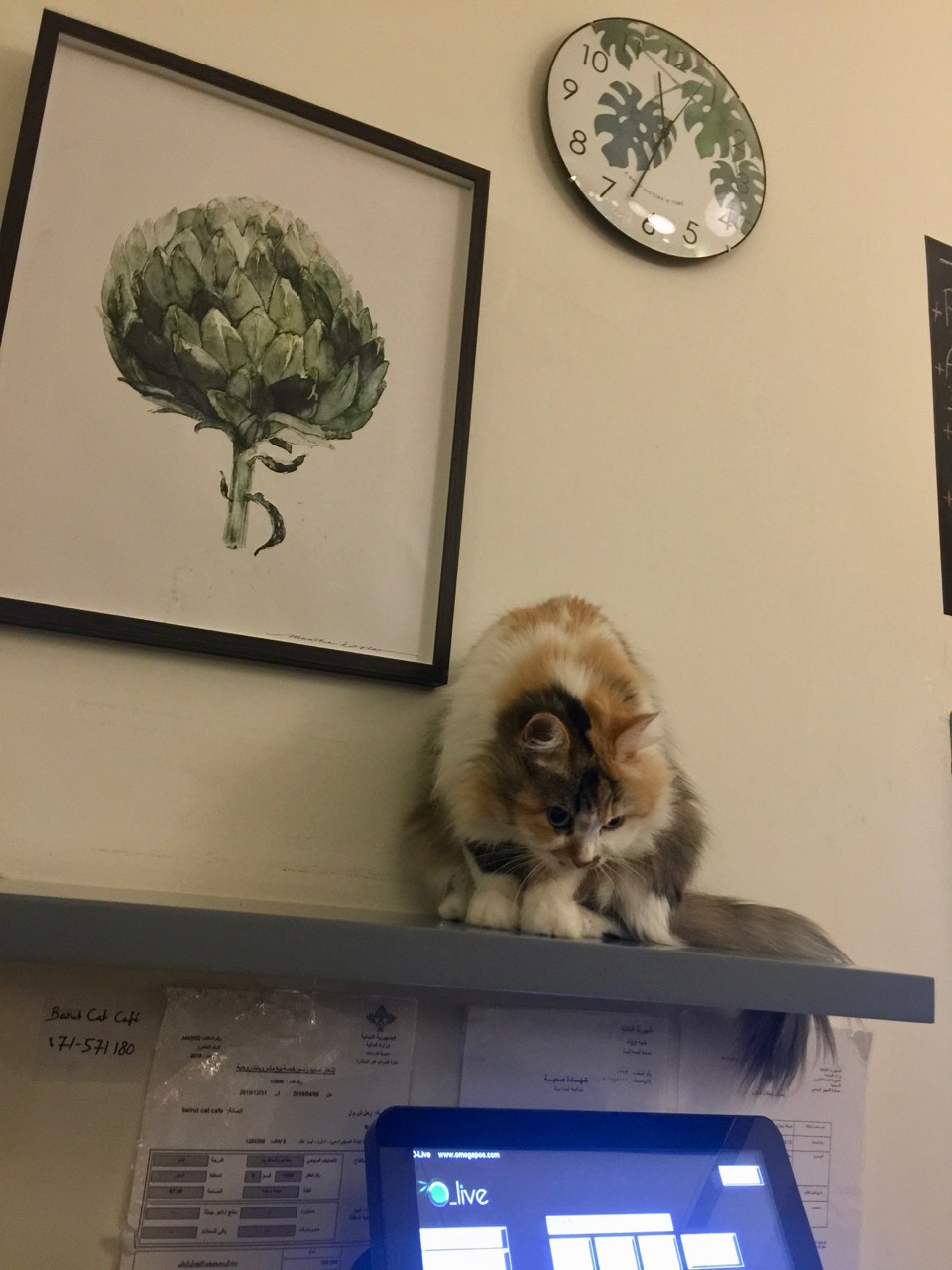
LebCat 30: On its usual perch, but appearing
more than a bit anxious. Cats can have
premonitions, right? (3 Jan. 2020 – Beirut Cat
Café, Mar Mikhael - Beirut)
            Last week a cemetery wall collapsed due to the hyper-saturation of the soil, toppling the deteriorating stone-and-cement construction onto the Damascus highway sidewalk in the Sodeco section of the city. The sadly ironic part is that it belonged to the old Beirut Jewish cemetery in a country that has almost no Jews left. Who will dare to take it upon himself to build a better retaining wall for that cemetery, I wonder? But if these storms continue, the outer wall of either the Anglo/Evangelical, French or Syriac cemeteries, all in a row, will be the next to fall. And then, maybe, the city will do a general reconstruction of all the walls – if there is any money left in their coffers.
            As business after business closes its doors, one in particular stands out for me: the Beirut Cat Café, in the Mar Mikhael area not far from us. I think of it as a “rent-a-cat” place, where for the price of a drink you can associate with willing felines for an hour or so and then leave; and if you are so inclined, you can apply to adopt one of them. Because of the impossibility of meeting their expenses in the declining Lebanese economy they are closing at the end of this month. What touches me the most about this particular place is that it represented a better side of humanity, where animals that are considered vermin can be seen in a different light. And that can have its positive effect on the way that people relate to the natural world as well as to each other. With its closing I feel that we are losing a part of our humanity, as ironic as that sounds. (Or a part of our felinity?) I hope it will open again some day soon, once these cruel storms have finished their destructive journey across the Middle East. 
LebCat 31: Blissfully unaware and uncaring at what is coming.
Probably better off that way. (3 Jan. 2020 – Beirut Cat Café,
Mar Mikhael - Beirut)
            No matter what, we will greet the coming day as we (Armenians) have always done: "Christ is born and revealed; great good news to us all!" (Krisdos dzenav yev haidnetsav; tzezi, mezi medz avedis!)    [LNB]

Monday, April 1, 2019

Decay and Growth


24.Decay and Growth (31 March 2019)
The huge, nearby Lebanese flag, struggling to unfurl while
soggy wet. Symbolic of the state of the state.
(31 Mar. 2019 – Mar Mikhael - Beirut)
            “So, there’s this thing in the parking lot – I think it’s an ark. And a bunch of animals, lined up in pairs…”
            Well, not really, but March in Lebanon is living up to its Armenian nickname: “crazy March” (in Armenian, “khent Mard”). We were fairly sure that the cold and rainy days were over. We were down to the occasional overnight drizzle, with mostly sunny days and blue skies. Now it seems like we are living in a (concrete) rainforest this last day of March, with nonstop rain from the middle of the night throughout the entire day. It is so rainy that the huge Lebanese flag atop a nearby building is completely saturated (not easy for something made of nylon) and shiny under the floodlights illuminating it.
The “thing” in the parking lot is not an ark, but
a second, more powerful generator for the
building. Because uninterrupted electricity
is not in the near future...
(21 Mar. 2019 – Geitawi, Beirut)
            As with other rainy stretches, those who are impacted the most are those living in makeshift dwellings. Translation: that means refugees. It means about a fifth or more of the population of Lebanon. Yes, the Syrian war (or as some call it, “the war on Syria”) is still a “thing”. And Lebanon continues to struggle under the weight of these regional uncertainties. Fear and threats swirl in the wind. There are reports of some local relief workers warning refugees not to return home, for whatever reasons, or perhaps out of self-interest. And then there are the imperial fiats of far-away leaders. A Syrian comedian recently went on TV, seated behind a desk, signing a certificate. He held it up and declared that he was ceding California to Mexico. Then he added that his certificate has as much worth as the one announced this month concerning the Golan Heights. It appears that the storms here will continue here for some time.
            Spring does an amazing thing, though. It makes you believe that the corruption and decay all around us can, in fact, be transformed into growth. Decay is what helps all those ants and cockroaches stay alive, as they dispose of whatever is lying around, plant or animal. Hmmm, maybe I have that backwards; ants and roaches keep us from drowning in waste by eating garbage, which ends up helping to keep us alive. Now that’s a weird thought.
My nemesis: spring flowers. So pretty. Such
torture to my nose. Note the trash in
the background. (25 Mar. 2019 – Zahlé)
            So, trees and plants are budding. And I am fighting my nemesis – pollen – with the only weapons at my disposal: allergy pills and tissues. Green growth is returning everywhere, covering the trash thrown out of windows and dumped at night. But where is the healthy growth, or the ants and cockroaches, that will obliterate, or better yet, remove, the decayed leaders?
            Some cabinet ministers in the new government are trying to take actions to improve the quality of life here. One of the projects is to remove the concrete barriers that have proliferated all around the city since the year of assassinations in 2005. But everyone was so used to seeing concrete that they became disoriented. Even the police. A couple of weeks ago we were in a taxi on Hamra Street, and a police car pulled up to us and asked the driver if he knew where the Interior Ministry was. It was just around the block, but no longer behind barriers or with a security gate, and therefore unrecognizable. And remember, this is the police asking a taxi driver for directions…
A new greenhouse for food as well as education.
(25 Mar. 2019 – Ainjar)
            But there is so much more needing to be done, and the population is generally disgusted by the decades of unfulfilled promises by the same political dynasties that were killing each other during the civil war. There is an old fellow in our neighborhood who delivers the propane tanks for our stove (there is no such thing as a gas line or a gas utility here), and in between conversations I have with him about Bible passages, he mutters on about how officials are robbing people. One could dismiss it as the rants of a broken-down old man. Or one could compare what he says to the reality people face and come to a different conclusion…
Ecumenical prayer, followed by fellowship (and food).
(28 Mar. 2019 – Norashen – Bourj Hammoud)
LebCat 23: A regular customer at the nearby artisanal bakery.
But to sleep, not to eat. (19 Mar. 2019 – Mar Mikhael, Beirut)
            Yet we know we must inspire hope and commitment, and focus on mission and growth, or else we’re just wasting our time.  I truly admire the faithfulness of my church in serving the community through education, with a network of schools in the Middle East. Just to see how they do so much with dwindling financial support is a testimony to their wholehearted dedication. One of those schools, the Armenian Evangelical Boarding School in Ainjar (in the agricultural Bekaa area), has constructed a greenhouse in order to (1) grow its own produce for the children’s meals, (2) teach students about agricultural work, (3) inculcate a sense of caring for the natural environment, and (4) maybe even be able to sell some of what they grow.
            In yet another sign of spring growth, a few days ago twenty Armenian clergy – Apostolic, Catholic and Evangelical – held a prayer and fellowship gathering in the Ss. Vartanants church in Bourj Hammoud, under the leadership of the heads of those three denominations. Although this type of ecumenical event is just starting here, there has always been cooperation between the churches and clergy in the region to some degree. But it is wonderful to see a clergy gathering coming into shape, much as we have had for over a half-century in the Armenian churches of Philadelphia. Now, this is the kind of spring I like to see, sniffles or not!   [LNB]

Thursday, January 24, 2019

Drip Drip Drip


22.Drip, Drip, Drip (23 January 2019)
A brief respite from the rain, the city, the daily grind… at the
Pastors’ Retreat at KCHAG. (11 Jan. 2019 – Monteverde)
            For the past two weeks, for more days than not, all we had been hearing was the sound of rain. Morning and daytime and evening and morning. Sometimes we had breaks from the wet, but we accepted the steady “drip, drip, drip” as a necessary part of the winter season. Each dark and dismal morning I would get up and look out the window to see if it were really morning, and if it were raining… again. Once we had ascertained the day had started, and once the haze had cleared for a brief respite, we would look out the other window to see a brighter, whiter quilting over Mount Sannine. What we experienced as drip, drip, drip, they received silently, in the form of heavy snowfalls.


Norma paying a visit to our balcony/rooftop.
(23 Jan. 2019 – Geitawi, Beirut)
            Our “early warning device” in our bathroom is the best indicator of the precipitation. When a single drop of rain falls, it pings on the “tarbouche” or “fez”, the cover on top of the vent pipe, giving us a more accurate weather picture than the TV or our phone apps. But it doesn’t show us the damage caused by the heavy rains, in a country whose infrastructure is not in optimal condition, and which won’t see improvement any time soon. All of this rain brought landslides to a number of areas, closing highways and causing traffic delays at every turn.
            Not only were the roads, drains and rivers unable to handle all of this, but the refugee camps, most of which are in the central portion of the country, were turned into swamp-like conditions. In some situations, the water flowing through them resembled whitewater rapids, which would not have been a problem for that farmland-turned-tent-city in “normal” days, but where in today’s world does “normal” exist?
            Schools, which closed for several days because of the storms, are now adding makeup “rain days” to the end of the school calendar. We in the city are awaiting the next deluge, and whose name will be heard over and over in the news. The big storm was “Norma”, followed by one with another Western name (which the Arab media changed to “Maryam”). Some are guessing that next, Norma’s husband, or boyfriend, or maybe even her “ex-” will show up…
The “tarbouche” on our roof. Actually looks more like a
Japanese-style wicker “kasa” hat. Which sounds pretty European
to me. But then the Japanese call Euro-style hats “boushi”.
Go figure. (10 Mar. 2018 – Geitawi, Beirut)
            Over last weekend, “drip, drip, drip” was replaced by “thump, thump, thump” – the familiar sounds of the Huey helicopters, audible from miles and miles away. Lebanon hosted an economic summit of Arab leaders earlier this month. Considering the ever-worsening economic state of Lebanon, this was probably a good thing to host, to give visibility to the problems the country and immediate region is facing. Most of those leaders said they were coming, but then after some locals tore down and burned one of the flags near the venue (and posted a video of themselves doing it, of course) to express a decades-old grievance, they canceled and sent lower-level ministers to represent them.
Graffiti that blesses and challenges passersby, long after the
artist’s death (Samuel Pashgian’s home,
22 Jan. 2019 – Geitawi, Beirut)
            But the summit went on, and again roads were closed (for security purposes), and people stayed home. So, instead of traffic jams on the ground, there was the incessant “thump, thump, thump” of the Hueys overhead. For soldiers in Vietnam in the 1960s, this meant that help was on the way. For us here in Lebanon, I’m not sure what it means.
            But the dripping sound is more analogous of things that we face, such as the steady closure of small businesses in favor of “outlet”-style stores in western-style shopping malls, and the emigration of their owners to Armenia. Like a slow leak under the kitchen sink, you don’t notice it until it’s already damaged the floor. This is just one of the indicators of how a sub-group of Lebanese society, such as the Armenian community, is being stressed. The society overall will be the worse if these small, industrious communities disintegrate.
A pointed message on an electrical post
(6 Jan. 2019 – Geitawi, Beirut)
            The slow attrition of church members, something seen around the world, can be seen here as well. People, for whatever reason, tend to leave very silently, such that only the very alert notice, and then have a window of opportunity to reach out to them. Fortunately, there is an active and committed group of church members, including many young people, who are taking note and trying to think of ways of keeping people connected and integrated to their churches and communities. They’re even thinking of ways to keep young people who find work in other regions of the Middle East to stay involved in the life of their local church, possibly making use of new technologies to bridge the physical distance. It’s exciting, and I’m looking forward to ideas that will emerge.
            I’ve resumed rehearsals for the Armiss choir, and we’re preparing to give a full concert in June. It will be hard work, especially to build their cohesion. Drop by drop (not drip by drip) we’re gathering singers, young and young-ish (my peers) to be a part of this, and hopefully for all four voices. Notice I did not liken the choir to a bucket. That was on purpose.
LebCat 21: A fat-cat, similar to the non-feline
variety so prevalent in the country, waiting for
a burger to fall to the ground.
(17 Jan. 2019 – Mar Mikhael, Beirut)
            There’s some very interesting graffiti around the city, and I don’t pretend to understand all of it. Some is ominous. Some is humorous. Some is objectionable. Some is a nuisance. And some is thought-provoking, like the wall in Hamra on which is scrawled “Free your mind – Kill your television”.
            It has been two years since we moved to Lebanon, and the excitement, the challenges and the rewards continue. It’s exciting that I am resuming my Arabic studies, after a 20-month “break”. It’s challenging to focus on just a few things, work- and personal-related, and to say “no” to a bunch of other things that legitimately need someone’s attention. (Something about praying to the Lord of the harvest…) Meanwhile, it’s rewarding to be part of a network of friends and colleagues who do their best to support each other. Early in the month I was part of our semi-annual Armenian Evangelical pastor’s retreat, in which colleagues from Syria and Lebanon came together for a 48-hour experience. It’s things like this that keep me grateful for God opening up the way for us to be here.   [LNB]

Wednesday, December 26, 2018

The Competition


21.The Competition (25 December 2018)

Only in Lebanon – a crèche alongside a mosque and a church, and
most of the visitors were non-Christians. (23 Dec. 2018 – Beirut)
            We finally made it back to the gym, after a two-month hiatus. And after almost getting t-boned in the first minute we were in the taxi, on our early-morning trip to the health club, our driver reassured us with a comment akin to what so many other drivers insist on: people in Lebanon, even at 6 a.m., don’t know how to drive properly. Yet every driver seems to say the same thing about every other driver. So, I’ve decided to look at the positive side: really, all of them want better behavior on the road. I can only hope that they’ll “be the solution” they’re looking for.
            Something else the driver said caught our attention. After complimenting Armenia on the amount of snow it gets (he was Arab), he expressed how happy he was for the rain here in Lebanon. Most people aren’t happy; they only complain about the inconvenience the rain brings to their daily routine, or their leaky roofs, or the country’s infrastructure. All real concerns, but not the only issues at play. When a rainstorm clears, or after days of rain, we look out our window in the hopes of seeing more snow on the mountains. Our driver, with his positive outlook on precipitation, beseeched God (because that is how you express yourself here) to send us at least 3 meters of snow, so that we would not have another dry summer without adequate water supply. Amen to that.
Let it snow! More accumulation on the mountains, and more on
the way. (21 Dec. 2018 – Beirut)
            We’ve attended a couple of concerts in recent days, which is another positive change for Maria and me. Much as we would love to have our full energy and attention devoted nearly 24/7 to our jobs (we wouldn’t actually love that, but that’s the conclusion you might draw from observing us), we have been making a little time for ourselves to enjoy some of what Beirut has to offer. We got to see an Armenian children’s choir, as well as a youth chamber ensemble. Admittedly, it’s difficult for the conductors to make music pleasing to the audience’s ear, but I am greatly appreciative of those children and youth who make the time for practicing and mastering their parts.
            Despite what people say or feel, time is not speeding up; it’s just that there is more competition for the existing amount of time. I find myself saying, “I don’t have time!” too often in the course of the day. What I should be saying is, “I can only focus on a limited amount of things, but I am lousy at saying ‘No’.” Or when I say “Yes” to so many things, I should add “and I don’t care about the quality of what I do” to be completely honest. 
            Going back to those recent concerts I attended: I can either be focused on the performance and let the designated videographers and photographers do their job, or I can sort-of listen while taking photos and videos of the concert. Which is what a lot of people do. When looking towards the stage and trying to enter into the musical moment, the view of the performers inevitably includes several glowing screens, quadrupling my viewing experience, I guess. At one concert I noticed the woman in the row in front of me reviewing a video she had just taken of the children’s choir… while the choir was still singing. To say that audiences need training in how to be an audience goes hand-in-hand with saying that people (myself included) need to be content with doing fewer things.
Choose whether you want to watch it live, or on somebody’s
screen. (22 Dec. 2018 – Beirut)
            It is incredibly quiet today – no car horns, no traffic, no people. It feels so unlike Beirut. Even the sound from a nearby minaret seemed quieter than usual. But that’s how Christmas is here. Everyone is at home, or away in their villages. Weeks ago local television stations geared up for the holiday, with their snowman- and Santa Claus-themed station IDs, including the sounds of jingling jingle-bells. A thoroughly American-style Christmas, right here in the Middle East. While this presents an incongruity with local cultural customs, or rather replaces them, it poses a different question for Armenians, who celebrate “Christmas” differently, and on a different date: Why bother being different?
Sunday School Christmas pageant, last day of Sunday School
before “Western” Christmas (23 Dec. 2018 –
Geitawi/Ashrafieh, Beirut)
            I have heard more than a few Armenians (and others) saying essentially that Armenians should “get with it” and celebrate Christmas the same date as “everyone else”; it’s said to be something “inevitable”, we just have to “face reality”. I’ve wondered about what is behind this drive to conform to the majority, and convince other Armenians to do so as well. Is it an aftershock emanating from the Genocide of a century ago, a “death wish” from a nearly-annihilated people who see no sense in continuing the struggle to exist? It is prevalent in so many areas of our individual and collective life. Here’s an example: Armenians typing messages in Armenian but using the English alphabet, and in two different dialects at that, without thought as to how this contributes to the decline (and perhaps the death) of the language. The standard used is “What’s the easiest?”, instead of “What’s the best – in the long run?” That’s without getting into the whole topic of “What does God want? Why did he help some of us survive?”
LebCat 20: Jazzcat hanging out behind the Blue Note Café
(2 Sep. 2017 – Beirut)
            In the best Armenian tradition, we don’t make Santa Claus compete with Jesus. Called “Gaghant Baba” by Western Armenians (“Father Calendar/Time”) or “Tzəmer Babi” for Eastern Armenians (“Father Winter”), the dancing, gift-bearing fellow makes his appearance to Armenian children on the last night of the year. Children (and sometimes willing adults!) recite a poem in Armenian, or sing or dance for him, and then he unloads his treasures and departs. Then, six days into the New Year, the focus is fully on Jesus, his appearance as a baby at his birth, as well as his appearance at his baptism as an adult. It’s a time for worship and proclaiming the best news the world has ever heard. Although it's not, if this were a competition based on the merits of how best to observe Christmas, the Armenian custom of January 6 wins hands-down. But if it’s just a popularity contest, well . .  .   [LNB]