Showing posts with label infrastructure. Show all posts

Wednesday, August 23, 2023

Oh Wow Fives

60. Oh Wow, Fives! (23 August 2023)
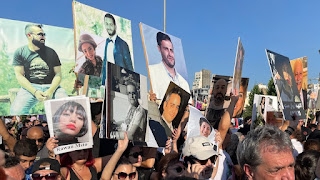
Faces of loved ones sacrificed in the 2020
Port explosion – a pain and an injustice
continually ignored by authorities.
(4 Aug. 2023 - Beirut Port)

I went into a store here in Beirut to buy something, and as I prepared to pay in Lebanon’s official currency – the U.S. dollar – the cashier saw I had taken out $5 bills and exclaimed  (in English), “Oh wow, fives!” Her delight was due to the fact that as businesses, great and small, abandon the use of the Lebanese Pound, they are always in need of small denominations of U.S. currency to return change to their customers. I provided a much-needed resource to a small business, as people struggle to make their way through daily life unassisted by any authorities, swimming in that morass of disinterest and disconnection that is the country’s ruling elite. Courtesy of our son Sevag’s annual visit to us here in Lebanon, we enjoy the privilege of having small denominations of U.S. currency. Here I was, the hero of the moment, with my crumpled and discolored images of Abraham Lincoln, bringing a moment of joy in the middle of the hot, muggy summer.
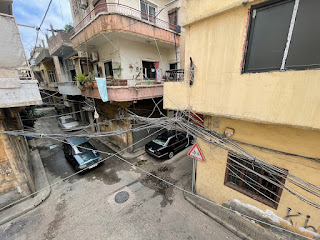
But seriously, can't you tell that the
infrastructure has improved?
(11 June 2023 - Bourj Hammoud)

            One of the most distasteful aspects of my life today in Lebanon (though by no means the only one) is the necessity to focus or fixate on monetary issues. Lebanese, especially Beirutis, have always made currency exchange rates, values of precious metals, gasoline prices and more their daily small talk. Though there is so much more to life, though much greater depth is possible in conversation, but this is what one hears from each passerby, from men gathered at curbsides, from women catching their breath over a cup of coffee: the never-ending stream of analysis and “expertise” that has supplanted hopes, dreams and ideals – the very things that young and old should be actively investing in their country in order to push it toward a brighter future. Instead, materialism, reinforced by circumstances created by those in power and their cooperative external powers, is pushing the brightness out of the country just to dissolve in diasporas around the world.
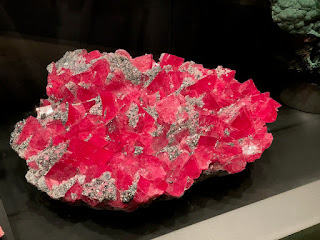
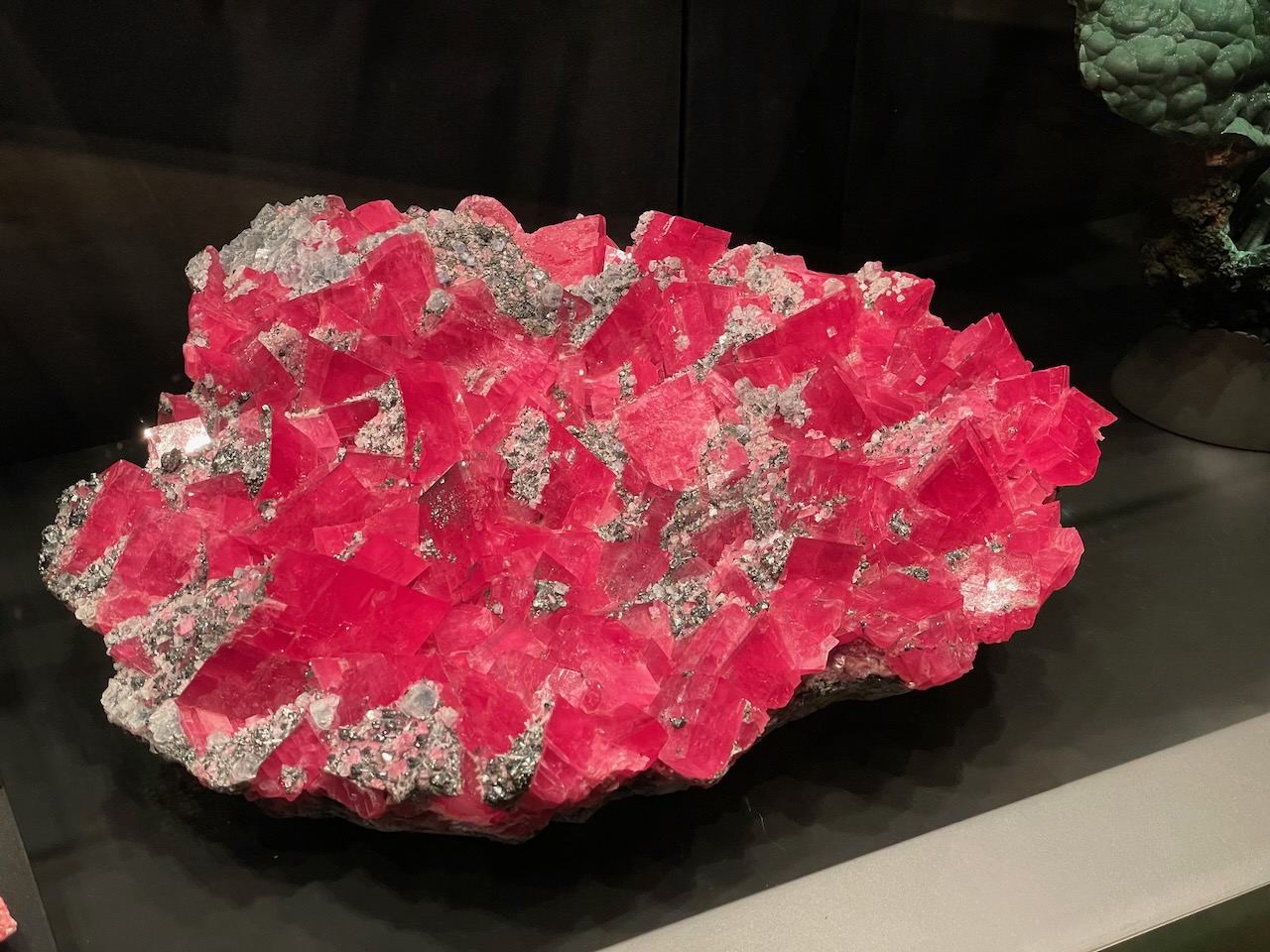
Watermelon? Strawberry gelatin? Sevag and
I puzzled over this one at the Mineral
Museum. (1 Aug. 2023 - Mathaf, Beirut)

            The impact of all of this upon the Armenian community in Syria and Lebanon is what troubles me the most. As the Dons of this kleptocracy look for new ways to fill their stomachs – most recently by a farcical “helicopter tour” of the new oil-drilling rig off the Lebanese coast –small and “unimportant” groups such as the Armenian community are left to fend for themselves. It is interesting to see how a country can continue to appear as a functioning entity while running on “autopilot”. A bit of electricity here, some trash collection there, fixing a water main when it breaks, leaving NGOs to install street lighting and traffic lights, and repair the worst potholes as highways steadily deteriorate, while many, many employees in the public sector come to work but once every one or two weeks, as their monthly salaries hardly cover the cost of transportation – this is today’s Lebanon.
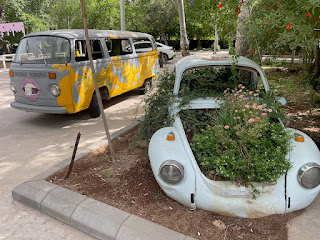
When gas prices rise too high, there are
still great ways to make use of your auto!
(3 June 2023 - Ainjar)

            We’ve been noticing one of the semi-comical expressions of that while driving around various parts of the country with Sevag. It’s the “LPO mode” that auto owners have entered: “License Plate Optional”. Earlier this year I began to notice an absence of license plates of some cars on the road. Now it is probably up to 5 to 10 percent of cars. The office that processes car registrations is clearly not functioning. But in classic Lebanese manner the population is facing the situation with humor. It’s considered a badge of honor to drive an LPO car, even to the point, some say, that people will remove their license plates just to be seen as part of the LPO club!

            This summer I walked into a store in Ainjar, the mostly-Armenian village in the Bekaa valley. Whenever we’re going to be there for a few days I’ll stop in to pick a thing or two, and often times, since this is Ainjar, and since, due to my position, I can’t remain anonymous, I’ll run into people I know including people who know me since the 1990s, or the 2000s, or current times. The lady behind the counter, who does not belong to one of the aforementioned groups, asked me, in Armenian of course, “Are you Ainjartsi (her intent: “originally from Ainjar, but visiting from overseas”)? My interest piqued, I said, “No, I’m not. Why do you ask?” With no hint of malice or sarcasm, just puzzlement, she said, “Well, lots of people are very happy when they see you.”

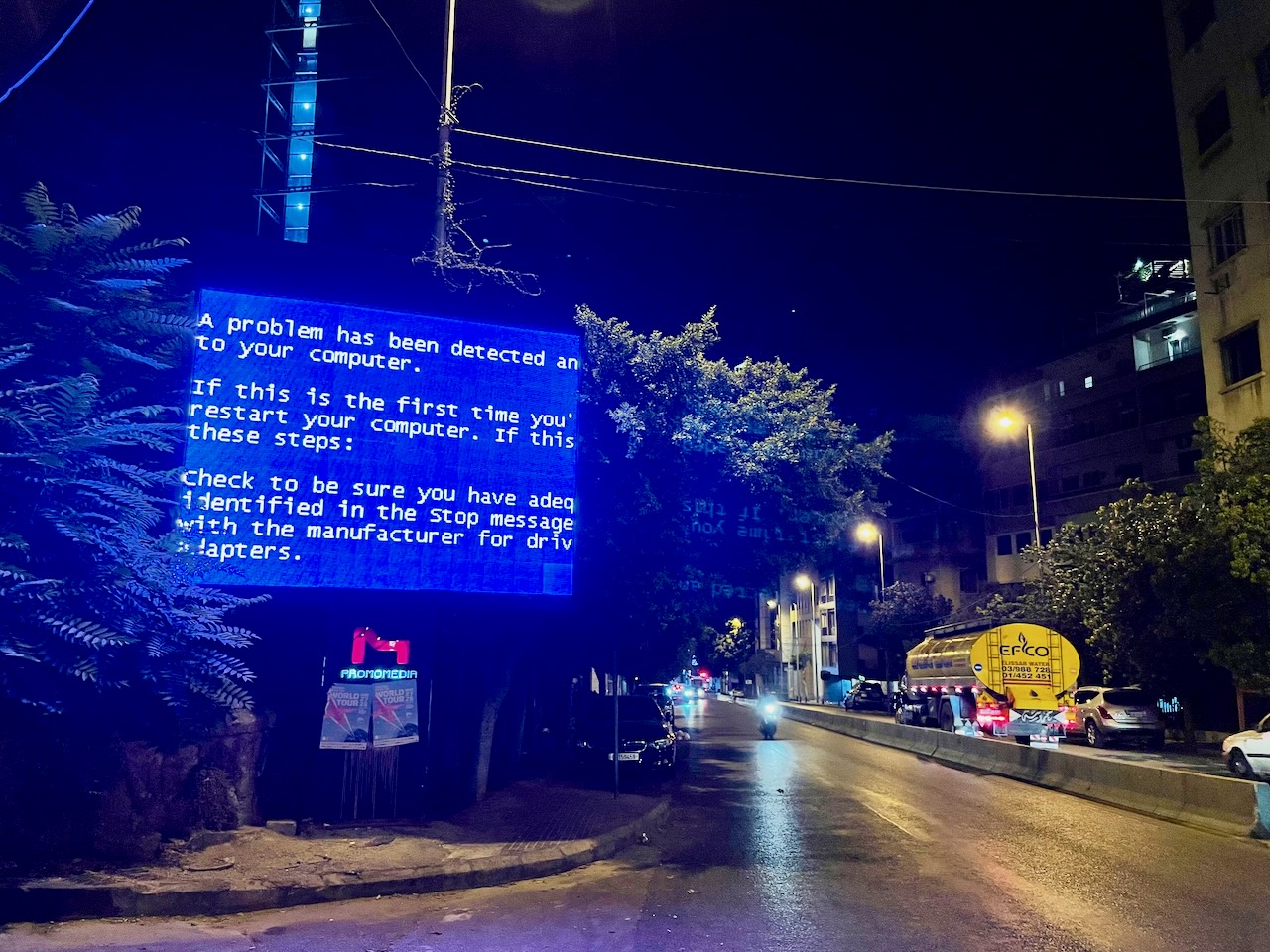
Providing an unintentional glimpse into
the dysfunction of the country.
(4 Aug. 2023 - Tabaris, Beirut)


            Amid such a negative environment I’m glad we can have positive encounters with those we meet, and grateful that our casual interactions can be uplifting. Certainly, this is not something we can automatically produce: without God’s encouragement in our times of frustration and discouragement we would have little to share with others. As well, without organizations backing us up it would be a challenge to remain positive in the enforced misery people are subjected to each day. So, I don’t mind being mistaken for an “Ainjartsi”, and I don’t mind that (most) people are happy to see me!

            During the summer a small group of young Lebanese-Armenians in their twenties, on their own initiative, approached Haigazian University in order to present a film series, seven items in all, ranging the gamut from practically “home-made” to professionally produced. Their emphasis was on increasing the public’s knowledge of Western Armenia and elevating the use of the Western Armenian language. They delivered their introductions each evening in flawless Western Armenian as well as English, and it was clear that they cared deeply about the entire project, and plan to expand their efforts to develop other materials that would interest young Armenians in their heritage, using modern pedagogical methods in a technologically accessible way. The name with which they christened their platform is “Hnarti” /Հնարդի, combining the Armenian words for “old” and “contemporary”. Despite the hemorrhaging of young blood from the Middle East, vision and vitality can still emerge from this community.
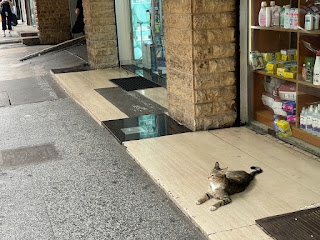
LebCat 60: Every pharmacy should have a
watchcat at the door.
(14 Aug. 2023 - Hamra, Beirut)

            In eight weeks I’m hoping to bring the Armiss Choir back on stage to sing one or two numbers. Hopefully a couple other Lebanese choral groups will also perform. A colleague and dear friend has just published a book on a century of Lebanese-Armenian choirs (1920-2020). The dedication of the new book will happen in October, and part of the dedication program will be vocal selections. From real choirs singing in harmony. Live – which is how music is best done. So, it’s time to get things organized and underway, and to invest a bit more in the health of the country and in a couple of its modest but essential components, that is, the arts, the Lebanese-Armenian community and the Armenian Evangelical Church.

            Finally, something to talk about besides currency rates!   [LNB]

Monday, January 6, 2020

Stormy Weather


31.Stormy Weather (5 Jan. 2020)
Stalled construction – for now – in the downtown area, center
of the protests that began on Oct. 17. (27 Dec. 2019 – Martyrs’
Square, Beirut)
It’s Christmas Eve. And it’s raining fairly steadily, as it has been for the past several weeks. Youth groups from the various Armenian Evangelical (and other Armenian) churches are preparing to spread out over the metropolitan region to visit homes and sing the good news of Christ’s revelation to mankind. Throughout the night until the early hours of the morning they will be climbing in and out of cars and vans, cramming into elevators or traipsing up flights of stairs to carol and share scripture, as well as to distribute a custom-made gift to each household. And they will enjoy the chocolates, candies and other goodies prepared by each household they visit. And get drenched to the bone. And create memories that will stay with them until their old age.
Our neighbors and we prepared snacks for the carolers to
recharge themselves before going on with their caroling.
(5 Jan. 2020 – Qobaiyat - Beirut)
            Today I found out from my son Sevag (in the U.S.) that in Aleppo this year the churches there will also be sending their youth out to carol and herald Christ’s birth. If this good news is sorely needed here in Lebanon (and it is very much needed), it is needed at least as much there. No surprise that the news went from the Middle East to the US back to the Middle East; it’s simply how the Armenian grapevine works.
Capitalizing on the tire-burning protest
movement. (21 Dec. 2019 – Nahr el Mawt)
            The season’s stormy weather seems to be the perfect analogy of what people are going through, and not just in Lebanon, but also in the region. People are teetering on the edge of a very deep cliff, and it seems certain that the country will be in freefall before too long. The dividing line between a liveable income and poverty is steadily rising, engulfing more and more people each week, and I expect that in a short while we will be seeing people focused on little else but how to get a some food on the table – if they haven’t sold the table by then. Banks are still limiting withdrawals of more than the equivalent of $300 per week, and they, as well as the exchange booths (an officially condoned, albeit black market, feature of the Lebanese economy for decades upon decades) continue to profit from the headlong fall of the Lebanese pound. Paper money (pounds, that is) is getting harder and harder to come by, and billions in local currency have steadily been relocated under the mattresses and in the coffee cans of homes throughout the country.
Some irony to chew on: poking fun at the
revolution with 22 karat gold gum.
(27 Dec. 2019 – Burj al Ghazal, Beirut)
            The other, uglier side of all of this is that for decades, politicians and businesspeople have embezzled and stolen and transferred billions in US currency out of the country, while the Central Bank has run banking affairs like an Amway franchise. Even after the uprising, when the writing was on the wall that this thievery was going to be stopped, those transfers to foreign banks did not stop. There is a reason why Lebanon has remained a “third-world” country for so long instead of developing into the jewel it has the potential to be: it’s called “greed”, described “to a T” in I Timothy 6.10.
            These unrelenting rainstorms (or snowstorms in the higher elevations) are laying bare the unkempt infrastructure of the country. Roads are being washed out, foundations are collapsing, more garbage is falling into the sea. The tourism and service industries (restaurants, etc.), which form such a great part of the (honest) income of Lebanese, have stopped dead due to the complete lack of foreign tourists and cautious spending of locals. These are not pleasant times for the country.
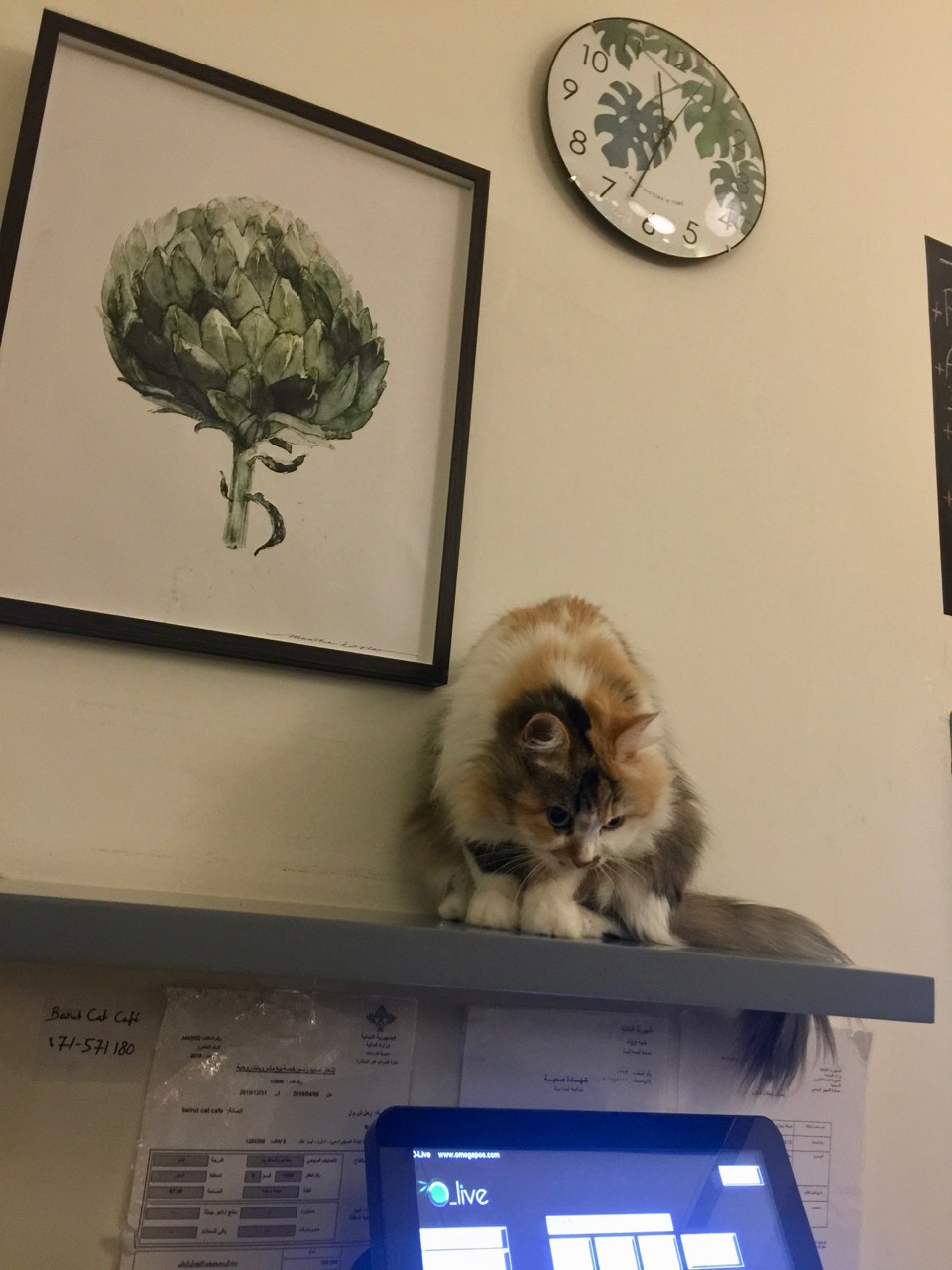
LebCat 30: On its usual perch, but appearing
more than a bit anxious. Cats can have
premonitions, right? (3 Jan. 2020 – Beirut Cat
Café, Mar Mikhael - Beirut)
            Last week a cemetery wall collapsed due to the hyper-saturation of the soil, toppling the deteriorating stone-and-cement construction onto the Damascus highway sidewalk in the Sodeco section of the city. The sadly ironic part is that it belonged to the old Beirut Jewish cemetery in a country that has almost no Jews left. Who will dare to take it upon himself to build a better retaining wall for that cemetery, I wonder? But if these storms continue, the outer wall of either the Anglo/Evangelical, French or Syriac cemeteries, all in a row, will be the next to fall. And then, maybe, the city will do a general reconstruction of all the walls – if there is any money left in their coffers.
            As business after business closes its doors, one in particular stands out for me: the Beirut Cat Café, in the Mar Mikhael area not far from us. I think of it as a “rent-a-cat” place, where for the price of a drink you can associate with willing felines for an hour or so and then leave; and if you are so inclined, you can apply to adopt one of them. Because of the impossibility of meeting their expenses in the declining Lebanese economy they are closing at the end of this month. What touches me the most about this particular place is that it represented a better side of humanity, where animals that are considered vermin can be seen in a different light. And that can have its positive effect on the way that people relate to the natural world as well as to each other. With its closing I feel that we are losing a part of our humanity, as ironic as that sounds. (Or a part of our felinity?) I hope it will open again some day soon, once these cruel storms have finished their destructive journey across the Middle East. 
LebCat 31: Blissfully unaware and uncaring at what is coming.
Probably better off that way. (3 Jan. 2020 – Beirut Cat Café,
Mar Mikhael - Beirut)
            No matter what, we will greet the coming day as we (Armenians) have always done: "Christ is born and revealed; great good news to us all!" (Krisdos dzenav yev haidnetsav; tzezi, mezi medz avedis!)    [LNB]

Thursday, October 24, 2019

Devils and Details


29.Devils and Details (24 Oct 2019)
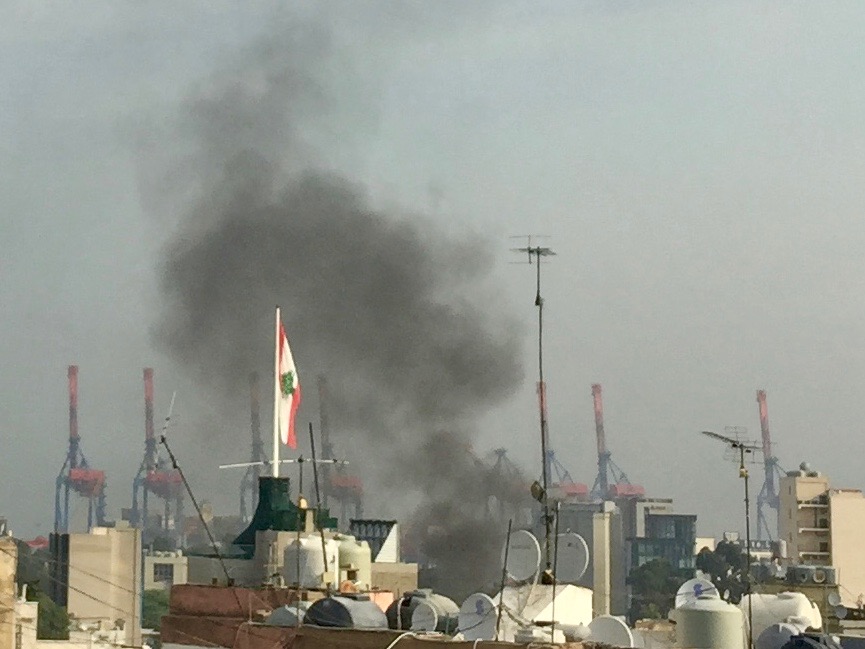
Smoke from tires burning on the Autostrade, filling the air.
(18 Oct. 2019 – Karantina - Beirut)
A week ago there was an announcement, replete with locally generated “great and unmatched wisdom”, in which the government here would begin taxing Internet-based (VoIP) communications (such as Whatsapp, Messenger, FaceTime). As many have already said, this was just the match that lit a blaze, the straw that rendered the camel a paraplegic, yet became an almost-inconsequential detail leading to the explosion of protests all across the country. The outcry and rage even targeted certain well-known leaders whom the populace heretofore has never dared to (publicly) criticize.
Shuttered businesses the entire length of the normally
busy Arax Street. (23 Oct. 2019 – Bourj Hammoud)
            So, the first couple of days we inhaled the acrid smell and particulates of burning tires, in addition to the ongoing stench of garbage dumps and polluted water. Those first few days also saw the emergence of a few disruptors who either were intent on destroying and looting private property, or reasserting the supremacy of their political party and its flags. Both types were quelled by Internal Security and Lebanese Armed Forces. Then emerged the chants of “Thawra! Thawra!” (“Revolution!” “Revolution!”). And the open-air party atmosphere. And the congenial “we’re all in this together” atmosphere.
            Later, other slogans emerged, as the
Push-back against multinational corporations… and an icon
of the protests, a woman kicking an armed guard where it
hurts. (22 Oct. 2019 – Mar Mikhael - Beirut)
demands intensified: “Kellon, ya3ni, kellon!” (“All of them, that is, all of them!”), so that no one group would think its leader exempt from the demands for a complete change in leadership – and a new political system, one not based on religious identity. If there are 3 million Lebanese in Lebanon, then thanks to television crews roaming in and among the various protests sites we are hearing what seems to be 3 million statements of discontent from young and old blocking streets and highways. Their words are crammed with emotion, seething with frustration at the struggle the average citizen has to endure for things like inadequate health care, expensive education, intermittent electricity and water, poor waste management, environmental degradation, unaffordable housing, corruption to the core, and so much more, including a sky-high national debt.
            But what has been absent is someone to take the helm of this movement and focus it into a clearly-defined direction. The prime minister gave a public address the day after the start of the protests, but it appeared to be directed to his political opponents. The president addressed the country today, a week after the start of these events. A decade and a half ago a handful of potential alternative leaders may have existed, except that they disappeared one by one in still-unsolved car bombings. Where are the new visionaries to keep Lebanese from turning against one another, expressions of which are beginning to emerge? There is only so long that an outburst can be sustained, and so what is sometimes (erroneously) compared to Armenia’s “Velvet Revolution” may take some unwanted turns in the days to come. Chanting for overall change is a start, but the devil is in the details.
The last day Lebanon was able to focus on something besides
its protests. (16 Oct. 2019 – Bourj Hammoud)
            And speaking of devils, only a few short weeks have passed since great (and locally great) powers have decided against the Kurds in northern Syria. It is such a familiar narrative; the roles now played by certain peoples and countries were played a century ago by many of the same minorities and world powers. And the story ends the same: strategic and oil interests superseding any humanitarian interest or pang of conscience. Who will be the losers in these military “games” being played out in the region? You can start with the great powers, who again squander their names as they easily abandon their local allies (We all should bring to mind how Armenian brigades and the population were betrayed by Europe). Yet a greater loss is being shouldered by the people of the land, not just Kurds, but Assyrians, Chaldeans, and, yes, Armenians. The Kurds may rebound due to sheer numbers. But what of the Christians, who are the ancient residents of that region? One of the winners no doubt will be the incipient “Islamic State Part 2”, thanks to the support of some and the negligence of others. So many devilish details, too many to keep track of, that invaders will just say “Oops” to you after the fact, as you disappear into the oblivion of genocide, deportation, migration and assimilation.
LebCat 28: A flat cardboard box is better than
no box at all. Hanging out with LebCat 13.
(3 November 2018 – Bourj Hammoud)
            But back to Lebanon. The protests continue, and roads are still blocked; sometimes by protestors, and sometimes by rainwater flooding the highways (like today) due to poor infrastructure… another burden borne by the population. But people need something beyond the protests – and they need a just resolution, without being co-opted by outside forces. They need to be able to work, to eat and send their children to school, but also to dream about the future and marry and care for and protect their homeland. Will this be a moment of historic change for Lebanon and its unity, or will it end in disarray and divisions? My hope and my prayer is that the people will continue to gather under the Lebanese flag, something all sincere religious leaders desire, and something the Bible commands us to do: “Seek the welfare of the city where I have sent you into exile, and pray to the Lord on its behalf, for in its welfare you will find your welfare” (Jer. 29.7).   [LNB]