52.Powerless Living (31 August 2022)
From time to
time, it almost seems as if it might be possible to get used to being without
electricity every single night. I can entertain this fantasy thanks to the
local generator subscription we have, which supplies us with enough power to
cool our bedroom from evening until midnight, and then we can manage to sleep with
just a battery-powered fan until around 4 a.m. As well, one can almost endure the
powerless hours during the day, in between the times of generator supply. Almost.
Because it’s not just the lights that are off for 12 of each 24-hour period,
but everything gets interrupted, whether in your work life or your home life. A
recent expat, living in some far-away, amazing land where there is electricity
all the time (are there such places?), wrote to me yesterday: “We’re in an age
where you can maybe live without lights, but not without internet.”
Demonstrations that closed the coastal road
on the second anniversary of the still-
uninvestigated and still-unpunished Beirut
Port blast (4 Aug. 2022 - Marfa' - Beirut)
And so, today our internet access stopped.
Dead. Completely. Landline phones, internet, whatever you would need to get
through your workday. Striking workers? Lack of fuel? Something else? The
reasons are myriad. The cellular system is (still) working, but who can afford
to pay cell phone rates just to do a bit of online work or to communicate with
colleagues locally or overseas? The key word here is “communication”, a common factor
in all that doesn’t work in Lebanon, whether institutional or personal. Communication
is what the powerful in any relationship and in any land attempt to keep within
their control, and when possible, they communicate the particular version of events
that they want people to think. Yet as the “powerless” in every land are increasingly
able to take greater control of the story of their lives, they can communicate their
stories to each other and to the outside world in a more complex, and truer,
way. Except when there is no electricity. And no reliable internet. And no steady
water supply. And no waste management And no government.. And hyperinflation. And
no access to bank accounts. And…
After two days of overflowing trash, it
seemed like a dream that collection had
resumed! And just a couple hours later:
magic! (30 Aug. 2022 - Geitawi)
One of the narratives the powerless
in Lebanon are continually subjected to is how the government made this or that
deal with this or that country to supply fuel to their environmentally-deadly
power plants in order to add 3 or 4 more hours per day of electricity (up from
0 to 1 hours per day). And then they hear how there is this or that banking
obstacle that came up. And then they hear that there is this or that infrastructure
issue that came up. And then they hear that there is this or that political
party that is preventing it from happening. And then they hear that the
government doesn’t want to fall under American sanctions* by getting the wrong
fuel from the wrong source that might pass through the wrong country. Meanwhile,
threats of the country plunging into “complete darkness” continue to echo, though,
as a news website recently noted, “those who have private generator
subscriptions are unlikely to feel the effect of a state-wide blackout.”
After most of the grain silos collapsed this
month, a sign appeared: "No justice without
accountability" (28 Aug. 2022 - Marfa')
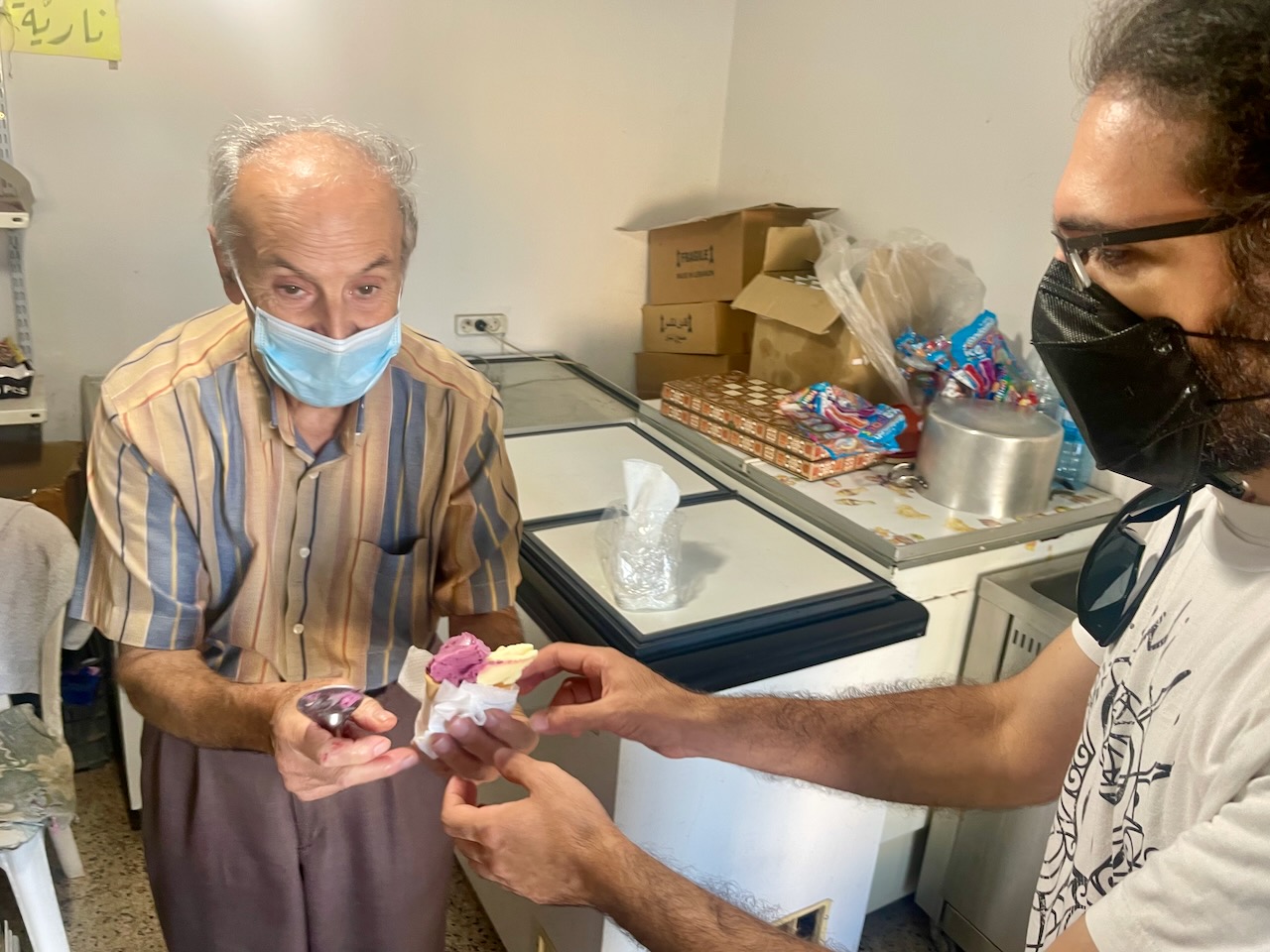
At what is possibly the best Arabic ice cream
spot in Lebanon. Says Sevag: "Excuse me,
photo is taken, please hand that over right
now." (26 July 2022 - Saghbine)
There are many, many people here who
are powerless to do anything but subsist without power. They cannot afford (as
we can) to buy generator subscriptions to fill in the huge gaps in the municipal
power supply. Their homes remain in the dark, and their refrigerators are useless,
and their nutritional intake suffers, and their health declines, and their
ability to obtain health care when they inevitably need it… vanishes. Meanwhile
the young and resourceful continue leaching from the country, leaving their
families and their heritage far behind…
Yet amid all of this, today I was witness to an example of benevolent involvement in the struggles of Lebanon, as well as an intelligent grasp of the country’s needs. The Japanese Ambassador to Lebanon, H.E. Okubo Takeshi joined Lebanon’s Minister of Public Health, Firass Abiad, M.D., to dedicate equipment that the Japanese have donated to the Karagheusian Assn.’s Primary Healthcare Center in Bourj Hammoud. The Ambassador spoke of the commitment of his country to support the Lebanese people (making this important distinction in his words). Then Dr. Abiad, showing an unusual grasp (for someone in government) of the health care crisis in Lebanon, told the audience how the country for too long has invested large amounts in tertiary health care and ignored developing primary health care, thereby rendering basic health care unaffordable to people of modest means. He also described his plan to restructure the allotment of health care funds to the primary type. It was refreshing to hear someone with a vision, someone in a position of authority who is interested in improving what has been handed him, rather than blaming others for his lack of action.
Before the program, when the Ambassador
arrived and was being introduced to the clergy, I got to greet him with the phrase
I had been coached on and had been practicing for a whole day, including in my
sleep the previous night. “Kakka, oai dekite kouei desu.” It is a most
unfortunate coincidence that this phrase begins with a word that in Japanese
means “Your Excellency”, but in most of the languages I know means something quite
different. The important thing is that the Ambassador understood my stumbling
Japanese, “Your Excellency, it is an honor to meet you,” and responded in
English with, “Very pleased to meet you, also.” The other important thing is
that no one else who heard my greeting reprimanded me for saying an indelicate
word to the Ambassador.
Dr. Abiad addressing the audience, following
Amb. Okubo's speech (31 Aug. 2022 -
Nor Marash - Bourj Hammoud)
One of the famous Japanese sayings
invoked today was “Fall down seven times, get up eight.” What more appropriate
way is there than this, to think about how the powerless in this world can persevere
and continue their struggle. My mind especially goes to the One who was beaten
down, but rose again, he who is ever on the side of the downtrodden, Christ
Jesus. He was considered powerless in the eyes of the world, but his purported “weakness”
was wrongly estimated by those in power. His victory over death, and his promised
Coming, are the basis for hope of all those under the weight of personal or
societal failure. He is the One keeping us going, especially when the lack of
power – or vision – looms large around us, whether here, in Armenia, or anywhere.
LebCat 52: "Wait, is that... a pig flying? Oh,
yes, this is Lebanon!" (31 Aug. 2022 -
Nor Marash - Bourj Hammoud)
And yes, we still cheer like Santa Claus just showed up whenever the power comes back on! [LNB]
(*The country that does its utmost to prevent foreign meddling… by doing what they don’t want other countries doing.)


