Showing posts with label corruption. Show all posts

Tuesday, February 28, 2023

Dead Foxes

57. Dead Foxes (28 February 2023)

Commemorating 35 years since Azerbaijan
began targeting Armenians for
extermination. (26 Feb. 2023 - Beirut)

Earlier this month, while driving along the coastal highway, I slowed down behind a line of cars and trucks exiting and noticed an animal lying alongside the roadway, obviously dead. From a distance I could tell it was too large to be a cat, too small to be a dog, and my guess was confirmed as I slowly crept alongside… a red fox. I was happy and sad at the same time; happy that there is still wildlife in this overbuilt metro area, and sad that it met this fate. I realize that those in rural places might not share my dismay, considering the losses they may incur because of foxes. Here this death is sadly poignant. While actual foxes become road kill, human foxes are left alive. And the “fox hunters” trying to pursue this latter kind are systematically eliminated, and the foxes pretending to be humans continue their sadistic rule over the henhouse.

Empty since the port blast, Lebanon's electric
company building - gutted, just like the service
it provides (20 Feb. 2023 - Mar Mikhael-Beirut)

            One of the more insidious of that species is now facing a “natural disaster” of his own making. Over the years he granted waivers for poorly constructed housing in exchange for ballot-box loyalty, so that he could establish full political control. That narcissism transformed the tragedy of this region’s February 6 earthquake into an unmitigated disaster. Will he be held accountable for the crimes he is now heaping upon the corrupt lower-level operatives? Not if the spin doctors around him can do their psyops job well, and transform this fox’s image into, let’s say, that of a pussy-cat. A devout, embattled fighter for the rights of the ordinary citizen. A strong leader his country needs to rebuild it and make it proud. Any of a raft of addictive lies that people in so many lands believe, sad to say.
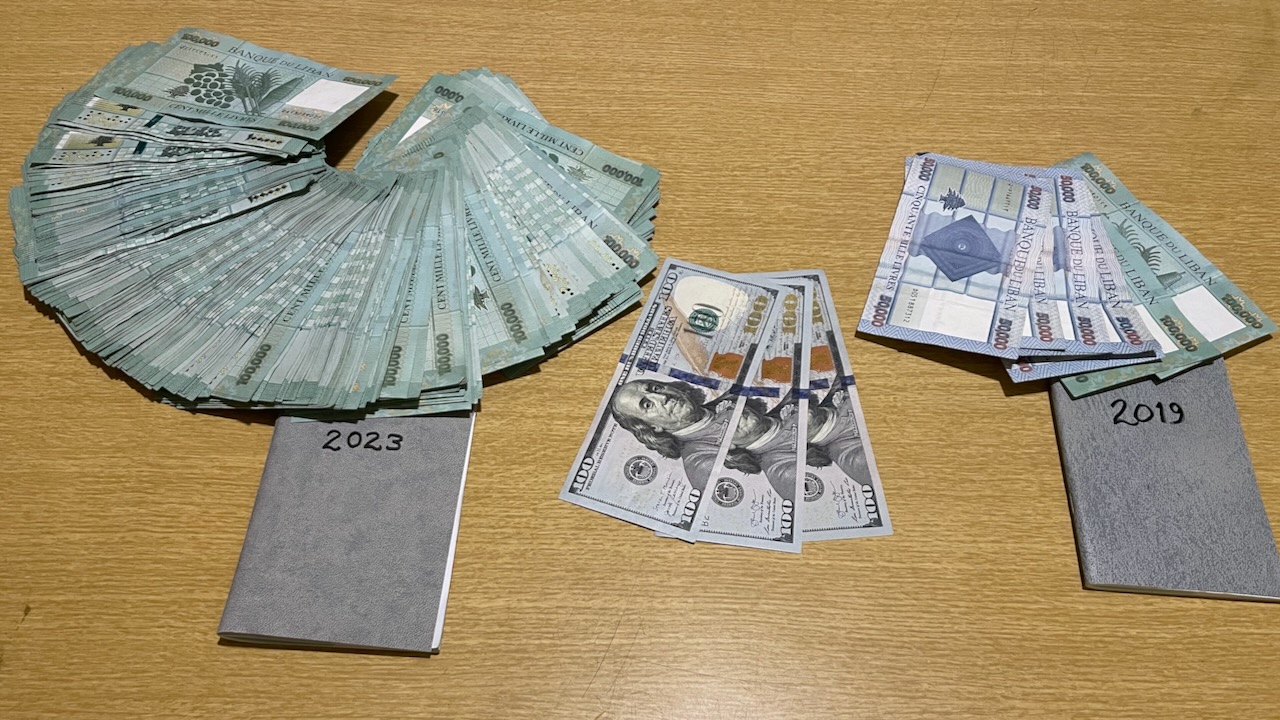
The value of $300 in local currency, in
2019 (right) and 2023 (27 Feb. 2023 - Beirut)


Meanwhile, others try to dodge the traffic that would run them over and put an end to their positive impact. Though contributing to the betterment of society, and though they are not the ones able to cause a fundamental, systemic change in the status quo, yet their activity is nonetheless significant in the long term. Unlike the wealthy foxes who continue to find ways to launder their money or sink it into building more empty buildings in the capital, they are a different sort of investor. They sink their time and effort into human capital; into teaching students to think, into inculcating character and faith into young people, into creating cultural riches to feed the souls of generations yet unborn. The anniversaries of the region’s Armenian institutions (churches, schools and so forth) are reminders of the deep investment our forebears made to rebuild and sustain a broken nation after the Genocide, making the Middle East’s Armenian communities the powerhouse of the Diaspora. And it continues to serve in that capacity, feeding and nurturing Armenian identity but with a frighteningly small number of visionary laborers engaged in this crucial work.

As spring approaches, tree branches and
neighborhood generators begin to
sprout offshoots
(27 Feb. 2023 - Bourj Hammoud)

            Who are they? First of all, they are teachers of all subjects and in all manners. Especially focusing on language, history and culture, they might be using state-of-the-art methods and materials, or they might be solidly stuck in the 19th century in their approach, but at least they are making an effort. Others who develop new, relevant materials for various grade and knowledge levels are also part of that army, along with those who digitize existing materials (a special shout-out to the Armenian National Library in this regard). Then there is anyone making a difference in just one child’s or adult’s awareness or self-awareness of his (or her) identity as an Armenian. I would also include “influencers”, who know how to make effective use of information media and place it or disseminate it in easy-to-find locations. Really, in our world so full of foxes, all Armenians should be engaged in this effort on the micro or macro scale, and spend less time self-absorbed in things that do not satisfy (see Isaiah 55.1-2) or edify, such as self-promotion on social media platforms.

A reminder to continue being visionary,
despite it all
(28 Feb. 2023 - Gemmayzeh-Beirut)

            I’ve noticed that Armenians (myself included) tend to put things in life-or-death terms; maybe it is because Armenians, like nearly all minorities, face life-or-death realities much more frequently than majority populations. Majority populations and those intent on a homogenized, globalized mono-culture, tend to object to this existential angst, seeing it as unnecessary (which it isn’t) or disruptive (which it must be). The angst felt among Armenians here in the Middle East is because they are battered and dishonored, treated as collateral damage by the major foxes and their sub-foxes who play at political and financial war. As it was a century ago, so it is today. Enabled by a disengaged international community, foxes circle around Armenia and Artsakh, drooling over the thought of ruling over an emptied henhouse, expertly using propaganda, lies, threats and a sham “protest” to lay hold of the remainder of the Armenian homeland devoid of Armenians.

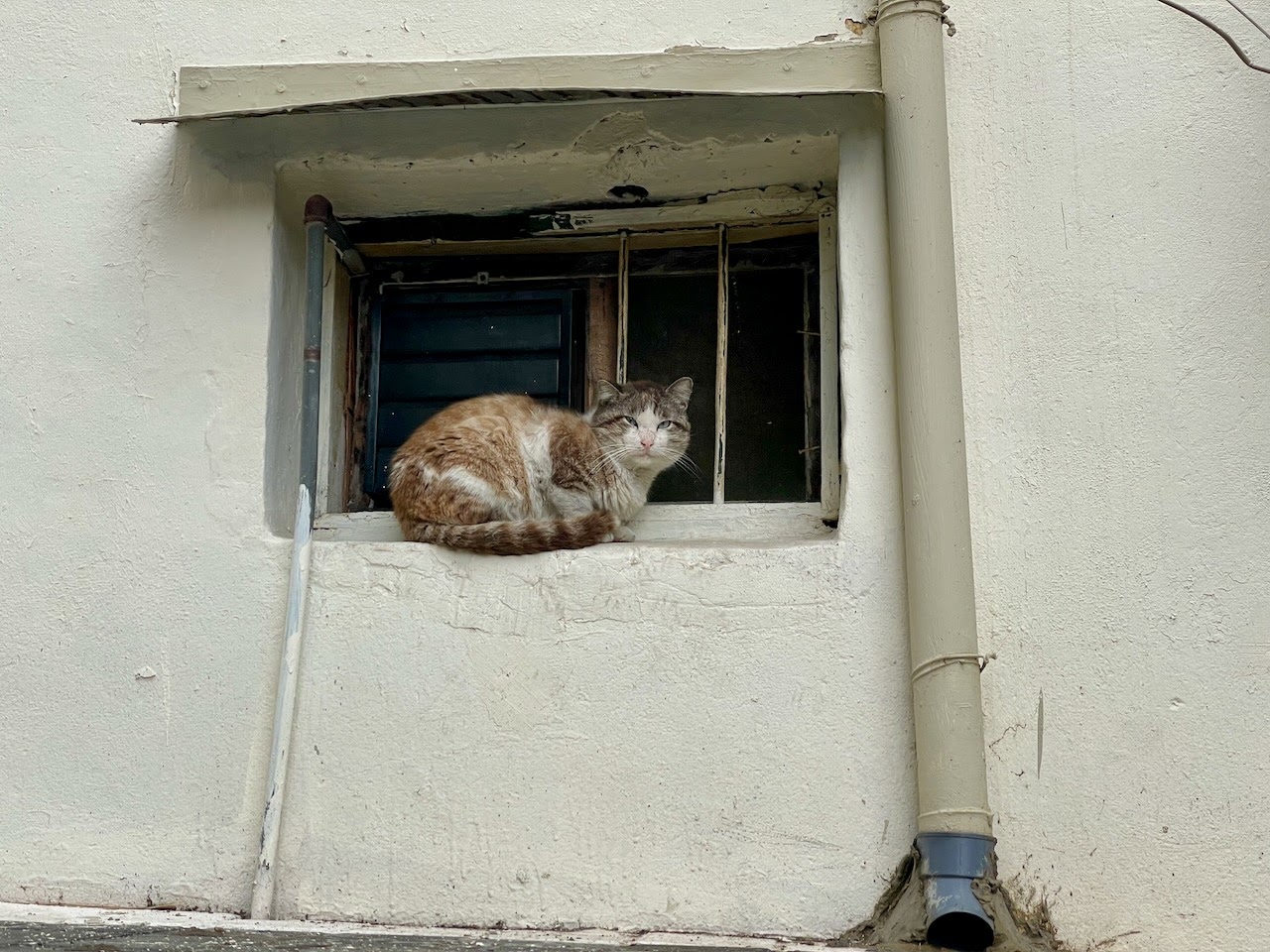
LebCat 57: Hard at work receiving phone bill
payments. This may explain a few things about
the system. (28 Feb. 2023 -
Geitawi-Beirut)
            When the Lord Jesus faced off against the oppression his people were bearing, he dared call the ruler of that day a “fox” (Lk. 13.32). It was a calculated, public insult, and a challenge to his duplicitous authority. Despite the deadly actions of all manners of foxes, God will accomplish his purposes, he will bring hope and healing to the downtrodden, and will revitalize life within all who trust in his Son.   [LNB]

Saturday, April 30, 2022

The Same Playbook

49.The Same Playbook (30 April 2022)

Facing the electric company and registering
his opinion with no ambiguity
(28 March 2022 - Gemmayzeh, Beirut)


One of the most distressing feelings one might have is when it seems like someone, near or far to your heart, has obtained a copy of the script of your life and is reenacting the worst scenes in it, sometimes with only slight variations. There is nothing you can do to affect the outcome except to watch helplessly (or avert your eyes) and hope for the best. You know the story line, because you went through it once – or perhaps copied from someone else’s playbook before you, and at that time you didn’t listen to anyone’s advice to take a different direction. The saying in Armenian (and other languages) is true: a person learns from his own purse. Rare is the one who learns from another’s hard lessons.

The children showing the people how to
worship (10 April 2022 - Geitawi, Beirut)

            It seems that this is also true on a larger scale, with entities such as organizations and even entire nations following a preset script. The Armenian nation presents an interesting example of this, as it takes up its old playbook and reenacts the worst days of its own history. In general, its behavior is fueled by a strange bit of amnesia as to the reasons for it suffering what it did in the past, combined with an inability or unwillingness to chart a different course for the future. The country of Armenia, ever at the mercy of greater powers, is struggling to continue its existence, while it suffers setback after setback following its disastrous defeat in 2020. The Armenian people, part of the larger entity called “the nation”, are sometimes filled with concern over what is happening, and sometimes are profoundly disinterested over what seems (to them) will not really affect them. An acquaintance from Armenia recently said that these days are probably more dangerous than the post-Genocide days. I concur, because the post-Genocide generation knew that they needed to forge an identity and pursue that in all aspects of their life; we of today’s generation are so fragmented and individualistic that we cannot be bothered to see where our indifference and disunity will lead us.

Easter morning, the pied piper of... KCHAG?
(17 April 2022 - Monteverde)

            I had the good fortune of never having been a serious participant in any sports activity. Always one of the last to be chosen when picking teams in or out of school, I early on put aside any delusion that I possessed sports-related skills. I focused on the arts and music (but not on studying). But, whether you use the playbook or the script image, this is a helpful way to view today’s disastrous world, and to see important connections between seemingly disparate events. The “who-cares-we’re-a-failed-state” playbook had been in use by local leaders long before the economy crashed, though it was never publicized. It is still the primary one driving current events and directing local actors to perform well for their masters. The population has picked up the well-worn copy of the “vote-for-your-party-not your-country” as it nears parliamentary elections in May, following which those elected will be using the “it’s-their-fault” playbook when daily life fails to improve. Those outside Lebanon use the “benevolent-state” playbook, announcing their full support for local reforms while maintaining policies that undermine any possibility of improvement in any area.

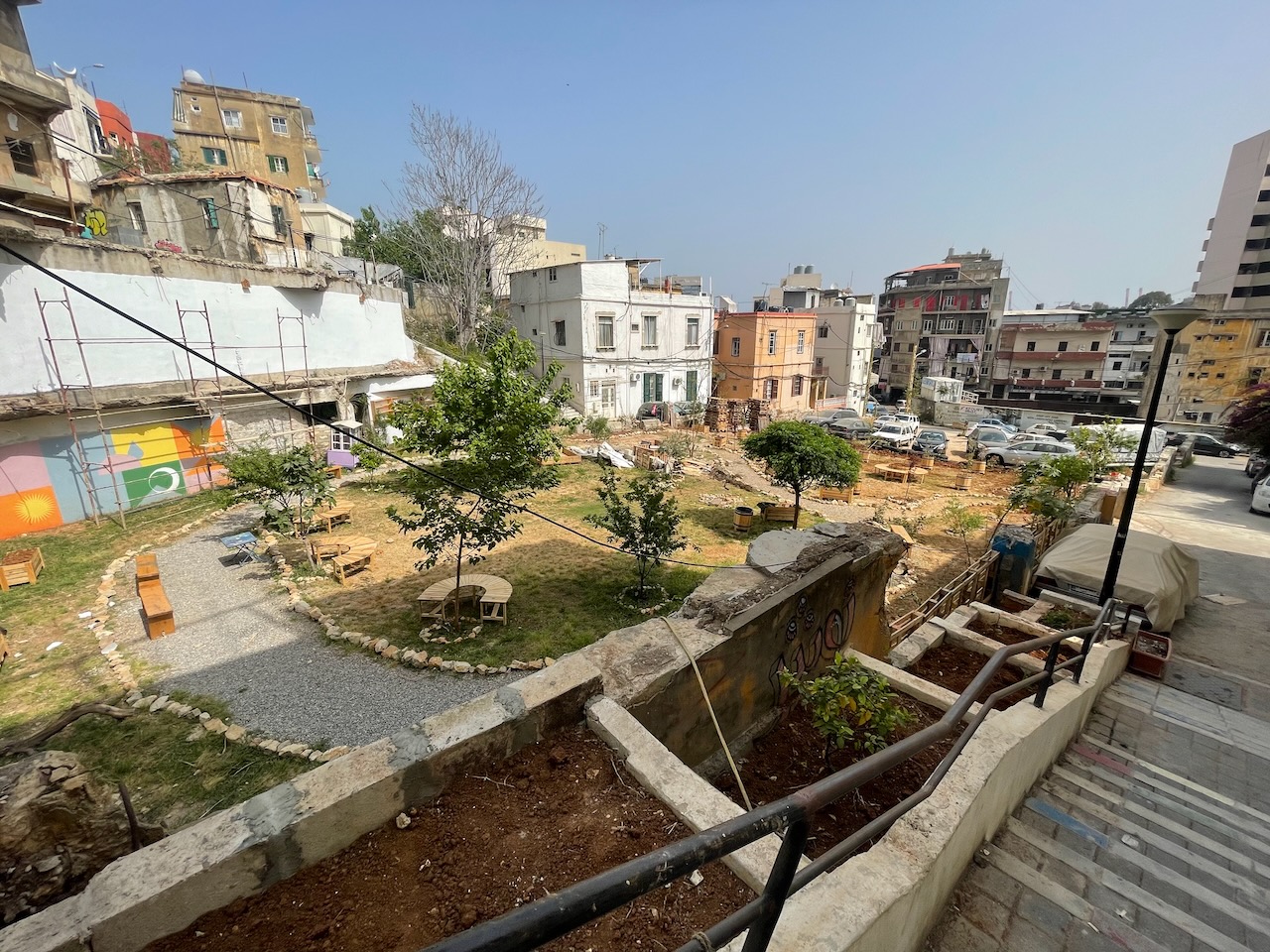
An "illegal" green space developing on the
grounds of the former Laziza brewery.
Greenery appears to be illegal in Beirut
(28 April 2022 - Geitawi, Beirut)

            During the current European war the “bomb-into-submission” and “everyone-is-our-enemy” playbook is the one in use, connecting today’s aggressors to the aggressors in the Artsakh war of 2020, and so many other wars, including the Ottomans’ war against its Armenian citizens a century ago. The “territorial-integrity” playbook is in heavy use in Ukraine, just as it was by Azerbaijan (and by the sympathetic but impotent friends of Armenia) when Artsakh was being attacked. The “black-and-white” playbook is opened frequently in the West (and for the West), in order to explain the intricacies of wars and security actions to those with limited interest or ability to discern grayscale shades. And the “your-oil-is-more-important-than-you” playbook is probably the only one shared by every single major power, no matter in which direction their guns are pointed or shipped. The “ideological-high-ground” playbook is also frequently read from, though the actors never take the stage. It is a grand drama and a high-stakes game that we are witnessing, based on a series of playbooks that will make the world the same as it has ever been, or ever will be.

Naming the evil that allows
disasters, destroying people and
their heritage (30 April 2022 -
Mar Nicola, Beirut)

            Fortunately – and I say this sincerely – there are weak and unimportant people in the world. These are the ones who I consider to be able to make real and lasting change. They are the ones who interface with their neighbors each day and look into their eyes with perception and compassion. This is not to praise interpersonal relations in general. The other day a small shopkeeper spoke of how some homemade food distributors in Lebanese villages easily take advantage of people like her by following the fluctuations in local currency against the dollar, then collecting payment well above the day’s street value, saying, “If you don’t want to pay, then I’ll find someone else to sell to.” Despite my insistence that I pay the current value of my purchase, she refused to take more from me than the outdated prices listed on her shelves.

God hears, but do we?
(8 April 2022 - Mar Mikhael, Beirut)

            My guess is that the difference lies in whether people have an actual, human relationship with each other, and not a transactional one. It’s the same with the church. Do I share a gospel message with someone because it’s expected of me, because it’s a requirement, because I consider my religion superior and his inferior or completely wrong? Or do I truly care for the other person as someone created in God’s image, whom God loves as much as he loves me? That person-to-person playbook is the one that brings true hope and opens hearts to receive the actual good news. It may be crass to characterize Jesus’ ministry in this way, but the gospel is so full of these kinds of interpersonal “detours” that Jesus took as he shared the gospel of God’s kingdom and the promised new life in that kingdom, that it must be an integral part of the message. My conclusion is that God has put his playbook into our hands and sent us from the church to the world. One who plays according to this script stands little chance of preventing the “rulers of this age” to seize the day; but in God’s timing, living this way will undermine every earthly power.

LebCat 49: Go find your own ledge!
(24 March 2022 - Geitawi, Beirut)

            We have been encouraged in recent weeks by young people in the Armenian community who, despite the discouragement and fear so prevalent in the country, have chosen life. Some have made engagement pledges to one another, others have brought newborns into the world and surrounded them with love, and all of them have taken these risky steps relying on God’s provision. God’s hand is certainly guiding them, and as they grow as families, the joy of the Lord is giving them – and us – strength.

            Once upon a time in Lebanon, when paying for groceries, if there were a few piastres (or liras) left to round up the total, the cashier would toss a pack of 2 pieces of chewing gum into your order. In recent years it became the whole box of gum, and then progressed to a sachet of instant coffee. Today as I was buying fruit from my friendly fruit-cart pusher, “Abou Mawz”, he announced 8,000 lira for a half-kilo of bananas. Then he winked and said he would make it 10,000, as I nodded and he tossed another banana on the scale. Imagine… fruit as small change. But that’s the playbook regular Lebanese people have long used. And it’s the playbook that even those most desperate to leave the country will be searching for, and not finding, in their newly-adopted homelands.   [LNB]

Tuesday, August 31, 2021

45.Another World (31 August 2021)

Children's Conference restarted with two one-
day events (KCHAG, Monteverde - 24 July 2021)
It has been two-and-a-half weeks since we left Lebanon for our 5-month “Home Assignment”. The question that dogged us when we told people in Lebanon of our trip (“Are you going to come back?”) is still dogging us here in the U.S., but inverted: “Are you going to go back?” Because things are terrible in Lebanon, and even worse than they were when we flew out, people assume that our (unwise in their estimation) answer must be based only on conditions on the ground. We tell them, “Yes, Lord willing, that is our plan,” since our move there four years ago was also based on the Lord’s guidance above all else. But to those living in this world, we must be unaware of what the situation is on the ground – or in the news.

Enjoying a scavenger hunt at the conference
(KCHAG, Monteverde - 20 July 2021)
            When we think of Lebanon, we do not first of all think of the rampant corruption, the hoarding of resources, those seeking a profit from peoples’ misfortune, the long hours without electricity, the lack of sleep in the hot summer nights, the anxiety over finding food and medicine, the terrible banking system, the destruction of last year’s explosion and much, much more… We think of the people, the friends and loved ones we have, the children and young people, our colleagues, the small businesses we frequent, the churches, schools and institutions where we serve, the Armenian community we are a part of, and so much more. We also look to the coming years, to “what’s next”, the challenges ahead, the opportunity to add our strength and experience to the efforts of others, working with God to sustain life in a place and among a people whose muffled cry is: “We want to live!” The misery that their leaders are spawning all over the land must not determine our steps, but rather the One who placed this on our hearts. It won’t convince everyone questioning our planned return, but that’s the way it is.

A prickly-pear (cactus) seller finds a whole
row of customers, waiting to fill their gas
(25 July 2021 - Beirut)
            As the memory fades of the hardships we faced each day and each moment in Lebanon, it seems like we are currently living in another world. We remember that people continue to suffer even more humiliation there, but it has started to disappear from our consciousness, as we experience the luxuries of life in the U.S. Luxuries such as 24-hour electricity, uninterrupted water supply, filling a tank of gas without waiting in a long line, stable prices and currency, banks that allow you full access to your savings, fully-stocked pharmacies, the ability to plan a work day or a vacation day, heating and cooling of homes and businesses as needed, schools and universities happily planning to receive children and youth for the new school year, continuous internet at fast speeds, and on and on. We are inhabiting a parallel world from the one we left; a world where, strangely enough, things function as they were intended. Much like the world of privilege Lebanon’s leaders inhabit while they perpetuate a world of misery and humiliation for their people.

Socially-relevant graffiti, quoting
prophecy from Isaiah 6
(30 July 2021 - Beirut)
            Although it may seem so to anyone who has to endure daily deprivations, everything is not perfect in this parallel world we inhabit today. As time passes the dark side of life in the U.S. gradually reveals itself to us more starkly. One thing that has begun to creep into my consciousness is the “irrelevance” of being Armenian in this “far” Diaspora (far from the lands we were dispossessed of). With so much to do, buy, see, download, play, watch, consume, fix, replace, who has time to think about existential issues? Questions that keep some of us awake through the night are so irrelevant; questions such as, “Who am I? To whom do I belong? Do we Armenians have a collective future? What are the internal and external threats facing us? Are we our worst enemies, or are the criminal regimes surrounding Armenia? Can we work toward a coordinated Diaspora that neither ignores its own needs nor discounts those of Armenia?” One by one these concerns fade from view as I get wrapped up in the busy-ness of each day, and the many things that insist I pay attention.

            I also consider how “irrelevant” these questions now seem to many enduring great deprivations in Syria, Lebanon, and elsewhere in the “near” Diaspora, where the very visceral struggle just to subsist overtakes any considerations of national identity, of strategic planning for the future, of battling “red” or “white” genocides, of challenging globalization’s threats to us and other small nations… Each of these parallel worlds, one shiny and bright, the other dark and dreary, imposes itself on me, and on us, and makes us push aside any considerations of what truly matters, what keeps us human, what gives us meaning and identity, what can help us endure and flourish as a nation.

From every walk of life, walking to the city
center to remember those lost on August 4,
2020, and demand accountability
(4 Aug 2021 - Geitawi, Beirut)
           Even issues of faith are affected by the powers at play in these worlds. When you have every thing (emphasis on “thing”) available to you, God can become just another add-on to your life, and faith can be a pleasant – and optional – diversion. One that you meld and adjust to fit the values and standards of society. On the other hand, when you have nothing, faith can turn into a mere lifeline that you use to survive each day. Lifting your head up from the misery of each day in order to seek and do God’s will where you are right now can appear as an impossible luxury. How easily the immediate and urgent can supplant the important and foundational, and how often the temporal overwhelms the eternal. How hard it is to live in God’s world no matter what “real world” you occupy.

Portraits of the fallen in the 2020 port blast
(6 Aug 2021 - Saifi, Beirut)
            We had a full summer before we left Lebanon, including an extended stay (again) by our son Sevag, and preparation for our absence. Despite the steady decline in living conditions, we enjoyed being at home together. He had time to serve, time with friends, and time to eat bouza arabi (natural Arabic ice cream, home-made with goat’s milk). When people in his “usual” world ask him, “How was it in Lebanon? Wasn’t it dangerous? Wasn’t it difficult for you?” he simply answers them, “It was very good to be with my parents.” He, too, realizes that it is difficult for people in one world to grasp the reality of another world.

LebCat 45: Dreaming of donuts and other
easy handouts from the AUB crowd
(28 July 2021 - Bliss St., Beirut)
            Having experienced the Port Explosion of 2020 together with Sevag, we also experienced its first anniversary together. Sevag participated in a service of remembrance and prayer at Ashrafieh’s Armenian Evangelical Church, whose church and school buildings were hard hit by the blast. It was also a day for us to express our gratitude to God that we emerged safely from that maelstrom. A Christian artist from the U.S. honored the over-200 dead from the blast by preparing their portraits and pasting them around the perimeter of one of the big, empty buildings being built in downtown Beirut, a few steps away from the Martyrs’ Statue. As we walked past those portraits, gazing into their eyes brought home the pain and the reality of the loss – to their families, their communities, and their country. It’s a temporary exhibit, as those panels will be removed once the construction is completed. Hopefully their memory will not be temporary, and a new generation of those who love the truth will emerge and prevail, to pursue what is right, true and merciful in the world God so loves.    [LNB]


Monday, June 21, 2021

Two Hours Is Plenty

44.Two Hours Is Plenty (21 June 2021)

Street art around AUB
(Bliss St., Beirut - 27 May 2021)
When the foxes who have ruled the henhouse for the past three decades claim that they are going to improve henhouse conditions, like install air conditioning, or clean up the mess on the floor, it should take less than three decades to realize that this will never happen. Case in point: the endless promises up until last year that Lebanon’s decaying power grid and lengthy power cuts were going to be “fixed” – “very soon” – have passed their expiry date and are smelling rancid. Two hours a day of electricity is plenty, right? No massive popular movement emerges against these foxes – or perhaps they are wolves? “So let’s cut it down to 1-1/2 hours per day.” And on and on it goes.

And more than a few people eat at these sorts
of "food outlets" (Mar Mikhael -
Beirut - 4 June 2021)
            How bad is the electricity in Lebanon? Wait… I’ve heard this joke before. It’s so bad that their offices got blown to smithereens in the port blast last year and nobody noticed the difference. It’s so bad that even the private generator owners are complaining that their machines are working too much.

            The primary occupation of Lebanese in these times is watching, in real-time, a country rich in natural resources, human capital (especially its youth), healthy growth possibilities, history, heritage, and service industries, fall apart, bit-by-bit. It’s not a pre-occupation, because that would imply you have a job. The economy has (up to now) contracted to the point where it will take a decade or two to recover, so says the World Bank. Therefore, until and if recovery starts, “wait and watch” will be the primary work engaging Lebanese of all stripes. Possibly also the pre-occupation of the regional and international players fielding their teams in “Stadium Lebanon”.

Wounded voices from the blast zone
(Mar Mikhael - Beirut - 7 June 2021)
            Meanwhile, foreign and expatriate Lebanese partygoers looking for a bargain are flowing into the country, keeping the eating and drinking sector in business. Like vultures on carrion, nightly they noisily fill the “bar-way” – Armenia Street / rue Nahr / Mar Mikhael – near us until the wee hours of the morning. One could say, “At least they are putting  ‘fresh money’ into the economy.” But that money comes at the price of humiliation and dependency. Yesterday’s militia leaders (i.e., today’s political leaders) have treated the Lebanese this way for three or more decades, as they reinforce their place in Lebanon’s confessional-based system, offering their followers jobs, “monetary incentives”, or even COVID-19 vaccines, in exchange for unquestioning party loyalty. A similar effect can be had by narcotics.

Lines, lines everywhere
(Beirut - 14-16 June 2021)
            That currency devaluation continues by the day, and the banking system, against which the uprising began late in 2019 (before it derailed), continues to devise new ways to keep depositors’ money in their hands. This is in open defiance of international efforts to salvage Lebanon’s shipwrecked economy. Similarly, the supply of medicines, including medicines for chronic conditions, is being controlled and rationed, though it seems that there is no shortage in depots. Hospitals, deeply affected by this situation, will soon inform their chemo and dialysis patients not to come in for treatment, due to lack of supplies. Kleptomania is an addiction, and as any drug abuser can relate, you could sell anything or anyone if it got you what you crave. For Reformed theology fans, the term “total depravity” has here been replaced with utter depravity.

            Why has there been no public uprising against the perpetrators of this heartless and endless misery purposely inflicted upon the Lebanese? I refer you to “The Frog and the Kettle” analogy, which best explains the slow adjustment of the population to the deadly atmosphere around them. In previous years, as power cuts occurred, the government would announce they’re “trying to fix” the electricity (or trash, or any other) problem. Now, they don’t even bother saying anything to the public. There is no spirit or will left (so far) to hold anyone accountable. And as we all know, uprisings where mafias rule result in bloodshed.

You know your neighbors love you when they
leave onions and garlic in your mail slot!
(17 June 2021 - Geitawi - Beirut)
            One of the bright spots in this morass is one of the only governmental agencies that is working for, and not against, the people: the Health Ministry. It has an active cabinet minister who actually has the proper qualifications for the job. He makes sure the press is present during his surprise visits to hospitals, clinics, vaccination centers and medicine depots, and maintains updates on the Ministry’s website and social media, so as to increase public awareness and accountability. His recommendations for governmental policy are based on scientific and public health concerns, and not on the dictates of any religious community head. As a result, Lebanon has been able to see a vast reduction in COVID-19 cases, including a reduction in deaths from the disease. How we wish he could step out of his caretaker role and be part of the yet-to-be-formed-if-ever cabinet.

A newly-formed Armenian family exchanging
vows before a newly rebuilt stained glass
cross! (19 June 2021 - Beirut)
            Another bright spot – or rather a whole lot of bright spots – are those citizens who demonstrate humanity toward their fellow citizens, despite their own suffering. Some help to push cars that are out of gas in the waiting lines at gas stations (which dispense a few litres of fuel to a single customer as slowly as possible). Some pay a little extra at the food market so that someone else who is short of cash can buy food. Others write alerts via social media where young parents can find baby formula or diapers. In one of those online encounters the donor of some much-needed medicine refused any payment – only asking the recipient to “pray for her”. Despite the misery (and I’ve highlighted only a fraction of the spheres of corruption in which the country is drowning), the ordinary humanity of the authentic Lebanese still shines, albeit dimly.

Praying for God's blessing on the Armenian
Evangelical Central HS graduating
class (Geitawi - Beirut - 13 June 2021)

            The Armenian community here is faring as well as everyone else: not better, not worse. But in pursuing its daily life and continuing its existence, it is engaging in civil disobedience, defying the rampant corruption in which it is compelled to exist. Merely the act of rebuilding structures damaged in the port explosion (a disaster resulting from years of corruption and negligence on a staggering scale) shows that defiance. The installation of a re-imagined version of the stained glass cross in the First Armenian Evangelical Church, rededicated yesterday, is another example. Armenian schools (and Haigazian University) holding their year-end programs these weeks and prayerfully graduating their students to the next level of their education shows that same determination. Or a young Armenian couple taking their marriage vows and pledging to stand by one another no matter what the circumstances is another act of civil disobedience against the wolves running the henhouse. And for what is yet to come, faith in God’s grace will be the only way to endure.

LebCat44: What, are you going to start
charging me for chilling under this car?
(Geitawi - Beirut - 13 June 2021)
            So we are back to spending summer nights without electricity, pretending to sleep, and then dragging ourselves through the daytime, pretending we are awake. Until last week we had our neighbors with whom to commiserate, but they returned to Armenia for the summer… and have their own set of challenges to face, as Armenia decides its future leaders, and continues to be the object of interest to neighboring Canis lupus appetites, and the object of continued Western humanitarian disinterest.

            Since there is only One who holds the future, we put our trust in him alone these days. Probably not a bad idea for everyone, everywhere, to do the same, no matter the level of comfort you (currently) experience.    [LNB]
Sunday, November 29, 2020

Know Thyself

40.Know Thyself (29 November 2020)

No Independence Day celebrations on Nov. 22,
but a large, hand-painted flag was hung over
the damaged buildings in central Beirut
(24 Nov. 2020 - Beirut)
Sunday morning in Beirut… the last day of a two-week lockdown, with hints of more to come

after the New Year’s holiday, since the COVID-positive test percentages are not decreasing. A sunny day, and all is still, as driving is forbidden on Sundays. No sounds but the loudspeakers broadcasting church services, mostly the Armenian Apostolic liturgy from churches in Nor Hadjin, Khalil Badawi, even across the Beirut River from Bourj Hammoud. Church bells and chants… and the sound of Israeli drones. They’re up there practically every day; yet on quiet days like today their sound can even be heard inside, behind closed doors and windows.

            My mind drifts from our balcony in Beirut to those Armenian soldiers in Artsakh (the correct historical name; but if you are a big fan of Soviet nomenclature, you can go ahead and call it “Nagorno-Karabakh”), soldiers in their trenches and posts, some of whom we have a close personal connection to, trying to fight a conventional war against drones similar to what we hear all the time. Bought from the same country, not coincidentally, as well as from another nemesis of Armenians, Turkey. The Turkish ones are made from components imported from all over the world, Europe, Canada, U.S., and others. All sold to countries that hold their hand over their heart and swear that the technology will never, ever, ever be used against unarmed civilians.

Businesses, large and small, closing
permanently. So, why bother replacing
window glass? (31 Oct. 2020-Accaoui, Beirut)

           
Oh, it was a bloody war, and many civilized and uncivilized countries had a part in it and bear responsibility, if they do any self-examination: those who indignantly protested against it (but did little else), and those who said, “Hey, Armenians, don’t take it personally – it’s just business”; that sponsor and importer of Islamist militias and Turkic settlers into the Caucasus; those who promoted the anti-Armenian propaganda and lies emanating from Azerbaijan and Turkey; and not to forget those who had other “strategic” interests to pursue and couldn’t really be bothered by the dismemberment of an ancient people from their soil. It was just another news story in a media and online environment that has many interesting wars and disasters and flashpoints to flit to and from. Everyone in the news-ish industry was able to leave it behind after the infamous Armenian-Azeri-Russian cease-fire document of November 10.

All 970 of my office books, back in our moving
boxes from 2017, waiting for the refurbishing
to finish (2020-11-20 - Geitawi, Beirut)


But Armenians haven’t moved on. They can’t. The sorrow, shame, disgust, self-loathing, recriminations, protests, calls for resignation, fund-raising, speech-making, mourning, desperation, search for abducted soldiers and citizens, belated attempts to have countries recognize the Republic of Artsakh, appeals to human rights groups, appeals to cultural preservation organizations, more sorrow, more shame, and on and on… have swallowed up Armenians’ souls worldwide. I have felt that we Armenians are now living inside a horror movie whose plot continues to unfold, with no ending and no credits. Like many others, I am wishing to awake from this nightmare and find that it was not, in fact, a re-creation of the human devastation of the 1915-1923 Genocide and the subsequent decades of cultural genocide. It’s quite strange, when you think about it—complaining about being in a nightmare while unable to sleep properly.

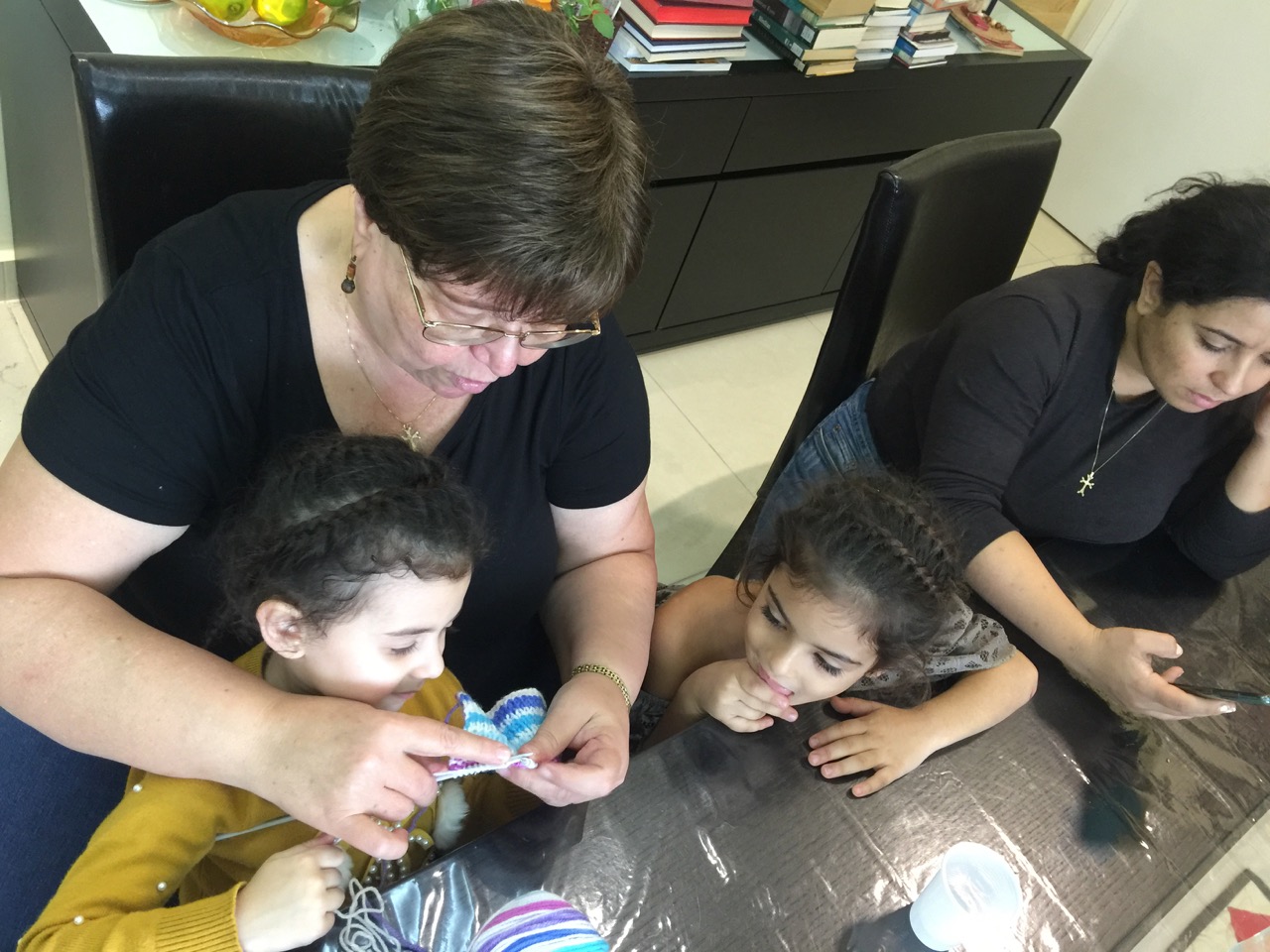
Maria showing the neighbor girls how to knit,
while one of the moms awaits some news
from Artsakh (15 Nov. 2020 - Geitawi, Beirut)

           
In the context of this national disaster I am forced to come to terms with the ancient saying, “Know thyself”. Before knowing your friend or your enemy, it is necessary to know yourself deeply – what drives you, what confounds you, what blinds you. Knowing one’s friend or even one’s enemy can provide an important window into this crucial self-knowledge. And since Armenians apparently have more of the latter than the former, it would follow that knowing ourselves should be a fairly direct matter, one to which we can readily apply ourselves. However, this 44-day war clearly showed how little we know our friends (such as they are), or our enemies (who were more than we realized), or even ourselves (who think that songs and poetry can win wars). Our flawed understanding of how to live in this sin-filled world expressed itself grotesquely in the self-confident misinformation shared with Armenians the world over each evening by the army’s press spokesman. He invariably ended with the words: “Don’t worry – we are winning.” It also appeared very clearly in the self-justifying speeches of Armenian leaders after the cease-fire treaty was signed. It was more subtly expressed in the three decades of public theft and unaccountability since Armenia’s “independence”, and in their lack of preparation for this inevitable attack by Azerbaijan and Turkey. It was seen in the century-and-a-half old, romantic, self-deluded attitude of certainty that the West will come to the rescue of Armenians “because of our dark eyes”. It is seen now in the rapid implementation of road construction, cultural destruction and appropriation, and ongoing propaganda disinformation spread by Azerbaijan. It is visible in the dazed finger-pointing and calls of “traitor” by one Armenian to another. We have not known ourselves or our weaknesses; we only see our accomplishments. And we have blinded ourselves with the pride that we are somehow valuable to this world’s powers that be.

Christmas trees on each balcony, but no glass
(24 Nov. 2020 - Beirut)

           
Not only this, but our theology has reflected that same misunderstanding. We have a long list of why we think God will play favorites and give us advantages that he won’t afford other nations. This is not to say that we do not have a unique, valuable, irreplaceable cultural and religious heritage, a history that predates the “winners” of this war, and a multiplicity of things of which we can rightly be proud. But that cannot be the basis of a hope-filled, faith-filled, self-giving Christian nation. As well, none of those treasures or that history can form the basis of an intelligent, balanced, and farsighted strategy of nation-building. Will we know ourselves more fully as a result of this catastrophe? Even if it only be “as through a mirror, dimly”, we have no choice but to make the effort.

The bird never stood a chance.
(26 Nov. 2020 - Geitawi, Beirut)

           
Watching the American election from overseas was akin to watching a fan’s amateurish remake of “Survivor”. Days upon days, weeks upon weeks of bewildering events and announcements before and following Election Day provided an unwelcome diversion from the depressing news that was crushing us – and only us, it seems – each day. Whatever transpires in Washington these next several weeks will do little to improve the lot of the millions around the world, struggling just to stay alive, including Lebanon and Armenia. Meanwhile, will America come to know itself, and see who and what it is clearly from within; and also learn something from those on the outside, from those upon whom it makes not just an impression, but an indelible imprint for good or ill?

            Here in Lebanon the same ancient question applies: do we know ourselves? Do we understand what drives us to see some things and ignore other things, both good and bad? Do we note that we are being made to play by “rules” that have been at work since the end of the Civil War, rules that keep communities divided and competing with each other for privileges? A few days ago the caretaker Interior Minister said, “95% of Lebanon’s judiciary is corrupt”, to which, tragi-comically the judiciary responded, announcing that it was going to prosecute him for making such a statement. As Armenians say, “If I say ‘leb’, you should understand ‘leblebou’ (chick peas).” It was his polite way of saying that the system is rotten to the core. Will anything be done to remedy this? Can anything actually be done? To which I say, “Who runs Sicily these days?”

LebCat 40 - "Don't make me get up, I just found a
nice, warm spot." (19 Nov. 2020 - Geitawi, Beirut)

           
Following the disaster here in Lebanon the cabinet had enough integrity to resign. They knew that they no longer had credibility with its citizens, and could not in good conscience stay in their positions. The theater that subsequently is (still) playing out here in the capital is another story, a story in which “everyone, that means everyone (kullon, ya3ni kullon)” is back on stage. Compare and contrast this with what happened following the strategic disaster in Armenia… What more can I say?

            Somehow it seems appropriate that in this maelstrom we were able to gather with our neighbors (including our three families in our building – a sort of permanent “quarantine”) for a Thanksgiving meal, complete with a turkey imported from the U.S. Tensions and uncertainties were temporarily suspended, even though we all felt the sorrow over the death of our neighbor’s brother during military service in Shushi. We enjoyed the blessings God has granted us and knew this about ourselves: during this season of isolation we have not been abandoned by God or by one another.   [LNB]