Showing posts with label Syria. Show all posts

Thursday, October 24, 2019

Devils and Details


29.Devils and Details (24 Oct 2019)
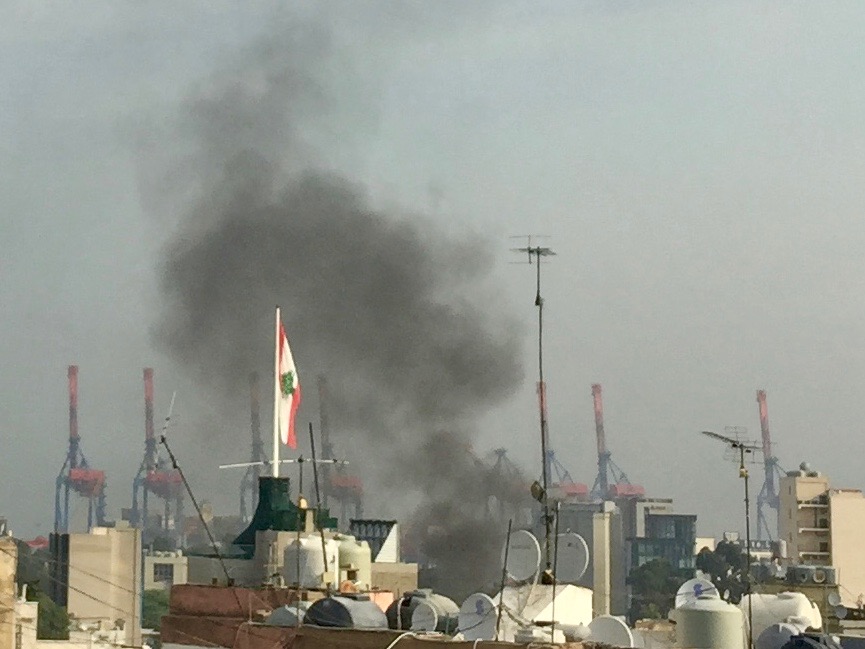
Smoke from tires burning on the Autostrade, filling the air.
(18 Oct. 2019 – Karantina - Beirut)
A week ago there was an announcement, replete with locally generated “great and unmatched wisdom”, in which the government here would begin taxing Internet-based (VoIP) communications (such as Whatsapp, Messenger, FaceTime). As many have already said, this was just the match that lit a blaze, the straw that rendered the camel a paraplegic, yet became an almost-inconsequential detail leading to the explosion of protests all across the country. The outcry and rage even targeted certain well-known leaders whom the populace heretofore has never dared to (publicly) criticize.
Shuttered businesses the entire length of the normally
busy Arax Street. (23 Oct. 2019 – Bourj Hammoud)
            So, the first couple of days we inhaled the acrid smell and particulates of burning tires, in addition to the ongoing stench of garbage dumps and polluted water. Those first few days also saw the emergence of a few disruptors who either were intent on destroying and looting private property, or reasserting the supremacy of their political party and its flags. Both types were quelled by Internal Security and Lebanese Armed Forces. Then emerged the chants of “Thawra! Thawra!” (“Revolution!” “Revolution!”). And the open-air party atmosphere. And the congenial “we’re all in this together” atmosphere.
            Later, other slogans emerged, as the
Push-back against multinational corporations… and an icon
of the protests, a woman kicking an armed guard where it
hurts. (22 Oct. 2019 – Mar Mikhael - Beirut)
demands intensified: “Kellon, ya3ni, kellon!” (“All of them, that is, all of them!”), so that no one group would think its leader exempt from the demands for a complete change in leadership – and a new political system, one not based on religious identity. If there are 3 million Lebanese in Lebanon, then thanks to television crews roaming in and among the various protests sites we are hearing what seems to be 3 million statements of discontent from young and old blocking streets and highways. Their words are crammed with emotion, seething with frustration at the struggle the average citizen has to endure for things like inadequate health care, expensive education, intermittent electricity and water, poor waste management, environmental degradation, unaffordable housing, corruption to the core, and so much more, including a sky-high national debt.
            But what has been absent is someone to take the helm of this movement and focus it into a clearly-defined direction. The prime minister gave a public address the day after the start of the protests, but it appeared to be directed to his political opponents. The president addressed the country today, a week after the start of these events. A decade and a half ago a handful of potential alternative leaders may have existed, except that they disappeared one by one in still-unsolved car bombings. Where are the new visionaries to keep Lebanese from turning against one another, expressions of which are beginning to emerge? There is only so long that an outburst can be sustained, and so what is sometimes (erroneously) compared to Armenia’s “Velvet Revolution” may take some unwanted turns in the days to come. Chanting for overall change is a start, but the devil is in the details.
The last day Lebanon was able to focus on something besides
its protests. (16 Oct. 2019 – Bourj Hammoud)
            And speaking of devils, only a few short weeks have passed since great (and locally great) powers have decided against the Kurds in northern Syria. It is such a familiar narrative; the roles now played by certain peoples and countries were played a century ago by many of the same minorities and world powers. And the story ends the same: strategic and oil interests superseding any humanitarian interest or pang of conscience. Who will be the losers in these military “games” being played out in the region? You can start with the great powers, who again squander their names as they easily abandon their local allies (We all should bring to mind how Armenian brigades and the population were betrayed by Europe). Yet a greater loss is being shouldered by the people of the land, not just Kurds, but Assyrians, Chaldeans, and, yes, Armenians. The Kurds may rebound due to sheer numbers. But what of the Christians, who are the ancient residents of that region? One of the winners no doubt will be the incipient “Islamic State Part 2”, thanks to the support of some and the negligence of others. So many devilish details, too many to keep track of, that invaders will just say “Oops” to you after the fact, as you disappear into the oblivion of genocide, deportation, migration and assimilation.
LebCat 28: A flat cardboard box is better than
no box at all. Hanging out with LebCat 13.
(3 November 2018 – Bourj Hammoud)
            But back to Lebanon. The protests continue, and roads are still blocked; sometimes by protestors, and sometimes by rainwater flooding the highways (like today) due to poor infrastructure… another burden borne by the population. But people need something beyond the protests – and they need a just resolution, without being co-opted by outside forces. They need to be able to work, to eat and send their children to school, but also to dream about the future and marry and care for and protect their homeland. Will this be a moment of historic change for Lebanon and its unity, or will it end in disarray and divisions? My hope and my prayer is that the people will continue to gather under the Lebanese flag, something all sincere religious leaders desire, and something the Bible commands us to do: “Seek the welfare of the city where I have sent you into exile, and pray to the Lord on its behalf, for in its welfare you will find your welfare” (Jer. 29.7).   [LNB]

Monday, April 1, 2019

Decay and Growth


24.Decay and Growth (31 March 2019)
The huge, nearby Lebanese flag, struggling to unfurl while
soggy wet. Symbolic of the state of the state.
(31 Mar. 2019 – Mar Mikhael - Beirut)
            “So, there’s this thing in the parking lot – I think it’s an ark. And a bunch of animals, lined up in pairs…”
            Well, not really, but March in Lebanon is living up to its Armenian nickname: “crazy March” (in Armenian, “khent Mard”). We were fairly sure that the cold and rainy days were over. We were down to the occasional overnight drizzle, with mostly sunny days and blue skies. Now it seems like we are living in a (concrete) rainforest this last day of March, with nonstop rain from the middle of the night throughout the entire day. It is so rainy that the huge Lebanese flag atop a nearby building is completely saturated (not easy for something made of nylon) and shiny under the floodlights illuminating it.
The “thing” in the parking lot is not an ark, but
a second, more powerful generator for the
building. Because uninterrupted electricity
is not in the near future...
(21 Mar. 2019 – Geitawi, Beirut)
            As with other rainy stretches, those who are impacted the most are those living in makeshift dwellings. Translation: that means refugees. It means about a fifth or more of the population of Lebanon. Yes, the Syrian war (or as some call it, “the war on Syria”) is still a “thing”. And Lebanon continues to struggle under the weight of these regional uncertainties. Fear and threats swirl in the wind. There are reports of some local relief workers warning refugees not to return home, for whatever reasons, or perhaps out of self-interest. And then there are the imperial fiats of far-away leaders. A Syrian comedian recently went on TV, seated behind a desk, signing a certificate. He held it up and declared that he was ceding California to Mexico. Then he added that his certificate has as much worth as the one announced this month concerning the Golan Heights. It appears that the storms here will continue here for some time.
            Spring does an amazing thing, though. It makes you believe that the corruption and decay all around us can, in fact, be transformed into growth. Decay is what helps all those ants and cockroaches stay alive, as they dispose of whatever is lying around, plant or animal. Hmmm, maybe I have that backwards; ants and roaches keep us from drowning in waste by eating garbage, which ends up helping to keep us alive. Now that’s a weird thought.
My nemesis: spring flowers. So pretty. Such
torture to my nose. Note the trash in
the background. (25 Mar. 2019 – Zahlé)
            So, trees and plants are budding. And I am fighting my nemesis – pollen – with the only weapons at my disposal: allergy pills and tissues. Green growth is returning everywhere, covering the trash thrown out of windows and dumped at night. But where is the healthy growth, or the ants and cockroaches, that will obliterate, or better yet, remove, the decayed leaders?
            Some cabinet ministers in the new government are trying to take actions to improve the quality of life here. One of the projects is to remove the concrete barriers that have proliferated all around the city since the year of assassinations in 2005. But everyone was so used to seeing concrete that they became disoriented. Even the police. A couple of weeks ago we were in a taxi on Hamra Street, and a police car pulled up to us and asked the driver if he knew where the Interior Ministry was. It was just around the block, but no longer behind barriers or with a security gate, and therefore unrecognizable. And remember, this is the police asking a taxi driver for directions…
A new greenhouse for food as well as education.
(25 Mar. 2019 – Ainjar)
            But there is so much more needing to be done, and the population is generally disgusted by the decades of unfulfilled promises by the same political dynasties that were killing each other during the civil war. There is an old fellow in our neighborhood who delivers the propane tanks for our stove (there is no such thing as a gas line or a gas utility here), and in between conversations I have with him about Bible passages, he mutters on about how officials are robbing people. One could dismiss it as the rants of a broken-down old man. Or one could compare what he says to the reality people face and come to a different conclusion…
Ecumenical prayer, followed by fellowship (and food).
(28 Mar. 2019 – Norashen – Bourj Hammoud)
LebCat 23: A regular customer at the nearby artisanal bakery.
But to sleep, not to eat. (19 Mar. 2019 – Mar Mikhael, Beirut)
            Yet we know we must inspire hope and commitment, and focus on mission and growth, or else we’re just wasting our time.  I truly admire the faithfulness of my church in serving the community through education, with a network of schools in the Middle East. Just to see how they do so much with dwindling financial support is a testimony to their wholehearted dedication. One of those schools, the Armenian Evangelical Boarding School in Ainjar (in the agricultural Bekaa area), has constructed a greenhouse in order to (1) grow its own produce for the children’s meals, (2) teach students about agricultural work, (3) inculcate a sense of caring for the natural environment, and (4) maybe even be able to sell some of what they grow.
            In yet another sign of spring growth, a few days ago twenty Armenian clergy – Apostolic, Catholic and Evangelical – held a prayer and fellowship gathering in the Ss. Vartanants church in Bourj Hammoud, under the leadership of the heads of those three denominations. Although this type of ecumenical event is just starting here, there has always been cooperation between the churches and clergy in the region to some degree. But it is wonderful to see a clergy gathering coming into shape, much as we have had for over a half-century in the Armenian churches of Philadelphia. Now, this is the kind of spring I like to see, sniffles or not!   [LNB]

Monday, January 29, 2018

The Departure Lounge


12.The Departure Lounge (28 January 2018)
The third of four groups of carolers in
front of our (and the neighbor’s)
door in the wee hours of Christmas
Day (6 Jan. 2018 – Beirut)
            We were enjoying our “last supper” with Lara, waiting for Hovig to take us to the airport for Lara’s return trip to Armenia. It had been a relaxing, fun, all-around great eight days of family time together. Suddenly, the neighbors across the hallway burst out of their apartment and began pounding on our door, hysterically screaming, “My!!! My!!! (in Arabic, “Water! Water!”). I rushed to their apartment to see what was burning, while Maria ran to our kitchen to grab a container to fill with water to douse the flame. When I reached their kitchen and saw a 26-year-old flat on her back with the family gathered around trying to rouse her, I rushed back to our place, grabbed the water from Maria and told her to go immediately and help them. That’s something I’m trained to do, after 38 years (this month) of marriage to an R.N. I consider it a finely-honed skill.
            The neighbors across the way were a Syrian-Armenian family from Damascus, who had come to Lebanon because they had been accepted by the Australian government to be relocated to Australia, albeit to a city where there is no Armenian community. Neither refugees nor tourists here in Lebanon, they consist of a widowed mother in her 50s and her three children in their 20s. Her fourth, the eldest son, had already escaped to Germany, and is working on obtaining a law degree there. They had been staying a few days here and a few days there for a month, until one of our pastors arranged for them to remain in a single place while they tried to get their affairs in order before their departure.
If it looks like we’re happy to be together, it’s because we are!
(3 Jan. 2018 – Beirut)
            Christmas Eve (January 5, that is) rolled around, and we were excited because Lara was going to bravely go out (only her third day in Beirut) with complete strangers from one of the church youth groups, to carol hither and yon in Armenian all night, something I used to do with my church’s youth 40 years ago back in Philly (albeit in English), something that stopped when members were no longer living in the vicinity of the church. We were also excited that four different churches were going to send their carolers to us, and in that way our temporary neighbors, burdened with fears from having lived in a war zone, along with the uncertainty about their impending relocation, would also enjoy the good news of Christ’s coming as each group showed up to sing (the last one arriving at 3 a.m.). And their faces were joyful! That night marked the transition from saying “hello” in passing to becoming “neighbors” in the local sense, where you stop by at any time, no invitation needed or expected, to talk and have a cup of (Arabic, of course) coffee.
            Oh, sorry… I left one of the neighbors passed out on the kitchen floor.
            So, Maria was doing her best to help this young lady wake up, while her younger sister and brother were yelling her name, and her mother was just yelling. Hysterics, in the not-funny sense. I stood at the ready, doing whatever Maria needed me to do, trying to calm down the mother, and eventually they got her up, onto a chair, and eventually into bed. But why had she passed out? Probably from not sleeping for two or three days. They had been going to a variety of local government offices for documents needed by the Australian embassy to grant them passage out of Lebanon, but they also had to travel back and forth to Damascus to get documents from there. They did that last trip to Syria in 24 hours, there and back. Lack of sleep, lack of proper food, and there you are on the kitchen floor.
Excursion with Lara to Jbeil/Byblos. Can you spot her in
this picture? (7 Jan. 2018 – Jbeil)
            Yet sharing this moment of crisis drew us even closer, as we listened to whatever they felt they could tell us. At first it was about their experiences in government offices here, trying to get their papers in order, and returning day after day, waiting from morning until evening, then being told to come back the next day. Later, they shared a bit of their past, and some of what they experienced during these seven years of war in Syria. Their neighborhood was surrounded on three sides by terror groups, giving them an unwanted front-line war experience. The mother said that one day a couple of years ago the army showed up, handed out guns to the men in her building (including her older son) and told them to defend it if Daesh (IS/ISIS/ISIL) broke through their defenses. This is a woman who had built her home bit by bit, saving up and doing improvements (like a roof and walls) as she was able, a woman who had the grit to study and sit for governmental exams at age 45 in order to get her high school diploma. She knew that this very real danger would soon reach both her sons. She called a friend who drives a taxi and told him to come by right away and whisk her older son away, out of the country, quickly, however he could. Eventually, she also sent her younger son to Lebanon, and then a few months ago, along with her daughters, joined him.
            As we sat and visited, and as they shared more and more with us, we spoke about how their lives were going to change radically in that “Western” country they were headed to. They would have peace and security, they would have cleanliness and order, but they would also be very lonely. I shared, “It’s an individualistic culture, where age, experience, family, and culture – aside from their own culture – are much maligned.” They were aware of this, and aware to some degree that they would need to adapt in many, many ways, including mastering English and gaining an education. They laughed as they related the story of a father sitting in a preparatory class given by the embassy, teaching about how to treat your children, Western-style: you musn’t hit them when you want them to do something, but explain to them why it is important to do this or that, etc., etc., etc. Yes, yes, yes, the father said he understood. But taking his child by the hand and leaving the classroom, as soon as they were outside the door, he soundly smacked him on the head for his disobedience!
For those who were worried that we haven’t yet gotten a set of
wheels, worry no more. (28 Nov. 2017 – Beirut)
            A few days ago we made another trip to the airport, this time taking this family, their eight suitcases and four carry-on bags, to leave them there to await the embassy agent who would guide them through until they boarded the airplane to their new life. It was a tearful parting, because they – and we – knew that they were not just leaving newly-found friends, but were also leaving a place of familiar comforts and terrors, and heading toward the unknown. I told them, “I’m happy for you, but I’m sad for our community. Each person who departs takes something away from us.”
            I often get the feeling that I’m living in a departure lounge. People are milling about me, doing the various tasks that are part of their daily lives, and their church and community life. But their one ear is on the public address system, waiting for their flight to be announced. Today after the worship service a fellow said to me, “You know, they all have their escape planned. All of them.”
            And now, a year after arriving, people are still asking us, “So, you’re planning to stay?” And we wonder how it is possible to be committed to a people and a place when you are mentally living in a departure lounge. Meanwhile, some, far away, are, as it were, sending text messages from those dreamed-about places to those in the lounge, saying, “What are you waiting for?”
LebCat 11: Sophisticated tastes, obviously, on
display in a jewelry store. Next to a falafel
restaurant. (28 Apr. 2017 – Burj Hammoud)
            Fortunately, there are many others here who know that a departure lounge is no place to live. We have cast our lot to be with them, to live and serve alongside them. Taking all the uncertainties and deprivations of daily life here into account, and realizing that the ill-advised and arrogant declarations of the rich and powerful elsewhere in the world are dealing crushing blows to people of all faiths and conditions in this part of the world, we are focusing on doing what is of lasting value. And there is so much to do in so many areas! …educational, cultural, environmental, and on, and on, and a great need for people who will keep their ear on God’s word, not the public address system.
            We came home from the airport that night feeling empty, feeling that loss. The day after, when the family had arrived in Australia, we sent them audio and text messages to encourage them. And we carried on with our week, praying for them, and we continue to do so. But we are resolved not to live in a departure lounge.   [LNB]

Monday, October 23, 2017

Here and There


9.Here and There (22 October 2017)
            “Oh, so you’re from Armenia?”
            When they hear I'm Armenian, what seems to them like an easy question to answer isn’t at all. It’s asked by people who do not have a circle of Armenian friends who will eagerly fill them in on the finer points of what an Armenian is, where Armenians are from, why the Armenian Genocide is such a crucial issue to Armenians and should be to as non-Armenians, where the language is on the Indo-European language tree, what Armenians typically eat (all of which they, of course, invented), why there are fifty times (Armenian hyperbole) more Armenians outside Armenia than inside, why there has been a steady decrease of Armenians from the Armenian Republic since independence in 1991, and on and on. Really, I can’t imagine how people can get through their lives without having an Armenian tutoring them on all these issues, and so many more!
You could probably seat 5 people across in this classic
at Republic Square (4 Oct. 2017 – Yerevan)
            This summer I visited Armenia on two occasions. A mere hour and some change flight from capital to capital, Beirut to Yerevan.
            My first trip, in August, was a six-day visit, during which I led a retreat for Armenian Evangelical pastors. I was delighted to discover that the retreat was going to be held in Artsakh, in the town of Shushi, a place I have not visited in 18 years. The second trip Maria and I did together, ten days at the end of September until early October, and I was the speaker at the annual assembly of the Evangelical Church of Armenia. And this was only Maria’s second visit to Armenia, the first one having been 16 years ago. Both trips were great experiences, challenging, enjoyable, friend-filled, refreshing.
Open-air performance of Armenian folk dance
and song, “Koutan”, at the foot of the Cascade,
on the day we arrived! (28 Sept. 2017 – Yerevan)
            But the question remains: am I “from Armenia”? When I’m in Armenia, am I from “here” or “there”? “There”, of course, is the gaping hole left in the lives, culture and heritage of Western Armenia, the region that the Ottoman Empire/Turkish nationalists attempted to scrub clean of its pollutants, the Armenian people. They did a pretty good job, too, because they ruined an ancient civilization and left them to die a drawn-out, confusing death scattered across the Middle East (to be finished off later by attrition and emigration), throughout Europe (to maintain an exotic, “oriental” flavor while being re-oriented), and across the Americas (to be tossed alive into the “melting pot” while forever arguing with each other over “American-Armenian” vs. “Armenian-American”). For Western Armenians such as myself, there is an inevitable longing for something irrecoverable, bewilderment over what “Armenia” means, and the clash of familiarity with foreignness when hearing Armenian spoken in the “homeland”.
Supplying the missing “N” to the mini-market’s
name, “Bakalia” – according to Eastern Armenian
pronunciation (5 Oct. 2017 – Yerevan)
            Here’s an example: before leaving Beirut, we borrowed two SIM cards in order to use our telephones in Armenia. While feeding some money to a payment kiosk on a Yerevan street, I must have said “ayo” (yes) to something related to one of the numbers, because after congratulating me via SMS for paying that amount, it then claimed that I had only half of the amount left on that SIM card. Hmm. Time to investigate. First, I asked an acquaintance what might have happened. Was there an unpaid debt on the card that I had just paid off? He didn’t know. So I asked another acquaintance if she could call the company and ask about it. (I wanted someone who could actually understand Eastern Armenian over the phone, something I find very difficult.) She spoke to the agent, then explained something to me that I thought I understood: yes, the missing amount went to pay for something or other. But I needed to know what that something or other was, so I found an actual store run by that phone company, took a ticket, and waited my turn to speak to a live human being behind a counter. When my turn came, I asked her to explain why only half of the amount I paid was shown, and although she spoke in Armenian, it was littered with various foreign (Russian and European) words, much like the litter of Turkish, French, English, Arabic and even Kurdish words blow about our Western Armenian speech. So I asked her if she could explain it again, which she did, with a bit less patience. Then I apologized, and said, “I’m sorry, but I can’t really understand what you’re explaining. Thanks for your trouble.” And I left.
            Later on, as I mulled this over instead of going back to sleep, I figured out what had happened to the missing amount. I suppose the jumble of explanations and the various words from various languages finally sorted themselves out, and I concluded (correctly) that I had purchased a calling plan – the amount hadn’t just vanished. But it was emotionally exhausting to be in a place that didn’t exactly feel like I belonged.
            Perhaps this gave me a glimpse of the travails encountered by the latest group of “returnees” to Armenia, the Syrian-Armenians. Many sought refuge from the war in Syria, beginning in 2012, and in the intervening years some have gone on to places like Canada, others have returned to Syria, following the subsiding of military activity, and the rest have settled in Armenia. They have brought a distinct, yet Armenian, culture to the place, and one can sense it – if one happens to also be a “Western Armenian”.
Lara and us at the “Haleb” social aid organization, operating
out of a Northern Blvd. basement (6 Oct. 2017 – Yerevan)
            Maria and I met up with a young woman, Lara, from our former church in the U.S., who is now working through Birthright Armenia at an agency helping Syrian Armenians with various social needs. The restaurant we had chosen was not accepting people without reservations, so we went to one a couple of doors down. The waiter who greeted us seemed to speak a more intelligible version of Armenian, though not the Western dialect. Perhaps he was just accommodating us as Diasporan Armenians, something quite a few Yerevan natives are able to do.
            When he came to our table to take our order, he asked where we were from. “I know she (Lara) is from the U.S., but what about the two of you?” I said, “From Lebanon.” “Where in Lebanon?” “From Beirut.” “Where in Beirut?” “From Ashrafieh” (the eastern half of the city). “Where in Ashrafieh?” “From Geitawi” (a section of Ashrafieh). “Where in Geitawi?” The conversation was getting stranger by the second. “Uhhh… we live in the former CMC (Christian Medical Center) building.” “I was born in that building!” And so three Western Armenians connected on a sidewalk in Yerevan, feeling at home with each other because of the “there” that joined us together.
LebCat 8: “Excuse me, is there a law that says I have
to be inside the box?” (30 Mar. 2017 – Beirut)
            Often, when encountering people disgruntled at life in the Middle East (and in Armenia), we hear them complain about the “here” of their lives today: “This place will never straighten out.” “You can’t get anywhere if you don’t have powerful friends.” “Why bother? This isn’t our homeland anyway.” This multitude of comments are all a way of disengaging with one’s environment, and are usually followed by an announcement of departure to pursue a life “there”, far away from this region. We are amazed at how people can feel more connected to that distant, western environment than to what they consider the corrupt, future-less land of their birth, unable to see any redeeming qualities. I have no ability to read people’s minds, much less see what only God can see – their hearts. But I wonder if people can connect in a different way to the “here” of this part of the world, to experience joy and contentment in the midst of struggles, and find meaning in investing in people, albeit while dealing with undeniable hardships.
            This is something that matches our experiences “here” and “there” – when talking with those who are devotedly working to help others, they note, as we do, that the greatest need is to prepare people – leaders, especially – who will love their homeland(s) and serve with their strength, skills and wisdom for the betterment of all.
            So, Armenia, we’ll be back! We’ve made our home here, close by. We consider both places our own, and trust that they might also consider us their own. [LNB]

Monday, July 17, 2017

What I Really Meant Was


6.What I Really Meant Was… (16 July 2017)
Lebanese coffee manufacturer “Najjar” and its answer to the
single-serve coffee machines so popular in the west.
(30 April 2017 – Hamra, Beirut)
            For someone like me who considers coffee one of the basic food groups, being in a place like Beirut satisfies a deep longing in my heart. “Coffee hour” after church services does not consist of the watered-down version, but is simply, without question, Arabic coffee. If you want the other kind, generically called “nescafé” without the capital “n”, you have to ask specifically for it. And the reason that’s funny is because “nescafé” sounds like “half-coffee” in Arabic.
            In the U.S., someone came up with a single-service coffee machine you can put on the kitchen counter and generate fresh cups of various kinds of coffee, or if you like, various kinds of tea with a faint coffee residue flavor. And you can generate huge amounts of non-recyclable k-cups destined for landfills everywhere. The popular brand of this machine is something I pronounce “kouyrig”, which means “dear sister” in Armenian. I like my sister much, much more than these machines. Still, I was intrigued when, back in April, the local version of the “kouyrig” hit the market, claiming to consistently make the best cup of Lebanese coffee. With the same little trash-generating k-cups, in regular or cardamom flavor. As far as I know, the traditional method of cooking Arabic coffee in a pot over a fire is not in danger of being replaced.
The exact same type of Arabic coffee machine
at the place where I now take Arabic lessons!
(21 Mar. 2017 – U-Turn Center, Hamra)
            All of this brought to mind an experience I had seventeen years ago, way back in A.D. 2000, when we moved to Beirut as a family and I took up my new position as Campus Minister at Haigazian University. Imagine my delight in seeing something I had never encountered before: a hole-in-the-wall bakery on rue Mexique, next door to the University, which had a machine that brewed Arabic coffee! You put in a 500-lira coin (33 cents), chose what level of sugar you want, sat a disposable cup in the little ring (there we go with more trash-production…) and waited for the little “ibriq” (“coffee pot”) to fill with water, the correct measure of coffee, a touch of sugar, then cook the coffee, and when it was ready, it tilted on a hinge to fill up your cup! It became my new favorite hangout.
            I befriended with the woman who ran the bakery, me with my nearly non-existent Arabic, and her with her non-existent English. I found out that she was supporting her family, and that she was part Armenian, but didn't speak the language. We mostly used smiles, gestures and a few words to interact. One day I went to buy my usual cup of coffee, but when I tasted it I found it had no sugar. I drank it anyway, because you just don’t waste a good cup of coffee. Two days later, on my next visit to the baker, I decided I would be a proper customer (in my U.S. way of thinking) and inform the establishment owner of the problem with the coffee machine. And do so in Arabic (my only choice). So I said what I thought was, “The day before yesterday there was no sugar.” What actually came out of my mouth was: “There is no closed the day after tomorrow” (“Ma-fi sakkar ba3d bukra.”). I had changed “sukkar” into “sakkar”, and “the day before yesterday” wasn’t even in my Arabic vocabulary.
LebCat6 lives around the corner from our current
housing and keeps an eye… or two on comings
and goings. (2 Apr. 2017)
            Telling this story later that day caused much mirth in the Bakalian household, but generated no sympathy for my linguistic struggles. On another occasion a few years later, after Maria and I had dropped off our younger son Sevag at a summer camp, on our way back to Beirut we stopped at a bakery on the highway, and I went in to buy two bottles of water. Our older son Armen trailed behind me as I went up to the counter and asked for two bottles of water. Except that the two words I used were of two different languages: “tnayn tchoor”, one, the Arabic word for "two", and one, the Armenian word for "water". The employee looked at me puzzled as I repeated myself a bit more insistently. More puzzlement. Then he figured out what I wanted to say, and grabbed two cold bottles and set them on the counter. As I turned around, still oblivious to what I had said, I noticed my son walking away from me, back to the car where Maria was waiting, hand clasped over his mouth to prevent something from coming out. Once outside, he burst into hysterical laughter as he told his mother what I had just said. After I paid and joined them outside, I also found out. No sympathy whatsoever.
            Part of my current job description includes communications. I am supposed to facilitate connections between our church union and various groups near and far. Fortunately, this responsibility is based on my English proficiency. In English, and slightly less so in Armenian, I am usually able to say what I mean. So, I endeavor to help “decode” what others are saying, so that I understand their intent, even if the words don’t exactly match or make sense. Having been on the other side, and having had these and many other experiences of misstating what I had meant, helps me to be particularly sensitive to this. I am especially grateful that God is the One who by his Spirit “translates” our misstatements and even our frustration, exhaustion and pain into eloquent prayers. I believe that God calls us to do the same work of helping each other with our flawed attempts at communication, expressing the gentleness that is so often absent from the soulless “posts” and heartless declarations that comprise much of modern, instantaneous, worldwide “communication”.
LebCat6 (again) resting after an exhausting day on the
front-end loader. (15 Apr. 2017)
            Our summer in the city is hot and humid, and we try our best to seek out air-conditioned spaces as we do our part to serve, strengthen and encourage our friends here. We are working hard to prepare for the Christian Endeavor Youth Camp, where I am the main speaker, and the Children’s Camp, where Maria is the official “camp grandmom”. Additionally, we note that the refurbishing of our permanent living quarters has begun, and we expect that perhaps by summer’s end we will begin to make our move there. But more than all of this, we are excitedly awaiting our son Sevag’s arrival this week to spend 15 days with us here, and reconnect with the people and places that formed the world of much of his formative years.
            Finally, an encouraging event from a week ago. Following the annual general assembly of our church union, a small delegation traveled to Kessab, Syria, to rededicate the refurbished Armenian Evangelical Church in the town center. Kessab is the last remaining Armenian village from the myriad towns and cities inhabited wholly or in part by our ancestors prior to the 1915 Genocide. It is right inside the border with Turkey, and was overrun by militants entering from Turkey in March 2014, resulting in much destruction and widespread looting. Churches were especially targeted, so the reopening of this historic building was a day of celebration for all, Christian and Muslim alike, involving religious and governmental leaders. So we pray for the continued peace (or cessation of armed actions) that will promote the rebuilding of lives, homes and livelihoods across Syria and the region. [LNB]