|
| Part of the nearly invisible "army" of children subsisting on what they can scavenge from Beirut's trash. (23 Dec. 2020 - Geitawi - Beirut) |
Slowly but surely people got used to the “dumpsters” placed curbside every few blocks or so, even though it took some time for them to place their trash inside them, and not on the ground beside them. It also took some time for people to wait until after 5 pm to take out their garbage, so it would not rot and exude a stench under the hot Mediterranean sun. Over the three decades since the end of the war these lessons in urban coexistence have experienced deterioration whenever a crisis has overtaken Lebanon, especially in the interim between the ending of landfill contracts and the beginning of new landfill contracts.
In
the aftermath of the Beirut Port explosion in August, with one-fourth of the
city turned into ruins and then into a construction zone, piles of discarded
rubble accumulated once more, as they did in the early 1990s, when the downtown
area was sacrificed on the altar of the newly-elected Prime Minister’s construction
company. But this time the rubble, twisted metal and broken glass piled up both in as well as
around the trash receptacles. In fact, so much refuse accumulated that the
sanitation company was unable to keep up with the collection, and only until a
month ago has the situation returned to “normal”. Yet to accept the current state
of waste management as “normal”, one must quash any musings on where all this
refuse is dumped after leaving your neighborhood. 
A hopeful sign that winter snows will help avert
summer drought. (23 Jan. 2021 - Mt. Sannine)
Recently I was taking our household trash to the receptacles a few steps outside the front door of our building, expecting to toss it into the bin, perhaps see a few cats jump out in fright at the airborne garbage bag, and then with a satisfied smile on my face for a job well done, turn on my heels and head back inside. Instead I came face-to-face with a young Syrian boy in grimy clothes, who extended his hand to take the trash bag from me so that he could rip it open and inspect it for saleable items. Obediently, I handed over the bag, turned and left uneasily. I wondered if I had better Arabic language skills, would I have engaged him in a conversation, no matter how brief? What could I have said to this refugee child, part of an army of unmasked children who scour the city’s trash bins, alone or in groups, to find recyclable or saleable objects and make a living?
 |
| Dusty roads can be swept, but what about the children who live their lives there? (26 Dec. 2020 - Bourj Hammoud - Photo: Paul Haidostian) |
These are not the only non-Lebanese children who have taken up permanent residence here. Some have become fixtures for us, begging at certain intersections – young mothers sitting on the sidewalk, holding infants or sending toddlers up to passersby to beg for money; young boys weaving in and out of traffic to sell a package of paper tissues; or other young girls, tapping on car windows, girls whose noticeable maturing will make them likely targets for a different kind of selling… and then young motherhood.
In the midst of an economic meltdown, Lebanon has had one of the strictest lockdown programs in the world, possibly because it has few other ways of holding the coronavirus at bay. Its hospitals – minus about five that were ruined in the port blast – are almost at full capacity, mostly with coronavirus patients. Social services for the general public are notoriously few and far between. Financial assistance to needy families is non-existent, and agencies, such as the ones our church Union administers, do their best to reach those they know about. Donor organizations, such as the World Bank, have begun assistance programs to the poor, but they themselves will be handling the distributions of funds, not trusting governmental institutions to do the job properly. Public trust, essential for any society to avoid implosion (such as events witnessed in the American capital earlier this month), is on the wane wherever one turns.
 |
| Idle cranes at the port, in a country whose lifeblood is imports. (21 Jan. 2021 - Karantina - Beirut) |
These stresses on society have erupted into frequent clashes with the state security services, most notably seen currently in the northern city of Tripoli. Tripoli is home to great numbers of poor as well as the hometown of some of the very wealthiest in the country. One can question the motives of some of the protestors in attacking state institutions, but they should not be the only ones to be questioned. There are the regional masters, who each have their following, both within the political structures as well as among many on the street. But it cannot be denied that the poverty quietly overtaking Lebanon is due to the questionable motives and actions of those in seats of power, both inside and outside “officialdom”. Any possible alleviation of the virus due to a vaccination program might bring and end to the lockdown and free those dependent on daily work to again find their daily bread for their families, but it will also bring the unaddressed social-economic-political crises back to the fore.
 |
| The new definition of "roadside café". Or perhaps a return to the old. (13 Jan. 2021 - Qobaiyat - Beirut) |
Being in a 24-hour-a-day lockdown may sound like paradise to an introverted person like me, but there are limits to its appeal. Whereas previously I was able to have long, solitary walks to do errands, now I am required to apply for approval for any excursion (usually granted within minutes for things such as doctor’s appointments, trips to the pharmacy or bakery, etc.), and only within the immediate neighborhood. For things such as produce or grocery shopping we have to place orders by phone and have the seller deliver the items to our door. Language differences make this state of affairs all the more interesting. I send a voice memo to the grocer: “I’d like 1 kilo of apples.” “Red or yellow?” comes the voice message back. “Just yellow, please.” And when the delivery boy unloads his scooter and I lug the produce up to our apartment, and as Maria and I start unpacking them, of course the apples are red. Mind you, the conversation was in English, not Arabic.
Ordering from the big-name supermarkets is another adventure. We get SMSs saying “Next day delivery!”, and that encourages us to give it a try. Seated at the computer, we go through page after page of items in no particular order. Sorting them yields less-than-satisfactory results, because we are not seeing things that we know the store stocks. As we scroll down the items start showing buttons such as “out of stock”. This is one of two labels visible on the pages, the other being “Made in Lebanon”. That’s fine, we are more than happy to “buy local” when possible.
 |
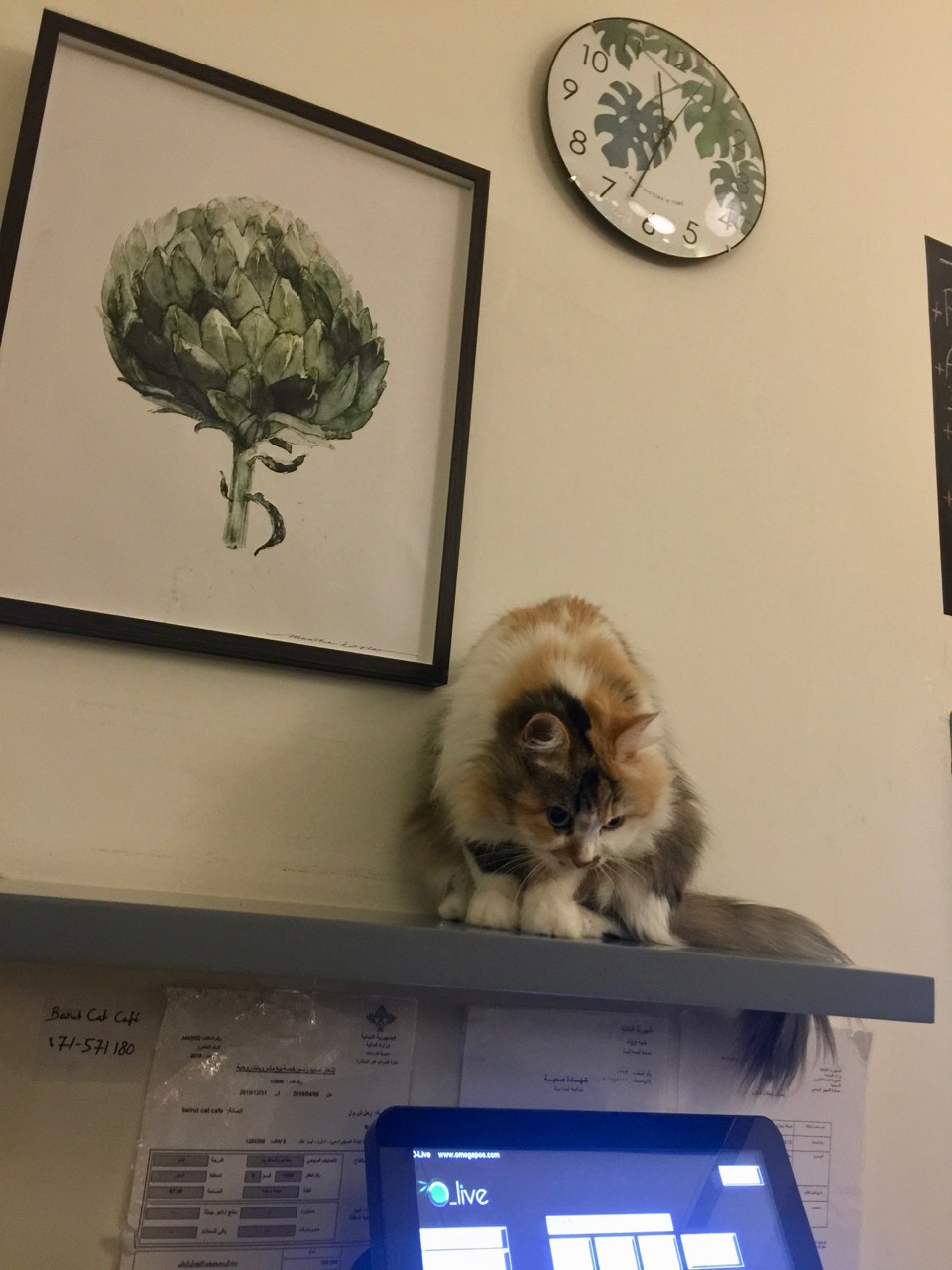
| LebCat 42: Junior, watch carefully how a pro does it. (26 Jan. 2021 - Geitawi - Beirut) |
But when we come to the “checkout” page, and enter our name, address and location pin, we are shown the available delivery times and days. Ten days from now? Really? Calling the help line is of little help, because it is apparent that live persons are not the ones in control. But we bite the bullet and go ahead with the order. But the next page doesn’t open. And there is no indication of what might be the problem. Back to the help line (an email chat, which may be answered right away, or if it’s evening, the next day). We are told to do the very same thing we just did. Meanwhile, the delivery slot gets delayed by a day. Are you using such-and-such browser? No, there is nothing that shows what browser we are required to use. These sorts of adventures continue, and we decide to remove whatever items we need quickly and only order things we can do without for ten days. Or is that now two weeks? Oh well. So we call our nearby mini-market, and get the staple items we need brought to our front steps… an hour after we call. These days are teaching us to center on the things – and the people – that truly matter. The situation is compelling us to give up quite a few things that we became accustomed to, some good and some not. But we haven’t given up everything. On Christmas Eve (Jan. 5) we were overjoyed when two church youth groups (3 persons each, but, arriving at almost the same time, became one 6-person group) stopped by our building for a moment of caroling, reminding us of the hope we have regardless of the circumstances in which we find ourselves this day, or this year. [LNB]