Showing posts with label electricity. Show all posts

Tuesday, August 20, 2024

System Overload

62. System Overload (20 August 2024)

An artist found beauty in the colors
and shapes of Beirut rooftops and skies
(31 July 2024 - Mar Mikhael)

When you live in a country that makes you provide your own basic services – things that citizens of other countries can take for granted – you have to get good at guessing. For example, though we’ve been enjoying nearly non-stop electricity for over a year following the solar power installation on our building, there are still quirks. When the (currently nonexistent, pun intended) municipal current exceeds the normal 220 volts, a system overload occurs, and we are left in the dark. We figured out that we had to wait until the municipal power “calms down” to something under 240 volts, then switch the main power off and on to resume our electricity. Problem managed (not solved)! Other power interruptions still occur, and we’re still trying to guess why…

Finding a way to get the job done,
and nobody got hurt - I think
(29 Mar. 2024 - Geitawi)
            “Overload” is also a daily issue in a place and a community with a plethora of needs and concerns but a dearth of willing and capable hands. Those who are willing and capable can often (somewhat understandably) be very protective of their time and energy. Others may be on the job but lack the necessary capabilities. Still others are unwilling to learn or change. I regularly wonder how overloading is affecting those around me.

            So many people have left this region (the “dearly departed”) for a more balanced or safer or prosperous life, and those who haven’t (yet) left continue to care for the community and experience more system overload. Since I’m now (in a way) part of this latter group, I try not to think about the load-bearing that we are doing, and just continue to plug along. Occasionally we find a little bit of energy left to train and empower others who have the potential to work for the common good, with the hopes that they will continue to stay side-by-side with us and not take an offramp.

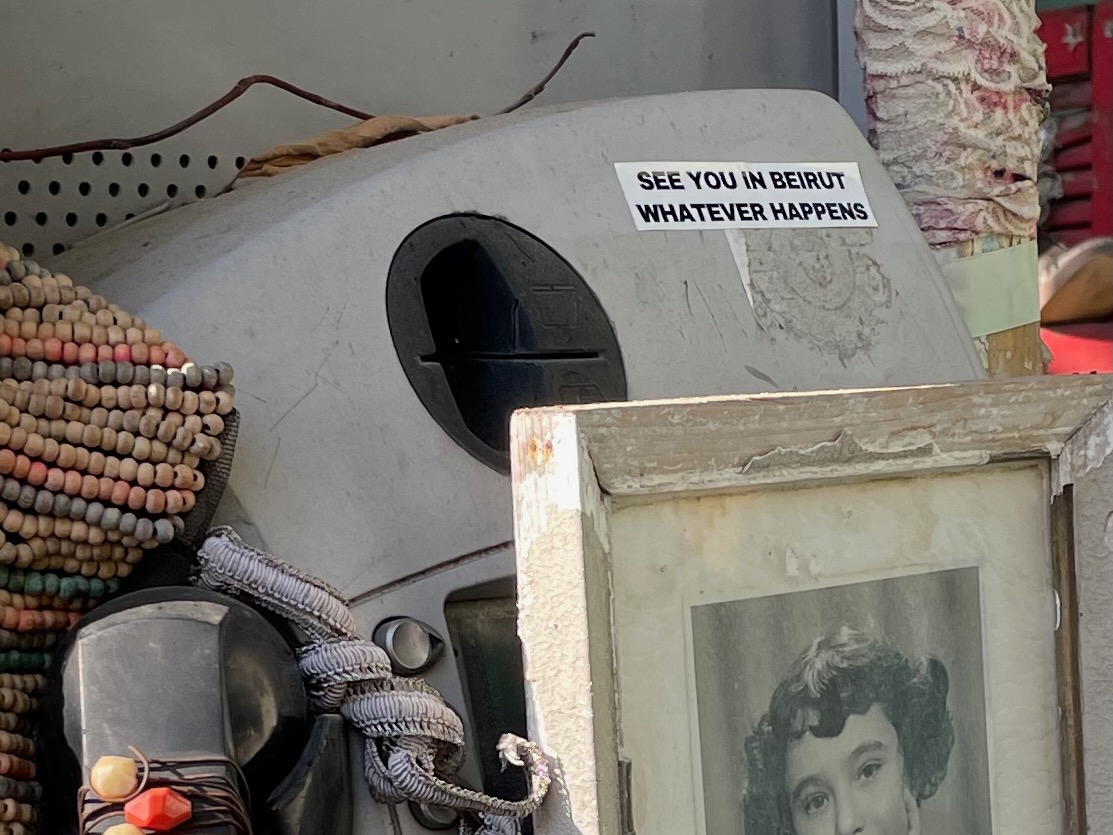
A sidewalk collage with a message...
whatever happens
(10 July 2024 - Gemmayzeh)
            I think that “system overload” also properly describes my thought world of the past year. I have been filled to overflowing with the barbarity and especially the counter-barbarity in the lands “South of the Border” to us; the genocidal onslaught on Armenia and Artsakh (to borrow another butcher’s words, “Who speaks nowadays of the destruction of Artsakh?”) by its neighbors, assisted by the resources of “the Middle East’s only democracy”, and emboldened by the inaction of its “friends”; the lack of depth, political sense or appreciation of heritage of those in power in the “Homeland”; the pervasive indifference and confusion of the Armenian Diaspora towards the existential threats it is facing; the diabolical contradiction between the words and actions of purported champions of human rights; all of this causes a huge “system overload” in my circuitry. Is this paragraph too long? That’s “system overload” doing its thing.
Far from Beirut's din, the peace
and majesty of the cedar forest
(22 July 2024 - Arz el Barouk)
            When surge protectors interrupt an electrical circuit, either the circuit stays off until the “reset” button is pressed, or they wait a few seconds before automatically restoring the current. Maybe all of us need surge protectors to keep us from these varieties of overloading, including the surplus data that is provided to our eyes and brains via our handheld devices. That excess of information, coupled with the lack of time to reflect on so many issues of substance, cause us to fall from our true humanity, in almost as insidious a way as Adam and Eve’s transgression did. And it may explain why in the past twelve months I’ve only managed to eke out one “Nshanakir”, and why I’ve been trying since April to write this one. Seems I’m having trouble locating the “reset” button on my surge protector.

            To switch the imagery and to do some self-correcting, something I tell those who say that they are in a pit or a rut is this: “When you find yourself stuck in a hole, the first rule is – Stop Digging.” Others may advise differently, like focusing on something positive, which may be particularly challenging when the “most moral army in the world” sends its warplanes over Beirut to terrify you, as we have been enjoying of late. Oh, right, stop digging.

            Yet searching for bright spots may be the best method to finding a way out of these many pits and potholes we encounter. Here are a few.

Newly-engaged, a bright spot needing
no electricity! (21 July 2024 - Geitawi)

            One bright spot is the occasional kind taxi driver that Maria encounters in her commute. These are usually “old-timers,” fellows who are not new to the job, who exude an attitude of politeness and caring, something in short supply these tense days. Of course, Maria has a distinct advantage over me in these exchanges, being that she can converse with them in Arabic. If nothing else, it gives me peace of mind and puts a smile in my heart when I hear that one of these gents has been her chauffeur that day.

            Another bright spot happened at a sweet shop on a hot afternoon last week, when I inadvisedly bought an ice cream cone. Almost instantly it turned into a colorful series of tributaries streaming down my hand onto the sidewalk. An employee rushed out of the store and put a stack of tissues on our table, then grabbed my cone and plopped what was left of it into a cup, speaking as if to reprimand the ice cream for making such a mess all over me. She shooed me into the store to wash up at the sink behind the counter, then made me tell her what flavors (of Arabic ice cream, of course) I had ordered. She had the ice cream server make up a new order for me in a cup, of course, with the cone sticking out of it at a rakish angle. After enjoying my ice cream I went back inside to thank her. “Walaw, walaw,” she politely dismissed my thanks. Based on her awareness and consideration, I figure she may have even told the guy inside to make sure to use cups whenever serving ice cream during Lebanon’s glorious summer heat.

LebCat 62 - "Will act cute for food"
(22 July 2024 - Deir al Qamar)
            It’s just like Fred Rogers’ mother told him as a little boy when he was frightened: “Look for the helpers. You will always find people who are helping.” Bright spots are there for those who are looking for them.

            Of course, the brightest spot was indubitably Sevag’s annual month-long visit. It became even brighter when his girlfriend Rhoda arrived from Pennsylvania the last week of his visit and they surprised us by exchanging rings in the middle of a kebab lunch with dear friends. The happiness and brightness quotient soared that day, and there was no system overload anywhere to be found! A few days later we held a formal engagement ceremony in the Armenian tradition, placing the wedding bands on their right hands and invoking God’s blessing on their growing relationship.

            Thinking upon such bright spots definitely help us to bridge the “power interruptions” of these days!   [LNB]

Tuesday, January 3, 2023

With Whom Is God Pleased

56. With Whom Is God Pleased? (3 January 2023)

A glimpse of Christmas joy in the
neighborhood, powered by
"ishtirak"
(30 Dec. 2022 - Geitawi, Beirut)

Holidays in Lebanon, especially in the winter, have fallen off my list of favorites, probably in no small part due to the lack of electricity we (and so many other Lebanese) experience at home. The offices where I work close, meaning that our building’s generator stays off. Our subscription for supplemental power covers only about half of the day, anyway, bringing inside temperatures close to what is outside. And municipal power supply continues to emulate Halley’s Comet in its rare appearances. Combining all the national holidays with the ones of various religious denominations, plus Armenian holidays, here in Lebanon we experience close to a month each year of these “off” days.

            But there is another layer of distaste. Holidays are too often turned into platforms for social and political assertiveness, rather than times of rest, reflection, redirection and rededication. Firecrackers (and bullets) fill the air over neighborhoods where a particular holiday is most observed. Not to forget the obligatory firecrackers and fireworks launched at important life events, such as funerals and weddings, or your World Cup football team scoring a goal. We were able to watch three games of this year’s football “Mondial” in early December since we were visiting Armenia for a week. There, games were broadcast on Armenian state television for anyone to view. Here was a different story, as is the case with so many things. The sounds of firecrackers and nearby fans yelling would prompt us to refresh the official website in order to see the latest scores — a somewhat anticlimactic method.

Constructing the "New Year's tree" at the
Yerevan train station
(30 Nov. 2022 - Yerevan, Armenia)

            In this particular season the biblical phrase, “Peace on earth, good will towards men,” is widely touted, or more commonly quoted simply as “Peace on earth”, without involving men (in the generic sense) or good will. The more intricate version of Luke 2.14, “Peace on earth among those with whom God is pleased,” is avoided, likely because it doesn’t fit neatly into 21st century greeting cards (i.e., social media platforms and posts), and likely also because it states that there is a God, also implying that this God makes judgments. About us. Also not fitting popular sensitivities in these oversensitive times.

A garden of Armenian letters seemingly
growing out of stones, hopefully an inspiration,
more than just a tourist attraction.
(29 Nov. 2022 - near Artashavan, Armenia)
            Whether or not it plays well in mass culture, a question sticks in my mind: With whom is God pleased these days? My immediate guess is “no one”, as evidenced by the lack of peace on earth. The lofty goal of peacemaking is left largely untouched, while nations allegedly aim for (but fail to reach) the lower goal of temporary cease-fires. Yet even where cease-fires are attained there are always those who find ways to continue their aggression.

            Since mid-December and continuing into the New Year, Azerbaijan-sponsored phony “environmental activists” have been blocking the only lifeline for food or medicine or transit that Artsakh Armenians have, the “Lachin corridor” linking it to Armenia. Add to this the Azeri government and industries that are driving all of this, entities that blithely cut off energy supplies to Artsakh in the cold of winter. Add to this the inaction of those charged with keeping the road open, allowing the situation to be created. And finally add to this the meaningless verbal bravado (and little more) of world powers, busying themselves with statements and resolutions condemning the blockade, but unwilling to intervene in a sovereign country. If all of this looks and sounds like world powers’ failure to prevent the Genocide in 1915, there’s a good reason for that. Summing it all up, it immolates the dove of peace over the flames of war.

A mural depicting Old Beirut, in a park where
an old Beirut building was torn down.
(8 Dec. 2022 - Geitawi, Beirut)
            Peacemaking can be torn apart in various ways: by individuals, societies, companies, governments, you name it. It does not have to be done in the obtuse ways that Armenia’s rapacious neighbors are so fond of. Sometimes it can be as subtle as tolerating inept (fill in the name of your favorite country) governance, or by making self-centeredness and self-indulgence a societal value, or in disdaining others in order to elevate yourself.

            Yet despite all attempts to kill it, peacemaking is alive, and peacemakers are at work. Whenever we hear about or witness a teacher who goes beyond the lesson plan and above the minimum requirements to help her class learn to relate with care for each other, there peace is being inculcated. Last week I was in a store in Bourj Hammoud when an older fellow in tattered clothes stood at the door with his hand raised in greeting - not for a handout. The Arab worker (who happens to speak Armenian) addressed him affectionately, giving and receiving words of blessing; this, too, is peace-building. When someone in the course of a conversation asks me to pray for him right there on the spot, God’s peace hovers over both of us and enables us to express more grace to others.

Christmas bazaar at the Zvartnots Center,
which brings hope and love to special needs
children.
(22 Dec. 2022 - Nor Sis, Bourj Hammoud)

            That message to the shepherds heralding “peace” at Christ’s birth is more of a challenge to self-absorbed humanity than a statement of present reality. The One whose appearance they announced made it his aim to establish peace through servanthood and a particular act of sacrifice. It grew more intense and pervasive as he grew “in stature and in God and man’s favor” . We might strain to see those around us who join him in this endeavor, but the thread that joins each instance together, shining with the angelic light seen outside ancient Bethlehem, is that of service.

            Serving others, motivated by love, produces peace. And only God himself can fill and refill that love.

LebCat 56: Since the electric company isn't
using these anyway, I'll just settle in.
(30 Dec. 2022 - Mar Mikhael, Beirut)
            Since “Armenian Christmas” is but three days away, an Armenian greeting on the occasion and a wish for God-pleasing peacemaking: Christ is born and revealed; blessed is the revelation of Christ!*   [LNB]

*Քրիստոս ծնաւ եւ յայտնեցաւ. օրհնեա՛լ է յայտնութիւնն Քրիստոսի։

Monday, October 31, 2022

How about Them Apples?

54.How about Them Apples? (31 October 2022)

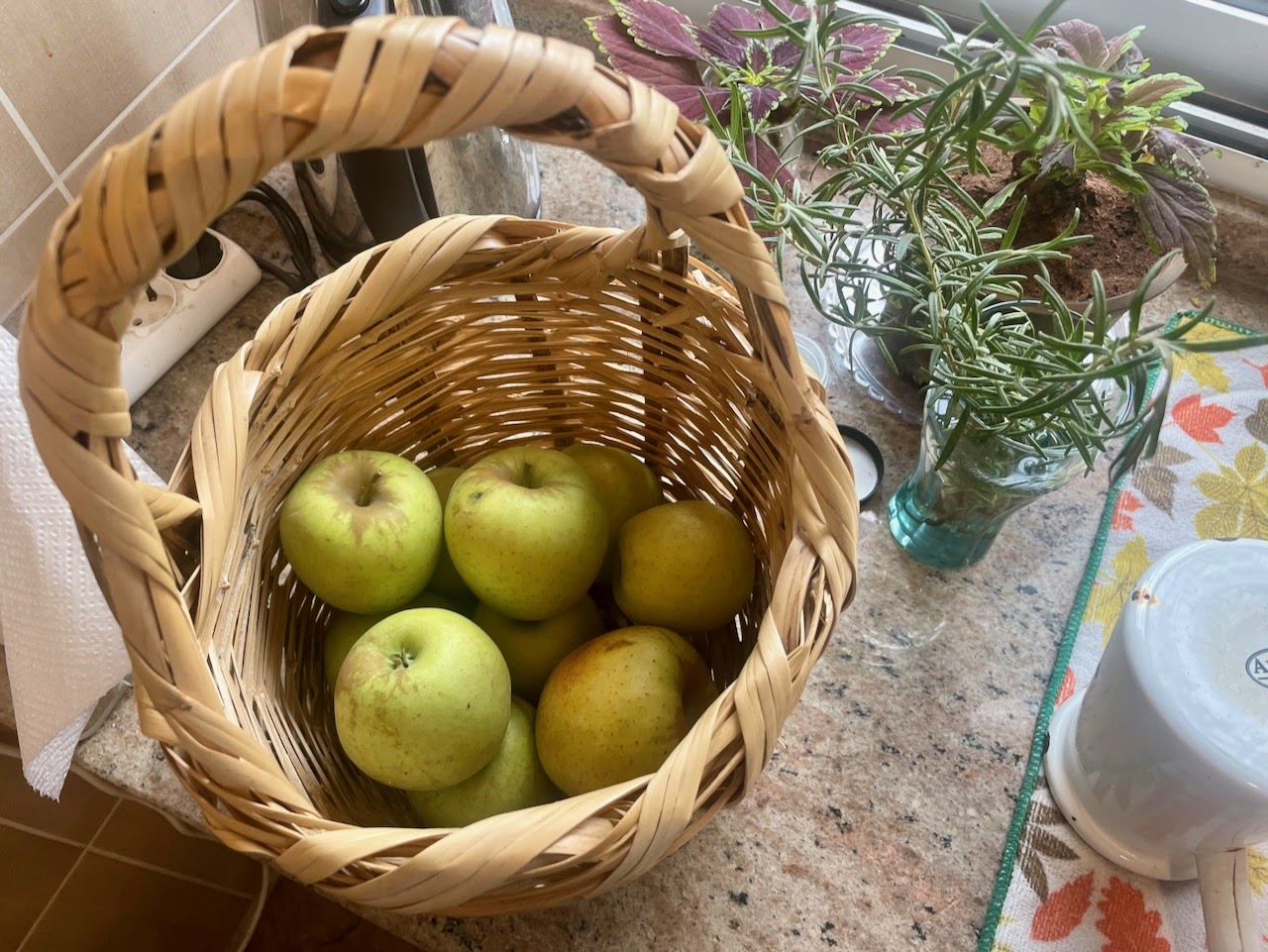
The last few apples from a half-crate
bequeathed to us (5 Oct. 2022 - Geitawi)

As the people await the outcome of deliberations to select yet another paragon of mediocrity, ineffectiveness and corruption to lead the country, and as Lebanese, young and old, meanwhile engage in their mindless mimicry of that most worthless and idiotic of American holidays, Halloween, my mind goes to things of slightly greater value in this autumnal season. That, of course, includes the beauty of the changing colors of deciduous trees, visible elsewhere in the country, but hard to find in Beirut, where any sort of tree is happily sacrificed for the sake of building empty concrete-and-steel structures (if you know the right people). In our previous home in the east coast of the U.S., we reveled in that yearly shift from greens to warm tones, deep reds and bright oranges and shimmering yellows that heralded the cooling weather. When we come across the smallest evidence of those colors in the countryside, we experience a moment of joy and wonder at God’s handiwork refreshing our eyes and spirits.

Clouds on the horizon, and the sun
illuminating the illegal landfill on the coast
(13 Oct. 2022 - towards Bourj Hammoud)
            Another aspect of this season, also connected to our previous life in the U.S., has to do with one of the quintessential gifts of the land in the fall, namely apples. They are plentiful in Lebanon, and are available in several varieties, from sweet to tart. Sadly, apple cider hasn’t really caught on, but apple vinegar is prepared in great quantities for a variety of uses. For whatever reason this year (I leave that to your deduction), the market for apples is glutted, and domestic apple production is a losing proposition. When visiting Ainjar recently, friends there said that they are leaving their apples on the trees – and the ground – because they cannot sell them, and therefore it is meaningless to harvest them. And then they gave us a huge bag of apples, just gathered that morning, to take back to Beirut to enjoy. Fresh. No chemicals. Delicious. And unsaleable.

The neighborhood transformed into a street
in Egypt for a movie filming
(30 Sept. 2022 - Geitawi)

            Last week, on one of my shopping trips (which I do by foot, since I can get some exercise that way), as I entered a nearby fruit stand, I noticed that a middle-aged woman was talking with the grocer about apples, their price, the varieties and so forth. Probably just another interested shopper, I assumed. Until I was leaving the shop and saw that she and the shopkeeper had walked over to her car, where the open trunk revealed crates and crates of apples… And she was continuing to talk about apples and negotiate a price for them. It bothered me, not just because of the reason for the glut of apples in Lebanon today, but also about the state of the “middle class” here, which has taken to driving around to neighborhood fruit stands to sell a bit of their homegrown produce. And to add to the inscrutability of the situation, the cost to the consumer is not dropping as it should, but rather continually increases. It’s not just the poor who are bearing the brunt of the self-serving “leaders” running this drama, but all strata of society. As my mother used to say when astonished at something, “How about them apples?”

The odor of burning garbage can't hide the
beauty of wedding flowers and the joy of
a wedding! (15 Oct. 2022 - Khalil Badawi)
            The irregularities of life here have become something of a routine. Strangely, the near-complete lack of municipal electricity – a total of about 10 hours for the entire month of October – has made life more predictable. We know that whatever the schedule is for our supplemental power (“ishtirak”), that is when we have power, amounting to a little under 12 hours per day. Since we live in the same building as my office, that adds another 4 hours on weekdays. So, sitting in the dark, or shaving in the dark, or doing my online Arabic lesson while I wait for the lights to come on, is just another feature of life in Lebanon. Add to that the irregularity of the office internet, which the provider cuts for anywhere from a half-hour to 3-1/2 hours during work hours, and one becomes inured to things that would cause major emotional upheaval anywhere in the “developed” world. Except perhaps with looming energy shortages this winter, the developed world will know how the other 90% of the world lives (statistic courtesy of me making it up).

It's a bit of a drive to get there, but
at last I've found some equipment
to start my exercise program
(2 Oct. 2022 - Sawfar)

            I have a human Arabic teacher who has an amazing command of the language, and an amazing amount of patience with me and my esoteric interests. Fortunately, as a schoolteacher she is aware of all of the classroom tricks that someone in his 60s tries to pull off and keeps me moving forward. It will soon be six years since we began our lives here, and although I have accumulated a fair amount of exposure to the language, gaining facility in Arabic for daily interactions remains a hill I need to climb. Doesn’t help that my job is conducted mostly in Armenian with some English. We’ve begun to focus exclusively on spoken “Lebanese”, which I expect will propel me up that hill.

            I also have a mechanical Arabic teacher. It’s an “app” on my devices, and it has more than a few quirks. Those quirks help me maintain my interest (292 days in a row and counting). I particularly like the mispronunciations that the developers haven’t bothered fixing. Things like “tabibbouleh” for “tabbouleh”, and “shishai” for “shai”, and the American city “Safanennah” instead of “Savannah”. I’ve even taken to pronouncing those words the same way!

LebCat 54: Keep walking and mind your own
business. I'm working for the security
company (3 Oct. 2022 - Geitawi)
           
And I continue to invoke my mother, especially when I see the insanity around us and the barbarity inflicted on Armenia and Artsakh while everyone is looking somewhere else, and the self- and other-inflicted miseries overtaking so many. Things like this may no longer amaze me, yet I can’t help but say, “How ’bout them apples...”   [LNB]

Wednesday, August 31, 2022

Powerless Living

52.Powerless Living (31 August 2022)

Demonstrations that closed the coastal road
on the second anniversary of the still-
uninvestigated and still-unpunished Beirut
Port blast (4 Aug. 2022 - Marfa' - Beirut)

From time to time, it almost seems as if it might be possible to get used to being without electricity every single night. I can entertain this fantasy thanks to the local generator subscription we have, which supplies us with enough power to cool our bedroom from evening until midnight, and then we can manage to sleep with just a battery-powered fan until around 4 a.m. As well, one can almost endure the powerless hours during the day, in between the times of generator supply. Almost. Because it’s not just the lights that are off for 12 of each 24-hour period, but everything gets interrupted, whether in your work life or your home life. A recent expat, living in some far-away, amazing land where there is electricity all the time (are there such places?), wrote to me yesterday: “We’re in an age where you can maybe live without lights, but not without internet.”

After two days of overflowing trash, it
seemed like a dream that collection had
resumed! And just a couple hours later:
magic! (30 Aug. 2022 - Geitawi)

            And so, today our internet access stopped. Dead. Completely. Landline phones, internet, whatever you would need to get through your workday. Striking workers? Lack of fuel? Something else? The reasons are myriad. The cellular system is (still) working, but who can afford to pay cell phone rates just to do a bit of online work or to communicate with colleagues locally or overseas? The key word here is “communication”, a common factor in all that doesn’t work in Lebanon, whether institutional or personal. Communication is what the powerful in any relationship and in any land attempt to keep within their control, and when possible, they communicate the particular version of events that they want people to think. Yet as the “powerless” in every land are increasingly able to take greater control of the story of their lives, they can communicate their stories to each other and to the outside world in a more complex, and truer, way. Except when there is no electricity. And no reliable internet. And no steady water supply. And no waste management And no government.. And hyperinflation. And no access to bank accounts. And…

After most of the grain silos collapsed this
month, a sign appeared: "No justice without
accountability" (28 Aug. 2022 - Marfa')
            One of the narratives the powerless in Lebanon are continually subjected to is how the government made this or that deal with this or that country to supply fuel to their environmentally-deadly power plants in order to add 3 or 4 more hours per day of electricity (up from 0 to 1 hours per day). And then they hear how there is this or that banking obstacle that came up. And then they hear that there is this or that infrastructure issue that came up. And then they hear that there is this or that political party that is preventing it from happening. And then they hear that the government doesn’t want to fall under American sanctions* by getting the wrong fuel from the wrong source that might pass through the wrong country. Meanwhile, threats of the country plunging into “complete darkness” continue to echo, though, as a news website recently noted, “those who have private generator subscriptions are unlikely to feel the effect of a state-wide blackout.”

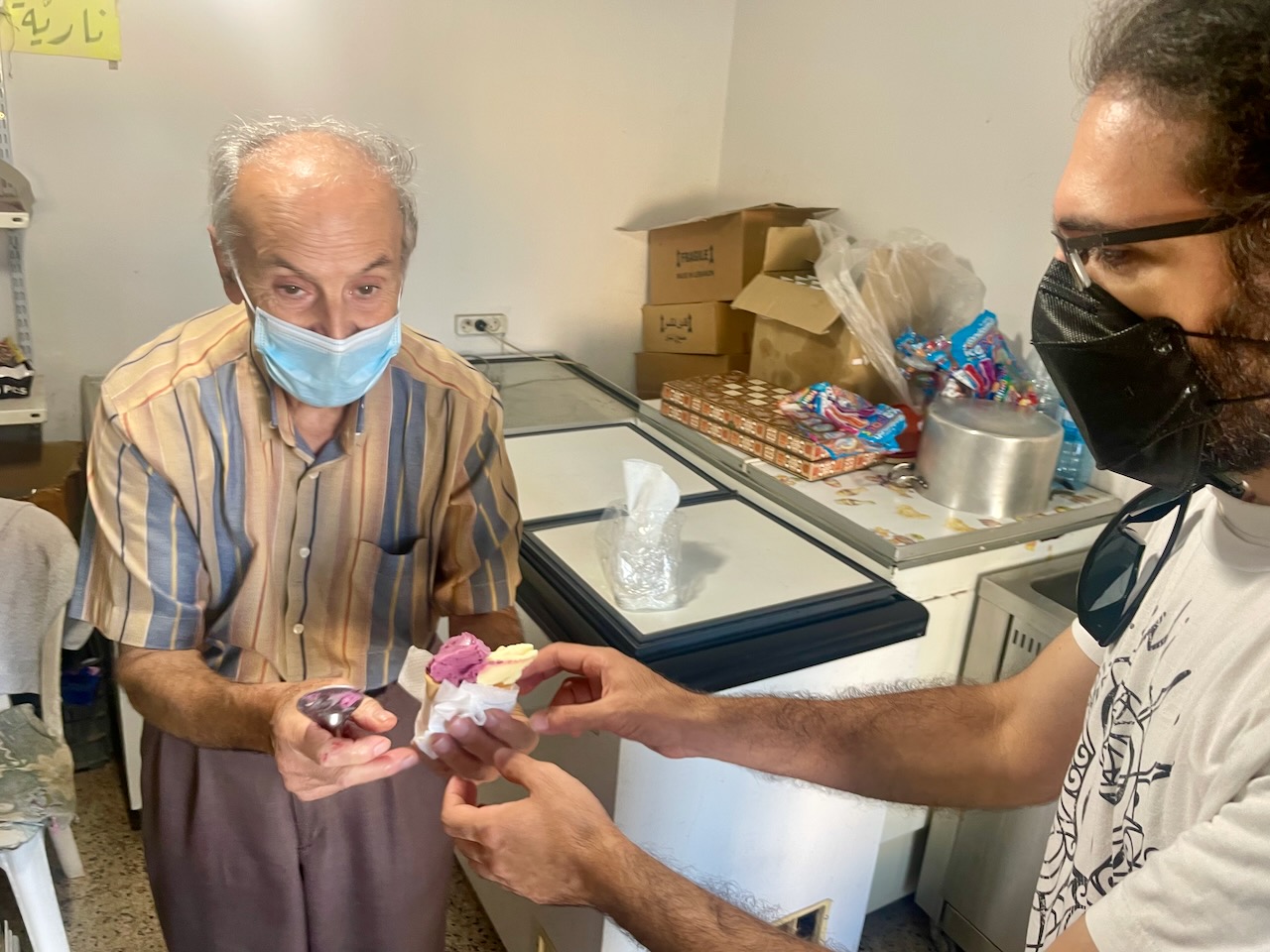
At what is possibly the best Arabic ice cream
spot in Lebanon. Says Sevag: "Excuse me,
photo is taken, please hand that over right
now." (26 July 2022 - Saghbine)


            There are many, many people here who are powerless to do anything but subsist without power. They cannot afford (as we can) to buy generator subscriptions to fill in the huge gaps in the municipal power supply. Their homes remain in the dark, and their refrigerators are useless, and their nutritional intake suffers, and their health declines, and their ability to obtain health care when they inevitably need it… vanishes. Meanwhile the young and resourceful continue leaching from the country, leaving their families and their heritage far behind…

            Yet amid all of this, today I was witness to an example of benevolent involvement in the struggles of Lebanon, as well as an intelligent grasp of the country’s needs. The Japanese Ambassador to Lebanon, H.E. Okubo Takeshi joined Lebanon’s Minister of Public Health, Firass Abiad, M.D., to dedicate equipment that the Japanese have donated to the Karagheusian Assn.’s Primary Healthcare Center in Bourj Hammoud. The Ambassador spoke of the commitment of his country to support the Lebanese people (making this important distinction in his words). Then Dr. Abiad, showing an unusual grasp (for someone in government) of the health care crisis in Lebanon, told the audience how the country for too long has invested large amounts in tertiary health care and ignored developing primary health care, thereby rendering basic health care unaffordable to people of modest means. He also described his plan to restructure the allotment of health care funds to the primary type. It was refreshing to hear someone with a vision, someone in a position of authority who is interested in improving what has been handed him, rather than blaming others for his lack of action.

Dr. Abiad addressing the audience, following
Amb. Okubo's speech  (31 Aug. 2022 -
Nor Marash - Bourj Hammoud)
            Before the program, when the Ambassador arrived and was being introduced to the clergy, I got to greet him with the phrase I had been coached on and had been practicing for a whole day, including in my sleep the previous night. “Kakka, oai dekite kouei desu.” It is a most unfortunate coincidence that this phrase begins with a word that in Japanese means “Your Excellency”, but in most of the languages I know means something quite different. The important thing is that the Ambassador understood my stumbling Japanese, “Your Excellency, it is an honor to meet you,” and responded in English with, “Very pleased to meet you, also.” The other important thing is that no one else who heard my greeting reprimanded me for saying an indelicate word to the Ambassador.

LebCat 52: "Wait, is that... a pig flying? Oh,
yes, this is Lebanon!" (31 Aug. 2022 -
Nor Marash - Bourj Hammoud)
            One of the famous Japanese sayings invoked today was “Fall down seven times, get up eight.” What more appropriate way is there than this, to think about how the powerless in this world can persevere and continue their struggle. My mind especially goes to the One who was beaten down, but rose again, he who is ever on the side of the downtrodden, Christ Jesus. He was considered powerless in the eyes of the world, but his purported “weakness” was wrongly estimated by those in power. His victory over death, and his promised Coming, are the basis for hope of all those under the weight of personal or societal failure. He is the One keeping us going, especially when the lack of power – or vision – looms large around us, whether here, in Armenia, or anywhere.

            And yes, we still cheer like Santa Claus just showed up whenever the power comes back on!   [LNB]


(*The country that does its utmost to prevent foreign meddling… by doing what they don’t want other countries doing.)


Sunday, July 31, 2022

The Land That Honor Forgot

51.The Land That Honor Forgot (31 July 2022)

Kindergarten graduation is a big deal here!
(17 June 2022 - Nor Marash)


A couple of weeks ago, as I was leading the washing-machine repairman up the steps in complete darkness, the tiny lights of our cell phones revealing the steps before us, I apologized that, after a long day of work, I had to make him walk the steps and not take the elevator. Deflecting my apology, in Arabic (and some broken Armenian, as he used to work in Bourj Hammoud) he said, “Haram, Beirut, haram that such a beautiful city as you is like this, haram!”

            “Haram” means “shame”. And supposedly the Middle East is one of the many regions throughout the world that operates around an “honor/shame” culture, something the West has great trouble grasping. Not that the West doesn’t use the term “shame”; it does, but only when attempting to shame others, and no longer as a means of self-examination or personal reform. Here, shame is part and parcel of each day, and especially in today's Lebanon, with the abundance of shameful situations. Yet although so much is shameful, those responsible for engineering this state of affairs over the years have no sense of shame… and therefore no honor.

The "Cine Vendome" steps have been
upgraded to include a playground!
(24 June 2022 - Mar Mikhael)

            As Maria, Sevag and I were driving on a “highway” through an agricultural region last week, we happened upon a two-vehicle accident, possibly a head-on collision or a side-swipe. Scattered across the road were bits of produce and wooden crates, and sprawled on the shoulder were women and men in their colorful garb, being attended to by paramedics next to a Red Cross ambulance. Men standing around were not helping traffic to get past the scene, as car after car slowed down to see what was going on, and even to chat with those on both sides of the road. What a shame to see these agricultural workers – not Lebanese, of course – who had a short while earlier been crammed into these vehicles to take them back to their camp after a day’s work. Who feels compassion for these injured women and men, even though there would be no produce in the markets if they weren’t out in the sun each day tending the fields?

Traffic jam on the Stepanavan-Vanatzor
roadway. (8 July 2022 - Armenia)

            Earlier, when driving in the other direction on this same road, we happened upon another traffic jam. There seemed to be no reason for it in such a small town, until we saw a bakery outlet with a couple hundred people in front and across the road from it, anxiously waiting for a delivery of Arabic bread. Why was there a “bread crisis”? Because the legislature was discussing the terms of international funding to enable Lebanon to buy wheat, and how much it should cost, and whether wheat subsidies should be lifted. While these men (only a handful of hardy women dare to serve in the parliament) were debating, the people were panicking, experiencing the shame of having to wait in line for bread, when their leaders have absolutely no food worries.

"Mer Shougan" (Our Market) on Arax Street,
to promote the home-based products of
Lebanese-Armenians
(10 July 2022 - Bourj Hammoud)

            And to add more shame to this scene, the army and police had to intervene to keep the order at this and so many other bakeries. Men on this side, women on that. Lebanese in this line, Syrians stand over there. Accusations intensify about who is buying up the stocks of subsidized bread to sell at twice the legal price to people who have no choice but to pay that amount, about who is smuggling bread out of the country to sell elsewhere, just as subsidized medicines are hoarded and sold in countries far from Lebanon.

            These God-given sensitivities – shame and honor – have often been misused when they are detached from personal conscience and used as weapons for controlling others. But in our current situation they are merely a veneer of words used by the powerful, devoid of meaning or effect, papering over the corruption within. John the Baptist (Matt. 3.7-12) and later Jesus Christ (Matt. 12.34-37), when confronting the corruption of their day, challenged the powerful to change direction or else face relentless justice from the God they no longer feared. Honor needs to be seen in honorable actions, not just in long-winded speeches or televised soundbites.

Facing the explosion site, memorials to
those killed in the Beirut Port blast
of 2020 (photo by SAB - 30 July 2022)
   As if fatigued from the hypocrisy and mendacity swirling around the abortive investigation of the Beirut Port Explosion of August 4, 2020, today part of the damaged grain silos collapsed in a plume of dust, debris and fungus from the fermenting grain within. These fifty-year-old silos, which held nearly the entire grain reserves of the country, are among the heroes of that unforgettable day. Their structural integrity shielded half of the city from destruction. Though inanimate, they hold a place of honor alongside the heroic first responders who were cut down on that summer evening; a level of honor that those who were sworn to protect and lead the country will never achieve – save for their total, systemic and true repentance.

            We’re finding ourselves approaching our refrigerator with trepidation, since the power (from all three sources) is off more than it is on in these hot and humid days. It used to be that stocking up the freezer and putting leftovers in the fridge put our minds at ease for coming busy days. Now we play the game “What’s That Smell?” when we open the fridge. Good smell? Thumbs up. Bad smell? To quote my college roommate’s slogan, “When in doubt, throw it out.”

            Maria and I had our first bout of CoVID-19 last month, as we were preparing to receive our son Sevag and then travel to Armenia together. See plans, apply wrench. After the readjusted Armenia trip concluded and we returned to Lebanon, Sevag had his first bout of the disease. We were grateful that we didn’t have any loss of smell or taste (refer to preceding paragraph). And grateful that we were able to provide him with at-home care.

LebCat 51: "It's simple: you climb up this
grapevine, push one of those switches down,
and then someone comes out to his balcony
and starts yelling. You meow and he throws
you a treat when he comes down to switch it
back on." (24 June 2022 - Geitawi)

            Sadly, I am getting less exercise, after realizing that the circuit breaker for our supplemental electricity could be relocated right outside our apartment door (refer to my Jan. 2022 blog) and not down a bunch of stairs and out at the end of the street. Now they easiest thing in the world is to make a mistake by turning on the hot water tank or flushing the toilet, and then saying, with a smile, “Oh well, no problem!” and just open the front door and flip the switch back on. Talk about living in the lap of luxury!

            What concerns me the most is that those among whom I work – Armenians and Lebanese – will lose their sensitivity to the tools God gives to keep their consciences alive. The poisonous examples are so very prevalent, and only with divine help and concerted mutual support will we avoid this plague, this collective degradation – whether in Armenia, in the Diaspora, or here.   [LNB]

Saturday, May 28, 2022

Living in DIY-land

50.Living in DIY-land (28 May 2022)


A panel here, a panel there, and Nejmeh
Square is proclaimed "open"...
(26 May 2022 - Beirut)

           In most places in the world, people pride themselves on their DIY (do-it-yourself) skills and experience. Why have other people build or fix things, when you can do it yourself? And you get a greater appreciation for how things work, and the confidence that comes from knowing that the quality of the work is up to your personal standards. Of course, this is a “first-world” issue, because in much – if not most – of the world there is no alternative to doing it yourself. It’s like those who go to the gym to stay in good physical shape because they no longer move, bend, lift, pull, push or sweat as part of their days work… contrasted with the rest of the world whose survival depends on their physical engagement with every aspect of their lives.

The elections came, and the elections went,
and now everyone waits to see what's next.
(14 May 2022 - Geitawi, Beirut)
            And then there’s Lebanon. I need to be circumspect about this because I signed a paper promising that I would only say nice things about Lebanon. This is a DIY society for very different reasons than the two categories mentioned above. People do a myriad of things themselves because either the function in question was never done by the authorities, or because the functions have stopped functioning, and now it’s up to you to do things like store your own money, or generate your own electricity, or import your own medicines, or provide security for your family, and so on. And if you examine the extensive network of services for the refugee population (probably a quarter of the total population), you will find networks of aid agencies, each with its particular emphasis. Essentially, today’s population is living in DIY-land.

It's amazing; every day it fills up, and every
night it gets emptied! What manner of sorcery
is this? (16 May 2022 - Geitawi, Beirut)

            There are also many functions that were never done by the state, which explains why there are so many organizations identifiable by a particular socio-religious coloring. Let’s keep in mind that this was a “gift” left by France as it ended its mandate over Lebanon in 1943; namely to create a government consisting not of capable citizens, but of mandated religious representatives, in order to make it as difficult as possible for any one group to have authority over another. Or that was the plan, anyway. It ended up being a wide gate to nepotism and cronyism, and public service jobs are bloated by people getting paid to fill quotas, not to provide services. It also made each religious grouping look out for its own, reinforcing people’s view that only one’s own group will look out for them.

Anyone want to take some for DIY crowd
control? (26 May 2022 - Beirut)

            And so each socio-religious community has its own old age home (Armenians have CAHL) and other hospital services (Armenians have the Armenian Sanatorium, and Armenian Evangelicals used to have the Christian Medical Center – housed in the building where we now live). Armenians as well as others have an assortment of relief and socio-medical centers catering mostly to their own groups. They each have their network of parochial schools and institutions of higher education. They have their own press, and their own television and radio stations. They also have their own demographic regions, though in the pre-civil war days there was more admixture between groups, blurring those lines a bit. There is not much one can point to and say, “This is for all.”

DIY noise control by the unfortunate residents
of the boisterous (until 4 a.m.) pub street, "rue
Armenie". (26 May 2022 - Mar Mikhael, Beirut)
            So, the parliamentary elections came and went. And there were small shifts in power bases, including some disorganized “revolution” people. But few are expecting significant changes. In an act of low drama, the outgoing (who is also the incoming) speaker “approved” the removal of metal and concrete barriers that have surrounded the parliament since the uprising began 2-1/2 years ago, as if to herald a new day of openness and prosperity for Lebanon and its capital city – supervised by the old guard. This, as the simple majority of hungry and unemployed citizens (and others) turns into an overwhelming majority. And as the currency continues its death-dive, something that economic experts consider to have no economic basis for occurring, only political. And as those who impoverished Lebanon continue to claim to be her saviors.

Preparing KCHAG for energy independence.
(22 May 2022 - Monteverde)

            In recent days government officials have continued to express the DIY-ness of today’s Lebanon. Some obscure decision was taken by the Central Bank, and the currency magically improved. A new electronic platform was released for shoppers to report price-gouging at supermarkets. Bank heads are advising people not to keep their cash under a single mattress, but to spread it out throughout all their bedrooms. Governmental security heads are warning people to keep their valuables in various places, and not just in one old purse in the back of a closet. The population has gradually resigned itself to the permanent absence of municipal electricity and the ever-increasing cost of diesel fuel running the DIY generators (called “ishtirak” – see Jan. 2022 blog: “Power-Hungry”) in each neighborhood, so that throughout the country solar panel installations are sprouting up, raising the hopes of some that they will be able to live somewhat “normally”.

The ultimate in DIY-ing:
a flea market! (26 May 2022 -
Nor Hadjin, Beirut)
            Surveying such rough terrain, in which the country’s DIY-ers live either with endless discouragement or self-delusion, or alternate between the two, the points of light are challenging to discern. More than any other place, I see them among teachers and others who express a heartfelt commitment to serve others. In the case of teachers, there are some so discouraged that they can no longer give what a teacher must give and a student must have. But there are many others who continue to challenge their students to think and grow, facing not just the negativity of students who say, “What’s the use?” but also that of the discouraged parents who transmit their hopelessness to their children. Once the complaint was about the ”burden” of the Armenian curriculum; now the entire curriculum is often questioned by those who only want to find a way out of their misery. Teachers are the front-line workers, who should be given standing ovations at the end of every school day, for continuing to believe in the future of the children they educate, and especially for those teachers who continue to believe in the importance of an Armenian education (a topic for another time).

LebCat 50: "If you want to run a store the
right way, you have to do it yourself!"
(17 Mar. 2022 - Geitawi, Beirut)
            Along with teachers being front-line, essential personnel, there are also those committed to serving others, whether in health care, or social work, or ministry, or even just being a good neighbor, keeping an eye out for those whom they see silently suffering. They, too, should be regularly applauded and encouraged. A doctor recently told me, “I should thank the country for teaching me how to prepare for a retirement without any money!” But he and so many others continue to use their skills and their hearts to help those around them. Lebanon is the ideal place to come and learn what it means to serve others, and to receive your reward from the One who came not to be served, but to serve. Though it is easy to slip into discouragement ourselves, Maria and I try our best to be encouragers. This is not a DIY job, because we don’t have the resources to last. Surrounding us there is the church, whose members rely on the prayers of many and renewal from above. And there is Christ, who Did It Himself, going through all of this, and more, to bring light out of the darkness!   [LNB]