Showing posts with label Armenian Genocide. Show all posts

Monday, November 11, 2024

Who Are You Fooling

64. Who Are You Fooling? (11 November 2024)

A side street in autumnal Beirut
(4 Nov. 2024 - Gemmayzeh)

We’ve been telling people, “We will only be gone for four months,” as we prepare for our mandated “home assignment.” We’re going to the U.S. to have meetings and travel around to talk about our work, as well as to have our term agreement renewed. This was all supposed to happen next summer, but as Lebanon’s stability and safety became more questionable, and as Israel spread more and more misery around, our supporting bodies moved that four-month excursion to a fairly immediate departure, just four days from now. When we say to our colleagues and friends, “We’ll be back in four months,” are we fooling anyone with this hopeful but uncertain declaration? Who knows what monstrosities are yet to be perpetrated on peoples indigenous to the region, with the bloody complicity of the government of “the land of the free and the home of the brave”? Who are we fooling except ourselves?

Even Lebanon's cargo holders are painfully
crying "Akh!" (20 Oct. 2024 - Yerevan)

            Genocide, or “ethnic cleansing”, or “ensuring our security”, or the legion of other names assigned to it is so commonplace that we are no longer repulsed by the word – except when you are the one promulgating this policy. Exterminating those in the way of your expansionist designs is acceptable practice around the world, whether by Israel or Azerbaijan or Turkey (the ones that most immediately impact me as an Armenian, also linked together by their cooperative genocidal efforts). Brutality obliterates morality, and all the hand-wringing in the world will not protect the rescuers and witnesses trying to bring a modicum of humanity to this misery. As Israel targets hospitals, ambulances and journalists, and laughingly destroys families and lands, and as Azerbaijan (with Israeli technology) and Turkey destroy Armenian architectural heritage, convert churches to mosques or lying about their origin, they prepare themselves to richly receive the wrath of God (see Romans 1).

Political parties marking out their
territory, just like it was... 50 years ago.
(11 Nov. 2024 - Geitawi)

            Also puzzling are the regular announcements of an imminent cease-fire, an imminent end to hostilities in Gaza, the West Bank and Lebanon. Is the intent to fool a gullible public somewhere in the world? Or to raise hopes among those subjected to this sub-humanity, so as to shatter those hopes completely? Depending on who you talk to, this war will either be over in a couple of weeks, or will continue until Lebanon is also annexed and ceases to exist except on 20th century maps.

            What causes me the most pain is seeing the long-term effects of this attack on Lebanon and the impotence or unwillingness to confront it, particularly as it relates to inter-communal relations. Apparently one of the aims of this war is to create internecine strife, pitting one community or demographic against another, trading blame, scapegoating, and so forth. It’s the “divide-and-conquer” approach of any occupying power throughout history.

Hopefully these children will be
just as enthusiastic about
actually reading.
(25 Oct. 2024 - Yerevan)

            Coming to an even more personal level, the wartime conditions further threaten and weaken the Armenian community of the country and region, and therefore the church, moreso than it already was last fall. Rather than us thinking ahead and building towards a more healthy and stable society, we are witnesses to the dismantling of what has been built for the last century. The saddest of all is the dismantling of families. Armenian parents actively encouraging their children to emigrate. Armenians with dual nationalities permanently, not temporarily, relocating. Skyrocketing numbers of divorces among Armenians. Rampant substance abuse, physical, sexual and mental abuse, wasting of income on legal and non-sanctioned gambling.

            Those of us in positions of responsibility must now focus on disasters at the expense of other non-urgent but important issues. Recalling the post-Genocide period, when the Armenian people were subject to similar stresses, the people in leadership intentionally looked at the community’s long-term needs and urgencies, not just immediate relief work, and built a legacy that endures till today. In this crisis if we must find a way not only to ameliorating people’s suffering from the war, but moreso to plan with faith for the future of what is the most important center of the Armenian Diaspora. Without visioning and planning we are only fooling ourselves into thinking that this community will continue its existence.

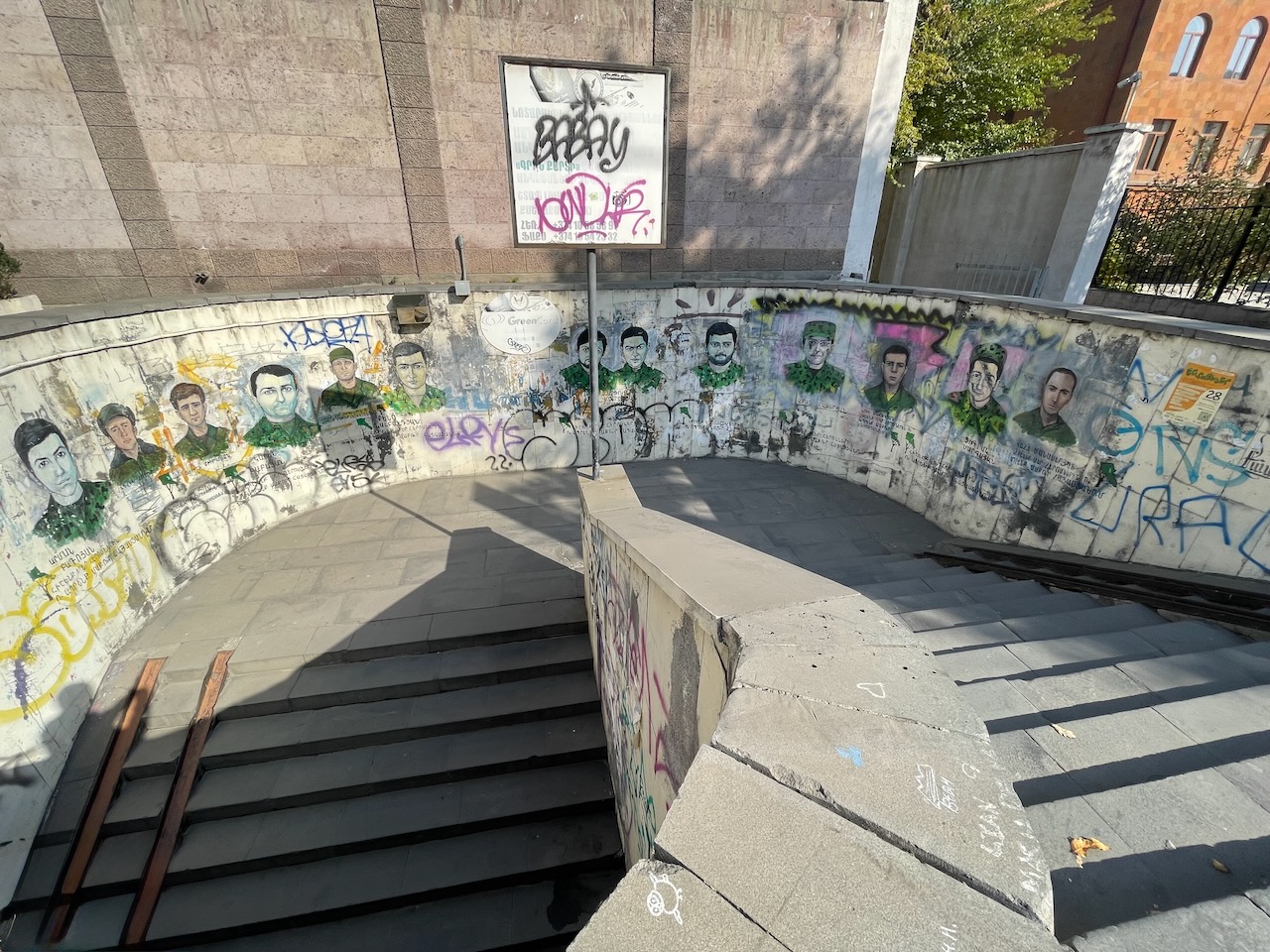
The faces and names of soldiers who fought
and died in the Artsakh war and
deportation, graffitied all over
the capital. (2 Nov. 2024 - Yerevan)
            One cannot help but feel a change in the capital, after the influx of a million internally displaced people on top of the three million residents of the metro area. Cars parked everywhere. Unfamiliar faces and dress. Arguments, fights and much worse over “squatters rights”. Generators catching fire from overloads while municipal electricity is scarcely supplied. The diffidence of what few police and army personnel are still visible. If Lebanon was a DIY country (see my previous post), then this is a DIY war, where the population is left alone to figure things out and survive by their own wits or connections, while bosses continue their decades old, self-serving political wrangling as usual.
            And when the war inevitably ends, what then? Will things magically return to their previous state, and people effortlessly drift back to their flattened villages? Will massacred families and clans magically reappear and reclaim their birthright? How much can one country fool itself? I say “one country”, although Lebanon is not really one country but an amalgam of tribes living within one political boundary. The building and rebuilding of society and the development of a healthy social contract where none are marginalized is one of the greatest challenges facing Lebanon in the coming decades, and is something that has been waiting to be addressed for its entire history.

LebCat 64: Intensely focused on birds
flying around... and certainly aware that
it is only a reflection? But they're so close!
(9 Nov. 2024 - Bourj Hammoud)

            Meanwhile, our friends’ faces bear fearful and questioning looks when we tell them about our change in plans. “You must know something, that’s why you’re going,” they say outright or imply non-verbally. Try as we may, we are unable to assure them that we have no insider knowledge about what is to come, something that contradicts their doubts concerning why we are leaving now instead of later. We cannot fool them into thinking otherwise, nor do we want to. And we hope we are not the fools, either. Only through hope in God can we look forward to their fears being disproved.

            So, without any self-deception, but with faith and hope we lovingly say that in four months we will be willing and able to return and continue our part in that work, “with God’s permission”, as the Arabic saying goes (“bi’izn Allah”).   [LNB]


Sunday, April 30, 2023

Hesaid-Shesaid Disease

58. Hesaid-Shesaid Disease (30 April 2023)

It's springtime, and the Mediterranean is not
too cold for a swim. (2 Apr. 2023 - AUB, Beirut)

Supermarkets in the U.S. have (or used to have) bulletin boards near the entrance, a place to post community activity announcements, job advertisements, lost dog posters, Fire Prevention Week fliers, you name it. Occasionally I would notice someone standing and examining each notice; but usually these bulletin boards were merely something to pass on your way out or your way into the store. Now, times have changed, and the bulletin board as well as its relative, the newspaper gossip column, have transformed into a new, electronic format, eagerly consumed by people the world over.

Lake Laziza – stagnant waters
collecting in the site of yet another
useless construction project.
(27 Mar. 2023 - Mar Mikhael)

            Social media platforms guide the thinking of so many people, young and old. Sometimes it guides its users to access well-thought-out writings about important issues or events. Often it entices us into habits that divert us from looking deeply or critically into topics. I would propose that our God-given minds and consciences are also “platforms” to help us consider what is true, or beautiful, or healthy, as well as what is “good, acceptable and perfect” (cf. Romans 12.2). The condition of today’s “marketplace of ideas” – a condition that predates the Internet – swarms with lies and half-truths, as well as with vested interests, mixed together with Truth. Separating the worthwhile from the worthless is akin to trying to separate the ingredients of a tabbouleh salad once it is mixed.

            But effort must be spent in separating the good and bad, no matter how painstaking the task. The discipline of deep thinking, including research and debate, is crucial to avoiding a relativism, antagonism and shallowness. And it is a rare, perhaps endangered, species.

Another sign of spring, high in the mountains
of Lebanon (10 Mar. 2023 - Azzounieh)

            At one time newspapers and periodicals bristled with the pointed tips of journalistic and academic inquiry. They played an essential role in in piercing shells of deceit and kept the “He said-She said Disease”, so prevalent in partisan and entertainment “news”. It pushed back the waves of mendacity of the powerful, and challenged vested interests. Where there should be courageous truth-telling, too often news reports are filled with “he said this, but, on the other hand, she said that”. A shrug of the shoulders, and on to the next story.

             And this is why April is the bitterest month for Armenians. They suffer from the “Hesaid-Shesaid Disease” that runs rampant in popular and populist media. Their just cause, and the unacknowledged and unpunished crime against them, has been turned into a target of the propaganda war by those responsible – the governments of Turkey and Azerbaijan. The Armenian nation, in its struggling Eastern portion, and its exiled Western portion, has been seated at a table replete with impotent statements of sympathy from world powers demonstrating their prowess in verbal gymnastics.

And this is why we now have 24-hour
electricity. And a working elevator.
(6 Apr. 2023 - Geitawi, Beirut)

           Caught in such a worldwide web as this, it is no wonder that militant groups have emerged from among all subjugated people groups, and not just from Armenians. Those who are silenced or sidelined from public forums can often see no other way than this: to force the powerful to pay attention to (and sometimes feel on their own skin) the injustices that are freely roaming the streets of every city and country, easily ignored by an otherwise occupied public. Sadly, the chronic disenfranchisement of such people groups leads to their disarray, dismemberment and dissolution, something widely observed among my people. 

        Allowing “Hesaid-Shesaid Disease” to spread unchecked may be intentional. It enables genocidal regimes to bend the wills of “great powers” who don’t want to endanger their access to resources. It allows Turkey and Azerbaijan to declare historic Armenian lands and culture as its own. It emboldens them to claim that Armenia and Armenians never existed. It gives them a green light to persist in their genocidal policies, both “soft genocide” and “hard genocide”. It gives credence to Hitler’s dismissal of concerns over his genocide against the Polish people, telling his generals in 1939 to abandon their humanitarian scruples: “Who speaks nowadays of the annihilation of the Armenians?”

Armenian scouts headed to their Saturday
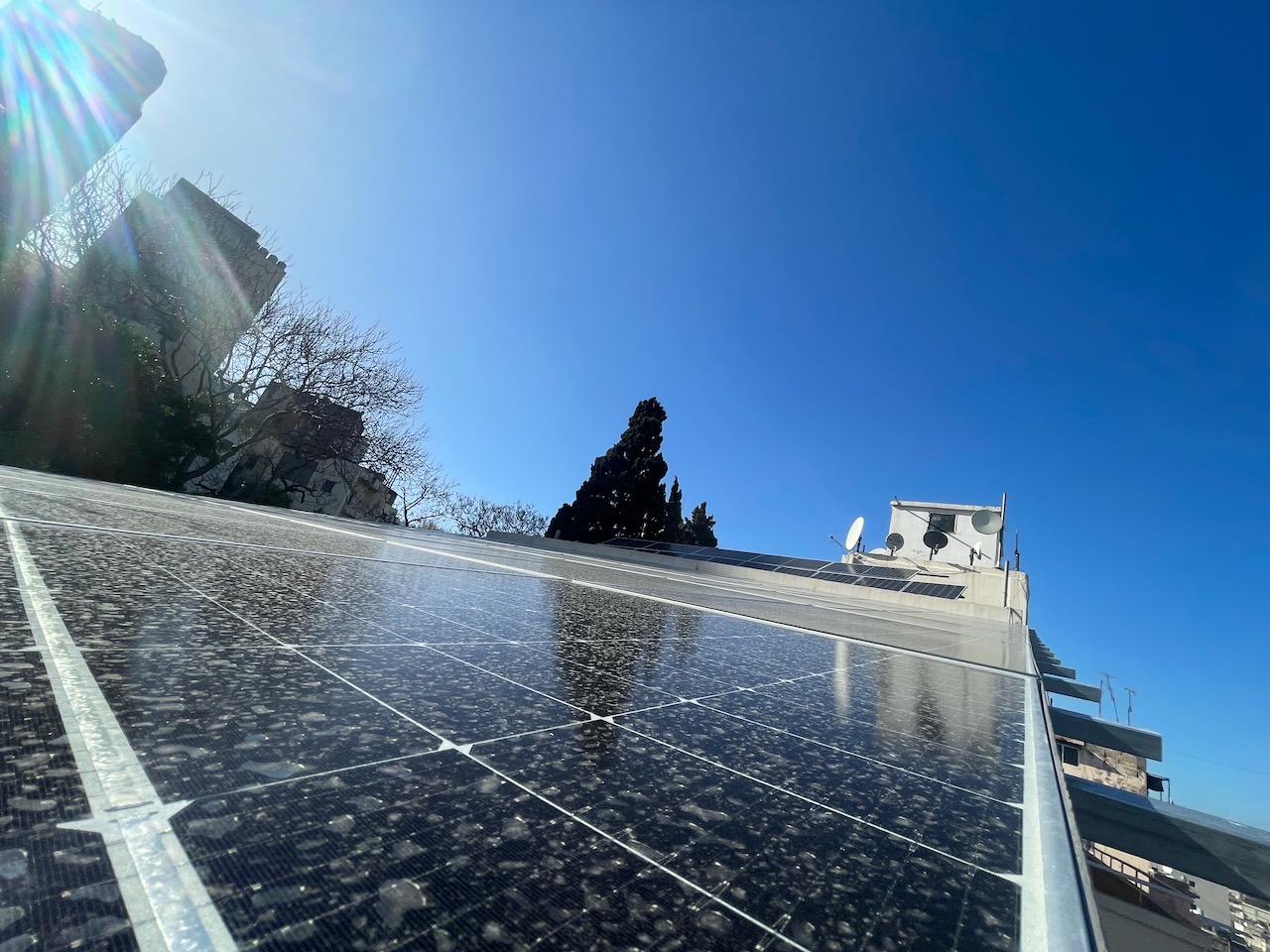
meeting, while street lights are being
replaced with solar-powered LED fixtures.
(15 Apr. 2023 - Khalil Bedawi, Beirut)

            The disease has no cure. It is as old as the dialogue between Adam and God in the Garden of Eden (cf. Genesis 3.9-13) and ingrained within the human heart. Although it cannot be eradicated, it can – and must – be kept at bay. As mentioned earlier, deep and rigorous thinking is one of the necessary treatment regimens. Another is careful and considerate listening, something that takes time and commitment. And time is one of the casualties of the information/entertainment glut engulfing the world. The third treatment is to “make love your aim” or to “follow the way of love” (cf. I Corinthians 14.1). Loving others as yourself. Loving the truth. Loving (including a fear of) God. 

LebCat 58 - Not sure how I got into this
building (UAECNE HQ). Could you provide
me with an escape route? Please?
(26 Mar. 2023 - Geitawi, Beirut)
                            April 24th – Armenian Genocide Remembrance Day – has come and gone, with various and sundry observances here in Lebanon and in many places throughout the world. It was noted by the diseased as well. The governor of Istanbul forbade its observance for the second year in a row. Azerbaijan increased its propaganda about the nefarious designs of the Armenian government, and intensified its military aggression against Armenia and Artsakh. Therefore, I have no choice but to do my part to combat this disease with faith in God, for the sake of my descendants and the inheritance of their rightful legacy.   [LNB]

Tuesday, February 28, 2023

Dead Foxes

57. Dead Foxes (28 February 2023)

Commemorating 35 years since Azerbaijan
began targeting Armenians for
extermination. (26 Feb. 2023 - Beirut)

Earlier this month, while driving along the coastal highway, I slowed down behind a line of cars and trucks exiting and noticed an animal lying alongside the roadway, obviously dead. From a distance I could tell it was too large to be a cat, too small to be a dog, and my guess was confirmed as I slowly crept alongside… a red fox. I was happy and sad at the same time; happy that there is still wildlife in this overbuilt metro area, and sad that it met this fate. I realize that those in rural places might not share my dismay, considering the losses they may incur because of foxes. Here this death is sadly poignant. While actual foxes become road kill, human foxes are left alive. And the “fox hunters” trying to pursue this latter kind are systematically eliminated, and the foxes pretending to be humans continue their sadistic rule over the henhouse.

Empty since the port blast, Lebanon's electric
company building - gutted, just like the service
it provides (20 Feb. 2023 - Mar Mikhael-Beirut)

            One of the more insidious of that species is now facing a “natural disaster” of his own making. Over the years he granted waivers for poorly constructed housing in exchange for ballot-box loyalty, so that he could establish full political control. That narcissism transformed the tragedy of this region’s February 6 earthquake into an unmitigated disaster. Will he be held accountable for the crimes he is now heaping upon the corrupt lower-level operatives? Not if the spin doctors around him can do their psyops job well, and transform this fox’s image into, let’s say, that of a pussy-cat. A devout, embattled fighter for the rights of the ordinary citizen. A strong leader his country needs to rebuild it and make it proud. Any of a raft of addictive lies that people in so many lands believe, sad to say.
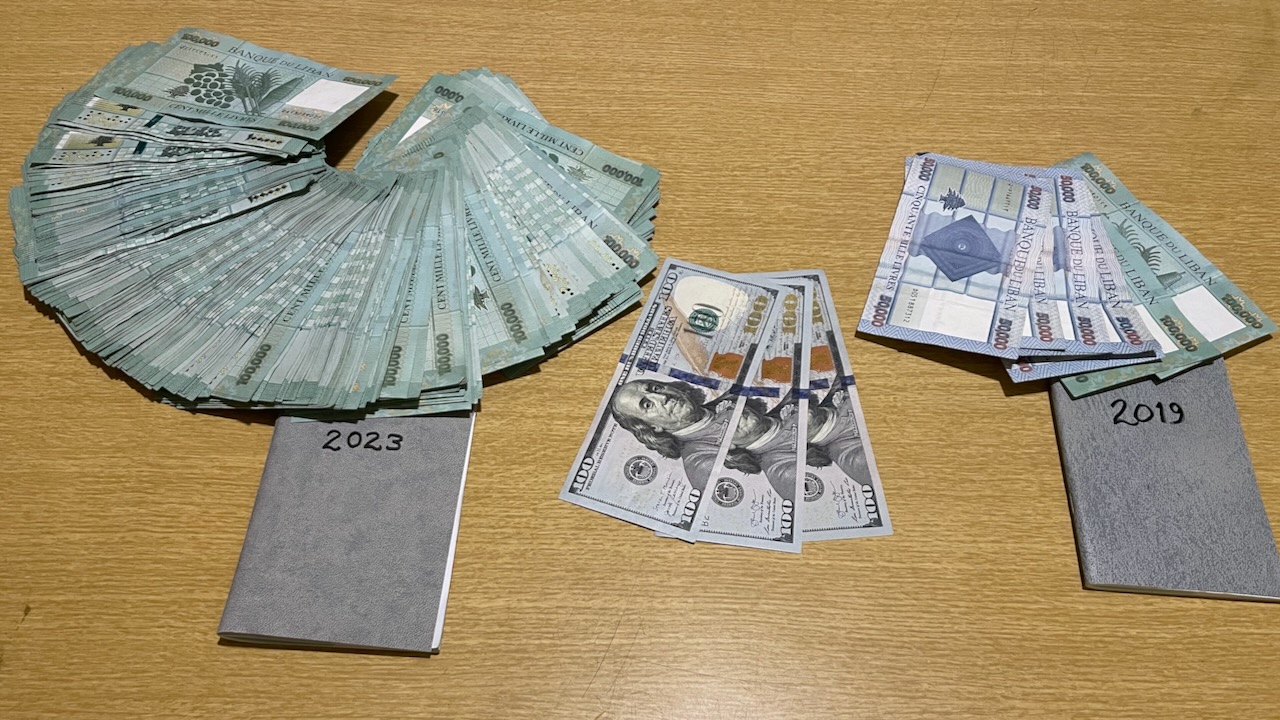
The value of $300 in local currency, in
2019 (right) and 2023 (27 Feb. 2023 - Beirut)


Meanwhile, others try to dodge the traffic that would run them over and put an end to their positive impact. Though contributing to the betterment of society, and though they are not the ones able to cause a fundamental, systemic change in the status quo, yet their activity is nonetheless significant in the long term. Unlike the wealthy foxes who continue to find ways to launder their money or sink it into building more empty buildings in the capital, they are a different sort of investor. They sink their time and effort into human capital; into teaching students to think, into inculcating character and faith into young people, into creating cultural riches to feed the souls of generations yet unborn. The anniversaries of the region’s Armenian institutions (churches, schools and so forth) are reminders of the deep investment our forebears made to rebuild and sustain a broken nation after the Genocide, making the Middle East’s Armenian communities the powerhouse of the Diaspora. And it continues to serve in that capacity, feeding and nurturing Armenian identity but with a frighteningly small number of visionary laborers engaged in this crucial work.

As spring approaches, tree branches and
neighborhood generators begin to
sprout offshoots
(27 Feb. 2023 - Bourj Hammoud)

            Who are they? First of all, they are teachers of all subjects and in all manners. Especially focusing on language, history and culture, they might be using state-of-the-art methods and materials, or they might be solidly stuck in the 19th century in their approach, but at least they are making an effort. Others who develop new, relevant materials for various grade and knowledge levels are also part of that army, along with those who digitize existing materials (a special shout-out to the Armenian National Library in this regard). Then there is anyone making a difference in just one child’s or adult’s awareness or self-awareness of his (or her) identity as an Armenian. I would also include “influencers”, who know how to make effective use of information media and place it or disseminate it in easy-to-find locations. Really, in our world so full of foxes, all Armenians should be engaged in this effort on the micro or macro scale, and spend less time self-absorbed in things that do not satisfy (see Isaiah 55.1-2) or edify, such as self-promotion on social media platforms.

A reminder to continue being visionary,
despite it all
(28 Feb. 2023 - Gemmayzeh-Beirut)

            I’ve noticed that Armenians (myself included) tend to put things in life-or-death terms; maybe it is because Armenians, like nearly all minorities, face life-or-death realities much more frequently than majority populations. Majority populations and those intent on a homogenized, globalized mono-culture, tend to object to this existential angst, seeing it as unnecessary (which it isn’t) or disruptive (which it must be). The angst felt among Armenians here in the Middle East is because they are battered and dishonored, treated as collateral damage by the major foxes and their sub-foxes who play at political and financial war. As it was a century ago, so it is today. Enabled by a disengaged international community, foxes circle around Armenia and Artsakh, drooling over the thought of ruling over an emptied henhouse, expertly using propaganda, lies, threats and a sham “protest” to lay hold of the remainder of the Armenian homeland devoid of Armenians.

LebCat 57: Hard at work receiving phone bill
payments. This may explain a few things about
the system. (28 Feb. 2023 -
Geitawi-Beirut)
            When the Lord Jesus faced off against the oppression his people were bearing, he dared call the ruler of that day a “fox” (Lk. 13.32). It was a calculated, public insult, and a challenge to his duplicitous authority. Despite the deadly actions of all manners of foxes, God will accomplish his purposes, he will bring hope and healing to the downtrodden, and will revitalize life within all who trust in his Son.   [LNB]

Tuesday, January 3, 2023

With Whom Is God Pleased

56. With Whom Is God Pleased? (3 January 2023)

A glimpse of Christmas joy in the
neighborhood, powered by
"ishtirak"
(30 Dec. 2022 - Geitawi, Beirut)

Holidays in Lebanon, especially in the winter, have fallen off my list of favorites, probably in no small part due to the lack of electricity we (and so many other Lebanese) experience at home. The offices where I work close, meaning that our building’s generator stays off. Our subscription for supplemental power covers only about half of the day, anyway, bringing inside temperatures close to what is outside. And municipal power supply continues to emulate Halley’s Comet in its rare appearances. Combining all the national holidays with the ones of various religious denominations, plus Armenian holidays, here in Lebanon we experience close to a month each year of these “off” days.

            But there is another layer of distaste. Holidays are too often turned into platforms for social and political assertiveness, rather than times of rest, reflection, redirection and rededication. Firecrackers (and bullets) fill the air over neighborhoods where a particular holiday is most observed. Not to forget the obligatory firecrackers and fireworks launched at important life events, such as funerals and weddings, or your World Cup football team scoring a goal. We were able to watch three games of this year’s football “Mondial” in early December since we were visiting Armenia for a week. There, games were broadcast on Armenian state television for anyone to view. Here was a different story, as is the case with so many things. The sounds of firecrackers and nearby fans yelling would prompt us to refresh the official website in order to see the latest scores — a somewhat anticlimactic method.

Constructing the "New Year's tree" at the
Yerevan train station
(30 Nov. 2022 - Yerevan, Armenia)

            In this particular season the biblical phrase, “Peace on earth, good will towards men,” is widely touted, or more commonly quoted simply as “Peace on earth”, without involving men (in the generic sense) or good will. The more intricate version of Luke 2.14, “Peace on earth among those with whom God is pleased,” is avoided, likely because it doesn’t fit neatly into 21st century greeting cards (i.e., social media platforms and posts), and likely also because it states that there is a God, also implying that this God makes judgments. About us. Also not fitting popular sensitivities in these oversensitive times.

A garden of Armenian letters seemingly
growing out of stones, hopefully an inspiration,
more than just a tourist attraction.
(29 Nov. 2022 - near Artashavan, Armenia)
            Whether or not it plays well in mass culture, a question sticks in my mind: With whom is God pleased these days? My immediate guess is “no one”, as evidenced by the lack of peace on earth. The lofty goal of peacemaking is left largely untouched, while nations allegedly aim for (but fail to reach) the lower goal of temporary cease-fires. Yet even where cease-fires are attained there are always those who find ways to continue their aggression.

            Since mid-December and continuing into the New Year, Azerbaijan-sponsored phony “environmental activists” have been blocking the only lifeline for food or medicine or transit that Artsakh Armenians have, the “Lachin corridor” linking it to Armenia. Add to this the Azeri government and industries that are driving all of this, entities that blithely cut off energy supplies to Artsakh in the cold of winter. Add to this the inaction of those charged with keeping the road open, allowing the situation to be created. And finally add to this the meaningless verbal bravado (and little more) of world powers, busying themselves with statements and resolutions condemning the blockade, but unwilling to intervene in a sovereign country. If all of this looks and sounds like world powers’ failure to prevent the Genocide in 1915, there’s a good reason for that. Summing it all up, it immolates the dove of peace over the flames of war.

A mural depicting Old Beirut, in a park where
an old Beirut building was torn down.
(8 Dec. 2022 - Geitawi, Beirut)
            Peacemaking can be torn apart in various ways: by individuals, societies, companies, governments, you name it. It does not have to be done in the obtuse ways that Armenia’s rapacious neighbors are so fond of. Sometimes it can be as subtle as tolerating inept (fill in the name of your favorite country) governance, or by making self-centeredness and self-indulgence a societal value, or in disdaining others in order to elevate yourself.

            Yet despite all attempts to kill it, peacemaking is alive, and peacemakers are at work. Whenever we hear about or witness a teacher who goes beyond the lesson plan and above the minimum requirements to help her class learn to relate with care for each other, there peace is being inculcated. Last week I was in a store in Bourj Hammoud when an older fellow in tattered clothes stood at the door with his hand raised in greeting - not for a handout. The Arab worker (who happens to speak Armenian) addressed him affectionately, giving and receiving words of blessing; this, too, is peace-building. When someone in the course of a conversation asks me to pray for him right there on the spot, God’s peace hovers over both of us and enables us to express more grace to others.

Christmas bazaar at the Zvartnots Center,
which brings hope and love to special needs
children.
(22 Dec. 2022 - Nor Sis, Bourj Hammoud)

            That message to the shepherds heralding “peace” at Christ’s birth is more of a challenge to self-absorbed humanity than a statement of present reality. The One whose appearance they announced made it his aim to establish peace through servanthood and a particular act of sacrifice. It grew more intense and pervasive as he grew “in stature and in God and man’s favor” . We might strain to see those around us who join him in this endeavor, but the thread that joins each instance together, shining with the angelic light seen outside ancient Bethlehem, is that of service.

            Serving others, motivated by love, produces peace. And only God himself can fill and refill that love.

LebCat 56: Since the electric company isn't
using these anyway, I'll just settle in.
(30 Dec. 2022 - Mar Mikhael, Beirut)
            Since “Armenian Christmas” is but three days away, an Armenian greeting on the occasion and a wish for God-pleasing peacemaking: Christ is born and revealed; blessed is the revelation of Christ!*   [LNB]

*Քրիստոս ծնաւ եւ յայտնեցաւ. օրհնեա՛լ է յայտնութիւնն Քրիստոսի։

Monday, April 12, 2021

A Soapless Shave

43.A Soapless Shave (12 April 2021)

One more crumbling building in the
port area, swathed in scaffolding,
awaiting rescue.
(7 Apr. 2021 - Karantina-Beirut)
Last month, while the country was still in the throes of a total lockdown in order to stem the spread of the coronavirus, I made a sneak visit to the barber. As if conducting an illicit transaction, I walked towards his shop and happened to see him (or rather, he saw me) in his parked car. He rolled down his window. “Kiifak! I have to run an errand. I’ll meet you there in 10 minutes.” Since I know that “10 minutes” is not to be taken literally in Lebanon, I showed up in 20 minutes. Looking this way and that, he lifted the rolling shutters (the “daraba”) of his tiny shop, just high enough for us to fold ourselves in half and scurry in, then pulled it down behind us. He did his standard men’s haircut (the only one in his repertoire), and finished with a scissors-trim of my beard, and a scraping off of the unwanted hairs outside the “beard zone”. And did so with a straight razor, of course. With water.

            But anyone who has handled a razor knows that one must also use a thing called “soap”. But not this day. Could it have had something to do with the lockdown? I’m not sure. Perhaps if a policeman had come along, banging on the daraba, demanding to know if barbering was happening inside, the barber could have legitimately said, “No, I am not barbering,” since one does not shave without soap, right? Because if you are shaving someone without soap, your intent is to inflict as much pain as possible on the hapless person draped with a sheet and confined to your barber chair (i.e., me), and not to produce a smiling, satisfied customer.

The frustration, disillusionment and hope
expressed in graffiti on the barrier wall
at the port. (7 Apr. 2021 - Beirut)
            I was, in fact, experiencing on my own skin the oft-used proverb spoken by Western Armenians (and in Turkish, of course): saboun-souz terash (սապուն-սուզ թրաշ), meaning “a soapless shave”. Its meaning is not self-evident, whether in Turkish or in translation. It is not a reference to the pain such a shave induces, but rather to one who does not use all that is required for a task. It conveys a range of meanings that include “insincerity”, “hypocrisy”, “deceptiveness” and, ironically, “buttering up someone”. Hey, I would have even settled for butter to compensate for the missing soap!

            Shaving without soap is something existing all around us, especially when the subject is politics. The claims of Lebanese politicians, each the servant of some wealthy, unseen master locally, or in the region, or in powerful states, fits this phrase. One of them insists that he is honest and concerned for the suffering of the Lebanese people, while another says that no, he, not the other, is the one who truly has the people at heart, and on it goes. (And if you don’t like my use of the generic singular pronoun, I encourage you take a closer look at Lebanese politics.) Their concern for the poor is touching, except that none of them know the pain of those families who are reducing their daily meals to two a day, and then to one. None of them (no, not one) know the misery of those who sell their household possessions, piece by piece, in order to pay school or university tuition. Or the shame of having to receive handout after handout from NGOs, while the heads of the banking association and the Central Bank governor, in their grotesque charade, waste day after precious day pointing fingers at one another while the Lebanese Pound continues its downward spiral, and hyperinflation its upward spiral. A shave of the head as well as the beard, without any soap.

A traditional ibriq made of recycled
glass recovered from the Aug. 4 blast.
(27 Feb. 2021 - Geitawi-Beirut)
            The phrase is also clear in the pronouncements of the leaders of the countries that organized and conducted the latest episode of their genocidal program to eliminate Armenia and Armenians from existence. (This is not hyperbole, nor “Armenian hysteria”, but an old, cold-blooded agenda.) Turkey’s president recently spoke in support of the Armenian Prime Minister when cries for the latter’s resignation swelled in the past few months. It was indeed surreal: a neo-sultan who claims to be the keeper of peace and stability in the region, who also guaranteed Azerbaijan’s dominance in last fall’s war on Artsakh, also claims to wish to have “normal” relations with Armenia. Meanwhile, it pursues territorial advances in the Caucasus and encourages its “little brother” there to desecrate and destroy Armenian culture, just as it did in historic Armenian lands in the century since the Armenian Genocide. A shave that produces bloody wounds, over which world powers express sympathy, but are unwilling to stop.

A biblically-appropriate house built upon the
rock, with a beautiful view of Lebanon's
true beauty. (8 Apr. 2021 - Hammana)
            Not only all this, but the saying is further evident in the endless venting of rhetoric of various Armenian leaders, in and outside Armenia, in order to justify themselves and rally their supporters. No evidence of depth or far-sightedness shows, no plan or vision for mature state-building emerges; all one sees is the appearance of love of country, without substance. This posturing is a daily feature in the country and the Diaspora, while emigration continues unabated. Little did we know three decades ago that today the Armenian people would be so far from having a strong homeland; farther in many ways than their condition during the Soviet era. A barber who has forgotten that one needs soap in order to give a shave without injury.

A few of the hundreds of olive trees newly
planted on the Armenian Evangelical Church
campus, next to the Christian Endeavor Hall.
(2 Apr. 2021 - Ainjar)
            Maria and I had forgotten what the world looked like outside of our concrete home in our concrete neighborhood of our concrete city. The opportunity came thanks to the COVID-19 vaccine, for which we traveled 40 km (25 mi) to Azounieh last week. Trees! Wildflowers! Mountains! Snow! Villages! Fresh air! Orchards! Goats! Narrow, old streets! Speed bumps! It was almost too much to take in at one time. But we took it in, and enjoyed every moment, despite the presence of a pair of contrails far above our heads, evidence of daily airspace violations over Lebanon in order to raid Syria. Both Maria and I received our first shot, and since then already got notification for the follow-up shot in a few weeks. We'll take that, hoping for as few side-effects as we experienced this time, and enjoy a welcome reprise of our “natural” Lebanon tour.

A traditional and oft-seen do-it-yourself
parade through our neighborhood. Literally,
a Good Friday Caravan (get it?).
(2 Apr. 2021 - Geitawi, Beirut)
            Actually, for me it was the second time in one week that I was able to escape the city, having traveled to Ainjar to lead the Armenian Evangelical Church’s Maundy Thursday communion service. Something about springtime buds appearing on fruit trees fills you with wonder and even hope. And seeing so many boarding school youth in attendance, along with walking around to note new developments on the church & school campus (and being with the pastor and his family) impacted me positively as well. On the trip back to Beirut on Good Friday I even saw snow falling, for the first time in four years! Turns out it’s the same as I remember it.

            A few days ago I took a walk back to the site of the port explosion. Seeing the quantity of repair and restoration yet to be done is staggering. And the Lebanese are feeling it all the more as lengthy, daily power cuts pile on top of the crashing economy, the political intransigence, the pandemic, and the social despair. It has been difficult for me to think during the past few months, difficult to know how to express myself, as evidenced by my lack of writing.

LebCat 43: It's spring, and kittens are in bloom.
Mom and her three future LebCats.
(6 Apr. 2021 - Qobaiyat, Beirut)
            But we celebrated Easter! Yes, it was an online service for us (we’re being very cautious), though many others went in-person, ostensibly with official permission. Remembering Christ’s victory over the enemies of sin and death is a great encouragement in places and times such as this. A few of our church youth succinctly captured the “upward call” we have towards the Lord Jesus in a short video they created in place of the traditional Easter sunrise service at KCHAG conference center. Our hearts continue to long for the day when we can come together to proclaim the resurrection; but even that inward longing within us can shine a light outward, and bring healing in the dark and pain-filled places of this world.   [LNB]

Friday, October 30, 2020

Where Credit Is Due

39.Where Credit Is Due (29 October 2020)

A hotel clad in metal sheeting, similar to what Beirut’s
banks did to guard against protestors. But this has a
message. (28 Oct. 2020 - Downtown Beirut)
Here from crisis-ridden Beirut, as Maria and I look anxiously toward war-stricken Armenia and Artsakh (Karabagh), while living in a world reeling from a pandemic, while refugees flow unabated from their impoverished and unstable homelands like tributaries of a sorrowful river, and while second-class citizenship in “first-world” countries hangs like a cloud of fear over people of color, we struggle to comprehend how quickly we got mired in misery so early in this ill-fated century.

            They say that one should avoid speaking ill of the dead. Yet, it is impossible to avoid recounting the dead people who prepared this dish that this region is “eating” today. One of those dead people of course is Josef Stalin, who in the early 1920s tried to win the support of Turkey, as well as cut down the aspirations of the Armenians struggling to their feet after the Genocide, and perceived as a risk to the Soviets, capable of asserting themselves at some point in the future. Well, guess what? Here we are in that future, and the nightmare that Father Stalin and Beria (both Georgians, btw) cooked up for us has come true. Those two demons are peacefully decomposing, and we are struggling to exist. Their calculated act of “giving” historically Armenian regions to the rule of Turks or Turkic peoples set up the scenario that is playing out today.

Someone with a musical sense of
humor created a group that is
trying hard to cover up Beirut's
wounded heritage buildings before
the winter rains wreak their havoc.
(29 Oct. 2020 - Gemmayzeh, Beirut)
            To those who rely on others to think for themselves (including those who play at editorial roles), I am compelled to remind them that Stalin never gave non-Armenian lands to Armenians; it was always the other way around. (Please, please, don’t take my word for it; read some history for yourself to check what I’m saying.) The Azeris got Artsakh and Nakhichevan. The Georgians got Javakhk. The Turks got Kars and Ardahan. And Europe and the United States got their oil access.

            Oil access for the West plays such a central role in the sordid history of the Middle East, but is too often footnoted, ignored or denied. From a safe distance people (including Diasporan Armenians) shake their heads and say, “Why is there never peace in the Middle East?” Is it because Middle Easterners are wild and untamed people, unable to be as wise or developed as Europeans or Americans (or other regional allies)? Or, as history has shown, is it because the West has for at least 200 years been in a tug-of-war (emphasis on the “war”) over who will be able to benefit the most from the reserves of crude oil that regrettably exist in abundance underneath the surface of these lands? Figuratively as well as literally, oil lies under the surface of so much of the Middle East, but it is pumped out and taken away from our view, so that discussions of current events ever remain on the top layer.

Lots of banners in lots of languages, expressing
hope that Lebanon will overcome its
overwhelming difficulties (29 Oct. 2020 -
Gemmayzeh, Beirut)
            There was a recent interview with chess grandmaster Garry Kasparov, born in Baku, Azerbaijan SSR, to an Armenian mother. He likened Stalin’s incomprehensible and unjustifiable assignments of Armenian territory to a chess game, which Stalin expected to end in stalemate, since of course the USSR was going to last forever. Stalin’s aim was also to bring Turkey to the Soviet side, but the West moved Turkey’s piece on the chess board, granting it concession after concession, including their promised protectorate of a Cilician Armenian homeland. If shame existed in western culture, those countries would be hanging their heads right now.

            But since Armenians have no natural resources for outside countries to exploit, it remains ever the pawn in these international playing boards. Realizing this fact is not defeatism but realism, and if fully comprehended can enable Armenia and Armenians to formulate their strategy – hopefully – in dealing with this “Game of Thrones”. It has brought about unprecedented unity among Armenians worldwide, though sometimes tainted by fervent devotion to one or another political party in their countries of residence. Armenians are hearing the war being waged against them in the Caucasus portrayed as a “conflict” between equal forces, a “dispute”, something that they have been going at for “a looooong time”, an action of “rebels” in a “disputed territory”, and the deliberate targeting of civilian infrastructure (residences, churches, hospitals, schools, museums, etc.) as either accidental or “Armenian propaganda”. Anyone with the ability and the will to think and dig deeply will see how preposterous these statements are.

For obvious post-blast reasons, Salaam
Sweets, our favorite Arabic ice-cream shop,
moved from its original location. About the
same distance from us, thankfully.
(24 Sept. 2020 - Mar Mitr, Beirut)
           Thinking for oneself is an uphill battle in this world, where people have access to so much information – true, false, partly true, blatantly but boldly false, or too nuanced to survive in social media feeds. My highly unscientific view ascribes this allergy to deep thinking to the lack of a reading public. No longer do (many) people have the appetite or patience it takes to read a book or an extended essay. If something can’t be grabbed in a short glance as you scroll down your devices, then it’s “very complicated”. Our reward for adjusting our human capabilities to the least common denominator is that we have leaders and followers who are apparently incapable of thinking of the common good, and pour their efforts into shouting down or shaming anything or anyone who says differently. For this, we must give ourselves the credit.

Refurbishing, refurbishing, refurbishing. One
day I will get back into my office. (28 Oct. 2020
- Geitawi, Beirut)
            We are viewing all of this in a Lebanese context. One year has passed on the “revolution” – a year largely of failures, and a few bright spots of hope. Those who might have taken a different tack and led the country out of its sub-sub-divisions into a common goal for the benefit of all were sidelined and ultimately rejected by the established parties and powers. So, to no one’s surprise, the prime minister who resigned a year ago at the start of the “uprising” is back, and working on forming a “new” cabinet.

            Taking a walk through the broken streets of today’s Beirut brings upon me a heaviness that is difficult to describe. I noticed this early on that I am viscerally affected by what I see, and I audibly wince as I look about. It puzzled me for a while, but it made me realize that this amount of destruction displayed before your eyes draws you into the pain of others. Add this to your own pain, and you have to express it somehow. My expression is audible. And mental. There is still no credible explanation as to whom we can give the credit for the ruination of Beirut, or of Lebanon.

LebCat 39: Pre-freshman enrollment
in the AUB "Cat Club" is now open.
(22 Oct. 2020 - Bliss St., Beirut)
           
Rarely in my life (so far) have my exhausted days and sleepless nights been so filled with the sorrows of existence. It has turned my heart with a renewed and urgent focus toward a scripture that was my favorite from childhood: “God is our refuge and strength; a very present help in trouble” (Psalm 46.1). If we experience any peace in this world or in our lives, the credit is due to the Lor
d.   [LNB]