Showing posts with label weather. Show all posts

Saturday, February 3, 2024

Time and Flies

61. Time and Flies (3 February 2024)

A cloudy sunset in a cold and rainy winter
(1 Feb. 2024 - Manara-Beirut)

Among the unavoidables one encounters in life are time and flies. Both tend to fly, and in ways one would rather not experience. For example, all the miserable events of the past months rendered me incapable of harboring anything but angry thoughts, and the time for writing flew away just like that. Events like the brutal takeover of Artsakh, the desperate emptying of that Armenian homeland, and the disgraceful leadership of Armenia drained me of any desire or ability to express myself cogently. Sweeping the ethnic cleansing of Artsakh out of the news cycle was the brutal military incursion from Gaza into Israel, the unsurprising outcome of brutal occupation, repression and dehumanization by “the only democracy in the Middle East” and “the most moral army in the world,” the darling of the United States government. It added nothing but fuel to my desire to express nothing but outrage, and left me to watch time circle round and round above me like a vulture and regularly relieve itself on my head and shoulders. And through it all, having to witness the mendacity of world powers acting as if they are the defenders of the forgotten and downtrodden of the world caused yet more writer’s paralysis to freeze my fingers.

Planting hope at KCHAG conference center
(9 Dec. 2023 - Monteverde)

            What a trajectory: from our cautious optimism of this day seven years ago when we arrived in Lebanon (actual date: Feb. 1 – cf. Nshanakir No. 1), to today, when the humanity of humanity appears on the verge of collapse. People quickly get worked up about the potential threat “Artificial Intelligence” presents, robbing human beings of their agency and independence; yet the thirst and lust for destruction swirling about us springs directly from human hearts – no computer algorithms needed. A maelstrom is encompassing Lebanon, from the storms within, the self-serving “public servants”, the clash of a multiplicity of loyalties, the hopelessness of the population and the endemic lack of vision, to the simmering flames of war purposely being stoked in a country unable to deal with yet another crisis. Together these may form the “perfect storm” that will whip up winds to drive yet more of the youth and vitality Lebanon needs far from her shores.

How to tell you're not in Kansas anymore.
That and the McKafta burger (3 Sept. 2023 -
Nahr el Mawt)

            Speaking of storms, the abundant rain that has fallen (and continues to fall) this winter has brought about the collapse of infrastructure in every region of the country, with landslides, mudslides, and even Pigeon Rock-slides (the sidewalk alongside the road, that is). Recently, main roads flooded enough to cover the bottom half of the fire trucks sent out to rescue motorists from their cars. Long chains of trash wended their way down the Beirut River, flowing into the Mediterranean to join the trash sliding off of coastal “landfills”. These are just a few of the features of “Lebanon Winter Waterwonderland”.

            Since I’ve only gone skiing once in my life, and that was more than enough to eliminate any desire to continue skiing, I have adopted a new winter pastime: emptying water from car doors. It’s unlikely to be adopted as a sport at the Winter Olympics, but if it is, I may end up on the medals’ platform. Since the car’s rubber window seals are cracked and broken, heavy rains end up inside the doors, and when I do my usual evasive maneuvering while driving, the sloshing sound tells me it’s time to drain the doors. It’s a very small drain hole with an un-removable cover, so I stand, bent over, and hold it open for as long as 15 minutes until the trickle subsides. A couple of weeks ago the rain also ended up under the floorboards, so I got to sop up even more water. I just keep thinking about the medal that will one day hang around my neck.

From Quebec? Must have missed the turn
at Albequerque (18 Dec. 2023 - Beirut)


Also on the subject of water, the other day the neighborhood dry cleaner, shaking his head at the nonexistent public works, remarked that Lebanon is a place where there is an abundance of water (referring to the rain and the flooding) but at the same time no water (the kind that is supposed to come out of the tap).

            Last week there was a yawn-worthy announcement in the news about driving in Lebanon. Apparently Lebanon has the most dangerous roadways in the world. Unmaintained roadways, poorly designed roadways, aggressive drivers, pedestrians crossing highways, pedestrians unschooled in the meaning of red lights, people at the edges of roadways (sidewalks? what sidewalks?) who are run over, increasing numbers of car thefts, cockroaches (actually motor scooters) weaving in and out of traffic in every direction, lack of proper signage, lack of people obeying what signage there is… the list just flies by at breakneck speed. While people behind you blast their horns because you are inconsiderately stopping for a red light.

            It was a cheerful moment last October, in an otherwise bleak year, to bring the Armiss choir back to the stage, even if only for two songs. Although it was a significantly smaller group than has performed in recent years, their musicianship and sincerity produced beauty in their singing. The occasion was the release of a book, “A Hundred Years of Lebanese-Armenian Choral Art” by Roubina Artinian. As we continue pursuing such artistic efforts as choral singing in these lean days it’s crucial to keep that longer perspective at the fore. We are part of a continuum in Armenian life and culture, and we must take advantage of that momentum so as not to lose heart and leave a legacy for those yet unborn.

A different view of the Genocide Memorial
and Research Institute
(25 Oct. 2023 - Yerevan)

            Not only has a hundred years flown by for Lebanese-Armenian choirs, the church Union in which we are serving is also begun its centennial year, joining a processional of centennials of Armenian churches, schools and institutions in the Middle East. For the Union, a June celebration is in the works that will be the next target event for me and the Armiss Choir. But it will be tinged with a bittersweet taste due to the reason behind the founding of all these community structures, namely the Armenian Genocide. It is there, lurking in the shadows of everything we do, not just as an historical memory from the early 20th century, but also through the ongoing, contemporary annihilation of Armenian presence from its own homeland by perpetrators such as Turkey and Azerbaijan, and through the passivity of “friendly powers” that provide little more than pity to the ongoing human and cultural destruction of people groups (not just Armenians) in their native lands.

LebCat 61 - "Won't one of you
put down your phone long
enough to pet me?" (1 Feb.
2024 - Mar Mikhael-Beirut)


            I made a short trip to Armenia in October to see my sister and brother-in-law, and at every turn was faced with concern over Lebanon. “Is it safe there? Aren’t you going back to the U.S.?” And the least-informed question, “Why don’t they just stop bothering Israel?” Many people were sure that Lebanon was on the threshold of war, and few people accepted my observation that all was not as it appeared on the surface… just as the preoccupation with shopping and night life in Yerevan are not indicative of the precarious status of Armenia. Looking around while I was there, the impression I got was that Armenia has not a care in the world, even though Azerbaijan is preparing to wipe it off the map to claim what it brazenly calls “Western Azerbaijan”.


Lest I forget, yes, there are the flies: drain flies, that is. Our building’s staircase has been infested with them for several months, and they occasionally find their way into our apartment. They aren’t disease-carriers, thankfully. But they are annoying. And since I can’t seem to locate where they are breeding and deal a deadly blow by dumping a bucket of hot water down their drain, all I can do is squish them on the walls where they alight. Too bad every intractable problem can’t be managed so easily.   [LNB]

Monday, January 6, 2020

Stormy Weather


31.Stormy Weather (5 Jan. 2020)
Stalled construction – for now – in the downtown area, center
of the protests that began on Oct. 17. (27 Dec. 2019 – Martyrs’
Square, Beirut)
It’s Christmas Eve. And it’s raining fairly steadily, as it has been for the past several weeks. Youth groups from the various Armenian Evangelical (and other Armenian) churches are preparing to spread out over the metropolitan region to visit homes and sing the good news of Christ’s revelation to mankind. Throughout the night until the early hours of the morning they will be climbing in and out of cars and vans, cramming into elevators or traipsing up flights of stairs to carol and share scripture, as well as to distribute a custom-made gift to each household. And they will enjoy the chocolates, candies and other goodies prepared by each household they visit. And get drenched to the bone. And create memories that will stay with them until their old age.
Our neighbors and we prepared snacks for the carolers to
recharge themselves before going on with their caroling.
(5 Jan. 2020 – Qobaiyat - Beirut)
            Today I found out from my son Sevag (in the U.S.) that in Aleppo this year the churches there will also be sending their youth out to carol and herald Christ’s birth. If this good news is sorely needed here in Lebanon (and it is very much needed), it is needed at least as much there. No surprise that the news went from the Middle East to the US back to the Middle East; it’s simply how the Armenian grapevine works.
Capitalizing on the tire-burning protest
movement. (21 Dec. 2019 – Nahr el Mawt)
            The season’s stormy weather seems to be the perfect analogy of what people are going through, and not just in Lebanon, but also in the region. People are teetering on the edge of a very deep cliff, and it seems certain that the country will be in freefall before too long. The dividing line between a liveable income and poverty is steadily rising, engulfing more and more people each week, and I expect that in a short while we will be seeing people focused on little else but how to get a some food on the table – if they haven’t sold the table by then. Banks are still limiting withdrawals of more than the equivalent of $300 per week, and they, as well as the exchange booths (an officially condoned, albeit black market, feature of the Lebanese economy for decades upon decades) continue to profit from the headlong fall of the Lebanese pound. Paper money (pounds, that is) is getting harder and harder to come by, and billions in local currency have steadily been relocated under the mattresses and in the coffee cans of homes throughout the country.
Some irony to chew on: poking fun at the
revolution with 22 karat gold gum.
(27 Dec. 2019 – Burj al Ghazal, Beirut)
            The other, uglier side of all of this is that for decades, politicians and businesspeople have embezzled and stolen and transferred billions in US currency out of the country, while the Central Bank has run banking affairs like an Amway franchise. Even after the uprising, when the writing was on the wall that this thievery was going to be stopped, those transfers to foreign banks did not stop. There is a reason why Lebanon has remained a “third-world” country for so long instead of developing into the jewel it has the potential to be: it’s called “greed”, described “to a T” in I Timothy 6.10.
            These unrelenting rainstorms (or snowstorms in the higher elevations) are laying bare the unkempt infrastructure of the country. Roads are being washed out, foundations are collapsing, more garbage is falling into the sea. The tourism and service industries (restaurants, etc.), which form such a great part of the (honest) income of Lebanese, have stopped dead due to the complete lack of foreign tourists and cautious spending of locals. These are not pleasant times for the country.
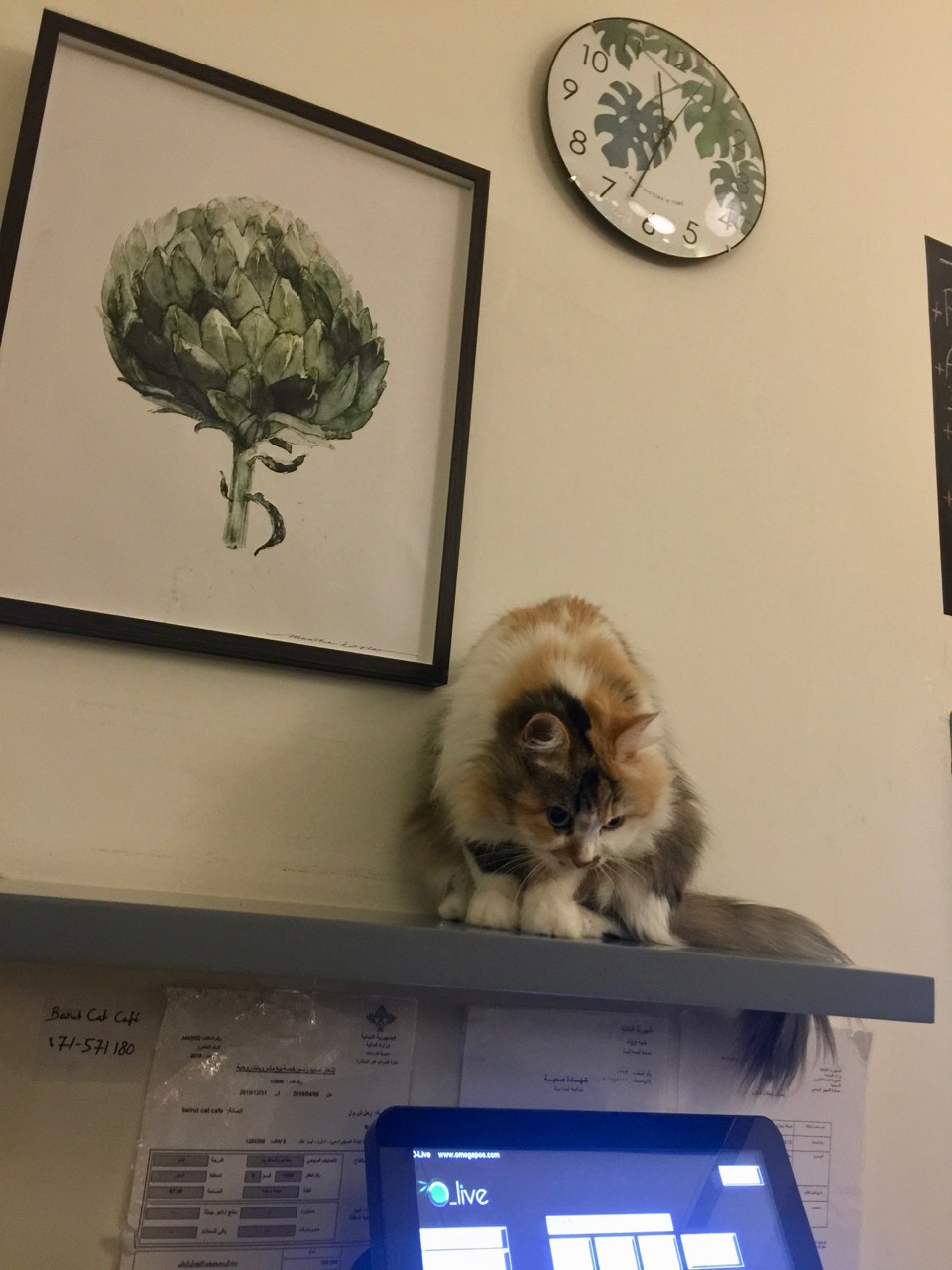
LebCat 30: On its usual perch, but appearing
more than a bit anxious. Cats can have
premonitions, right? (3 Jan. 2020 – Beirut Cat
Café, Mar Mikhael - Beirut)
            Last week a cemetery wall collapsed due to the hyper-saturation of the soil, toppling the deteriorating stone-and-cement construction onto the Damascus highway sidewalk in the Sodeco section of the city. The sadly ironic part is that it belonged to the old Beirut Jewish cemetery in a country that has almost no Jews left. Who will dare to take it upon himself to build a better retaining wall for that cemetery, I wonder? But if these storms continue, the outer wall of either the Anglo/Evangelical, French or Syriac cemeteries, all in a row, will be the next to fall. And then, maybe, the city will do a general reconstruction of all the walls – if there is any money left in their coffers.
            As business after business closes its doors, one in particular stands out for me: the Beirut Cat Café, in the Mar Mikhael area not far from us. I think of it as a “rent-a-cat” place, where for the price of a drink you can associate with willing felines for an hour or so and then leave; and if you are so inclined, you can apply to adopt one of them. Because of the impossibility of meeting their expenses in the declining Lebanese economy they are closing at the end of this month. What touches me the most about this particular place is that it represented a better side of humanity, where animals that are considered vermin can be seen in a different light. And that can have its positive effect on the way that people relate to the natural world as well as to each other. With its closing I feel that we are losing a part of our humanity, as ironic as that sounds. (Or a part of our felinity?) I hope it will open again some day soon, once these cruel storms have finished their destructive journey across the Middle East. 
LebCat 31: Blissfully unaware and uncaring at what is coming.
Probably better off that way. (3 Jan. 2020 – Beirut Cat Café,
Mar Mikhael - Beirut)
            No matter what, we will greet the coming day as we (Armenians) have always done: "Christ is born and revealed; great good news to us all!" (Krisdos dzenav yev haidnetsav; tzezi, mezi medz avedis!)    [LNB]

Wednesday, December 26, 2018

The Competition


21.The Competition (25 December 2018)

Only in Lebanon – a crèche alongside a mosque and a church, and
most of the visitors were non-Christians. (23 Dec. 2018 – Beirut)
            We finally made it back to the gym, after a two-month hiatus. And after almost getting t-boned in the first minute we were in the taxi, on our early-morning trip to the health club, our driver reassured us with a comment akin to what so many other drivers insist on: people in Lebanon, even at 6 a.m., don’t know how to drive properly. Yet every driver seems to say the same thing about every other driver. So, I’ve decided to look at the positive side: really, all of them want better behavior on the road. I can only hope that they’ll “be the solution” they’re looking for.
            Something else the driver said caught our attention. After complimenting Armenia on the amount of snow it gets (he was Arab), he expressed how happy he was for the rain here in Lebanon. Most people aren’t happy; they only complain about the inconvenience the rain brings to their daily routine, or their leaky roofs, or the country’s infrastructure. All real concerns, but not the only issues at play. When a rainstorm clears, or after days of rain, we look out our window in the hopes of seeing more snow on the mountains. Our driver, with his positive outlook on precipitation, beseeched God (because that is how you express yourself here) to send us at least 3 meters of snow, so that we would not have another dry summer without adequate water supply. Amen to that.
Let it snow! More accumulation on the mountains, and more on
the way. (21 Dec. 2018 – Beirut)
            We’ve attended a couple of concerts in recent days, which is another positive change for Maria and me. Much as we would love to have our full energy and attention devoted nearly 24/7 to our jobs (we wouldn’t actually love that, but that’s the conclusion you might draw from observing us), we have been making a little time for ourselves to enjoy some of what Beirut has to offer. We got to see an Armenian children’s choir, as well as a youth chamber ensemble. Admittedly, it’s difficult for the conductors to make music pleasing to the audience’s ear, but I am greatly appreciative of those children and youth who make the time for practicing and mastering their parts.
            Despite what people say or feel, time is not speeding up; it’s just that there is more competition for the existing amount of time. I find myself saying, “I don’t have time!” too often in the course of the day. What I should be saying is, “I can only focus on a limited amount of things, but I am lousy at saying ‘No’.” Or when I say “Yes” to so many things, I should add “and I don’t care about the quality of what I do” to be completely honest. 
            Going back to those recent concerts I attended: I can either be focused on the performance and let the designated videographers and photographers do their job, or I can sort-of listen while taking photos and videos of the concert. Which is what a lot of people do. When looking towards the stage and trying to enter into the musical moment, the view of the performers inevitably includes several glowing screens, quadrupling my viewing experience, I guess. At one concert I noticed the woman in the row in front of me reviewing a video she had just taken of the children’s choir… while the choir was still singing. To say that audiences need training in how to be an audience goes hand-in-hand with saying that people (myself included) need to be content with doing fewer things.
Choose whether you want to watch it live, or on somebody’s
screen. (22 Dec. 2018 – Beirut)
            It is incredibly quiet today – no car horns, no traffic, no people. It feels so unlike Beirut. Even the sound from a nearby minaret seemed quieter than usual. But that’s how Christmas is here. Everyone is at home, or away in their villages. Weeks ago local television stations geared up for the holiday, with their snowman- and Santa Claus-themed station IDs, including the sounds of jingling jingle-bells. A thoroughly American-style Christmas, right here in the Middle East. While this presents an incongruity with local cultural customs, or rather replaces them, it poses a different question for Armenians, who celebrate “Christmas” differently, and on a different date: Why bother being different?
Sunday School Christmas pageant, last day of Sunday School
before “Western” Christmas (23 Dec. 2018 –
Geitawi/Ashrafieh, Beirut)
            I have heard more than a few Armenians (and others) saying essentially that Armenians should “get with it” and celebrate Christmas the same date as “everyone else”; it’s said to be something “inevitable”, we just have to “face reality”. I’ve wondered about what is behind this drive to conform to the majority, and convince other Armenians to do so as well. Is it an aftershock emanating from the Genocide of a century ago, a “death wish” from a nearly-annihilated people who see no sense in continuing the struggle to exist? It is prevalent in so many areas of our individual and collective life. Here’s an example: Armenians typing messages in Armenian but using the English alphabet, and in two different dialects at that, without thought as to how this contributes to the decline (and perhaps the death) of the language. The standard used is “What’s the easiest?”, instead of “What’s the best – in the long run?” That’s without getting into the whole topic of “What does God want? Why did he help some of us survive?”
LebCat 20: Jazzcat hanging out behind the Blue Note Café
(2 Sep. 2017 – Beirut)
            In the best Armenian tradition, we don’t make Santa Claus compete with Jesus. Called “Gaghant Baba” by Western Armenians (“Father Calendar/Time”) or “Tzəmer Babi” for Eastern Armenians (“Father Winter”), the dancing, gift-bearing fellow makes his appearance to Armenian children on the last night of the year. Children (and sometimes willing adults!) recite a poem in Armenian, or sing or dance for him, and then he unloads his treasures and departs. Then, six days into the New Year, the focus is fully on Jesus, his appearance as a baby at his birth, as well as his appearance at his baptism as an adult. It’s a time for worship and proclaiming the best news the world has ever heard. Although it's not, if this were a competition based on the merits of how best to observe Christmas, the Armenian custom of January 6 wins hands-down. But if it’s just a popularity contest, well . .  .   [LNB]