Showing posts with label school. Show all posts

Friday, September 30, 2022

A Time for Discomfort

 53.A Time for Discomfort (30 September 2022)

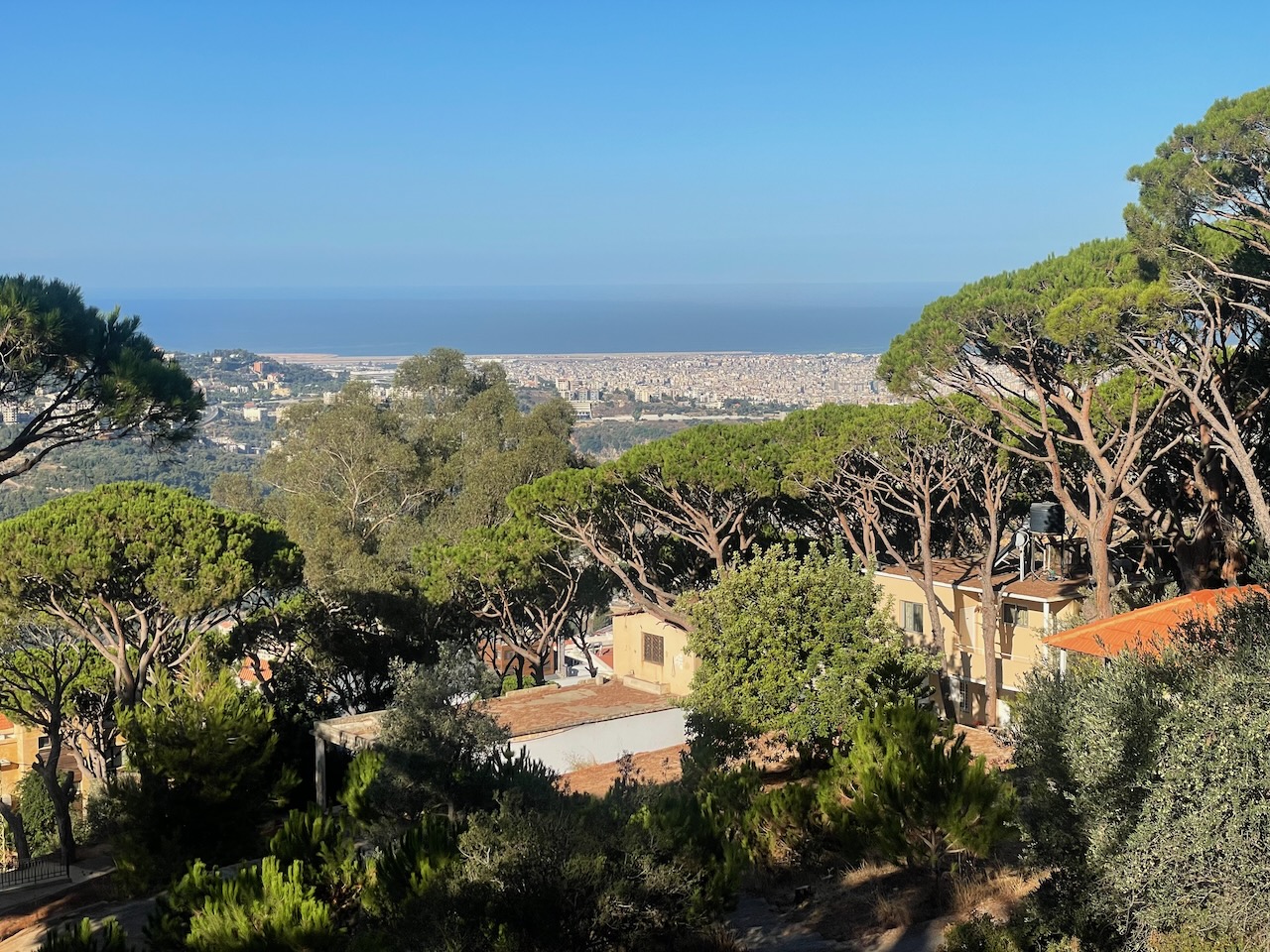
A rare day of low humidity, with a crystal-
clear view of Beirut from KCHAG.
(24 Sept. 2022 - Monteverde)

How much more surreal can things get? Yesterday the parliament met to make its first attempt at electing a president of the Republic. Hearing all the laughter and good-natured ribbing happening in the chamber, one might easily have concluded that there is little to worry about in the country, and that Lebanon is back to its glory days of the 1960s. Yet the upbeat mood in the room served only to highlight the deep disconnect between the people and their daily suffering and uncertainty on the one hand, and on the other hand those who are ensconced in the halls of power. Although this disconnect is arguably true in practically every country in the world, here it is as if a house is burning down, but the residents themselves must battle the fire alone, unassisted, running to and fro to find water to fill their basins and toss a few drops on the ever-heightening flames.

The building (at rear) where Armenian
orphan girls wove carpets after the Genocide
(17 Sept. 2022 - Ghazir)

            When people take up arms, even toy guns, and desperately enter the banks that hold their savings hostage, demanding their own money to be able to pay their own medical or business debts, it shows a deeply troubled society. They are depicted by news outlets as committing “bank heists”, as if readers were only capable of understanding Hollywood terminology. These are people struggling against the injustice and humiliation they have been fed continually for these past few years. The obliviousness of those who comfortably led Lebanon to this state, in local or international halls of power, only serves to increase our discomfort.

Reflecting on a day off, with the
help of a sculpture by local artists
(17 Sept. 2022 - Jbeil/Byblos)

            As we view the continued terror inflicted on Armenia by its un-neighborly “neighbors”, our discomfort multiplies all the more. The world today is witness to Azerbaijan’s push to impose military solutions on a weak and defeated country while the peacekeepers’ country is otherwise preoccupied. Yet once again, Armenians are demonstrating their political naïveté by rejoicing every time some Western government issues a condemnation of Azerbaijan, or a statement in support of the territorial integrity of Armenia. This same reasoning justified the international community’s lack of support for Artsakh’s Armenians during the war that began two years ago this week. Yet many Armenians the world over, in their self-imposed amnesia, continue to imagine that those statements will actually affect the reality on the ground. The reality is that this aggressor will take as much land as it can from Armenia, disrupting and destroying as many lives as it can, while big sister Turkey watches admiringly.

The streets around the Ashrafieh church &
school transformed into an Egyptian street
for a movie (30 Sept. 2022 - Geitawi)

            Meanwhile, despite the discomfort caused by events near and far, we are comforted in some measure by the beginning of a new school year. Armenian schools in both Lebanon and Syria welcomed their students back this month, providing much more than an Armenian education, as crucial as that is for the health and strength of Armenians everywhere. They are also providing a point of stability in the unstable world these children and adolescents inhabit. The daily conversations of adults around them, centering most often on continual worries about finances and the crashing currency, is being offset to a degree by the rhythm of the school day and the school week. Yes, the schools face deep financial challenges, especially if they have not yet installed a solar electric system on their grounds, and have to pour large amounts of currency into fueling their generators. Yes, this is aside from the inevitable school closures resulting from unexpected events, likely to increase as the current President’s term comes to an end. But it is an act of love and hope, based not on circumstances, but on vision and convictions.

Guitarist Ayman Jarjour transfixes the
audience with classical, Spanish and
"Oriental"-flavored pieces
(27 Sept. 2022 - Minet el Hosn)

            A moment of beauty I recently enjoyed was a guitar recital by the brother of a former student from my Haigazian teaching days. Aside from being a fundraiser for a rehabilitation center in Lebanon, the event provided a feast of musical delights, filling the church’s sanctuary for one hour with the sound of that one guitar (and the regular dings of someone unable to detach from Whatsapp). It was a gift that the guitarist gave to an audience hungry for something that would lift them up, if only for a brief time. As Fred Rogers’ mother told him when he was young and afraid, “Always look for the helpers. There’s always someone who is trying to help.”

LebCat 53: An exquisitely striped "McCat",
frequenting the location where it's most
likely to be fed - just not by me
(11 Sept. 2022 - Ain el Mreisseh)

            This is the way of the world. There are those in challenging places doing their best to help others, even at the cost of their own comfort. And there are others who seek only their own comfort, no matter how many others must suffer as a result. This is a “scalable” truth, applicable to societies as well as world powers. Though countries only occasionally enjoy peace, they are often oblivious to the role they themselves play in the natural, political or human disorder around them. More likely, though, they lack the moral grounding needed to admit their role in the hardship they cultivate.

            Yet this is the very same world into which Christ Jesus entered, into which today he leads his disciples to share words and works of comfort and hope to those truly in need of it, and to engage in the struggle for what is right, true and beautiful.   [LNB]

Wednesday, April 1, 2020

Cue the Locusts


33.Cue the Locusts (31 Mar. 2020)
It’s spring, but nobody’s going anywhere these days.
(24 Feb. 2020 – Geitawi - Beirut)
Here in Lebanon we look with amazement at a panicking world that, upon realizing that the novel coronavirus was not going to remain a “Chinese disease”, began by decrying the enforced confinement and “social distancing” intended to slow the advance of this nemesis, because of the perceived injuries to their liberties. The puzzlement here continued as the reality of this pandemic set in, and country after country realized that their economies were going into a deep pit because people were unable to work and therefore were cut off from the income they relied on. It may sound callous, but Lebanese, who have been in an economic downward spiral for the last several years, thanks to the greed and incompetence of their leaders, exploded with rage in October that they were not going to take it anymore. It shut down the country and the already abysmal economy, sending banks into panic over the danger to their usurious profits, whereupon they took it upon themselves to prohibit depositors from withdrawing more than a couple hundred dollars a month. The service industry, already limping along due to the lack of tourism, saw nearly a thousand restaurants close in Beirut alone, schools lost three weeks of instruction due to strikes and road closures, and specters of a return to civil war loomed in the shadows. The country was not on its knees, but rather prostrate on the ground when this virus became a local reality. How much farther down can you get?
The list of coming events at a nearby restaurant.
(23 Mar. 2020 – Qobaiyat - Beirut)
            I hope that no one would wish this situation on another, here or in any country. But it’s very tempting to say to the world, “So, how does it feel?” To face each day with fear, uncertain of what the future brings, wondering if death will snatch your friends, loved ones or even your own life? Yet there are so many people who face much greater trials than what most in the affluent world are struggling to comprehend. It is very easy to comprehend in lands under occupation, where walls are built to protect privileges. It is very easy to comprehend in places where refugees are used as political pawns. It is very easy to comprehend by those today continuing their jobs, with or without masks or gloves, who know that when the government says “lockdown” and “curfew”, it is effectively telling this subsistence-level stratum to starve to death. As many have commented, if rich people were to die from hunger, the world would find the will, the creativity and the resources to end that scourge. But those 9 million who die each year from hunger-related reasons remain out of the spotlight.
Not how a school playground is supposed to look in the
middle of the day. (24 Mar. 2020 – Geitawi - Beirut)
            Oh, did I mention? We are under a nightly curfew. The government announced, and is enforcing, a 7 p.m. to 5 a.m. curfew throughout the country. This is in addition to closing all “non-essential” businesses, that is, anything that does not sell food or medicine. And if your water tank is leaking (every household has a water tank on the roof because of the sporadic delivery of water, 30 years after the Civil War ended… sporadic, like all the other utilities), well, you won’t be able to call someone to repair it. Anyway, he might not have the parts to do repairs because the banks have had a 5-month stranglehold on the capital that is needed to import goods.
How I spent my 16th birthday – telling “Dad
jokes” at a youth/veteran C.E. youth gathering.
(29 Feb. 2020 – Armenian Evangelical Church
of Ashrafieh, Geitawi - Beirut)
            The school year has taken a body blow in this crisis-upon-crisis mode we call “the new normal”. Administrators and teachers have hastily transitioned to “online learning”, a tenuous format that might enable learning to occur. When the October protests dragged on, schools were already beginning to implement some of these methods, and it increased as the months dragged on, the strikes continued and regularly turned into violent clashes between protestors and various security forces (there are so many here I can’t keep track). Yet students as well as adults are learning quite a bit from this current in-house confinement. In some cases children are in a healthier environment. No longer do they chant, “Revolution! Revolution!” (“Thawra! Thawra!”) when being let out for recess, as if it were a game. Others are at the mercy of their abusive or neglectful parents/guardians. Those who care for the latter, such as the Armenian Evangelical Boarding School in Ainjar, constantly carry that burden in prayers for God’s mercy.
            The last couple of “normal” things I did were to deliver a talk on Hrant Dink, the Armenian journalist and activist who was assassinated in broad daylight in front of his newspaper office in Istanbul, and to attend a a wonderful lecture on Gomidas (or Komitas). Ironically, among the 300 of us sitting in the hall where that lecture/concert took place on March 8 were religious and community leaders and even a cabinet member, only one day after the government told people to avoid all crowds.
A tall tree at a nearby park, uprooted by gale-force winds
on Mar. 12. (25 Mar. 2020 – Geitawi - Beirut)
            Maria and I were already doing most of our work online since we arrived in Beirut. Except for the worship services we attend and where I assist. And except for the “Armiss” choir that I direct. And except for the committees in which we serve. Now, none of that is happening. In their place we have video conferences and work online from home. The choir rehearsals are suspended. And in place of Sunday worship services in various churches the UAECNE (our church Union) has begun broadcasting a single weekly pre-recorded program, which I am producing. (Look it up on YouTube under UAECNE.) Pastors are taking turns preaching the sermon, and I am including a variety of recorded hymns and anthems in Armenian. It is an interesting initiative that will likely continue in some form as an audiovisual ministry, and will find a home on the Union’s website (coming soon, I hope), connecting people not only across the region, but helping those who have emigrated elsewhere to maintain some connection with their roots.
LebCat 33: Look, I don’t care what the
government says about restaurants closing.
I know you’re in there. I can smell the
rotisserie chicken, OK? (13 Mar. 2020 –
Geitawi - Beirut)
            On March 12, as we were beginning our days/weeks/months of seclusion, Lebanon and the region experienced several hours of winds at speeds between 100 and 140 km/hr. The roaring sound woke us all up, as objects were being tossed from one rooftop to another. The huge flag flying on top of a nearby office building was torn from its mounts and ended up somewhere far away, perhaps in the Mediterranean? The following day everyone was out surveying the extensive damage throughout the country. Strangely, though our electricity was never interrupted – just our sleep.
            The news out of the northeast of Africa is not good. A devastating plague of locusts is destroying crops and threatening famine to countless people. Could that be next on the agenda for Lebanon? We watch… and pray.   [LNB]

Sunday, October 6, 2019

It's a Sign!


28.It’s a Sign! (6 Oct 2019)
Children in uniform, and parents carrying school bags. A sure
sign that fall is here. (1 Sept. 2019 – Shushi, Artsakh)
For years our family has had a running (inside) joke. When we see street signs or billboards, especially ones with the name of a city or country on it, we call out, “It’s a sign!” Perhaps not particularly funny… except that I’m a pastor, and one of the features / challenges of pastoral life is the ever-present possibility of relocation. And behind that possibility is the art of determining what constitutes a sign from God, particularly regarding a “call”, and the related relocation from ministry in one city (or country) to another. The joke is that if you are looking for a certain answer, sooner or later a “sign” will appear, confirming what you have already decided on your own. And then you can credit God for the sign. One of those Achilles’ Heels of believers everywhere.
An “old” sign, lying face down on the ground,
defeated by a new pole and by the company
that bagged a contract for replacing every. single.
pole. in the city. (18 Sept. 2019 – Khalil Badawi)
            In recent months in Beirut there has been a sprouting of metal posts and brand-new signs on sidewalks all around the city. Considering the narrowness and impassability of most sidewalks in Beirut, this has been an unwelcome intrusion to us walkers. And considering that the existing, if somewhat beaten-up, collection of traffic signs throughout the city was doing its job just fine, it makes one wonder whether there is something more behind this proliferation of poles than traffic concerns. In such an opaque and … not altogether “clean” … system as exists here, who knows? Rumors about this and a slew of other topics are pretty much all the general populace has to go on, as it tries to make sense of the rough road it has been on for decades.
Will they be able to break Mr. Sevag? An intense scavenger hunt at
the Children’s Conference. (7 Aug. 2019 – KCHAG, Monteverde)
Having the thrill of my life, leading a trained choir in concert, the
“Varanda” ensemble, while Zakar looks on. I wonder what he’s
thinking? (5 Sept. 2019 – Shushi, Artsakh)
            As a sign of how full the summer has been, two and a half months have passed since my last blog post. Why? Meetings and more meetings. Sevag’s month in Lebanon, including some vacation time with him, and a week in KCHAG, with Sevag in the children’s conference, and me in a bungalow, pretending to get studying done. Work in Armenia and time off in Artsakh. So much has come and gone. That trip to Artsakh (or Karabagh) was a memorable one, especially as Maria and I enjoyed the cultural and interpersonal riches of that region. I’ve reflected more about it in another place, but a highlight was definitely my being invited to conduct the “Varanda” childrens/youth choir in “Hayrenikis Hed” in concert.
 
Maria’s niece and family, recently relocated to
Armenia. And a penguin. (29 Aug. 2019 - Yerevan)
          
We were driven from Yerevan to Shushi by a young taxi driver who talked quite a bit about the hopefulness that is permeating Armenia since the so-called “Velvet Revolution” of last year. Yes, lots of things still need to be “fixed” in the country, but he insisted that the current government will get to it in due time. In contrast, a week later, on the taxi ride back to Armenia we had a different driver: an older, university educated man who worked in the Soviet system and the post-Soviet system, and is now witness to the current setup. His view of things was subtly skeptical, since there is movement going on, but not necessarily progress. He asked us a lot about Lebanon, and laughed, “So it seems that there are many, many similarities between the two countries!” He was referring to human potential, but moreso to the shared pitfalls.
Wait, is this town called "garlic"? The French side of the sign
reads like that Arabic word. Oops, my mistake. Good thing I’m
learning to read/understand Arabic! (10 Sept. 2019 – N. Lebanon)
            Armenia – and increasingly Armenians everywhere – speak enthusiastically about one Armenia for all. The Armenian Diaspora (the majority of Armenians in the world) is frequently relegated to a temporary and passing reality. Yet, once upon a time, in recent memory, the slogan was, “A strong Armenia with a strong Diaspora.” No more is this heard. Once upon a time Armenia had a Diaspora Ministry (usually aimed at connecting Diaspora finances to needs in the homeland). Though the channeling of resources, human and otherwise, continues, that Ministry is no more; it was closed up last year and its work subsumed into the Assistant Prime Minister’s portfolio. The Western Armenian language is a “threatened” cultural treasure, but the only serious attempts to strengthen it are coming from Diaspora organizations. (Armenia also closed its Ministry of Culture last year.) These signs betray a lack of depth of understanding of the importance of the Diaspora for Armenia as well as for Armenians everywhere. And a lack of depth in the thinking of the disorganized Diaspora as well as official Armenia.
LebCat 27: I’m looking fine… but don’t those two guys in the back
know how to pose for a selfie? (26 July 2019 – Beirut Cat Café,
Mar Mikhael - Beirut)
            Here in Lebanon, a sign that summer is over and the fall is here is the appearance of children all over the city in their school uniforms and toting their book-bags. We are all carrying another weight, though, as we closed of one of our schools this summer (shrinking income and galloping debt). It is a sign, not that Armenian Evangelical education is no longer needed, but that this vision is being challenged by other factors outside the church Union’s control. In fact, all Armenian schools outside of Armenia face this challenge. As historian Dr. Yervant Kassouny states in his recent book (Reflections on … Diasporan-Armenian Literature, 2019), “Closing an Armenian school in the Diaspora is equivalent to closing an Armenian army base in Armenia” (p. 11, translation mine). The Armenian school, along with the Armenian church and the Armenian family, is the place where this particular nation (in the cultural, not the political, sense) trains for the battle to survive and thrive in a world that works hard at homogenizing everything, not just milk.
            Keeping your eyes open, paying attention to the signs of these times, staying awake and prayerful – these are the means we employ when facing days like these. “A little sleep, a little rest, a little folding of the arms, and your poverty (including your spiritual and cultural poverty) will come upon you like an unexpected traveler, or an armed robber” (Prov. 24.33-34).   [LNB]

Monday, April 1, 2019

Decay and Growth


24.Decay and Growth (31 March 2019)
The huge, nearby Lebanese flag, struggling to unfurl while
soggy wet. Symbolic of the state of the state.
(31 Mar. 2019 – Mar Mikhael - Beirut)
            “So, there’s this thing in the parking lot – I think it’s an ark. And a bunch of animals, lined up in pairs…”
            Well, not really, but March in Lebanon is living up to its Armenian nickname: “crazy March” (in Armenian, “khent Mard”). We were fairly sure that the cold and rainy days were over. We were down to the occasional overnight drizzle, with mostly sunny days and blue skies. Now it seems like we are living in a (concrete) rainforest this last day of March, with nonstop rain from the middle of the night throughout the entire day. It is so rainy that the huge Lebanese flag atop a nearby building is completely saturated (not easy for something made of nylon) and shiny under the floodlights illuminating it.
The “thing” in the parking lot is not an ark, but
a second, more powerful generator for the
building. Because uninterrupted electricity
is not in the near future...
(21 Mar. 2019 – Geitawi, Beirut)
            As with other rainy stretches, those who are impacted the most are those living in makeshift dwellings. Translation: that means refugees. It means about a fifth or more of the population of Lebanon. Yes, the Syrian war (or as some call it, “the war on Syria”) is still a “thing”. And Lebanon continues to struggle under the weight of these regional uncertainties. Fear and threats swirl in the wind. There are reports of some local relief workers warning refugees not to return home, for whatever reasons, or perhaps out of self-interest. And then there are the imperial fiats of far-away leaders. A Syrian comedian recently went on TV, seated behind a desk, signing a certificate. He held it up and declared that he was ceding California to Mexico. Then he added that his certificate has as much worth as the one announced this month concerning the Golan Heights. It appears that the storms here will continue here for some time.
            Spring does an amazing thing, though. It makes you believe that the corruption and decay all around us can, in fact, be transformed into growth. Decay is what helps all those ants and cockroaches stay alive, as they dispose of whatever is lying around, plant or animal. Hmmm, maybe I have that backwards; ants and roaches keep us from drowning in waste by eating garbage, which ends up helping to keep us alive. Now that’s a weird thought.
My nemesis: spring flowers. So pretty. Such
torture to my nose. Note the trash in
the background. (25 Mar. 2019 – Zahlé)
            So, trees and plants are budding. And I am fighting my nemesis – pollen – with the only weapons at my disposal: allergy pills and tissues. Green growth is returning everywhere, covering the trash thrown out of windows and dumped at night. But where is the healthy growth, or the ants and cockroaches, that will obliterate, or better yet, remove, the decayed leaders?
            Some cabinet ministers in the new government are trying to take actions to improve the quality of life here. One of the projects is to remove the concrete barriers that have proliferated all around the city since the year of assassinations in 2005. But everyone was so used to seeing concrete that they became disoriented. Even the police. A couple of weeks ago we were in a taxi on Hamra Street, and a police car pulled up to us and asked the driver if he knew where the Interior Ministry was. It was just around the block, but no longer behind barriers or with a security gate, and therefore unrecognizable. And remember, this is the police asking a taxi driver for directions…
A new greenhouse for food as well as education.
(25 Mar. 2019 – Ainjar)
            But there is so much more needing to be done, and the population is generally disgusted by the decades of unfulfilled promises by the same political dynasties that were killing each other during the civil war. There is an old fellow in our neighborhood who delivers the propane tanks for our stove (there is no such thing as a gas line or a gas utility here), and in between conversations I have with him about Bible passages, he mutters on about how officials are robbing people. One could dismiss it as the rants of a broken-down old man. Or one could compare what he says to the reality people face and come to a different conclusion…
Ecumenical prayer, followed by fellowship (and food).
(28 Mar. 2019 – Norashen – Bourj Hammoud)
LebCat 23: A regular customer at the nearby artisanal bakery.
But to sleep, not to eat. (19 Mar. 2019 – Mar Mikhael, Beirut)
            Yet we know we must inspire hope and commitment, and focus on mission and growth, or else we’re just wasting our time.  I truly admire the faithfulness of my church in serving the community through education, with a network of schools in the Middle East. Just to see how they do so much with dwindling financial support is a testimony to their wholehearted dedication. One of those schools, the Armenian Evangelical Boarding School in Ainjar (in the agricultural Bekaa area), has constructed a greenhouse in order to (1) grow its own produce for the children’s meals, (2) teach students about agricultural work, (3) inculcate a sense of caring for the natural environment, and (4) maybe even be able to sell some of what they grow.
            In yet another sign of spring growth, a few days ago twenty Armenian clergy – Apostolic, Catholic and Evangelical – held a prayer and fellowship gathering in the Ss. Vartanants church in Bourj Hammoud, under the leadership of the heads of those three denominations. Although this type of ecumenical event is just starting here, there has always been cooperation between the churches and clergy in the region to some degree. But it is wonderful to see a clergy gathering coming into shape, much as we have had for over a half-century in the Armenian churches of Philadelphia. Now, this is the kind of spring I like to see, sniffles or not!   [LNB]

Saturday, September 29, 2018

Raise Your Voice


18.Raise Your Voice (29 September 2018)
First day of school at the Armenian Evangelical College, one of
the network of schools in Syria and Lebanon run by the Union.
Haigazian’s Philibosian Student Center (formerly “Webb”
building) is in the left background. (25 Sept. 2018 – Kantari,
Beirut. Photo courtesy of Rev. Hrayr Cholakian)
            Adjusting to a new environment takes time, and events around you or within you force you to admit that you are not “there” yet. If you are really smart, you’ll accept the fact that you will never get “there”, no matter how you define “there”. And you’ll do so sooner rather than later.
            The better part of adjusting consists of knowing how to keep your mouth shut, and continuing to observe and learn. But there are always a few things that perhaps you shouldn’t adjust to, that may be worth opening your mouth about.
            As I was trying out a new eatery (nothing to get excited about, sorry) a couple of days ago, the cashier directed me to their air-conditioned “eating room” (a separate storefront from the “ordering room”). I stuck my head inside the eating room, sniffed once, and
decided to cast my lot with the hot sun at a sidewalk table. The cashier eventually brought out my food, and asked, “It’s hot out here. Don’t you want to eat inside?” I responded with “Ma3lesh” (It’s nothing), although I did want to raise my voice in complaint to her about the cigarette stench in the eating room. O, Arabic lessons, why have I forsaken you?
A beautiful, old building that was being refurbished last year
collapsed before they were able to support its structure…
revealing another beautiful, old building. You can see the
remnants of the balconies lying askew on the ground.
(11 Sept. 2018 – Gemmazeh, Beirut)
            So, as I was eating (and sweating) on a sunny Ashrafieh sidewalk, watching cars go by, I noticed an older man (i.e., my age) on a motorcycle pulled up next to a driver’s window of a car that had stopped in the middle of the street. But he wasn’t asking for directions. He was yelling at the driver for several traffic infractions, including driving the wrong way on a one-way street, and probably almost running over the motorcyclist (who was not a traffic cop). I can only hope that he takes care not to break the same laws when no one is looking.
            I was pleased to see him making a nuisance of himself in this way, because people so often just shrug their shoulders at much of what goes on here when they should be speaking up. “Haideh Lubnan.” I hear it all the time, from friends and strangers. “This is Lebanon.” But although speaking out will never result in instantaneous or lasting changes, though it won’t turn those accustomed to decades and decades of ineffectual government and self-centered living into conscientious, law-abiding citizens. He was lighting a candle and cursing the darkness.
This is how the Union headquarters looked before
improvements began. It’s behind the trees, in case you
missed it. (6 Sept. 2018 – Geitawi, Beirut)
            Oops. I forgot that I’m not supposed to say anything but compliments about the government, as well as all other governments, save for one in particular that happens to border Lebanon. That’s what I put my signature to each year, when renewing my residence permit. But even without signing such a form, we are all facing similar pressures to keep dissent to ourselves (or, alternatively, to be loud and arrogant about our dissent and close our ears to other dissenters). This does not just concern the country of my birth, the U.S.A., for the past 17-plus years. In Armenia, post “velvet revolution”, the message being broadcast, is one, simple, unchallenged refrain: “The bad has left, the good is here; come to Armenia. ” Few dare to raise a dissenting voice concerning the “new”, save in private, or else risk ostracism. Even though they, too, care for Armenia’s well-being. It seem that criticism, especially self-criticism, is rare in today’s world, no matter what the side.
The old fence coming down, and the new going up.
(11 Sept. 2018 – Geitawi, Beirut)
            Yet people do speak up, and not just to point out flaws that they see. Here are some ways I’ve observed people in Lebanon “raising their voices”:
1. Tending your “garden”. The headquarters where I work, the Union of Armenian Evangelical Churches in the Near East, formerly an Armenian-owned hospital (the “Christian Medical Center”), got a complete makeover, 30 years after its previous one. Rev. Paul Haidostian, president of Haigazian University, is overseeing another renovation project, that of the Webb (or Philibosian Student Center) building, the university’s original structure. Someone observing the work remarked, “Do you know how encouraging it is for your neighbors to see you making improvements because you want to improve, and not because you were forced to by someone else?”
2. Getting up and getting out. After a long summer indoors (with their air conditioners), lots of locals have donned shorts and sneakers. I see them running and jogging and panting along sidewalks and streets in the city, preparing for the Nov. 11th Beirut Marathon. I’m not sure whether they’re aiming for the 8 km fun-run, the half-marathon, or the full 42.195 km thrill. I’m limiting myself to the gym.
A panorama of the newly-refurbished exterior of the Armenian
Evangelical church headquarters, formerly the “Christian
Medical Center” (27 Sept. 2018 – Geitawi, Beirut)
3. Speaking up about health and pollution dangers. People continue to gather to publicly protest the government’s mismanagement of the country’s waste disposal, especially after the recent decision to create three incineration facilities along the coast, while cancer rates continue to spike. Meanwhile, cow carcasses, presumably diseased ones tossed from ships before entering the Port of Beirut, are gently floating along our Mediterranean coast. Swimmers and divers are exposing these shameful scenes through social media posts.
4. Speaking up about abuse. The prevalence of non-Arab faces in and around the city points to the widespread use of southern-hemisphere workers in construction, sanitation and domestic labor. There is a robust network of organizations decrying the near-slavery conditions many of them are enduring at the hands (literally – please understand) of their employers. At least one of them per month commits suicide. Rather than let this “modern slavery” continue, they protest, they write commentary, they hold memorial services, all in an effort to put an end to the unregulated flow of hundreds of impoverished, southern-hemisphere “tourists” through the airport.
Just write “extra” on it. It doesn’t have to mean anything.
(28 Aug. 2018 – Geitawi, Beirut)
5. Opening Armenian schools for the new school year. Despite the continuing downward economic spiral in Lebanon, and the departure of many families (not just youth) from the country, Armenian schools of every kind have pressed forward in continuing their educational mission, and have started another school year. It is a powerful declaration of their will to survive, and a message to Armenians everywhere that the Diaspora has a reason to exist.
6. Publishing Western Armenian books. In a couple of weeks Haigazian University will hold another “Armenian Book” evening, presenting all of the books published in the Western Armenian dialect (and a few in other languages) in Lebanon in 2017. Beirut continues to let the world know that it is a cultural center for Armenians throughout the world, despite the past and present efforts to obliterate our presence in this region. (However, these Armenian books continue to cry out for people to pick them up and read them…)
7. Calling everything by a superlative. No matter what the item, it’s always better if you add the word “extra” to it. Or sometimes just name it “Extra”. This week I saw a man carrying a 50 kg (110 lb.) sack of flour to the nearby “manaqish” bakery. What was the brand of flour? “Extra”. Why not?
LebCat 17: All of these toilets are mine. And the boxes, too.
(26 Aug. 2018 – Nor Amanos, Baouchrieh)
            Raising your voice, for a Christian, usually means you are offering heartfelt praise to God. But it’s important to have a complete view of “being heard”. Christians must also cry out for the oppressed who have no voice, or challenge the idol-worshiping that is so much part and parcel of economic systems here and everywhere, or lift their voices in prayers of intercession or repentance, or raise a call to turn back from the paths of death to the ways of God. There is a time to be silent, but also a time to speak (Eccl. 3.7).
            Especially as an Armenian, there are so many more things about which I want to cry out, as I adjust to life here. And maybe I will. But this much for this time. [LNB]

[Note: Last blog’s “LebCat 16 & friends” was photographed in 2018 (not 2017) as they were dragging Sevag into their thrall.]