Showing posts with label war. Show all posts

Friday, April 24, 2026

Letters from Exile

 68. Letters from Exile (24 April 2026)

Year upon year this awareness is inculcated
in the hearts of the next generation
(24 April 2026 - Yerevan)
It has been 52 days since our “exit” from Beirut at the outbreak of the latest war on Lebanon, at the behest of our mission board. We have settled into a somewhat regular existence here in Yerevan, Armenia, contributing what we can online to the churches and institutions we were called to serve, while also offering occasional support in person to the Armenian Evangelical church union here. There are quite a few around us, clergy and others, whom we know from time they have spent in Beirut. There are also those who have sought refuge here in Armenia, sort-of “exiles” from their homelands.

Though in the distance, Ararat is an integral 
part of the Genocide Memorial
(24 April 2026 - Yerevan)
            “Homeland” is a contested concept for Armenians. The expectation of many non-Armenians is that Armenians the world over, without exception, consider today’s Republic of Armenia as their “homeland”. True, it is the only political entity that can be found on a modern map that provides that particular identity. Yet it also can be seen in the equivalency held by many Armenians as well, insisting that Armenians everywhere must think and feel that Armenia is their only homeland. However, many others, and possibly a majority of Armenians, carry a dual loyalty. They hold today’s Armenia in a special place in their self-understanding, while also remaining deeply rooted in their Diaspora homelands. Additionally, they often bear yet a third, precious “homeland” in their hearts, one that is rooted in the soil of Western Armenia. So, an Armenian who was born and raised in the Middle East can be deeply connected to the Republic of Armenia, visiting it often and caring about its present and future; and said person may also feel a strange magnetic pull when visiting various sites in today’s Turkey and seeing the people and places from which their parents, grandparents and even great-grandparents were driven. They are – that is, we are – ever children of exile, the descendants of those whose roots were pulled from their native soil, whose roots have been repeatedly replanted: belonging to more than one homeland, yet not fully belonging to any of them.

The ECA/AMAA delegation presenting their 
floral wreaths (24 April 2026 - Yerevan)
            Today, Armenian Martyrs’ Day, as we recall for the 111th time national displacement and loss, and inhabit the collective trauma that is yet a further, possibly universal, “homeland” for Armenians, I cannot help but experience regret. I regret all of the fragile root tendrils my elders carried, tendrils that I could have cared for in my childhood and adolescence, but did not, or was not encouraged to. Because collective amnesia (not just by the perpetrators, but also by those who suffered) is sometimes the only way to deal with a history too ugly to recall. Still, those tender roots that I did cultivate over the years have nevertheless sustained me and helped me to bear days like today, in such a situation in which we find ourselves. One thing that this extended stay in Armenia has shown me (the longest stretch we have ever had in Armenia), is that with God’s help my heart can stretch such that I can call this place “homeland”, while also calling Lebanon “home,” and the United States, too. Each has its own flavor and its own pull. Each has its own frustrations and disappointments. I do not have to close my heart towards two of them in order to embrace the third. This is not a revelation, of course; it is what it means to be a “third-culture” kid. (Look it up.)
Assyrian-Armenians preparing to ascend to 
the Genocide memorial; a shared struggle 
(24 April 2026 - Yerevan)

            Today I joined my Armenian Evangelical colleagues and friends, and mixed together with many Armenians, Armenian-Assyrians, Armenian-Yezdis, along with a smattering of Europeans and Americans (aside from me, that is), to make the long climb to the Genocide Memorial, the “Fortress of Swallows”, and remember, and reconnect, and rededicate ourselves to our rightful place among the living, and refuse to be a relic or an oddity in this world. I pray my descendants, whether by blood or by choice, will honor their ancestors by carrying forward a legacy of wisdom, sacrifice, service, creativity and faith. Easier said than done.

A symbol of what is, can, and should be 
Lebanon: Lent and Ramadan fasting 
on the same days this year 
(21 Feb. 2026 - Port of Beirut)
            Last week we ran into friends from Artsakh, friends we hadn’t seen since before the Armenian population was blockaded in 2023 and then “allowed” by Azerbaijan to abandon their centuries-old homeland. Seeing them and hearing about their children and grandchildren was heartwarming and hopeful, and they seemed to be adjusting, bit by bit, to their new homeland, Armenia. We weren’t completely lost as we conversed, since they spoke to us in Yerevan Armenian rather than their Artsakh dialect. That is, until a friend of theirs from Stepanakert approached, and they immediately switched to the language of their homeland!

LebCat(s) 68 - The butcher's window; 
better than watching CatTV 
(27 Feb. 2026 - Mar Mikhael, Beirut)
            This friend said to me, “I am sad for our lost homeland, but you know what makes me sadder? Seeing the way things are today in Armenia.” I asked him to say a little more, and he obliquely hinted at the divisions that are making Armenians intolerant of one another, dividing into factions and thinking the worst of others. Being that there are parliamentary elections in 44 days, this atmosphere will likely only intensify and will be unlikely to recede following that day.

            As our exile from Lebanon grows longer, we are also concerned about that which is dividing the people in our Lebanese homeland, and the increasing intolerance we are catching wind of. Certainly, nobody wants the country’s misery to continue, misery that has only grown in the thirty-five or so years since the end of the Civil War. But not tolerating unrest and war cannot be at the cost of the intolerance of others, people who also call Lebanon their homeland.

            And as God teaches in such times of exile, we are learning to seek the peace of the cities of our repeated displacements (Jerem. 29.7) and to hold each place in our hearts as a beloved homeland.   [LNB]

Tuesday, February 24, 2026

But Will It Make a Difference?

67. But Will It Make a Difference? (24 February 2026)

Billboards everywhere, anticipation 
abounding for Christian and Muslim alike 
(2 Dec. 2025 - Autostrade Bourj Hammoud)
For several weeks in November an unusual air of excitement wafted through the air as the country realized that the rumors of Pope Leo XIV visiting Lebanon were true. The more optimistic among the population imagined that this visit would herald a complete cease-fire from the near daily Israeli bombings. Those more realistic surmised that the papal visit would merely bring a respite from drone and warplane attacks for the duration of his time in Lebanon. Nonetheless, there was a pervasive sense that, for a change, something positive would happen in Lebanon. It buoyed the spirits of much of the country, not unlike that of children awaiting the arrival of Papa Noël.

Armenian school students lining the Pope's 
path to the Beirut Port Blast site (2 Dec. 
2025 - Autostrade Bourj Hammoud)
            It seems that Lebanon – that is, the people of Lebanon, merely by virtue of residing in this land, are compelled to pass their days in the no-man’s land between anticipation and reconstruction. It might be anticipation of the outbreak of war, civil unrest, or terrorist attacks; or perhaps anticipating possible steps toward reform, accountability for criminal acts, or enforcement of equal treatment under the law. Some might envision environmental cleanup, or affordable food, housing and health care, or even the country putting the common good before self-interest.
Artsakh women are making a 
difference with their artisanship
(30 Dec. 2025 - Gemmayzeh)

            And on the opposite border of this no-man’s land is reconstruction. This is something that Lebanese are constantly doing, or planning to do: spending emotional, mental and financial energies gathering the pieces of their lives torn apart by regional or international conflicts, internecine local struggles, or pervasively poor governance, reinforced with each election cycle. And when they attempt to rebuild their homes, villages and orchards, predictably our “neighbor’s” war machine grinds into action and destroys bulldozers and building equipment, preventing the Lebanese from recovery. At the same time, this “neighbor” is haunted by real or imagined threats, while they rebuild their homes, illegal settlements, watchtowers and walls, largely unmolested, justifying their racist actions as “self-defense”.

            The Holy Father’s visit itself, from Nov. 30 to Dec. 2, 2025, came together smoothly, appearing to the casual observer to have been the result of months of planning. In reality, it came together in a matter of weeks, and it included meetings with Lebanon’s officialdom, a pilgrimage to the St. Charbel shrine, an interfaith gathering in the city center, a massive youth rally at the Maronite Patriarchate, a visit to a mental care facility, a prayer at the scene of the 2020 Beirut Port explosion, and an open-air mass for thousands at the Beirut seaside, in addition to private meetings. Pope Leo’s message was consistent in each instance: to highlight the people’s longing for peace with justice, calling people and leaders alike to play a positive role in making that peace a reality. It expressed the theme of his visit, namely, Jesus’ words “Blessed are the peacemakers” (Matt. 5.9). The Pope repeatedly, even scoldingly, stressed this to local and regional leaders: “Listen to the cry of your peoples, who are calling for peace!”

Making a difference in my nourishment  
with my favorite grilled liver sandwich!
(31 Dec. 2025 - Nor Hadjin)
            So, will leaders take up the challenge? Will they cooperate with each other for the sake of the people, and develop an ethos of service and trust? Will young Lebanese – Arab and Armenian, Christian and Muslim, villager and city-dweller, take the Pope’s challenge to them to heart and choose the hard path of staying in Lebanon, and be “artisans of peace”, active in changing the present culture of strife and selfishness to a culture of caring and constructive engagement? The country, along with the region, waits in anticipation of the outcome of the reflection to which the Pope called his audiences; translating thought into action.

Making a truly Beiruti Christmas  
from old tires, rather than 
burning them... (16 Jan. 2026 - 
Mar Mikhael)
            Pope Leo considered his visit to Turkey and Lebanon as efforts toward “religious diplomacy”, using his physical presence to express the moral authority of the Vatican, such as it is, in the pursuit of justice, mercy, and mutual acceptance for the good of all. In a world that is intoxicated with the pursuit of self-enrichment while malevolently nurturing a culture of destruction and oppression, it is up to the individual to become convinced of this call to be a peacemaker. It may not make a difference immediately, but it will grow in strength and influence as those individuals become a tribe and focus their influence to compel leaders to change.

            When the people pray to God for deliverance from their sojourn of misery in this no-man’s land, they, knowingly or not, are appealing to God to change each human heart. As Ebenezer Elliott’s poem, “When Wilt Thou Save the People?” so plainly expressed, “From vice, oppression, and despair, God save the people!”

LebCat 67 - Keeping watch over 
comings and goings at the 
American University of Beirut 
Medical Center! 
(22 Jan. 2026 - Beirut)
            Cynically, within an hour of Pope Leo’s departure for Rome, the “neighbor’s” drone overflights and bombing resumed. Peace would not come that day, or that month, or even that year. So, we await with faith the transformation of this world, and we heed the Lord Jesus’ call to live as agents of peace, nurturing hope for the renewed earth that God has promised to the blessed peacemakers.   [LNB]

(apologies for the 2-1/2 month delay in posting)

Monday, April 14, 2025

Welcome Home

65. Welcome Home (14 April 2025)

"MLGA" - doesn't roll off the tongue very
nicely. I wonder how it would look on a cap?
(14 Apr. 2025 - Bourj Hammoud)
It has been almost four weeks since our return to Beirut from our “home assignment”, and we are relieved to be back. Not because everything is rosy or easy, but because we have a sense that we are where we are supposed to be, where we are called to be. Yes, the electricity and water supply is still unstable. Yes, the Internet is sometimes there, sometimes not, but always slow. Yes, the roads are full of people who care even less than before about how they drive. Yes, they still think that their car horns will magically cause the traffic in front of them to disappear. Yes, buildings continue to ascend to serve those who do not feel the pain of ordinary Lebanese. Yes, the economy is still in tatters, banks are continuing to abuse depositors, and we have to carry around dollars for larger purchases (such as groceries at the supermarket). Yes, the disparity between rich and poor is stark, and people mostly don’t notice the poor around them. Yes, drones still ply the skies overhead on behalf of “The Chosen”, to take note of and eliminate “The Rejected” and crush and kill “The Unlucky”. And, yes, the attacks by our war-mongering southern “neighbor” continues to be cheered on by the Machiavellian foreign policy of our home country. After we shared the news of the first attack on Beirut since our return, our son Sevag wrote to us: “Welcome home.” Sincere and ironic at the same time.

The end of another old building,
the beginning of another high-rise.
(25 Mar. 2025 - Ras Beirut)
            Sunday, April 13, marked a half-century since the Lebanese Civil War. It was a war, for sure, but the “civil” moniker is a debatable point. Wars are never polite, but more than that, it was not merely the outcome of local, societal tensions, but rather a product of regional conflicts, fueled by powers outside the region. In recent days we watched and read some remembrances and news commentaries, with lots of archival footage reminding us of that era in Lebanon. We lived through just a few – nine months’ worth – of the Civil War, when I was a theology student at NEST and Maria was a nurse at the American University Hospital. Perhaps it was at that time when Beirut started to occupy the quality of “home” in my thoughts and feelings. It was then that I had connected to something deeper than the misery and uncertainty of the war, something which some of my friends, now emigrated to the West, found puzzling. They would express their wonder: “You love this place more than us!”

The joy of children's "Hosannas"!
(13 Apr. 2025 - Qantari, Beirut
            But “home” is more than geography. It is geography plus people plus meaning. That is something we have found here, in this battered scrap of the remnant of Western Armenia. We regularly hear the comment, “Lebanon is such a beautiful country, but the people are trash! That’s the problem with this country.” Upon hearing this, a friend of ours countered, “But the people are beautiful, too! We have such dear ones around us, like you, to share a cup of coffee with!” Yesterday, during Palm Sunday services, I reminded myself that the presence of the children singing God’s praises, right before us, is more valuable than the memories of past Palm Sundays when there were so many more children, or when times were “better”.

Beirut ProTip: You can always find a place to
park if you look for the "No Parking" signs.
(11 Apr. 2025 - Hamra, Beirut)

            Living with contrasts and contradictions; that’s what it’s like to live in Lebanon. Some of the most beautiful springtime flowers in Beirut are the variegated orange blooms that come up amidst bright green leaves [Nasturtiums, for you gardeners] – and they are often seen proliferating… around garbage dumpsters. Or, to keep people from parking on sidewalks and to open up a place to walk instead of the streets, bollards are installed everywhere, to the point where you can’t walk on the sidewalks because the bollards take up all the space. Or, on Bliss Street, at the crosswalk across from the Main Gate of the American University, concrete blocks were placed in the street to keep people from double and triple parking and to improve the traffic flow. The result is that people double and triple park next to the obstacles, and so traffic on Bliss Street crawls more slowly in the narrow path remaining. And then there are the rubble-filled lots, or the bullet-ridden buildings that have been abandoned since the Civil War, that, thanks to nature, have given a bit of extra greenery to the crowded streets, while also serving as public toilets for taxi drivers. None of this is new to me, but it showed itself afresh as I reinstituted my daily walks, something I had scant opportunity to do while in the U.S.


Is Beirut still screaming? Shouldn't it be
louder? (28 Mar. 2025 - Gemmayzeh, Beirut)
           Last week while driving to the dojo where I work out I found myself stuck in a traffic jam, different than the usual evening rush hour. Motorbikes were weaving in and out of the rows of cars, some of them on delivery routes, but others of them with flags and Palestinian scarves. As I inched forward, I realized that I was headed into a demonstration. The wide sidewalk at Ain el Mraisseh was crowded with people, likely both Lebanese and Palestinians, protesting the war on Gaza. It seemed that those driving by were more in number than those on the sidewalk, though I didn’t stop and count. But as with all crises, including all the abuses perpetrated upon the Lebanese by their leaders, along with the rampant corruption infecting all spheres of life, things that may prove too entrenched to eradicate any time soon, those who just want to get on with their business (like me) will remain in the majority. Instead of resisting and raising our voices, we will merely complain and move on. But if it’s your home that’s at risk, shouldn’t you try to do more?

LebCat 65: Waiting for that one phone call,
that big break that will turn everything
around! (12 Apr. 2025 - Geitawi, Beirut)
            And so, my thoughts inevitably go to Armenia, both the part that the international community sort-of recognizes as well as the parts that are either ignored or considered inconvenient (even by some in Armenia’s officialdom). Calling Armenia “home” or “homeland” should lead us to do more than simply to hold a remembrance event on April 24. It must unite – in our thoughts, feelings and especially our actions – land, people and meaning, in the pursuit of what is just, not what is convenient. To that end, for the sake of “our homeland,” what am I doing? And what are you doing?   [LNB]

Monday, November 11, 2024

Who Are You Fooling

64. Who Are You Fooling? (11 November 2024)

A side street in autumnal Beirut
(4 Nov. 2024 - Gemmayzeh)

We’ve been telling people, “We will only be gone for four months,” as we prepare for our mandated “home assignment.” We’re going to the U.S. to have meetings and travel around to talk about our work, as well as to have our term agreement renewed. This was all supposed to happen next summer, but as Lebanon’s stability and safety became more questionable, and as Israel spread more and more misery around, our supporting bodies moved that four-month excursion to a fairly immediate departure, just four days from now. When we say to our colleagues and friends, “We’ll be back in four months,” are we fooling anyone with this hopeful but uncertain declaration? Who knows what monstrosities are yet to be perpetrated on peoples indigenous to the region, with the bloody complicity of the government of “the land of the free and the home of the brave”? Who are we fooling except ourselves?

Even Lebanon's cargo holders are painfully
crying "Akh!" (20 Oct. 2024 - Yerevan)

            Genocide, or “ethnic cleansing”, or “ensuring our security”, or the legion of other names assigned to it is so commonplace that we are no longer repulsed by the word – except when you are the one promulgating this policy. Exterminating those in the way of your expansionist designs is acceptable practice around the world, whether by Israel or Azerbaijan or Turkey (the ones that most immediately impact me as an Armenian, also linked together by their cooperative genocidal efforts). Brutality obliterates morality, and all the hand-wringing in the world will not protect the rescuers and witnesses trying to bring a modicum of humanity to this misery. As Israel targets hospitals, ambulances and journalists, and laughingly destroys families and lands, and as Azerbaijan (with Israeli technology) and Turkey destroy Armenian architectural heritage, convert churches to mosques or lying about their origin, they prepare themselves to richly receive the wrath of God (see Romans 1).

Political parties marking out their
territory, just like it was... 50 years ago.
(11 Nov. 2024 - Geitawi)

            Also puzzling are the regular announcements of an imminent cease-fire, an imminent end to hostilities in Gaza, the West Bank and Lebanon. Is the intent to fool a gullible public somewhere in the world? Or to raise hopes among those subjected to this sub-humanity, so as to shatter those hopes completely? Depending on who you talk to, this war will either be over in a couple of weeks, or will continue until Lebanon is also annexed and ceases to exist except on 20th century maps.

            What causes me the most pain is seeing the long-term effects of this attack on Lebanon and the impotence or unwillingness to confront it, particularly as it relates to inter-communal relations. Apparently one of the aims of this war is to create internecine strife, pitting one community or demographic against another, trading blame, scapegoating, and so forth. It’s the “divide-and-conquer” approach of any occupying power throughout history.

Hopefully these children will be
just as enthusiastic about
actually reading.
(25 Oct. 2024 - Yerevan)

            Coming to an even more personal level, the wartime conditions further threaten and weaken the Armenian community of the country and region, and therefore the church, moreso than it already was last fall. Rather than us thinking ahead and building towards a more healthy and stable society, we are witnesses to the dismantling of what has been built for the last century. The saddest of all is the dismantling of families. Armenian parents actively encouraging their children to emigrate. Armenians with dual nationalities permanently, not temporarily, relocating. Skyrocketing numbers of divorces among Armenians. Rampant substance abuse, physical, sexual and mental abuse, wasting of income on legal and non-sanctioned gambling.

            Those of us in positions of responsibility must now focus on disasters at the expense of other non-urgent but important issues. Recalling the post-Genocide period, when the Armenian people were subject to similar stresses, the people in leadership intentionally looked at the community’s long-term needs and urgencies, not just immediate relief work, and built a legacy that endures till today. In this crisis if we must find a way not only to ameliorating people’s suffering from the war, but moreso to plan with faith for the future of what is the most important center of the Armenian Diaspora. Without visioning and planning we are only fooling ourselves into thinking that this community will continue its existence.

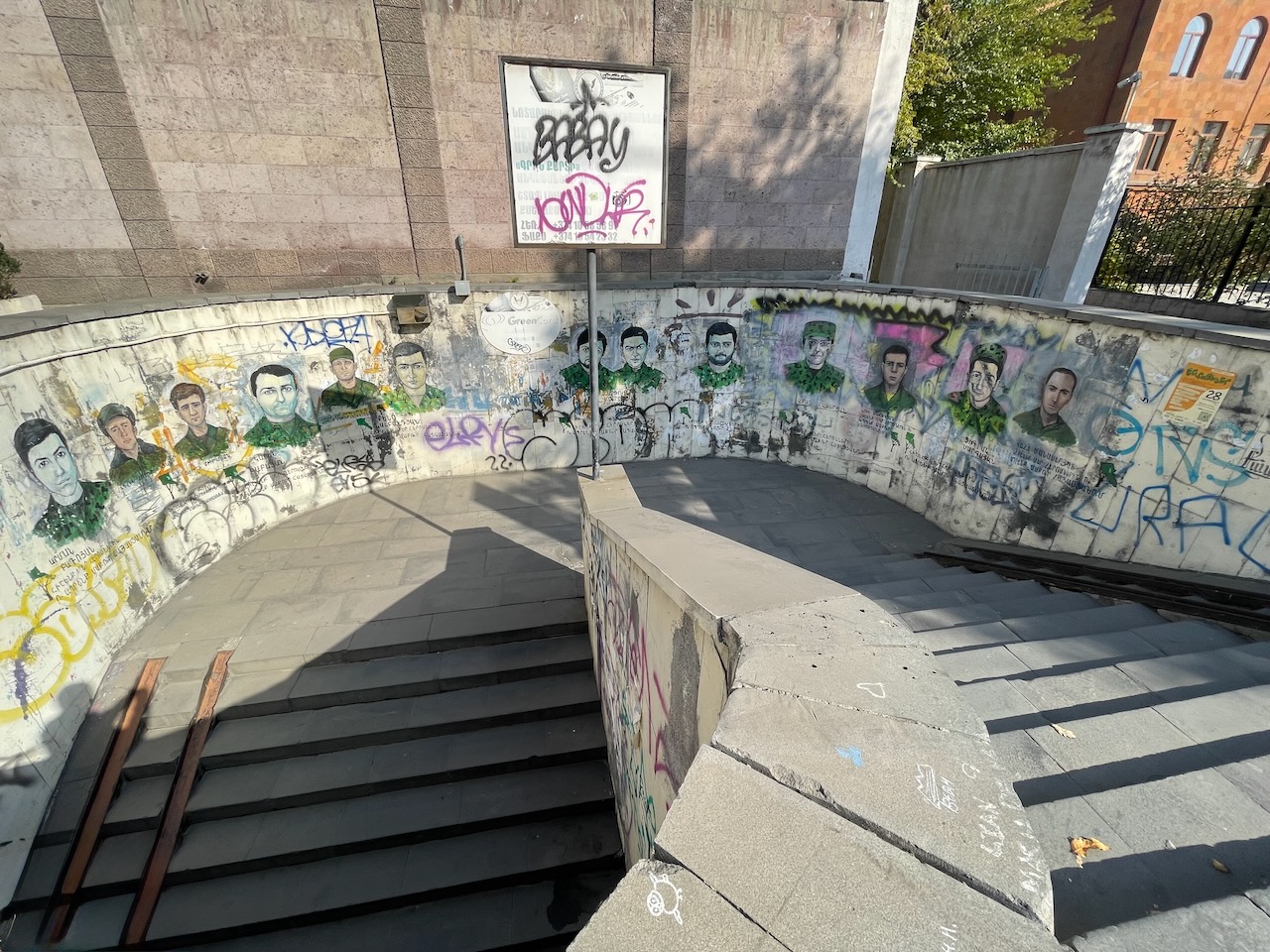
The faces and names of soldiers who fought
and died in the Artsakh war and
deportation, graffitied all over
the capital. (2 Nov. 2024 - Yerevan)
            One cannot help but feel a change in the capital, after the influx of a million internally displaced people on top of the three million residents of the metro area. Cars parked everywhere. Unfamiliar faces and dress. Arguments, fights and much worse over “squatters rights”. Generators catching fire from overloads while municipal electricity is scarcely supplied. The diffidence of what few police and army personnel are still visible. If Lebanon was a DIY country (see my previous post), then this is a DIY war, where the population is left alone to figure things out and survive by their own wits or connections, while bosses continue their decades old, self-serving political wrangling as usual.

            And when the war inevitably ends, what then? Will things magically return to their previous state, and people effortlessly drift back to their flattened villages? Will massacred families and clans magically reappear and reclaim their birthright? How much can one country fool itself? I say “one country”, although Lebanon is not really one country but an amalgam of tribes living within one political boundary. The building and rebuilding of society and the development of a healthy social contract where none are marginalized is one of the greatest challenges facing Lebanon in the coming decades, and is something that has been waiting to be addressed for its entire history.

LebCat 64: Intensely focused on birds
flying around... and certainly aware that
it is only a reflection? But they're so close!
(9 Nov. 2024 - Bourj Hammoud)

            Meanwhile, our friends’ faces bear fearful and questioning looks when we tell them about our change in plans. “You must know something, that’s why you’re going,” they say outright or imply non-verbally. Try as we may, we are unable to assure them that we have no insider knowledge about what is to come, something that contradicts their doubts concerning why we are leaving now instead of later. We cannot fool them into thinking otherwise, nor do we want to. And we hope we are not the fools, either. Only through hope in God can we look forward to their fears being disproved.

            So, without any self-deception, but with faith and hope we lovingly say that in four months we will be willing and able to return and continue our part in that work, “with God’s permission”, as the Arabic saying goes (“bi’izn Allah”).   [LNB]


Monday, October 7, 2024

Trouble in the Air

63. Trouble in the Air (7 October 2024)

A sooty autumn sky dawns over Beirut
(seen from Geitawi - 7 Oct. 2024)

A song from the Negro Spiritual repertoire, sung by one of my favorite gospel ensembles, the “Wings Over Jordan Choir”, has been repeating and repeating in my ear:

Over my head I see trouble in the air.

Over my head I see trouble in the air.

Over my head I see trouble in the air.

There must be a God somewhere.

The song, “Over My Head”, is just one Spiritual from an entire genre that is a rich treasury of cries for freedom from oppression. Yet we see how people and nations effortlessly switch from being the “oppressed” to being the “oppressors” these days, having learned nothing – or having forgotten much – of how and why one must avoid falling into this trap.

Ceremony repatriating - from Rome - the
remains of Cardinal Aghajanian (1895-1971)
(Martyrs' Square - 12 Sept. 2024)

            Here in Lebanon there is constantly trouble in the air. The incessant droning sounds of killing machines (courtesy of the United States) have set the entire country on edge, and not just the “offending party” that our southern neighbors find so objectionable. Similarly, the jets cynically breaking the sound barrier over Lebanon’s north, south, east and west (again, courtesy of the United States) is a blatant declaration to the terrorized Lebanese of all political persuasions that, with apologies to The Outer Limits, “We control the horizontal. We control the vertical.”

            On clear nights I walk out onto the balcony and look up to see dim points of light in the sky over Beirut. Are they stars overhead, or something more sinister? Reconnaissance drones, with eyes probing every square centimeter of the city, are monitoring moves and tracking targets. Mostly invisible in the bright daylight in this area of the city, I keep them in mind when I venture out of the apartment, and tell myself that I, too, am a mere assortment of data for a regime not interested in dwelling in peace and safety, but one bent on annihilating its adversaries, causing more than a little collateral damage (a.k.a. deaths and destruction) along the way.

As the trash piles up daily, one wonders,
"They collect it and dump it... where?"
(Khalil Badawi - 29 Sept. 2024)

            After another night of relentless bombing campaigns (bombs courtesy of the United States, also providing U.S. manufacturers with much-desired performance data), this morning I went out to the balcony to witness a thick blanket of soot covering the city, mixing with the cloud cover of early autumn. Reminiscent of the burning tires of the so-called “Cedar Revolution” of 2019, this morning’s acrid air was a reminder that only a short distance away neighborhoods were smoldering, and high-rise buildings were being reduced to rubble.

The late, lamented "Way In Book Shop",
now selling toilet paper and cleansers
(Hamra - 8 Sept. 2024)

            Everyone is familiar with the adversaries in the conflict of the past year, painted in the press almost exclusively as peace-loving citizens facing evil terrorists. The decades and decades of dispossession fueling the desperate brutality or calculated onslaughts of these groups are set aside in favor of harping on one date, October 7th, as if the world as we know it came into being on that day last year. As a person of faith, a Christian believer, I know that context is everything. But this deep awareness of context is missing from most reporting and commentary, as well as being completely absent from official declarations by the governments conducting their onslaught. It is a willful omission, certainly, because it would necessitate sympathy for those being oppressed, something that would empower the “peaceniks” and necessitate thinking diplomatically, and not exclusively militarily.

            As a Christian, my thoughts also go to the “just war” concept, which is frequently bandied about to justify the excessive military campaign the United States refuses to rein in. What has transpired this past year does not fit very well into the “just war” theory; at the same time these campaigns quite correctly fit the definition of “genocide”. Of course, casuists everywhere continue to enthusiastically argue in favor of the first and against the second, prolonging the torture of Palestinians as well as Lebanese, in order that “we achieve our goals”, as is being repeated ad nauseam. They are committed to destroying the enemies that they had a part in creating in the first place.

Refugee children taking a break from their
sales of tissues at intersections
(Mar Mikhael - 14 Sept. 2024)

            And who are the majority of these “enemies”, numbering well over 40,000? Unlike the 1,200 or so who were murdered a year ago, they are the nameless and detail-less men, women and children who cannot run fast enough from the “evacuation orders” before the fighter-bombers demonstrate their heartless power: rescuers trying to reach the dead and injured; a mother and her three daughters killed yesterday when their house was targeted; a man desperate to tend to his olive groves poisoned by white phosphorus bombings; a two-year-old whose legs were amputated, watching his friends run and play and asking his mother, “Will my legs grow back?” Practically speaking, these are the targets, for the most part.

            In the Old Testament, when God set a new standard for his people in dealing with offenses, he declared “eye for eye, tooth for tooth” (Exod. 21.24) to put an end to the disproportionate response to injuries so prevalent in the society of that day. He also instructed his people to designate cities of refuge, so that those seeking vengeance for injuries would not take it upon themselves to be judge, jury and executioner. Now, it seems there has been a huge step backward from this divinely-ordained standard; and rather than worshiping and obeying Yahweh, the Lord of all, obeisance is being done to Mars, the mythological god of war. This is without even addressing the standard set by Jesus Christ, who acknowledged the Old Testament rule yet developed it into one in which reconciliation is possible (Matt. 5.38-48).

LebCat 63: A wall just wide
enough for a kitten
(Mar Mikhael - 9 Sept. 2024)

            We are spending these days mostly at home, with necessary ventures to buy groceries, and having conversations with friends about the events of each day, or the preceding one, or the coming one. We listen to the fears of young and old, some declaring their loyalty to this besieged and beleaguered country, and others cursing their fate at being here at such a time. Enduring the sounds of earth-shaking bombing not far from home, a friend told me with tears how her seven-year-old son pleaded with her, “Mama, can we emigrate?” It is a struggle for many to keep clinging to faith, to hope and to love, focusing on the Author of those precious gifts.

            The final stanza of that Spiritual illuminates this struggle:

Over my head I see glory in the air.

Over my head I see glory in the air.

Over my head I see glory in the air.

There must be a God somewhere.

…And the prayer given us by the Lord Jesus: “Deliver us from evil (or the Evil One), for yours is the kingdom, and the power, and the glory.”  May it be so, dear God, and soon.  [LNB]

Tuesday, August 20, 2024

System Overload

62. System Overload (20 August 2024)

An artist found beauty in the colors
and shapes of Beirut rooftops and skies
(31 July 2024 - Mar Mikhael)

When you live in a country that makes you provide your own basic services – things that citizens of other countries can take for granted – you have to get good at guessing. For example, though we’ve been enjoying nearly non-stop electricity for over a year following the solar power installation on our building, there are still quirks. When the (currently nonexistent, pun intended) municipal current exceeds the normal 220 volts, a system overload occurs, and we are left in the dark. We figured out that we had to wait until the municipal power “calms down” to something under 240 volts, then switch the main power off and on to resume our electricity. Problem managed (not solved)! Other power interruptions still occur, and we’re still trying to guess why…

Finding a way to get the job done,
and nobody got hurt - I think
(29 Mar. 2024 - Geitawi)
            “Overload” is also a daily issue in a place and a community with a plethora of needs and concerns but a dearth of willing and capable hands. Those who are willing and capable can often (somewhat understandably) be very protective of their time and energy. Others may be on the job but lack the necessary capabilities. Still others are unwilling to learn or change. I regularly wonder how overloading is affecting those around me.

            So many people have left this region (the “dearly departed”) for a more balanced or safer or prosperous life, and those who haven’t (yet) left continue to care for the community and experience more system overload. Since I’m now (in a way) part of this latter group, I try not to think about the load-bearing that we are doing, and just continue to plug along. Occasionally we find a little bit of energy left to train and empower others who have the potential to work for the common good, with the hopes that they will continue to stay side-by-side with us and not take an offramp.

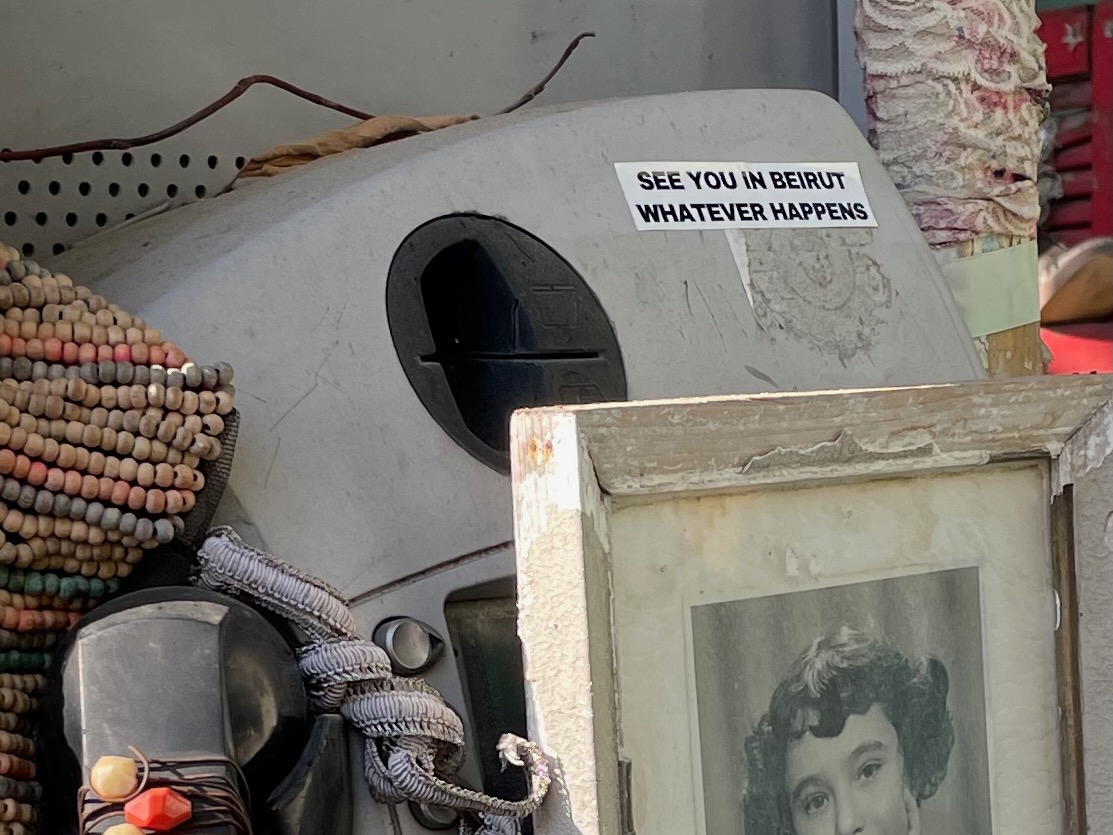
A sidewalk collage with a message...
whatever happens
(10 July 2024 - Gemmayzeh)
            I think that “system overload” also properly describes my thought world of the past year. I have been filled to overflowing with the barbarity and especially the counter-barbarity in the lands “South of the Border” to us; the genocidal onslaught on Armenia and Artsakh (to borrow another butcher’s words, “Who speaks nowadays of the destruction of Artsakh?”) by its neighbors, assisted by the resources of “the Middle East’s only democracy”, and emboldened by the inaction of its “friends”; the lack of depth, political sense or appreciation of heritage of those in power in the “Homeland”; the pervasive indifference and confusion of the Armenian Diaspora towards the existential threats it is facing; the diabolical contradiction between the words and actions of purported champions of human rights; all of this causes a huge “system overload” in my circuitry. Is this paragraph too long? That’s “system overload” doing its thing.

Far from Beirut's din, the peace
and majesty of the cedar forest
(22 July 2024 - Arz el Barouk)
            When surge protectors interrupt an electrical circuit, either the circuit stays off until the “reset” button is pressed, or they wait a few seconds before automatically restoring the current. Maybe all of us need surge protectors to keep us from these varieties of overloading, including the surplus data that is provided to our eyes and brains via our handheld devices. That excess of information, coupled with the lack of time to reflect on so many issues of substance, cause us to fall from our true humanity, in almost as insidious a way as Adam and Eve’s transgression did. And it may explain why in the past twelve months I’ve only managed to eke out one “Nshanakir”, and why I’ve been trying since April to write this one. Seems I’m having trouble locating the “reset” button on my surge protector.

            To switch the imagery and to do some self-correcting, something I tell those who say that they are in a pit or a rut is this: “When you find yourself stuck in a hole, the first rule is – Stop Digging.” Others may advise differently, like focusing on something positive, which may be particularly challenging when the “most moral army in the world” sends its warplanes over Beirut to terrify you, as we have been enjoying of late. Oh, right, stop digging.

            Yet searching for bright spots may be the best method to finding a way out of these many pits and potholes we encounter. Here are a few.

Newly-engaged, a bright spot needing
no electricity! (21 July 2024 - Geitawi)

            One bright spot is the occasional kind taxi driver that Maria encounters in her commute. These are usually “old-timers,” fellows who are not new to the job, who exude an attitude of politeness and caring, something in short supply these tense days. Of course, Maria has a distinct advantage over me in these exchanges, being that she can converse with them in Arabic. If nothing else, it gives me peace of mind and puts a smile in my heart when I hear that one of these gents has been her chauffeur that day.

            Another bright spot happened at a sweet shop on a hot afternoon last week, when I inadvisedly bought an ice cream cone. Almost instantly it turned into a colorful series of tributaries streaming down my hand onto the sidewalk. An employee rushed out of the store and put a stack of tissues on our table, then grabbed my cone and plopped what was left of it into a cup, speaking as if to reprimand the ice cream for making such a mess all over me. She shooed me into the store to wash up at the sink behind the counter, then made me tell her what flavors (of Arabic ice cream, of course) I had ordered. She had the ice cream server make up a new order for me in a cup, of course, with the cone sticking out of it at a rakish angle. After enjoying my ice cream I went back inside to thank her. “Walaw, walaw,” she politely dismissed my thanks. Based on her awareness and consideration, I figure she may have even told the guy inside to make sure to use cups whenever serving ice cream during Lebanon’s glorious summer heat.

LebCat 62 - "Will act cute for food"
(22 July 2024 - Deir al Qamar)
            It’s just like Fred Rogers’ mother told him as a little boy when he was frightened: “Look for the helpers. You will always find people who are helping.” Bright spots are there for those who are looking for them.

            Of course, the brightest spot was indubitably Sevag’s annual month-long visit. It became even brighter when his girlfriend Rhoda arrived from Pennsylvania the last week of his visit and they surprised us by exchanging rings in the middle of a kebab lunch with dear friends. The happiness and brightness quotient soared that day, and there was no system overload anywhere to be found! A few days later we held a formal engagement ceremony in the Armenian tradition, placing the wedding bands on their right hands and invoking God’s blessing on their growing relationship.

            Thinking upon such bright spots definitely help us to bridge the “power interruptions” of these days!   [LNB]