Showing posts with label Armenian language. Show all posts

Wednesday, August 23, 2023

Oh Wow Fives

60. Oh Wow, Fives! (23 August 2023)

Faces of loved ones sacrificed in the 2020
Port explosion – a pain and an injustice
continually ignored by authorities.
(4 Aug. 2023 - Beirut Port)

I went into a store here in Beirut to buy something, and as I prepared to pay in Lebanon’s official currency – the U.S. dollar – the cashier saw I had taken out $5 bills and exclaimed  (in English), “Oh wow, fives!” Her delight was due to the fact that as businesses, great and small, abandon the use of the Lebanese Pound, they are always in need of small denominations of U.S. currency to return change to their customers. I provided a much-needed resource to a small business, as people struggle to make their way through daily life unassisted by any authorities, swimming in that morass of disinterest and disconnection that is the country’s ruling elite. Courtesy of our son Sevag’s annual visit to us here in Lebanon, we enjoy the privilege of having small denominations of U.S. currency. Here I was, the hero of the moment, with my crumpled and discolored images of Abraham Lincoln, bringing a moment of joy in the middle of the hot, muggy summer.

But seriously, can't you tell that the
infrastructure has improved?
(11 June 2023 - Bourj Hammoud)

            One of the most distasteful aspects of my life today in Lebanon (though by no means the only one) is the necessity to focus or fixate on monetary issues. Lebanese, especially Beirutis, have always made currency exchange rates, values of precious metals, gasoline prices and more their daily small talk. Though there is so much more to life, though much greater depth is possible in conversation, but this is what one hears from each passerby, from men gathered at curbsides, from women catching their breath over a cup of coffee: the never-ending stream of analysis and “expertise” that has supplanted hopes, dreams and ideals – the very things that young and old should be actively investing in their country in order to push it toward a brighter future. Instead, materialism, reinforced by circumstances created by those in power and their cooperative external powers, is pushing the brightness out of the country just to dissolve in diasporas around the world.

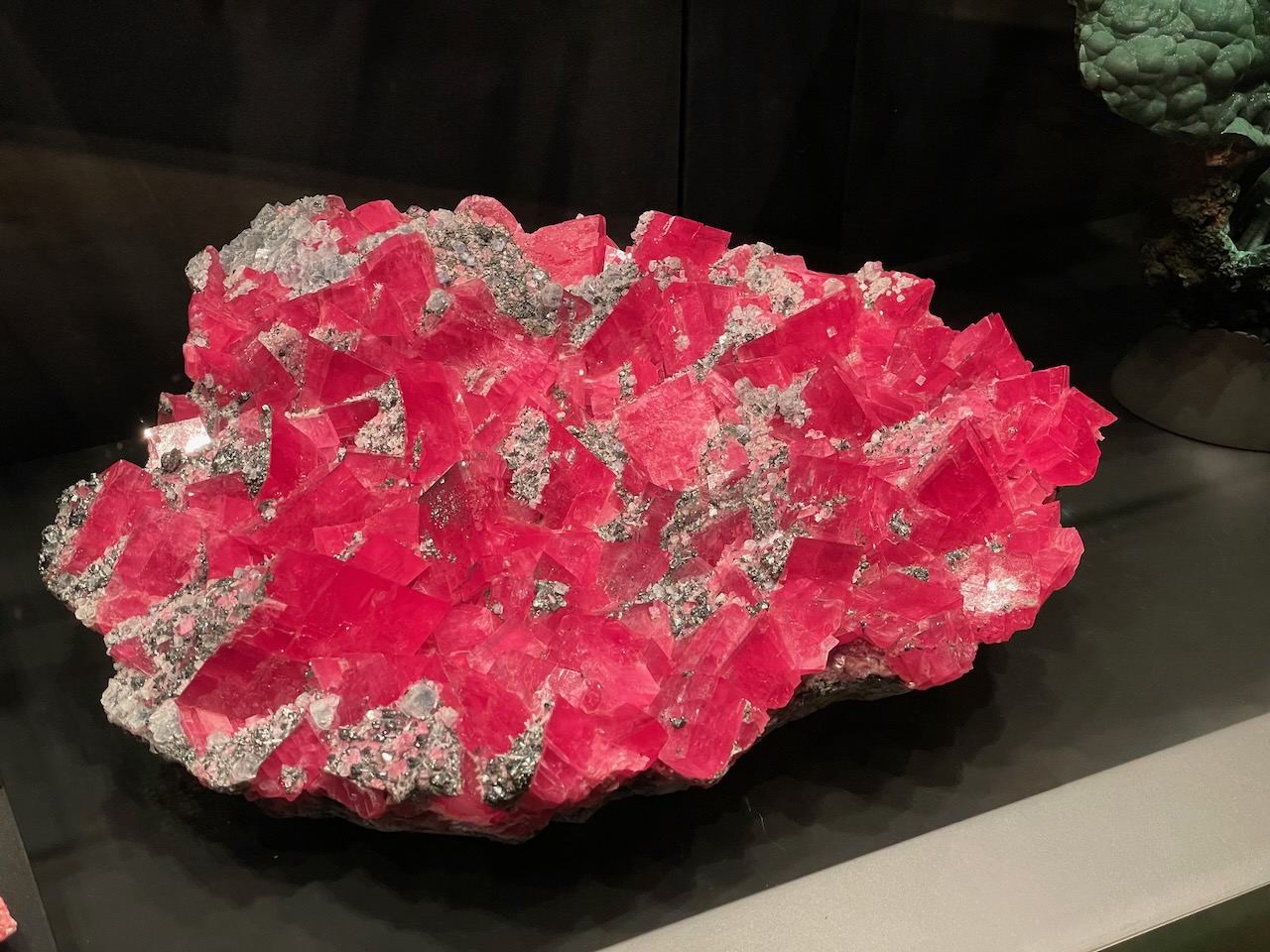
Watermelon? Strawberry gelatin? Sevag and
I puzzled over this one at the Mineral
Museum. (1 Aug. 2023 - Mathaf, Beirut)

            The impact of all of this upon the Armenian community in Syria and Lebanon is what troubles me the most. As the Dons of this kleptocracy look for new ways to fill their stomachs – most recently by a farcical “helicopter tour” of the new oil-drilling rig off the Lebanese coast –small and “unimportant” groups such as the Armenian community are left to fend for themselves. It is interesting to see how a country can continue to appear as a functioning entity while running on “autopilot”. A bit of electricity here, some trash collection there, fixing a water main when it breaks, leaving NGOs to install street lighting and traffic lights, and repair the worst potholes as highways steadily deteriorate, while many, many employees in the public sector come to work but once every one or two weeks, as their monthly salaries hardly cover the cost of transportation – this is today’s Lebanon.

When gas prices rise too high, there are
still great ways to make use of your auto!
(3 June 2023 - Ainjar)

            We’ve been noticing one of the semi-comical expressions of that while driving around various parts of the country with Sevag. It’s the “LPO mode” that auto owners have entered: “License Plate Optional”. Earlier this year I began to notice an absence of license plates of some cars on the road. Now it is probably up to 5 to 10 percent of cars. The office that processes car registrations is clearly not functioning. But in classic Lebanese manner the population is facing the situation with humor. It’s considered a badge of honor to drive an LPO car, even to the point, some say, that people will remove their license plates just to be seen as part of the LPO club!

            This summer I walked into a store in Ainjar, the mostly-Armenian village in the Bekaa valley. Whenever we’re going to be there for a few days I’ll stop in to pick a thing or two, and often times, since this is Ainjar, and since, due to my position, I can’t remain anonymous, I’ll run into people I know including people who know me since the 1990s, or the 2000s, or current times. The lady behind the counter, who does not belong to one of the aforementioned groups, asked me, in Armenian of course, “Are you Ainjartsi (her intent: “originally from Ainjar, but visiting from overseas”)? My interest piqued, I said, “No, I’m not. Why do you ask?” With no hint of malice or sarcasm, just puzzlement, she said, “Well, lots of people are very happy when they see you.”

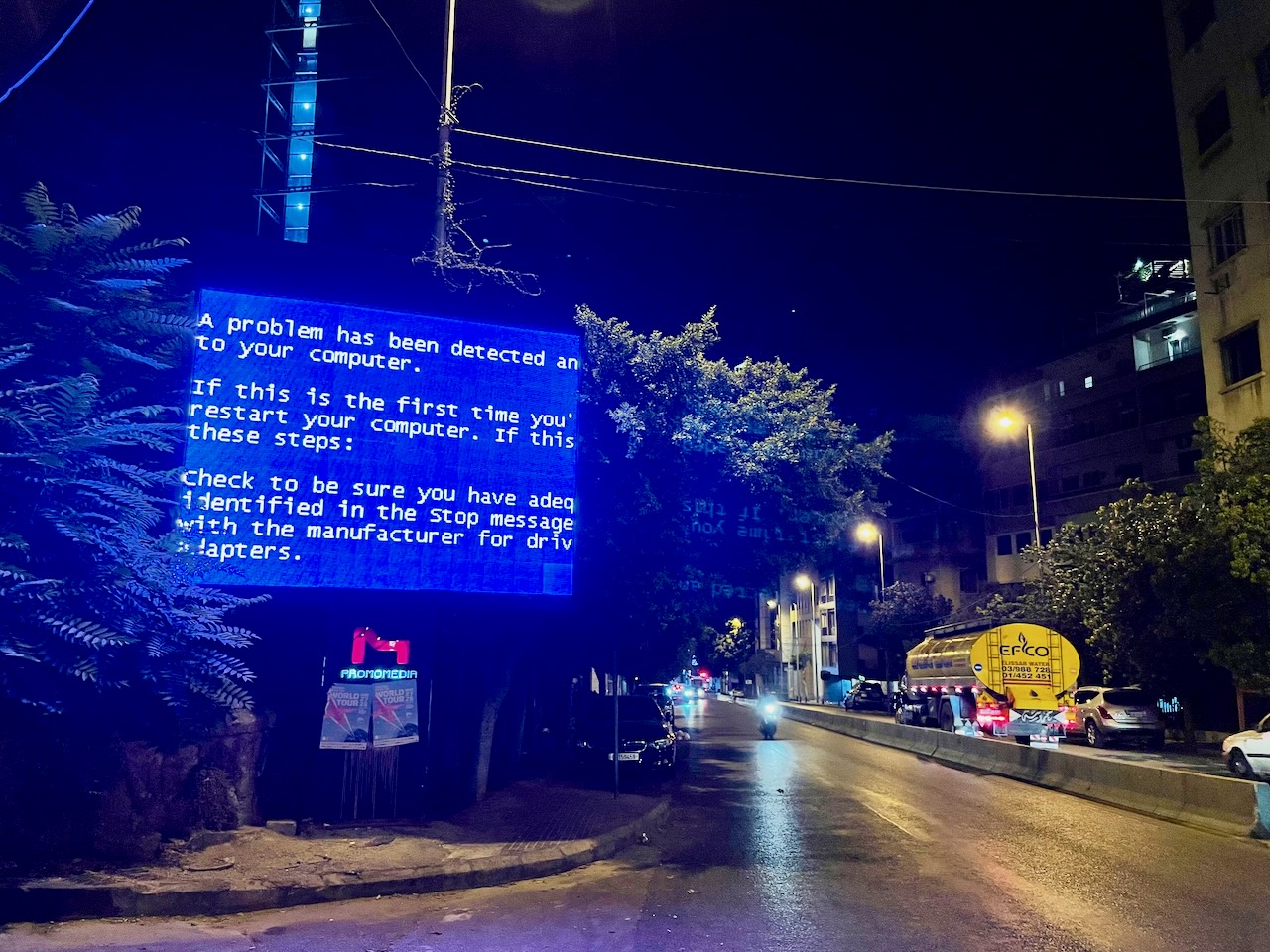
Providing an unintentional glimpse into
the dysfunction of the country.
(4 Aug. 2023 - Tabaris, Beirut)


            Amid such a negative environment I’m glad we can have positive encounters with those we meet, and grateful that our casual interactions can be uplifting. Certainly, this is not something we can automatically produce: without God’s encouragement in our times of frustration and discouragement we would have little to share with others. As well, without organizations backing us up it would be a challenge to remain positive in the enforced misery people are subjected to each day. So, I don’t mind being mistaken for an “Ainjartsi”, and I don’t mind that (most) people are happy to see me!

            During the summer a small group of young Lebanese-Armenians in their twenties, on their own initiative, approached Haigazian University in order to present a film series, seven items in all, ranging the gamut from practically “home-made” to professionally produced. Their emphasis was on increasing the public’s knowledge of Western Armenia and elevating the use of the Western Armenian language. They delivered their introductions each evening in flawless Western Armenian as well as English, and it was clear that they cared deeply about the entire project, and plan to expand their efforts to develop other materials that would interest young Armenians in their heritage, using modern pedagogical methods in a technologically accessible way. The name with which they christened their platform is “Hnarti” /Հնարդի, combining the Armenian words for “old” and “contemporary”. Despite the hemorrhaging of young blood from the Middle East, vision and vitality can still emerge from this community.

LebCat 60: Every pharmacy should have a
watchcat at the door.
(14 Aug. 2023 - Hamra, Beirut)

            In eight weeks I’m hoping to bring the Armiss Choir back on stage to sing one or two numbers. Hopefully a couple other Lebanese choral groups will also perform. A colleague and dear friend has just published a book on a century of Lebanese-Armenian choirs (1920-2020). The dedication of the new book will happen in October, and part of the dedication program will be vocal selections. From real choirs singing in harmony. Live – which is how music is best done. So, it’s time to get things organized and underway, and to invest a bit more in the health of the country and in a couple of its modest but essential components, that is, the arts, the Lebanese-Armenian community and the Armenian Evangelical Church.

            Finally, something to talk about besides currency rates!   [LNB]

Tuesday, February 28, 2023

Dead Foxes

57. Dead Foxes (28 February 2023)

Commemorating 35 years since Azerbaijan
began targeting Armenians for
extermination. (26 Feb. 2023 - Beirut)

Earlier this month, while driving along the coastal highway, I slowed down behind a line of cars and trucks exiting and noticed an animal lying alongside the roadway, obviously dead. From a distance I could tell it was too large to be a cat, too small to be a dog, and my guess was confirmed as I slowly crept alongside… a red fox. I was happy and sad at the same time; happy that there is still wildlife in this overbuilt metro area, and sad that it met this fate. I realize that those in rural places might not share my dismay, considering the losses they may incur because of foxes. Here this death is sadly poignant. While actual foxes become road kill, human foxes are left alive. And the “fox hunters” trying to pursue this latter kind are systematically eliminated, and the foxes pretending to be humans continue their sadistic rule over the henhouse.

Empty since the port blast, Lebanon's electric
company building - gutted, just like the service
it provides (20 Feb. 2023 - Mar Mikhael-Beirut)

            One of the more insidious of that species is now facing a “natural disaster” of his own making. Over the years he granted waivers for poorly constructed housing in exchange for ballot-box loyalty, so that he could establish full political control. That narcissism transformed the tragedy of this region’s February 6 earthquake into an unmitigated disaster. Will he be held accountable for the crimes he is now heaping upon the corrupt lower-level operatives? Not if the spin doctors around him can do their psyops job well, and transform this fox’s image into, let’s say, that of a pussy-cat. A devout, embattled fighter for the rights of the ordinary citizen. A strong leader his country needs to rebuild it and make it proud. Any of a raft of addictive lies that people in so many lands believe, sad to say.
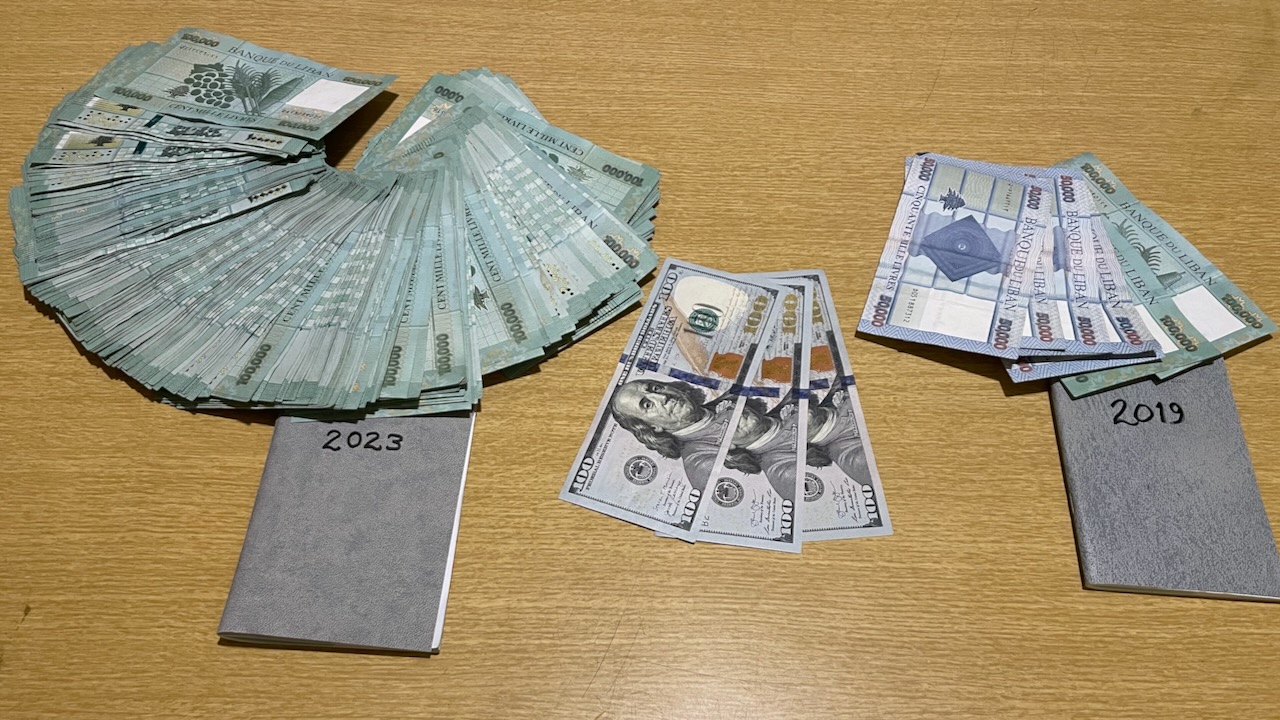
The value of $300 in local currency, in
2019 (right) and 2023 (27 Feb. 2023 - Beirut)


Meanwhile, others try to dodge the traffic that would run them over and put an end to their positive impact. Though contributing to the betterment of society, and though they are not the ones able to cause a fundamental, systemic change in the status quo, yet their activity is nonetheless significant in the long term. Unlike the wealthy foxes who continue to find ways to launder their money or sink it into building more empty buildings in the capital, they are a different sort of investor. They sink their time and effort into human capital; into teaching students to think, into inculcating character and faith into young people, into creating cultural riches to feed the souls of generations yet unborn. The anniversaries of the region’s Armenian institutions (churches, schools and so forth) are reminders of the deep investment our forebears made to rebuild and sustain a broken nation after the Genocide, making the Middle East’s Armenian communities the powerhouse of the Diaspora. And it continues to serve in that capacity, feeding and nurturing Armenian identity but with a frighteningly small number of visionary laborers engaged in this crucial work.

As spring approaches, tree branches and
neighborhood generators begin to
sprout offshoots
(27 Feb. 2023 - Bourj Hammoud)

            Who are they? First of all, they are teachers of all subjects and in all manners. Especially focusing on language, history and culture, they might be using state-of-the-art methods and materials, or they might be solidly stuck in the 19th century in their approach, but at least they are making an effort. Others who develop new, relevant materials for various grade and knowledge levels are also part of that army, along with those who digitize existing materials (a special shout-out to the Armenian National Library in this regard). Then there is anyone making a difference in just one child’s or adult’s awareness or self-awareness of his (or her) identity as an Armenian. I would also include “influencers”, who know how to make effective use of information media and place it or disseminate it in easy-to-find locations. Really, in our world so full of foxes, all Armenians should be engaged in this effort on the micro or macro scale, and spend less time self-absorbed in things that do not satisfy (see Isaiah 55.1-2) or edify, such as self-promotion on social media platforms.

A reminder to continue being visionary,
despite it all
(28 Feb. 2023 - Gemmayzeh-Beirut)

            I’ve noticed that Armenians (myself included) tend to put things in life-or-death terms; maybe it is because Armenians, like nearly all minorities, face life-or-death realities much more frequently than majority populations. Majority populations and those intent on a homogenized, globalized mono-culture, tend to object to this existential angst, seeing it as unnecessary (which it isn’t) or disruptive (which it must be). The angst felt among Armenians here in the Middle East is because they are battered and dishonored, treated as collateral damage by the major foxes and their sub-foxes who play at political and financial war. As it was a century ago, so it is today. Enabled by a disengaged international community, foxes circle around Armenia and Artsakh, drooling over the thought of ruling over an emptied henhouse, expertly using propaganda, lies, threats and a sham “protest” to lay hold of the remainder of the Armenian homeland devoid of Armenians.

LebCat 57: Hard at work receiving phone bill
payments. This may explain a few things about
the system. (28 Feb. 2023 -
Geitawi-Beirut)
            When the Lord Jesus faced off against the oppression his people were bearing, he dared call the ruler of that day a “fox” (Lk. 13.32). It was a calculated, public insult, and a challenge to his duplicitous authority. Despite the deadly actions of all manners of foxes, God will accomplish his purposes, he will bring hope and healing to the downtrodden, and will revitalize life within all who trust in his Son.   [LNB]

Saturday, May 28, 2022

Living in DIY-land

50.Living in DIY-land (28 May 2022)


A panel here, a panel there, and Nejmeh
Square is proclaimed "open"...
(26 May 2022 - Beirut)

           In most places in the world, people pride themselves on their DIY (do-it-yourself) skills and experience. Why have other people build or fix things, when you can do it yourself? And you get a greater appreciation for how things work, and the confidence that comes from knowing that the quality of the work is up to your personal standards. Of course, this is a “first-world” issue, because in much – if not most – of the world there is no alternative to doing it yourself. It’s like those who go to the gym to stay in good physical shape because they no longer move, bend, lift, pull, push or sweat as part of their day’s work… contrasted with the rest of the world whose survival depends on their physical engagement with every aspect of their lives.

The elections came, and the elections went,
and now everyone waits to see what's next.
(14 May 2022 - Geitawi, Beirut)
            And then there’s Lebanon. I need to be circumspect about this because I signed a paper promising that I would only say nice things about Lebanon. This is a DIY society for very different reasons than the two categories mentioned above. People do a myriad of things themselves because either the function in question was never done by the authorities, or because the functions have stopped functioning, and now it’s up to you to do things like store your own money, or generate your own electricity, or import your own medicines, or provide security for your family, and so on. And if you examine the extensive network of services for the refugee population (probably a quarter of the total population), you will find networks of aid agencies, each with its particular emphasis. Essentially, today’s population is living in DIY-land.

It's amazing; every day it fills up, and every
night it gets emptied! What manner of sorcery
is this? (16 May 2022 - Geitawi, Beirut)

            There are also many functions that were never done by the state, which explains why there are so many organizations identifiable by a particular socio-religious coloring. Let’s keep in mind that this was a “gift” left by France as it ended its mandate over Lebanon in 1943; namely to create a government consisting not of capable citizens, but of mandated religious representatives, in order to make it as difficult as possible for any one group to have authority over another. Or that was the plan, anyway. It ended up being a wide gate to nepotism and cronyism, and public service jobs are bloated by people getting paid to fill quotas, not to provide services. It also made each religious grouping look out for its own, reinforcing people’s view that only one’s own group will look out for them.

Anyone want to take some for DIY crowd
control? (26 May 2022 - Beirut)

            And so each socio-religious community has its own old age home (Armenians have CAHL) and other hospital services (Armenians have the Armenian Sanatorium, and Armenian Evangelicals used to have the Christian Medical Center – housed in the building where we now live). Armenians as well as others have an assortment of relief and socio-medical centers catering mostly to their own groups. They each have their network of parochial schools and institutions of higher education. They have their own press, and their own television and radio stations. They also have their own demographic regions, though in the pre-civil war days there was more admixture between groups, blurring those lines a bit. There is not much one can point to and say, “This is for all.”

DIY noise control by the unfortunate residents
of the boisterous (until 4 a.m.) pub street, "rue
Armenie". (26 May 2022 - Mar Mikhael, Beirut)
            So, the parliamentary elections came and went. And there were small shifts in power bases, including some disorganized “revolution” people. But few are expecting significant changes. In an act of low drama, the outgoing (who is also the incoming) speaker “approved” the removal of metal and concrete barriers that have surrounded the parliament since the uprising began 2-1/2 years ago, as if to herald a new day of openness and prosperity for Lebanon and its capital city – supervised by the old guard. This, as the simple majority of hungry and unemployed citizens (and others) turns into an overwhelming majority. And as the currency continues its death-dive, something that economic experts consider to have no economic basis for occurring, only political. And as those who impoverished Lebanon continue to claim to be her saviors.

Preparing KCHAG for energy independence.
(22 May 2022 - Monteverde)

            In recent days government officials have continued to express the DIY-ness of today’s Lebanon. Some obscure decision was taken by the Central Bank, and the currency magically improved. A new electronic platform was released for shoppers to report price-gouging at supermarkets. Bank heads are advising people not to keep their cash under a single mattress, but to spread it out throughout all their bedrooms. Governmental security heads are warning people to keep their valuables in various places, and not just in one old purse in the back of a closet. The population has gradually resigned itself to the permanent absence of municipal electricity and the ever-increasing cost of diesel fuel running the DIY generators (called “ishtirak” – see Jan. 2022 blog: “Power-Hungry”) in each neighborhood, so that throughout the country solar panel installations are sprouting up, raising the hopes of some that they will be able to live somewhat “normally”.

The ultimate in DIY-ing:
a flea market! (26 May 2022 -
Nor Hadjin, Beirut)
            Surveying such rough terrain, in which the country’s DIY-ers live either with endless discouragement or self-delusion, or alternate between the two, the points of light are challenging to discern. More than any other place, I see them among teachers and others who express a heartfelt commitment to serve others. In the case of teachers, there are some so discouraged that they can no longer give what a teacher must give and a student must have. But there are many others who continue to challenge their students to think and grow, facing not just the negativity of students who say, “What’s the use?” but also that of the discouraged parents who transmit their hopelessness to their children. Once the complaint was about the ”burden” of the Armenian curriculum; now the entire curriculum is often questioned by those who only want to find a way out of their misery. Teachers are the front-line workers, who should be given standing ovations at the end of every school day, for continuing to believe in the future of the children they educate, and especially for those teachers who continue to believe in the importance of an Armenian education (a topic for another time).

LebCat 50: "If you want to run a store the
right way, you have to do it yourself!"
(17 Mar. 2022 - Geitawi, Beirut)
            Along with teachers being front-line, essential personnel, there are also those committed to serving others, whether in health care, or social work, or ministry, or even just being a good neighbor, keeping an eye out for those whom they see silently suffering. They, too, should be regularly applauded and encouraged. A doctor recently told me, “I should thank the country for teaching me how to prepare for a retirement without any money!” But he and so many others continue to use their skills and their hearts to help those around them. Lebanon is the ideal place to come and learn what it means to serve others, and to receive your reward from the One who came not to be served, but to serve. Though it is easy to slip into discouragement ourselves, Maria and I try our best to be encouragers. This is not a DIY job, because we don’t have the resources to last. Surrounding us there is the church, whose members rely on the prayers of many and renewal from above. And there is Christ, who Did It Himself, going through all of this, and more, to bring light out of the darkness!   [LNB]

Monday, June 1, 2020

Sa Koronyan


35.“Sa Koronyan” (31 May 2020)

A March windstorm toppled the cross from the
red cupola of the Armenian Evangelical Church.
(31 May 2020 – Nor Marash - Bourj Hammoud)
Over and over again, we are hearing from medical and epidemiological experts telling us, to the best of their knowledge and experience, that we are going to be living with, not defeating the Coronavirus. It will be just one more thing that we have to take into account in our daily routine. What that means in terms of our lifestyles, our long-range plans, the economies and habits of families and countries, is still to be determined. How it will decimate minority communities, is also to be determined, although we are already getting a taste of what is to come. The Armenian community here in the Middle East, such a crucial guarantor of the continued existence of the Armenian people the world over, is facing daily traumas as it fights for its existence. In the past few days we lost yet another Armenian school, the St. Agnes Armenian Catholic School in Bourj Hammoud, while two weeks ago the last Armenian School in Jordan closed its doors. Yesterday I read that one of the two local Armenian FM radio stations was forced to go off-air and continue (hopefully) as an Internet-only station. In at least as critical a situation as we face today, Middle East Armenian families a hundred years ago went without many things, including shoes and new clothing, in order to maintain their schools and culture, and they produced vibrant and tough generations. But today people’s values and priorities are… not the same.
Experts report that a majority of mini-pizzas are displeased with
the direction of the economy. (9 May 2020 – Watwat - Beirut)
            We were scheduled for a few months of home assignment (or “furlough” in missionary parlance) in the U.S. later this year, beginning in late summer, in order to travel and inform interested church groups about the work of our partner organizations (the church union and the university). Now, all of that has come under question, and our sending body is studying the situation, examining what governments and the air travel industry will do to recover from their current state of disarray. Making any sort of prediction about travel, or saying anything else about what life will look like “A.C.” is a fool’s errand. (“B.C.” = “Before Corona/ Covid-19”; yet although it is inaccurate, I use “A.C.” = “After Corona”; it’s a better abbreviation than “W.C.” = “With Corona”, no?)
Reaching out to those in need now takes the form of leaving
clothing and shoes where they can be taken without
drawing attention to oneself. (25 May 2020 –
Khalil Badawi - Beirut)
            Tomorrow Maria will be venturing outside our home for the first time in 2 months, for a health checkup and a stop at Haigazian University. It will be interesting to hear her observations on this “release from captivity” when she returns. I know that I often dread venturing outside our home, particularly with all the protective items I am forced to wear. The Lebanese government now mandates wearing a mask when going outside, and is stressing the need to keep infection numbers low because of the lack of hospital capacity for those needing respiratory care for the virus.
            Nevertheless, my excursions outside the house have been more frequent, and not always negative. Three weeks ago a friend was driving me to do some grocery shopping, and I asked him to run by our old neighborhood, where we lived 20 years ago. What a refreshing visit, seeing old friends – the baker and the greengrocer – who asked about Maria and the boys by name, and were truly happy for this quick visit (and exhibited boundless patience with my stumbling Arabic). When we see how much we matter to people like this, who seek nothing of us but friendship, that’s when we feel truly alive, truly connected to this place.
Coronahair and coronahaircut. Apparently the barber
was quite satisfied with the job he did.
(29 May 2020 – Geitawi - Beirut)
            If it is permissible to say, I intensely dislike this plethora of online meetings and digital gatherings that are sometimes touted as the “new normal”. I doubt that it’s a generational thing, because I know of young people who say the same thing, and like me do not reject the technology, but do not also consider it universally applicable. The majority of communication that is done nonverbally is virtually (pun intended) eliminated from these electronic methods, rendering human interaction shallower, and distances farther. It’s not a small world after all. My sister as well as my son, both school teachers yet of different generations, realize how little real teaching and learning happens in this “virtual classroom space”. They know very well how struggling students need the physical presence of an instructor who can “read” their body language and step in with the necessary support, encouragement and creativity to help them move forward. This also is the case with online worship experiences, something in which I have been heavily involved in the past 2-1/2 months. We are enduring the pain of human separation, a pain that will remain for the foreseeable future, as long as “social distancing” is required.
LebCats 35: Lebanon’s success in stemming the
spread of the virus is due to high levels of
cooperation – even among cats – with social
distancing principles. (31 May 2020 –
Geitawi- Beirut)
            A fun project that came about because of a need for musical content in our worship broadcasts was a “virtual choir”. For the nine participants it was our first foray into this type of production, where the musicians, each in a different part of the world, collaborated in recording a song. Listening to the piano track we sang our parts into our computers or phones – some of us singing more than one part. Then the files went back to Washington state from Oregon, greater LA, Philadelphia and Beirut to the producer/ accompanist, who turned them all into one wonderful online vocal ensemble. Way to go Shahan, Arek, Sako, Palig, Sevag, Garin, Talar and of course Maria and me! Not a bad way to deal with this “A.C.” world!
            As I was walking around Bourj Hammoud recently, searching in vain for an open money-exchange house so that I could obtain local currency and buy some groceries, something struck my ear as one Armenian woman was commiserating with another over the current social and economic situation. She said (in Armenian), “Sa Koronyan yete asang sharounagvi…” (If this Koronya continues like this…). I was past them a few steps before I realized she was not referring to a perfume, but had Armenianized the word “corona”. Maybe the Armenian community will be able to adjust and even thrive in this “A.C.” world after all.   [LNB]

Monday, February 17, 2020

Exhale


32.Exhale (16 Feb. 2020)

A building collapse due to decades of neglect by its owner.
Strangely, the ground-floor bakery survived due to renovations
by its renter. (29 Jan. 2020 – Tabaris, Beirut)
For about four months the country has been holding its breath. Actually, long before that the country had been practicing holding its breath, as the economy and policies of government upon government sagged and sagged over the years, to the point of rupture. This past week the newly-formed cabinet, still the target of some protests, received approval from parliament to begin the work of saving the country from total collapse. Lebanon has always convinced itself that it is too important for the countries of the region and the West to let it fail. And therefore, corruption, theft and mismanagement of the public sector have ruled the day for as long as people can remember. Well, surprise!
            People write and ask us how we are managing with all that’s going on in the country. Aside from the psychic stress everyone endures, we face no particular hardship, due to the special nature of our employment. But how are actual citizens faring? While walking through an upscale neighborhood last week I noticed a grown man standing next to a dumpster carefully going through garbage and removing what was edible to put in his bag. Heretofore I would only see scavengers searching for scrap items to recycle or sell; only after passing him did I realize what I had just seen. He was wise to choose a dumpster in that neighborhood, where the likelihood of good quality and quantity food waste is greater. Yes, poverty is steadily advancing, and is moving more people squarely into nutritional insecurity. This is the picture in the city, anyway.
Upper row shows the early days of the uprising, with mere
barbed wire festooning the Grand Serail and Banks St.
Lower row shows the serious concreting of the centers of
government. (Jan. & Feb. 2020 – Riad el Solh - Beirut)
            Among the political elite – and there’s an overabundance of them (too bad Lebanon can’t export them to raise a little cash allay part of the national debt) – it is in fashion to say, “Oh, I’m also against corruption. We need to join together and find out where all these stolen funds are, and make new laws, blah, blah, blah.” Lebanese who hear these speeches are disgusted by them, because of the well-known secret that those who today rail against corruption and incompetence are guilty of the very things they decry. The relevance of the Bible appears once again in these circumstances, perfectly described by the Apostle Paul: “You who teach others… do you teach yourself?” (Read Romans 2.21-23 for an excellent assessment of today’s “speechifiers”.)
This is what protestors think of Lebanon’s banks,
and what they did to express that sentiment.
(15 Jan. 2020 – Hamra - Beirut)
            Another casualty of the times is health care. If you have a chronic condition that requires regular medication, you might have to go without it for a couple of weeks until a new supply can be imported. If you are experiencing chest discomfort, you might brush it off and not see a doctor, as the healthcare system does not cover diagnostic assessments. You will eventually see the doctor, but only after an ambulance has brought you to the emergency department. Or the other door across the way. In response to all of this, more than a few doctors and some hospitals have set up weekly low- or no-cost consultation hours to help those falling through the cracks, and a number of them are even waiving their surgical fees for the truly poor. But how much longer can private citizens and organizations bear this burden?
            For years Armenian agencies have been used to taking up the slack as best they can in the absence of proper governmental services. Social service agencies have networked themselves to serve the many low- and middle-class Armenians (plus in recent years quite a few Armenian and non-Armenian refugees from unrest next door and next door to next door). The income lifelines these agencies have relied on are becoming increasingly problematic, while those they are caring for continue their need for care, irrespective of whether its being paid for.
            Also, for decades the only reliable retirement plans for Lebanese have been to either receive remittances from their emigrated children or move overseas to live with them. A third possibility exists: to keep working until you “drop dead”. No wonder there is a lack of seasoned retirees in the churches, a demographic that is the backbone of any healthy ministry.
And this is what many people feel about living
in Lebanon. (15 Feb. 2020 – Geitawi - Beirut)
            Two days ago was the fifteenth anniversary commemoration of the assassination of PM Rafiq Hariri. Sevag, Maria and I were here at the time of that explosion, and we each have our memories of that momentous day. Schools, government offices and businesses close annually in observance of the day (and not because of St. Valentine). This year’s event featured the recently-resigned PM and political heir of his assassinated father, working the crowd as if addressing a campaign rally. The event also featured a video review of what’s happened to the country and its economy for the past 30 years, with the main message of: “It wasn’t my fault”. Each new event that occurs just makes this tragi-comedy more… interesting (for those drama fans out there).
            Actually, political assassinations are a way of life here. If you look up “Assassinated Lebanese” you’ll find a whole page dedicated to this, listing at least 36 public figures eliminated here in the past 100 years. And this doesn’t include attempts that only maimed their targets. If the government declared a holiday for each assassination, my guess is that an entire extra month the country would be closed for business!
Offstage at the C.E. youth event, anxiously reviewing their
lines, right? (11 Jan. 2020 – Armenian Evangelical Church
of Ashrafieh, Geitawi - Beirut)
            Lest it appear all gloom-and-doom here, in the midst of all of this the Armenian community is managing to continue its spiritual, educational and cultural output. Recently the Gulbenkian Foundation in Portugal announced an initiative to develop the teaching and use of Western Armenian in Lebanon, which, followed by Syria, are the only places in the world where Western Armenian is a viable, daily language of family, education, and commerce. It may seem strange to westerners, or to those steeped in western thinking, that one of the callings of the Armenian church in all its forms is to maintain a strong cultural sense as it goes about its spiritual mission. Although it is valid throughout the Diaspora, it is nearly impossible to see by those who embrace the majority culture. For them, it appears that the church should be on a purely spiritual mission, often not realizing how their own Christian outlook is so deeply grounded in the dominant culture surrounding them.
            In January Armenian Evangelical youth presented (in Armenian) a post-Christmas view of the main players in Jesus’ birth narratives, reflecting not only on what was to come for them, but also helping young people think about what is to come right here where they are, and what their attitude of faith should be. I was grateful to be involved in the planning, and was thrilled to see the church filled with over 150 youth that night.
LebCat 32: This is my laptop now, since you refuse to give me
lap space. (24 Jan. 2020 – the late Beirut Cat Café,
Mar Mikhael - Beirut)
            Two nights ago a newly-published booklet containing a dozen photos and lyrics of the great Gomidas (you can look him up under “Komitas”) had its public release. The main speaker, Shaghig Khudaverdian, a lecturer at Haigazian University, who stated that the essential task for any people wishing to survive is to speak their own language and sing their own songs, and thereby continue to breathe on this earth. And as if to demonstrate this, three different Armenian school choirs (including Armenian Evangelical) took turns on stage to sing selections from Gomidas’ pen. Afterward, I had the honor of joining Armenian Apostolic and Armenian Catholic representatives in congratulating the three choral conductors, and then dedicating the publication by pouring wine over it (in Armenian the word for this literally means “wine-dedication”).
            So, here’s a toast, which in many languages, including Armenian, goes: “To life!”   [LNB]