Showing posts with label Armenians. Show all posts

Friday, November 25, 2022

Waiving the Flag

55.Waiving the Flag (25 November 2022)

Preparing for school celebration of
Lebanon's Independence Day
(17 Nov. 2022 - Geitawi, Beirut)
Now that World Cup football (soccer for you Americans) has taken over the world for the coming four weeks, enabling some pleasant diversion from the strangeness of these times, Lebanon is once again subjected to the ineptitude of its kleptocracy. No government here means no decision-making regarding broadcasting rights for the World Cup on state television. Which means that football fans, of which there are many, will not enjoy a month away from talk shows reviewing their all-too familiar daily miseries. Daily cheering could provide positive, natural chemicals to bring health to the tired bodies in this country, without having to scour pharmacies for artificial remedies. Instead, a very few people with the financial means to do so will watch the games at home, though many of them will suffer with Lebanon’s insufferable internet speeds, with frozen screens and with dropped connections.

"Green" transportation may not exactly mean
this (14 Nov. 2022 - Ghabi, Beirut)
            A recent news report about this situation in Lebanon showed photos of Lebanese with a multitude of flags of their favorite teams while also recording the fans’ dismay at being deprived of the tournament. They could paying for a month’s cable subscription in order to watch it, but that would be tantamount to telling your family they will not eat for a month. One person quipped, “Meanwhile our politicians are probably in Qatar, watching the games live.”

            It’s not surprising that Lebanese Independence Day, November 22, passed by this week with hardly a mention. Yes, there was a smattering of interesting broadcast advertisements with the independence theme, and an event or two was held for select groups of people. As always, students participated in their schools’ programs in observance of the day. There were even small Lebanese flags planted along traffic circles and roadsides. But there were no army parades or air force fly-overs, and no grandstands because empty chairs would have had to have been placed there for officials yet to be elected/appointed. What was in abundance were the many who expressed their dismay at the use of the word “independence” in today’s reality, since it is apparent to all that Lebanon’s problems and solutions are dependency issues, dependent on other, outside players. On Independence Day 2022 the flag was waived more than it was waved.

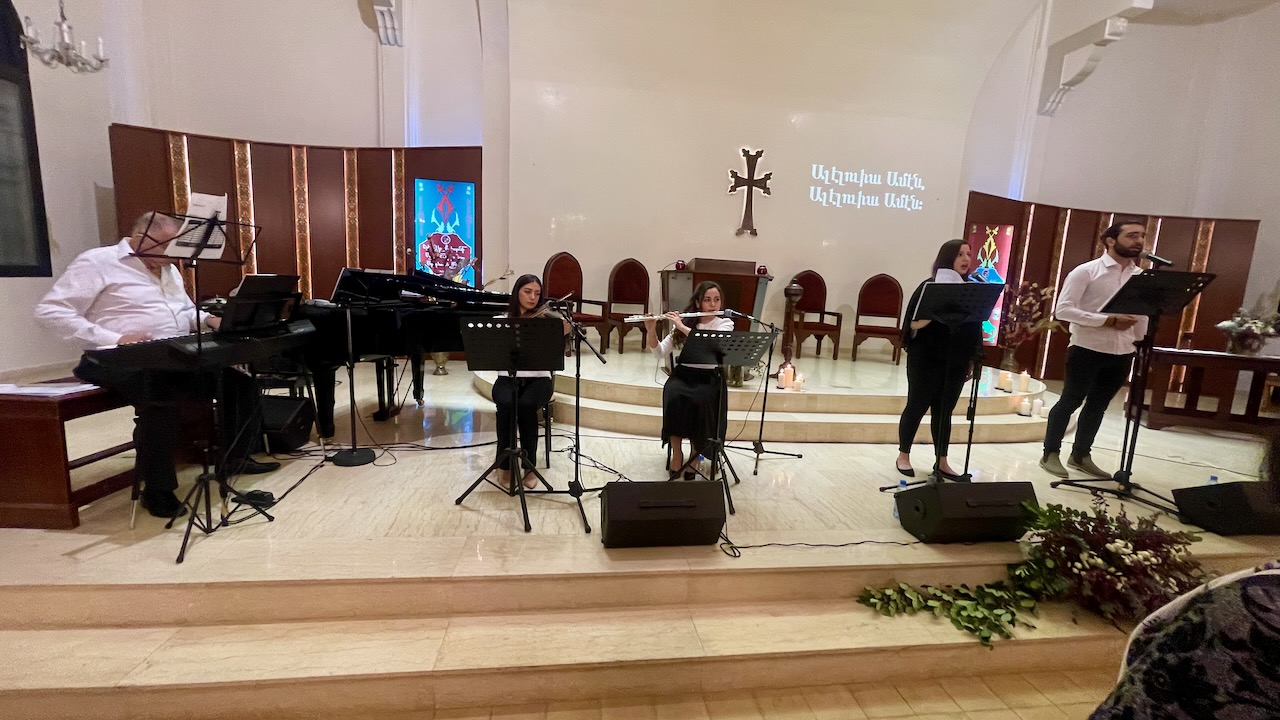
The best way to make music is to do it
yourself (13 Nov. 2022 - Geitawi, Beirut)
            It’s encouraging to see that despite all of this, rather than waiting for things to “get better,” people move forward to organize events and activities. This is most apparent to us in our church and university settings, though it is not limited to those circles. Concerts, plays, worship events, film premieres, lectures, debates, leadership training, conferences, infrastructure upgrades, publications, and of course, weddings! And this is just within the Lebanese-Armenian community! None of this means that conditions are improving. The economy is still floundering, the currency is still tumbling, the government is still somnabulate, and youth are still edging towards the exit doors. But there is a realization that consuming one’s time and energy in worry will not lengthen one’s days, and will only yield regrets for things undone or unattempted. So, I am glad when there are more activities that I want to attend than there is time to attend them.
An imaginary cedar of Lebanon, perched on
a narrow outcropping of rock... perhaps not
imaginary at all (29 Oct. 2022 - Gemmayzeh)
           Despite these robust signs, the present and future of the Armenian people is ever on my mind. For Armenia and Artsakh, for the near Diaspora and the far. Few Armenians learn from their past, though they study Armenian history in their school years. Names, places, events, dates, enemies are never in short supply, and swirl around in the minds of those with an Armenian education. But it is rare when your average “Hovsep” can appreciate the myriad mistakes and missteps that Armenians have made over the millennia, especially in the past century or two, up to this day, and then sketch a wiser path forward. Alongside this general concern (dare I say “worry”?) I see a glimmer of hope in my limited encounters with Armenian youth, as they wrestle with questions that their history presents, note similarities with today’s events, and ask “Can’t we do this differently?” Change will only happen when people are free to ask questions and pursue answers, not when they line up in rows and columns and follow leaders unthinkingly.

Something for children to play with on the
steps, but is anybody listening at the other
end? (17 Nov. 2022 - Mar Mikhael, Beirut)

            Leaders clothe their self-interests in patriotic rhetoric, and followers adopt that rhetoric, based on a limited knowledge of the dynamics and background. For small and unimportant peoples (like Armenia), the outcome is always in favor of those who can supply what large entities want. Mostly that means that those who have oil resources are treated with some deference, while those that don’t (like Armenia) have to figure out if they have something to offer to satisfy ravenous appetites. This is the way of the world, no matter that some consider themselves “exceptional”. And this is why the church is so important (as long as it doesn’t play political “world cup”), because it dares to love for God’s sake, not for gain.

LebCat 55: That's my nickname, and, yes,
that's my restaurant. (8 Oct. 2022 - Hamra)

           
These past few weeks we have enjoyed visits from people outside Lebanon, people who have dared to venture into this land of adventure. Our church’s annual meeting this week, usually held in the summer, hosted a group from Syria and Greece, and some of them had not been to Lebanon in years, despite being “just next door”. Earlier in the month there were visitors from Europe and the U.S., including a few who were here for the first time. We got to see our dear friend (and “boss”, as we affectionately call him) and share some relaxed time reflecting on life, work and ministry in this non-standard context. Although people tend to praise us for continuing to live and work here, as if it were just the outcome of our personal efforts, what is less visible is the support and encouragement we receive from many people, near and far, drawing us forward. And the unexplainable peace of God, helping us to keep our focus not on flag-waving and enthusiastic cheering for or against us, but on our calling from Christ himself.   [LNB]

Friday, September 30, 2022

A Time for Discomfort

 53.A Time for Discomfort (30 September 2022)

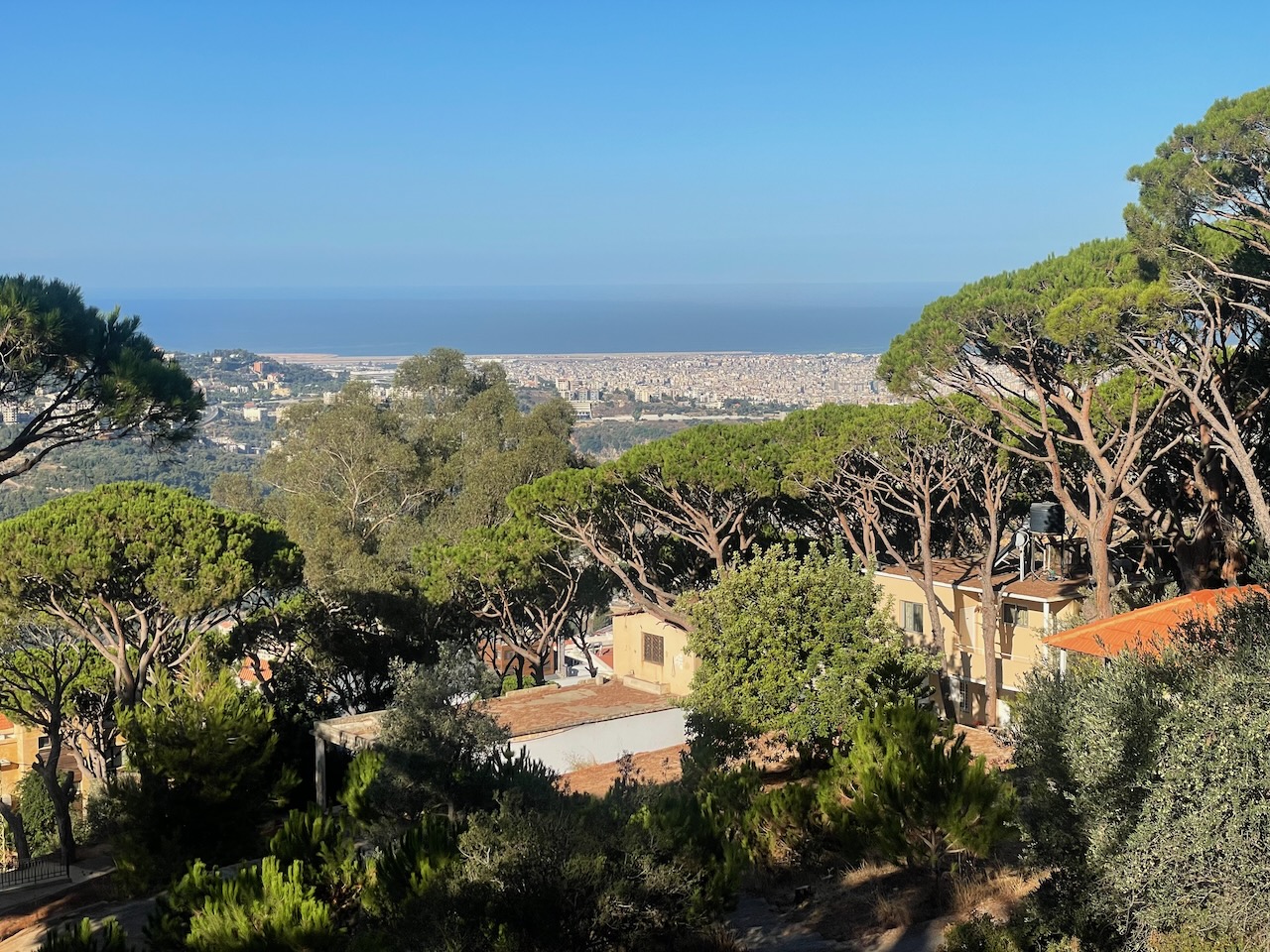
A rare day of low humidity, with a crystal-
clear view of Beirut from KCHAG.
(24 Sept. 2022 - Monteverde)

How much more surreal can things get? Yesterday the parliament met to make its first attempt at electing a president of the Republic. Hearing all the laughter and good-natured ribbing happening in the chamber, one might easily have concluded that there is little to worry about in the country, and that Lebanon is back to its glory days of the 1960s. Yet the upbeat mood in the room served only to highlight the deep disconnect between the people and their daily suffering and uncertainty on the one hand, and on the other hand those who are ensconced in the halls of power. Although this disconnect is arguably true in practically every country in the world, here it is as if a house is burning down, but the residents themselves must battle the fire alone, unassisted, running to and fro to find water to fill their basins and toss a few drops on the ever-heightening flames.

The building (at rear) where Armenian
orphan girls wove carpets after the Genocide
(17 Sept. 2022 - Ghazir)

            When people take up arms, even toy guns, and desperately enter the banks that hold their savings hostage, demanding their own money to be able to pay their own medical or business debts, it shows a deeply troubled society. They are depicted by news outlets as committing “bank heists”, as if readers were only capable of understanding Hollywood terminology. These are people struggling against the injustice and humiliation they have been fed continually for these past few years. The obliviousness of those who comfortably led Lebanon to this state, in local or international halls of power, only serves to increase our discomfort.

Reflecting on a day off, with the
help of a sculpture by local artists
(17 Sept. 2022 - Jbeil/Byblos)

            As we view the continued terror inflicted on Armenia by its un-neighborly “neighbors”, our discomfort multiplies all the more. The world today is witness to Azerbaijan’s push to impose military solutions on a weak and defeated country while the peacekeepers’ country is otherwise preoccupied. Yet once again, Armenians are demonstrating their political naïveté by rejoicing every time some Western government issues a condemnation of Azerbaijan, or a statement in support of the territorial integrity of Armenia. This same reasoning justified the international community’s lack of support for Artsakh’s Armenians during the war that began two years ago this week. Yet many Armenians the world over, in their self-imposed amnesia, continue to imagine that those statements will actually affect the reality on the ground. The reality is that this aggressor will take as much land as it can from Armenia, disrupting and destroying as many lives as it can, while big sister Turkey watches admiringly.

The streets around the Ashrafieh church &
school transformed into an Egyptian street
for a movie (30 Sept. 2022 - Geitawi)

            Meanwhile, despite the discomfort caused by events near and far, we are comforted in some measure by the beginning of a new school year. Armenian schools in both Lebanon and Syria welcomed their students back this month, providing much more than an Armenian education, as crucial as that is for the health and strength of Armenians everywhere. They are also providing a point of stability in the unstable world these children and adolescents inhabit. The daily conversations of adults around them, centering most often on continual worries about finances and the crashing currency, is being offset to a degree by the rhythm of the school day and the school week. Yes, the schools face deep financial challenges, especially if they have not yet installed a solar electric system on their grounds, and have to pour large amounts of currency into fueling their generators. Yes, this is aside from the inevitable school closures resulting from unexpected events, likely to increase as the current President’s term comes to an end. But it is an act of love and hope, based not on circumstances, but on vision and convictions.

Guitarist Ayman Jarjour transfixes the
audience with classical, Spanish and
"Oriental"-flavored pieces
(27 Sept. 2022 - Minet el Hosn)

            A moment of beauty I recently enjoyed was a guitar recital by the brother of a former student from my Haigazian teaching days. Aside from being a fundraiser for a rehabilitation center in Lebanon, the event provided a feast of musical delights, filling the church’s sanctuary for one hour with the sound of that one guitar (and the regular dings of someone unable to detach from Whatsapp). It was a gift that the guitarist gave to an audience hungry for something that would lift them up, if only for a brief time. As Fred Rogers’ mother told him when he was young and afraid, “Always look for the helpers. There’s always someone who is trying to help.”

LebCat 53: An exquisitely striped "McCat",
frequenting the location where it's most
likely to be fed - just not by me
(11 Sept. 2022 - Ain el Mreisseh)

            This is the way of the world. There are those in challenging places doing their best to help others, even at the cost of their own comfort. And there are others who seek only their own comfort, no matter how many others must suffer as a result. This is a “scalable” truth, applicable to societies as well as world powers. Though countries only occasionally enjoy peace, they are often oblivious to the role they themselves play in the natural, political or human disorder around them. More likely, though, they lack the moral grounding needed to admit their role in the hardship they cultivate.

            Yet this is the very same world into which Christ Jesus entered, into which today he leads his disciples to share words and works of comfort and hope to those truly in need of it, and to engage in the struggle for what is right, true and beautiful.   [LNB]

Saturday, May 28, 2022

Living in DIY-land

50.Living in DIY-land (28 May 2022)


A panel here, a panel there, and Nejmeh
Square is proclaimed "open"...
(26 May 2022 - Beirut)

           In most places in the world, people pride themselves on their DIY (do-it-yourself) skills and experience. Why have other people build or fix things, when you can do it yourself? And you get a greater appreciation for how things work, and the confidence that comes from knowing that the quality of the work is up to your personal standards. Of course, this is a “first-world” issue, because in much – if not most – of the world there is no alternative to doing it yourself. It’s like those who go to the gym to stay in good physical shape because they no longer move, bend, lift, pull, push or sweat as part of their days work… contrasted with the rest of the world whose survival depends on their physical engagement with every aspect of their lives.

The elections came, and the elections went,
and now everyone waits to see what's next.
(14 May 2022 - Geitawi, Beirut)
            And then there’s Lebanon. I need to be circumspect about this because I signed a paper promising that I would only say nice things about Lebanon. This is a DIY society for very different reasons than the two categories mentioned above. People do a myriad of things themselves because either the function in question was never done by the authorities, or because the functions have stopped functioning, and now it’s up to you to do things like store your own money, or generate your own electricity, or import your own medicines, or provide security for your family, and so on. And if you examine the extensive network of services for the refugee population (probably a quarter of the total population), you will find networks of aid agencies, each with its particular emphasis. Essentially, today’s population is living in DIY-land.

It's amazing; every day it fills up, and every
night it gets emptied! What manner of sorcery
is this? (16 May 2022 - Geitawi, Beirut)

            There are also many functions that were never done by the state, which explains why there are so many organizations identifiable by a particular socio-religious coloring. Let’s keep in mind that this was a “gift” left by France as it ended its mandate over Lebanon in 1943; namely to create a government consisting not of capable citizens, but of mandated religious representatives, in order to make it as difficult as possible for any one group to have authority over another. Or that was the plan, anyway. It ended up being a wide gate to nepotism and cronyism, and public service jobs are bloated by people getting paid to fill quotas, not to provide services. It also made each religious grouping look out for its own, reinforcing people’s view that only one’s own group will look out for them.

Anyone want to take some for DIY crowd
control? (26 May 2022 - Beirut)

            And so each socio-religious community has its own old age home (Armenians have CAHL) and other hospital services (Armenians have the Armenian Sanatorium, and Armenian Evangelicals used to have the Christian Medical Center – housed in the building where we now live). Armenians as well as others have an assortment of relief and socio-medical centers catering mostly to their own groups. They each have their network of parochial schools and institutions of higher education. They have their own press, and their own television and radio stations. They also have their own demographic regions, though in the pre-civil war days there was more admixture between groups, blurring those lines a bit. There is not much one can point to and say, “This is for all.”

DIY noise control by the unfortunate residents
of the boisterous (until 4 a.m.) pub street, "rue
Armenie". (26 May 2022 - Mar Mikhael, Beirut)
            So, the parliamentary elections came and went. And there were small shifts in power bases, including some disorganized “revolution” people. But few are expecting significant changes. In an act of low drama, the outgoing (who is also the incoming) speaker “approved” the removal of metal and concrete barriers that have surrounded the parliament since the uprising began 2-1/2 years ago, as if to herald a new day of openness and prosperity for Lebanon and its capital city – supervised by the old guard. This, as the simple majority of hungry and unemployed citizens (and others) turns into an overwhelming majority. And as the currency continues its death-dive, something that economic experts consider to have no economic basis for occurring, only political. And as those who impoverished Lebanon continue to claim to be her saviors.

Preparing KCHAG for energy independence.
(22 May 2022 - Monteverde)

            In recent days government officials have continued to express the DIY-ness of today’s Lebanon. Some obscure decision was taken by the Central Bank, and the currency magically improved. A new electronic platform was released for shoppers to report price-gouging at supermarkets. Bank heads are advising people not to keep their cash under a single mattress, but to spread it out throughout all their bedrooms. Governmental security heads are warning people to keep their valuables in various places, and not just in one old purse in the back of a closet. The population has gradually resigned itself to the permanent absence of municipal electricity and the ever-increasing cost of diesel fuel running the DIY generators (called “ishtirak” – see Jan. 2022 blog: “Power-Hungry”) in each neighborhood, so that throughout the country solar panel installations are sprouting up, raising the hopes of some that they will be able to live somewhat “normally”.

The ultimate in DIY-ing:
a flea market! (26 May 2022 -
Nor Hadjin, Beirut)
            Surveying such rough terrain, in which the country’s DIY-ers live either with endless discouragement or self-delusion, or alternate between the two, the points of light are challenging to discern. More than any other place, I see them among teachers and others who express a heartfelt commitment to serve others. In the case of teachers, there are some so discouraged that they can no longer give what a teacher must give and a student must have. But there are many others who continue to challenge their students to think and grow, facing not just the negativity of students who say, “What’s the use?” but also that of the discouraged parents who transmit their hopelessness to their children. Once the complaint was about the ”burden” of the Armenian curriculum; now the entire curriculum is often questioned by those who only want to find a way out of their misery. Teachers are the front-line workers, who should be given standing ovations at the end of every school day, for continuing to believe in the future of the children they educate, and especially for those teachers who continue to believe in the importance of an Armenian education (a topic for another time).

LebCat 50: "If you want to run a store the
right way, you have to do it yourself!"
(17 Mar. 2022 - Geitawi, Beirut)
            Along with teachers being front-line, essential personnel, there are also those committed to serving others, whether in health care, or social work, or ministry, or even just being a good neighbor, keeping an eye out for those whom they see silently suffering. They, too, should be regularly applauded and encouraged. A doctor recently told me, “I should thank the country for teaching me how to prepare for a retirement without any money!” But he and so many others continue to use their skills and their hearts to help those around them. Lebanon is the ideal place to come and learn what it means to serve others, and to receive your reward from the One who came not to be served, but to serve. Though it is easy to slip into discouragement ourselves, Maria and I try our best to be encouragers. This is not a DIY job, because we don’t have the resources to last. Surrounding us there is the church, whose members rely on the prayers of many and renewal from above. And there is Christ, who Did It Himself, going through all of this, and more, to bring light out of the darkness!   [LNB]

Saturday, April 30, 2022

The Same Playbook

49.The Same Playbook (30 April 2022)

Facing the electric company and registering
his opinion with no ambiguity
(28 March 2022 - Gemmayzeh, Beirut)


One of the most distressing feelings one might have is when it seems like someone, near or far to your heart, has obtained a copy of the script of your life and is reenacting the worst scenes in it, sometimes with only slight variations. There is nothing you can do to affect the outcome except to watch helplessly (or avert your eyes) and hope for the best. You know the story line, because you went through it once – or perhaps copied from someone else’s playbook before you, and at that time you didn’t listen to anyone’s advice to take a different direction. The saying in Armenian (and other languages) is true: a person learns from his own purse. Rare is the one who learns from another’s hard lessons.

The children showing the people how to
worship (10 April 2022 - Geitawi, Beirut)

            It seems that this is also true on a larger scale, with entities such as organizations and even entire nations following a preset script. The Armenian nation presents an interesting example of this, as it takes up its old playbook and reenacts the worst days of its own history. In general, its behavior is fueled by a strange bit of amnesia as to the reasons for it suffering what it did in the past, combined with an inability or unwillingness to chart a different course for the future. The country of Armenia, ever at the mercy of greater powers, is struggling to continue its existence, while it suffers setback after setback following its disastrous defeat in 2020. The Armenian people, part of the larger entity called “the nation”, are sometimes filled with concern over what is happening, and sometimes are profoundly disinterested over what seems (to them) will not really affect them. An acquaintance from Armenia recently said that these days are probably more dangerous than the post-Genocide days. I concur, because the post-Genocide generation knew that they needed to forge an identity and pursue that in all aspects of their life; we of today’s generation are so fragmented and individualistic that we cannot be bothered to see where our indifference and disunity will lead us.

Easter morning, the pied piper of... KCHAG?
(17 April 2022 - Monteverde)

            I had the good fortune of never having been a serious participant in any sports activity. Always one of the last to be chosen when picking teams in or out of school, I early on put aside any delusion that I possessed sports-related skills. I focused on the arts and music (but not on studying). But, whether you use the playbook or the script image, this is a helpful way to view today’s disastrous world, and to see important connections between seemingly disparate events. The “who-cares-we’re-a-failed-state” playbook had been in use by local leaders long before the economy crashed, though it was never publicized. It is still the primary one driving current events and directing local actors to perform well for their masters. The population has picked up the well-worn copy of the “vote-for-your-party-not your-country” as it nears parliamentary elections in May, following which those elected will be using the “it’s-their-fault” playbook when daily life fails to improve. Those outside Lebanon use the “benevolent-state” playbook, announcing their full support for local reforms while maintaining policies that undermine any possibility of improvement in any area.

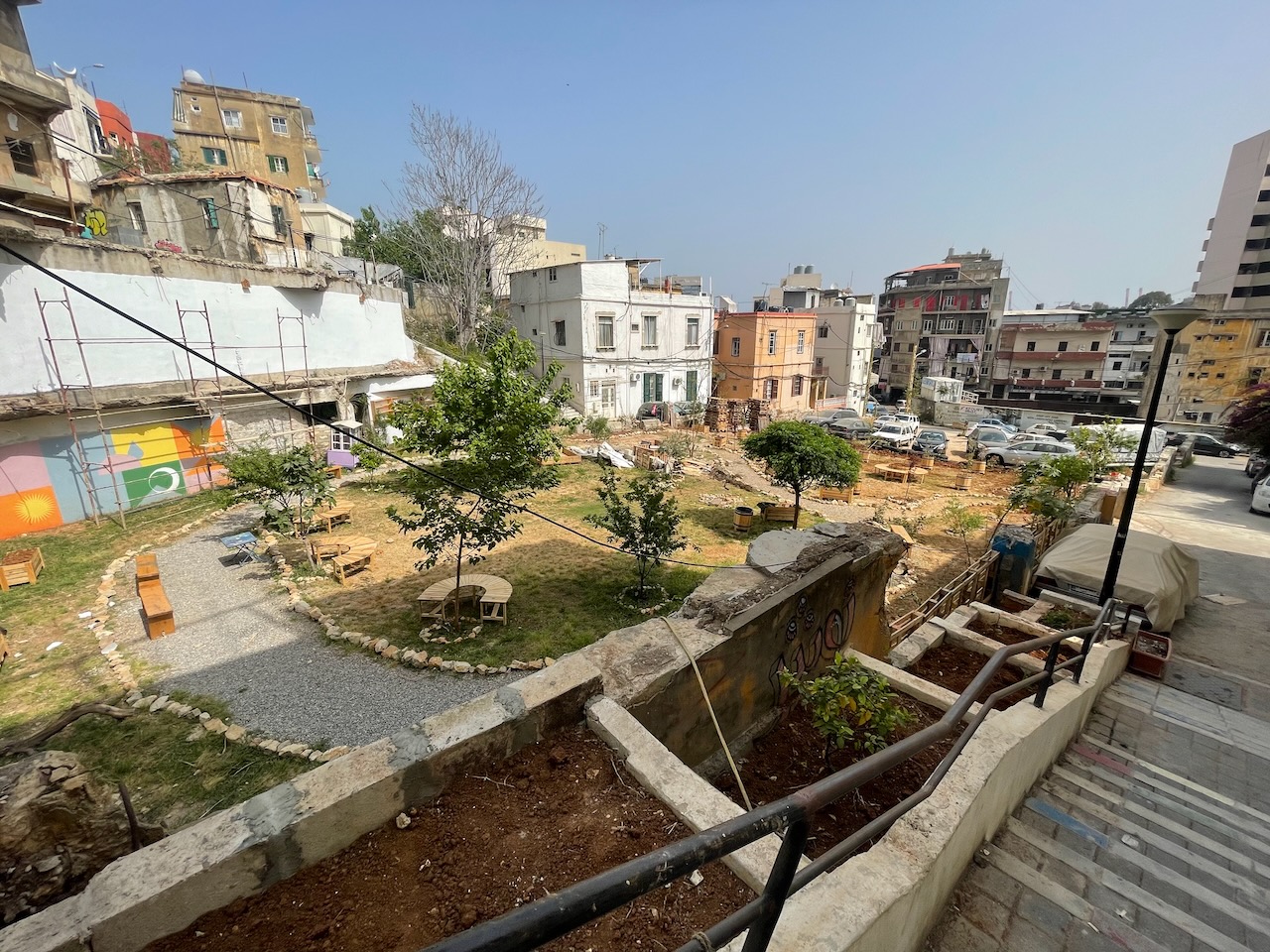
An "illegal" green space developing on the
grounds of the former Laziza brewery.
Greenery appears to be illegal in Beirut
(28 April 2022 - Geitawi, Beirut)

            During the current European war the “bomb-into-submission” and “everyone-is-our-enemy” playbook is the one in use, connecting today’s aggressors to the aggressors in the Artsakh war of 2020, and so many other wars, including the Ottomans’ war against its Armenian citizens a century ago. The “territorial-integrity” playbook is in heavy use in Ukraine, just as it was by Azerbaijan (and by the sympathetic but impotent friends of Armenia) when Artsakh was being attacked. The “black-and-white” playbook is opened frequently in the West (and for the West), in order to explain the intricacies of wars and security actions to those with limited interest or ability to discern grayscale shades. And the “your-oil-is-more-important-than-you” playbook is probably the only one shared by every single major power, no matter in which direction their guns are pointed or shipped. The “ideological-high-ground” playbook is also frequently read from, though the actors never take the stage. It is a grand drama and a high-stakes game that we are witnessing, based on a series of playbooks that will make the world the same as it has ever been, or ever will be.

Naming the evil that allows
disasters, destroying people and
their heritage (30 April 2022 -
Mar Nicola, Beirut)

            Fortunately – and I say this sincerely – there are weak and unimportant people in the world. These are the ones who I consider to be able to make real and lasting change. They are the ones who interface with their neighbors each day and look into their eyes with perception and compassion. This is not to praise interpersonal relations in general. The other day a small shopkeeper spoke of how some homemade food distributors in Lebanese villages easily take advantage of people like her by following the fluctuations in local currency against the dollar, then collecting payment well above the day’s street value, saying, “If you don’t want to pay, then I’ll find someone else to sell to.” Despite my insistence that I pay the current value of my purchase, she refused to take more from me than the outdated prices listed on her shelves.

God hears, but do we?
(8 April 2022 - Mar Mikhael, Beirut)

            My guess is that the difference lies in whether people have an actual, human relationship with each other, and not a transactional one. It’s the same with the church. Do I share a gospel message with someone because it’s expected of me, because it’s a requirement, because I consider my religion superior and his inferior or completely wrong? Or do I truly care for the other person as someone created in God’s image, whom God loves as much as he loves me? That person-to-person playbook is the one that brings true hope and opens hearts to receive the actual good news. It may be crass to characterize Jesus’ ministry in this way, but the gospel is so full of these kinds of interpersonal “detours” that Jesus took as he shared the gospel of God’s kingdom and the promised new life in that kingdom, that it must be an integral part of the message. My conclusion is that God has put his playbook into our hands and sent us from the church to the world. One who plays according to this script stands little chance of preventing the “rulers of this age” to seize the day; but in God’s timing, living this way will undermine every earthly power.

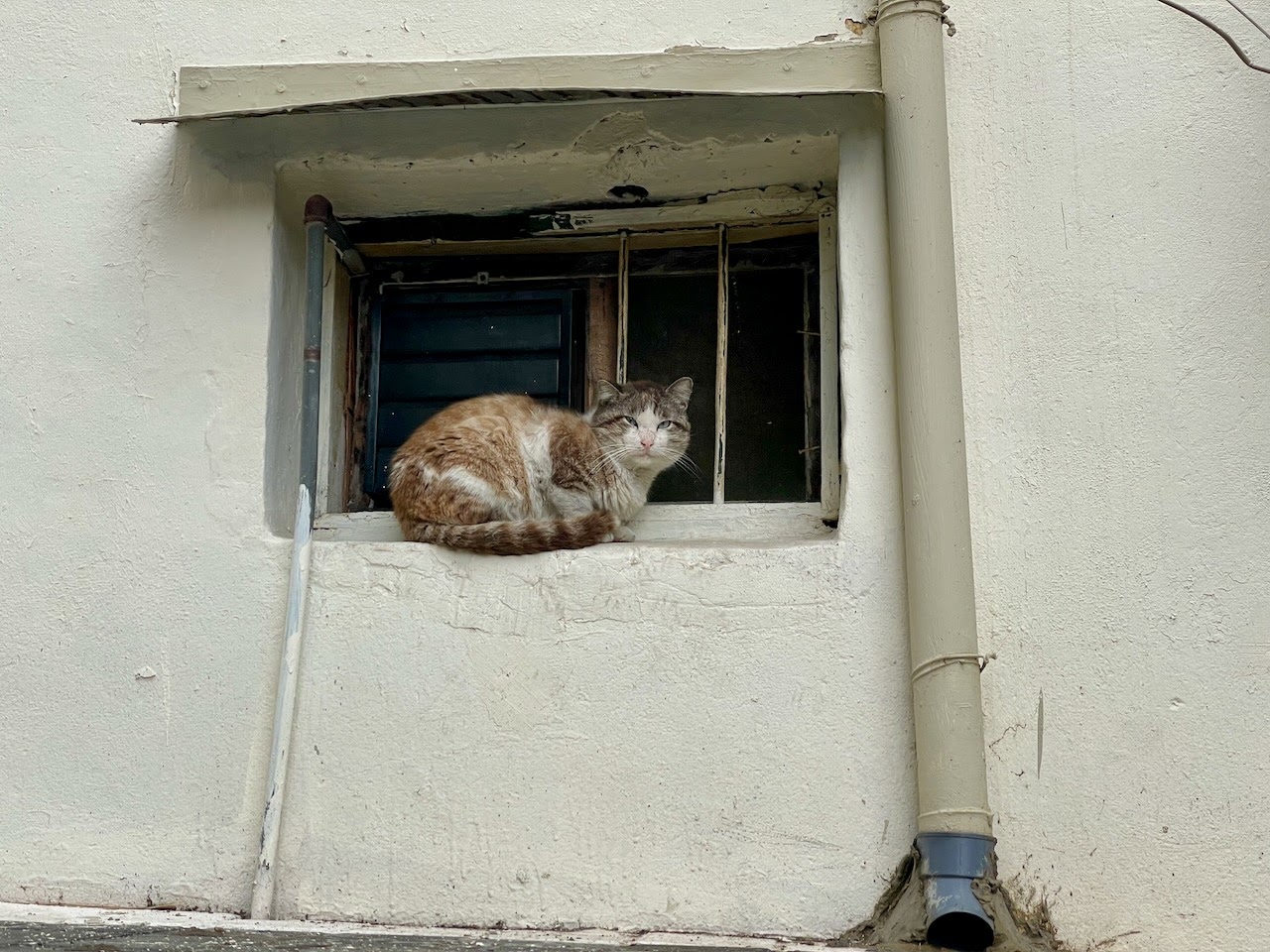
LebCat 49: Go find your own ledge!
(24 March 2022 - Geitawi, Beirut)

            We have been encouraged in recent weeks by young people in the Armenian community who, despite the discouragement and fear so prevalent in the country, have chosen life. Some have made engagement pledges to one another, others have brought newborns into the world and surrounded them with love, and all of them have taken these risky steps relying on God’s provision. God’s hand is certainly guiding them, and as they grow as families, the joy of the Lord is giving them – and us – strength.

            Once upon a time in Lebanon, when paying for groceries, if there were a few piastres (or liras) left to round up the total, the cashier would toss a pack of 2 pieces of chewing gum into your order. In recent years it became the whole box of gum, and then progressed to a sachet of instant coffee. Today as I was buying fruit from my friendly fruit-cart pusher, “Abou Mawz”, he announced 8,000 lira for a half-kilo of bananas. Then he winked and said he would make it 10,000, as I nodded and he tossed another banana on the scale. Imagine… fruit as small change. But that’s the playbook regular Lebanese people have long used. And it’s the playbook that even those most desperate to leave the country will be searching for, and not finding, in their newly-adopted homelands.   [LNB]

Friday, December 31, 2021

Motion Sickness

Motion Sickness

46.Motion Sickness (31 December 2021)

Awaiting one of our flights out of Philadelphia
(15 Oct. 2021 - Phila. Intl. Airport)

One of the constants of air travel, as well as ground travel, is the ubiquitous plastic-lined bag for the use of those experiencing stomach discomfort while being jostled back and forth, up and down, and side to side in the plane, boat, train, bus or car they are in. It also helps those around them to be able to stay clean and somewhat spared from the odor, though the poor sufferer continues to suffer what is gently referred to as “motion sickness”.

            We have been experiencing a type of “motion sickness” in recent times as we completed our required home assignment and made our way back to Lebanon last week. It was an uneventful flight, except that the airplanes were crowded cheek-to-jowl with travelers, some with masks, including those going to Lebanon. Maria and I lived through five months in the U.S. and Canada of constant travel, constant packing and unpacking, constant calculations of whether the weather would be warm or cold, along with constantly arranging flight and hotel bookings, constantly working on what kind of presentation fits a particular audience, constantly trying to wrap up paperwork and follow up on unfinished tasks in the concluding weeks when we were supposed to be “resting”. Getting back home to Beirut and its daily stresses and misery afforded us a bit of respite from the previous period!

Many ordinary people want to learn, pray and
help Lebanon. (31 Oct. 2021 - Pottstown, Pa.)

            Yet it wasn’t all misery, because we got to meet wonderful, caring people, Armenian and non-Armenian, many of whom were aware of the trials being endured by the Lebanese and the Lebanese-Armenian community. Hearing their questions, seeing their concern and willingness to do something, hearing their words of blessing and being with them in God’s presence was a gift we gratefully received. Yet it was balanced by the exhaustion of upwards of 14,000 mi / 22,000 km of traveling (aside from the 16,000 mi / 25,000 km to actually get to the US and back)! Enviable? Perhaps. I suppose it depends on who is doing the envying.

Getting the word out about Lebanon
(6 Nov 2021 - Belmont, Mass.)

            There is a TV ad that has appeared recently on Lebanese television depicting two young Lebanese boys talking about their dreams, which include going to school. It concludes with a voice-over stating, “Rights should not be just dreams.” Yet the dreams of a preponderance of people around us is not to have Lebanon become a livable country, but to leave Lebanon for a livable country. This “exit strategy” is based on yet a different kind of motion sickness: that of being made sick by a society that never experiences stability, that is continually in motion due to the profit-seeking, power struggles or whims of those in authority, whether locally, regionally or worldwide.

            On Beirut’s streets over the years, in my limited Arabic, I would often hear passersby including numbers in their conversations, assumedly regarding the price of this or that. How I wished that the conversations would revolve around ideas, or culture, or wonder at God’s creation! Today virtually all of the street conversations, and possibly also the private ones, are about the exchange rate, the cost of cheese and medicine, and the impossibility of carrying on in these conditions. One man at the exchange house said, “We’re living in an insane asylum!” I wish that my Arabic had not improved to the point where I could understand this much.

Exciting times on Home Assignment
(6 Dec. 2021 - Broomall, Pa.)

            Economic freefall produces one kind of motion sickness. Seeing dear friends and family members continually zoom away from you (and I’m not referring to screen time) can produce a similar spiritual nausea. When a family, or a community such as the Armenians, conclude that social disintegration is the best route to take, that their children must leave the country, then there is not much that can be said about the hopes for that family’s (or that people’s) future. Even if you are driven by the patriotic emotions that so often cloud Armenians’ judgment about their viability as a people, the consequences of cultural and societal disintegration cannot be dismissed. Many a person will insist on the necessity of laying hold, without delay, of the “promise of a better (economic, educational, health and secure) future elsewhere” – something that is only a promise, not a guarantee. It will apply to some lucky individuals, but what will become of collective identity? What will become of community? What will bring health and strength to the family, that place where individual and collective identity is formed and nurtured? We are in a rush toward “every man for himself”; and the shards of what was a collective hope, a concerted effort to come together to endure hardships and grow in character (such as was seen in the post-Genocide era), will become merely the subject of books and articles that very few read or care to reflect upon. Only a collective awakening to our spiritual and cultural resources can offer us a more hopeful outcome.
It's Christmastime in the city...
(30 Dec. 2021 - Geitawi–Beirut)

            I realize that I enjoy privileges and resources that few around me have. Yet I also have a perspective that many around me lack: that of having experienced the long-term consequences of living in a diaspora situation, in societies that are quite capable of swallowing up and homogenizing the qualities and distinctives that define a people group, including their language, creativity, spirituality, world view, and desire to survive and thrive as a unique entity. The motion sickness that we are all enduring will make it difficult, but all the more crucial, that we together take the long-term into account as well as the short- and medium-term… and listen well to each other.

LebCat 46: You look smashing in red... I mean
on red. (28 Dec. 2021 - Mar Mikhael–Beirut)

            One of the pleasures I enjoyed during “home assignment” was getting back to exercising (which is important, considering how much I enjoyed the pleasures of overeating and gaining weight during that same period). It was a long time since I was able to go to the gym at 6:30 a.m. and get a bit of sweat going. I also got back on the mat at the aikido dojo, but quickly remembered that aspect of warmups that I dread: forward and backward rolls. I dread them because of the dizziness they cause me. But I have learned that the way to work through this sensation is, first of all, to properly position my body to roll; second, to do the rolls more frequently; and third to fix my eye and my mind on a distant, stable point. That long-distance view enables me to be steady when the world seems to be slanted this way or that.

            My prayer for Lebanon, and in particular for the Armenian people, is that we fix our eye on that unchanging Point who does not change (James 1.17), who brings calmness, steadfastness and faith in Christ in the midst of the storm, and who blesses his people in the most difficult of circumstances with the enduring riches of wisdom, truth and love.   [LNB]

Monday, June 21, 2021

Two Hours Is Plenty

44.Two Hours Is Plenty (21 June 2021)

Street art around AUB
(Bliss St., Beirut - 27 May 2021)
When the foxes who have ruled the henhouse for the past three decades claim that they are going to improve henhouse conditions, like install air conditioning, or clean up the mess on the floor, it should take less than three decades to realize that this will never happen. Case in point: the endless promises up until last year that Lebanon’s decaying power grid and lengthy power cuts were going to be “fixed” – “very soon” – have passed their expiry date and are smelling rancid. Two hours a day of electricity is plenty, right? No massive popular movement emerges against these foxes – or perhaps they are wolves? “So let’s cut it down to 1-1/2 hours per day.” And on and on it goes.

And more than a few people eat at these sorts
of "food outlets" (Mar Mikhael -
Beirut - 4 June 2021)
            How bad is the electricity in Lebanon? Wait… I’ve heard this joke before. It’s so bad that their offices got blown to smithereens in the port blast last year and nobody noticed the difference. It’s so bad that even the private generator owners are complaining that their machines are working too much.

            The primary occupation of Lebanese in these times is watching, in real-time, a country rich in natural resources, human capital (especially its youth), healthy growth possibilities, history, heritage, and service industries, fall apart, bit-by-bit. It’s not a pre-occupation, because that would imply you have a job. The economy has (up to now) contracted to the point where it will take a decade or two to recover, so says the World Bank. Therefore, until and if recovery starts, “wait and watch” will be the primary work engaging Lebanese of all stripes. Possibly also the pre-occupation of the regional and international players fielding their teams in “Stadium Lebanon”.

Wounded voices from the blast zone
(Mar Mikhael - Beirut - 7 June 2021)
            Meanwhile, foreign and expatriate Lebanese partygoers looking for a bargain are flowing into the country, keeping the eating and drinking sector in business. Like vultures on carrion, nightly they noisily fill the “bar-way” – Armenia Street / rue Nahr / Mar Mikhael – near us until the wee hours of the morning. One could say, “At least they are putting  ‘fresh money’ into the economy.” But that money comes at the price of humiliation and dependency. Yesterday’s militia leaders (i.e., today’s political leaders) have treated the Lebanese this way for three or more decades, as they reinforce their place in Lebanon’s confessional-based system, offering their followers jobs, “monetary incentives”, or even COVID-19 vaccines, in exchange for unquestioning party loyalty. A similar effect can be had by narcotics.

Lines, lines everywhere
(Beirut - 14-16 June 2021)
            That currency devaluation continues by the day, and the banking system, against which the uprising began late in 2019 (before it derailed), continues to devise new ways to keep depositors’ money in their hands. This is in open defiance of international efforts to salvage Lebanon’s shipwrecked economy. Similarly, the supply of medicines, including medicines for chronic conditions, is being controlled and rationed, though it seems that there is no shortage in depots. Hospitals, deeply affected by this situation, will soon inform their chemo and dialysis patients not to come in for treatment, due to lack of supplies. Kleptomania is an addiction, and as any drug abuser can relate, you could sell anything or anyone if it got you what you crave. For Reformed theology fans, the term “total depravity” has here been replaced with utter depravity.

            Why has there been no public uprising against the perpetrators of this heartless and endless misery purposely inflicted upon the Lebanese? I refer you to “The Frog and the Kettle” analogy, which best explains the slow adjustment of the population to the deadly atmosphere around them. In previous years, as power cuts occurred, the government would announce they’re “trying to fix” the electricity (or trash, or any other) problem. Now, they don’t even bother saying anything to the public. There is no spirit or will left (so far) to hold anyone accountable. And as we all know, uprisings where mafias rule result in bloodshed.

You know your neighbors love you when they
leave onions and garlic in your mail slot!
(17 June 2021 - Geitawi - Beirut)
            One of the bright spots in this morass is one of the only governmental agencies that is working for, and not against, the people: the Health Ministry. It has an active cabinet minister who actually has the proper qualifications for the job. He makes sure the press is present during his surprise visits to hospitals, clinics, vaccination centers and medicine depots, and maintains updates on the Ministry’s website and social media, so as to increase public awareness and accountability. His recommendations for governmental policy are based on scientific and public health concerns, and not on the dictates of any religious community head. As a result, Lebanon has been able to see a vast reduction in COVID-19 cases, including a reduction in deaths from the disease. How we wish he could step out of his caretaker role and be part of the yet-to-be-formed-if-ever cabinet.

A newly-formed Armenian family exchanging
vows before a newly rebuilt stained glass
cross! (19 June 2021 - Beirut)
            Another bright spot – or rather a whole lot of bright spots – are those citizens who demonstrate humanity toward their fellow citizens, despite their own suffering. Some help to push cars that are out of gas in the waiting lines at gas stations (which dispense a few litres of fuel to a single customer as slowly as possible). Some pay a little extra at the food market so that someone else who is short of cash can buy food. Others write alerts via social media where young parents can find baby formula or diapers. In one of those online encounters the donor of some much-needed medicine refused any payment – only asking the recipient to “pray for her”. Despite the misery (and I’ve highlighted only a fraction of the spheres of corruption in which the country is drowning), the ordinary humanity of the authentic Lebanese still shines, albeit dimly.

Praying for God's blessing on the Armenian
Evangelical Central HS graduating
class (Geitawi - Beirut - 13 June 2021)

            The Armenian community here is faring as well as everyone else: not better, not worse. But in pursuing its daily life and continuing its existence, it is engaging in civil disobedience, defying the rampant corruption in which it is compelled to exist. Merely the act of rebuilding structures damaged in the port explosion (a disaster resulting from years of corruption and negligence on a staggering scale) shows that defiance. The installation of a re-imagined version of the stained glass cross in the First Armenian Evangelical Church, rededicated yesterday, is another example. Armenian schools (and Haigazian University) holding their year-end programs these weeks and prayerfully graduating their students to the next level of their education shows that same determination. Or a young Armenian couple taking their marriage vows and pledging to stand by one another no matter what the circumstances is another act of civil disobedience against the wolves running the henhouse. And for what is yet to come, faith in God’s grace will be the only way to endure.

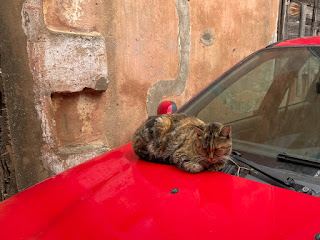
LebCat44: What, are you going to start
charging me for chilling under this car?
(Geitawi - Beirut - 13 June 2021)
            So we are back to spending summer nights without electricity, pretending to sleep, and then dragging ourselves through the daytime, pretending we are awake. Until last week we had our neighbors with whom to commiserate, but they returned to Armenia for the summer… and have their own set of challenges to face, as Armenia decides its future leaders, and continues to be the object of interest to neighboring Canis lupus appetites, and the object of continued Western humanitarian disinterest.

            Since there is only One who holds the future, we put our trust in him alone these days. Probably not a bad idea for everyone, everywhere, to do the same, no matter the level of comfort you (currently) experience.    [LNB]