Showing posts with label government. Show all posts

Wednesday, August 23, 2023

Oh Wow Fives

60. Oh Wow, Fives! (23 August 2023)

Faces of loved ones sacrificed in the 2020
Port explosion – a pain and an injustice
continually ignored by authorities.
(4 Aug. 2023 - Beirut Port)

I went into a store here in Beirut to buy something, and as I prepared to pay in Lebanon’s official currency – the U.S. dollar – the cashier saw I had taken out $5 bills and exclaimed  (in English), “Oh wow, fives!” Her delight was due to the fact that as businesses, great and small, abandon the use of the Lebanese Pound, they are always in need of small denominations of U.S. currency to return change to their customers. I provided a much-needed resource to a small business, as people struggle to make their way through daily life unassisted by any authorities, swimming in that morass of disinterest and disconnection that is the country’s ruling elite. Courtesy of our son Sevag’s annual visit to us here in Lebanon, we enjoy the privilege of having small denominations of U.S. currency. Here I was, the hero of the moment, with my crumpled and discolored images of Abraham Lincoln, bringing a moment of joy in the middle of the hot, muggy summer.

But seriously, can't you tell that the
infrastructure has improved?
(11 June 2023 - Bourj Hammoud)

            One of the most distasteful aspects of my life today in Lebanon (though by no means the only one) is the necessity to focus or fixate on monetary issues. Lebanese, especially Beirutis, have always made currency exchange rates, values of precious metals, gasoline prices and more their daily small talk. Though there is so much more to life, though much greater depth is possible in conversation, but this is what one hears from each passerby, from men gathered at curbsides, from women catching their breath over a cup of coffee: the never-ending stream of analysis and “expertise” that has supplanted hopes, dreams and ideals – the very things that young and old should be actively investing in their country in order to push it toward a brighter future. Instead, materialism, reinforced by circumstances created by those in power and their cooperative external powers, is pushing the brightness out of the country just to dissolve in diasporas around the world.

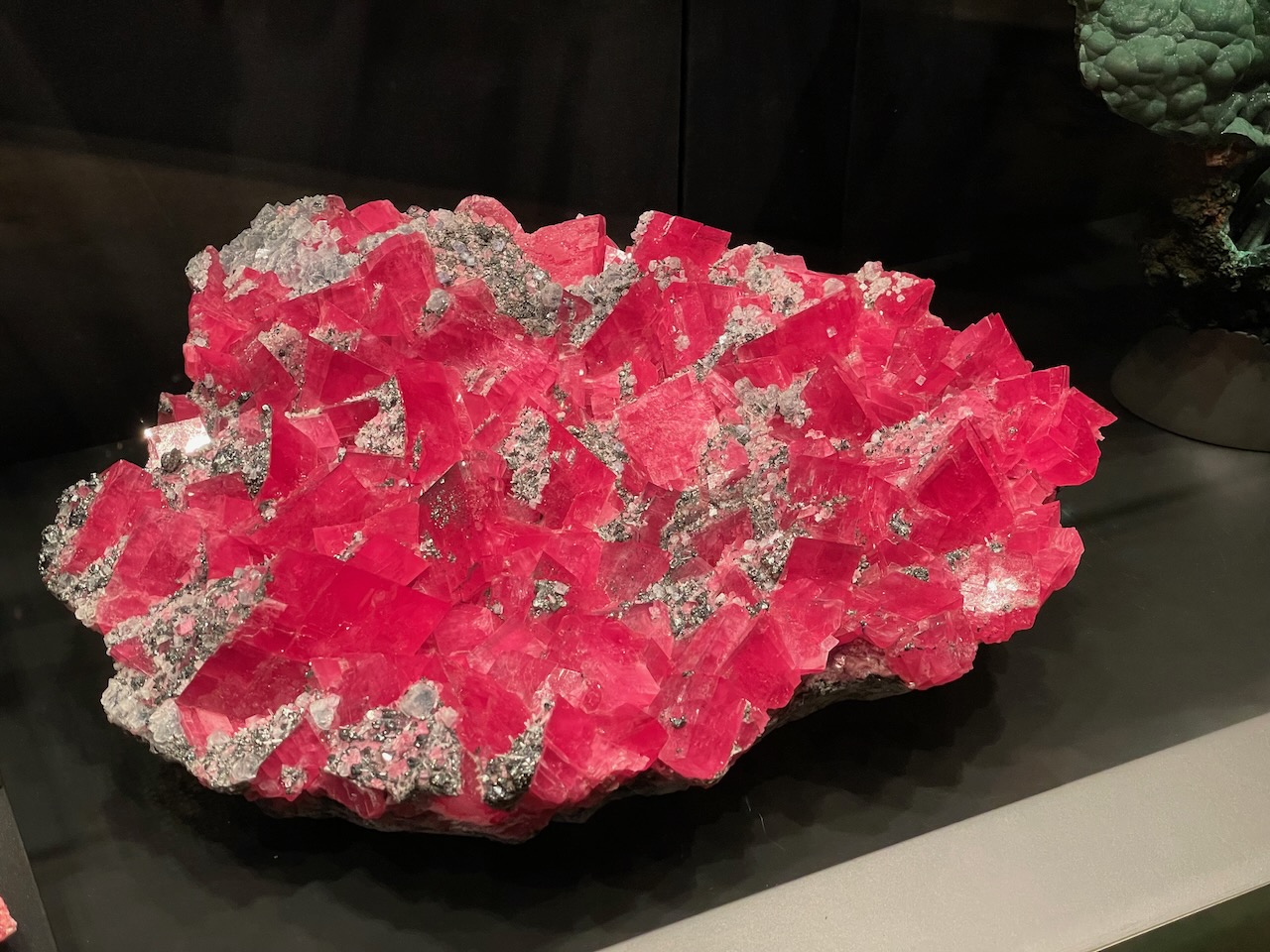
Watermelon? Strawberry gelatin? Sevag and
I puzzled over this one at the Mineral
Museum. (1 Aug. 2023 - Mathaf, Beirut)

            The impact of all of this upon the Armenian community in Syria and Lebanon is what troubles me the most. As the Dons of this kleptocracy look for new ways to fill their stomachs – most recently by a farcical “helicopter tour” of the new oil-drilling rig off the Lebanese coast –small and “unimportant” groups such as the Armenian community are left to fend for themselves. It is interesting to see how a country can continue to appear as a functioning entity while running on “autopilot”. A bit of electricity here, some trash collection there, fixing a water main when it breaks, leaving NGOs to install street lighting and traffic lights, and repair the worst potholes as highways steadily deteriorate, while many, many employees in the public sector come to work but once every one or two weeks, as their monthly salaries hardly cover the cost of transportation – this is today’s Lebanon.

When gas prices rise too high, there are
still great ways to make use of your auto!
(3 June 2023 - Ainjar)

            We’ve been noticing one of the semi-comical expressions of that while driving around various parts of the country with Sevag. It’s the “LPO mode” that auto owners have entered: “License Plate Optional”. Earlier this year I began to notice an absence of license plates of some cars on the road. Now it is probably up to 5 to 10 percent of cars. The office that processes car registrations is clearly not functioning. But in classic Lebanese manner the population is facing the situation with humor. It’s considered a badge of honor to drive an LPO car, even to the point, some say, that people will remove their license plates just to be seen as part of the LPO club!

            This summer I walked into a store in Ainjar, the mostly-Armenian village in the Bekaa valley. Whenever we’re going to be there for a few days I’ll stop in to pick a thing or two, and often times, since this is Ainjar, and since, due to my position, I can’t remain anonymous, I’ll run into people I know including people who know me since the 1990s, or the 2000s, or current times. The lady behind the counter, who does not belong to one of the aforementioned groups, asked me, in Armenian of course, “Are you Ainjartsi (her intent: “originally from Ainjar, but visiting from overseas”)? My interest piqued, I said, “No, I’m not. Why do you ask?” With no hint of malice or sarcasm, just puzzlement, she said, “Well, lots of people are very happy when they see you.”

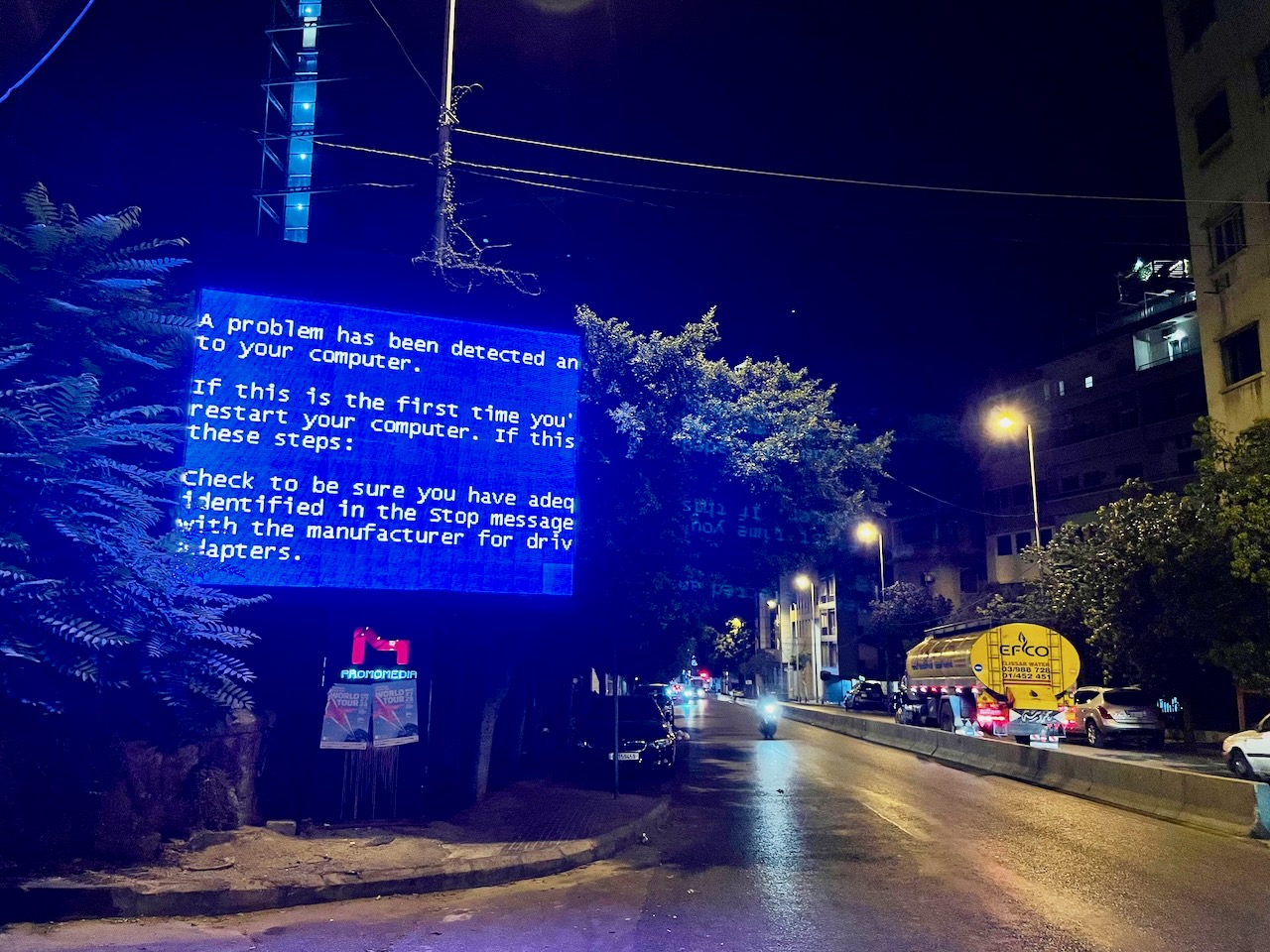
Providing an unintentional glimpse into
the dysfunction of the country.
(4 Aug. 2023 - Tabaris, Beirut)


            Amid such a negative environment I’m glad we can have positive encounters with those we meet, and grateful that our casual interactions can be uplifting. Certainly, this is not something we can automatically produce: without God’s encouragement in our times of frustration and discouragement we would have little to share with others. As well, without organizations backing us up it would be a challenge to remain positive in the enforced misery people are subjected to each day. So, I don’t mind being mistaken for an “Ainjartsi”, and I don’t mind that (most) people are happy to see me!

            During the summer a small group of young Lebanese-Armenians in their twenties, on their own initiative, approached Haigazian University in order to present a film series, seven items in all, ranging the gamut from practically “home-made” to professionally produced. Their emphasis was on increasing the public’s knowledge of Western Armenia and elevating the use of the Western Armenian language. They delivered their introductions each evening in flawless Western Armenian as well as English, and it was clear that they cared deeply about the entire project, and plan to expand their efforts to develop other materials that would interest young Armenians in their heritage, using modern pedagogical methods in a technologically accessible way. The name with which they christened their platform is “Hnarti” /Հնարդի, combining the Armenian words for “old” and “contemporary”. Despite the hemorrhaging of young blood from the Middle East, vision and vitality can still emerge from this community.

LebCat 60: Every pharmacy should have a
watchcat at the door.
(14 Aug. 2023 - Hamra, Beirut)

            In eight weeks I’m hoping to bring the Armiss Choir back on stage to sing one or two numbers. Hopefully a couple other Lebanese choral groups will also perform. A colleague and dear friend has just published a book on a century of Lebanese-Armenian choirs (1920-2020). The dedication of the new book will happen in October, and part of the dedication program will be vocal selections. From real choirs singing in harmony. Live – which is how music is best done. So, it’s time to get things organized and underway, and to invest a bit more in the health of the country and in a couple of its modest but essential components, that is, the arts, the Lebanese-Armenian community and the Armenian Evangelical Church.

            Finally, something to talk about besides currency rates!   [LNB]

Friday, November 25, 2022

Waiving the Flag

55.Waiving the Flag (25 November 2022)

Preparing for school celebration of
Lebanon's Independence Day
(17 Nov. 2022 - Geitawi, Beirut)
Now that World Cup football (soccer for you Americans) has taken over the world for the coming four weeks, enabling some pleasant diversion from the strangeness of these times, Lebanon is once again subjected to the ineptitude of its kleptocracy. No government here means no decision-making regarding broadcasting rights for the World Cup on state television. Which means that football fans, of which there are many, will not enjoy a month away from talk shows reviewing their all-too familiar daily miseries. Daily cheering could provide positive, natural chemicals to bring health to the tired bodies in this country, without having to scour pharmacies for artificial remedies. Instead, a very few people with the financial means to do so will watch the games at home, though many of them will suffer with Lebanon’s insufferable internet speeds, with frozen screens and with dropped connections.

"Green" transportation may not exactly mean
this (14 Nov. 2022 - Ghabi, Beirut)
            A recent news report about this situation in Lebanon showed photos of Lebanese with a multitude of flags of their favorite teams while also recording the fans’ dismay at being deprived of the tournament. They could paying for a month’s cable subscription in order to watch it, but that would be tantamount to telling your family they will not eat for a month. One person quipped, “Meanwhile our politicians are probably in Qatar, watching the games live.”

            It’s not surprising that Lebanese Independence Day, November 22, passed by this week with hardly a mention. Yes, there was a smattering of interesting broadcast advertisements with the independence theme, and an event or two was held for select groups of people. As always, students participated in their schools’ programs in observance of the day. There were even small Lebanese flags planted along traffic circles and roadsides. But there were no army parades or air force fly-overs, and no grandstands because empty chairs would have had to have been placed there for officials yet to be elected/appointed. What was in abundance were the many who expressed their dismay at the use of the word “independence” in today’s reality, since it is apparent to all that Lebanon’s problems and solutions are dependency issues, dependent on other, outside players. On Independence Day 2022 the flag was waived more than it was waved.

The best way to make music is to do it
yourself (13 Nov. 2022 - Geitawi, Beirut)
            It’s encouraging to see that despite all of this, rather than waiting for things to “get better,” people move forward to organize events and activities. This is most apparent to us in our church and university settings, though it is not limited to those circles. Concerts, plays, worship events, film premieres, lectures, debates, leadership training, conferences, infrastructure upgrades, publications, and of course, weddings! And this is just within the Lebanese-Armenian community! None of this means that conditions are improving. The economy is still floundering, the currency is still tumbling, the government is still somnabulate, and youth are still edging towards the exit doors. But there is a realization that consuming one’s time and energy in worry will not lengthen one’s days, and will only yield regrets for things undone or unattempted. So, I am glad when there are more activities that I want to attend than there is time to attend them.

An imaginary cedar of Lebanon, perched on
a narrow outcropping of rock... perhaps not
imaginary at all (29 Oct. 2022 - Gemmayzeh)
           Despite these robust signs, the present and future of the Armenian people is ever on my mind. For Armenia and Artsakh, for the near Diaspora and the far. Few Armenians learn from their past, though they study Armenian history in their school years. Names, places, events, dates, enemies are never in short supply, and swirl around in the minds of those with an Armenian education. But it is rare when your average “Hovsep” can appreciate the myriad mistakes and missteps that Armenians have made over the millennia, especially in the past century or two, up to this day, and then sketch a wiser path forward. Alongside this general concern (dare I say “worry”?) I see a glimmer of hope in my limited encounters with Armenian youth, as they wrestle with questions that their history presents, note similarities with today’s events, and ask “Can’t we do this differently?” Change will only happen when people are free to ask questions and pursue answers, not when they line up in rows and columns and follow leaders unthinkingly.

Something for children to play with on the
steps, but is anybody listening at the other
end? (17 Nov. 2022 - Mar Mikhael, Beirut)

            Leaders clothe their self-interests in patriotic rhetoric, and followers adopt that rhetoric, based on a limited knowledge of the dynamics and background. For small and unimportant peoples (like Armenia), the outcome is always in favor of those who can supply what large entities want. Mostly that means that those who have oil resources are treated with some deference, while those that don’t (like Armenia) have to figure out if they have something to offer to satisfy ravenous appetites. This is the way of the world, no matter that some consider themselves “exceptional”. And this is why the church is so important (as long as it doesn’t play political “world cup”), because it dares to love for God’s sake, not for gain.

LebCat 55: That's my nickname, and, yes,
that's my restaurant. (8 Oct. 2022 - Hamra)

           
These past few weeks we have enjoyed visits from people outside Lebanon, people who have dared to venture into this land of adventure. Our church’s annual meeting this week, usually held in the summer, hosted a group from Syria and Greece, and some of them had not been to Lebanon in years, despite being “just next door”. Earlier in the month there were visitors from Europe and the U.S., including a few who were here for the first time. We got to see our dear friend (and “boss”, as we affectionately call him) and share some relaxed time reflecting on life, work and ministry in this non-standard context. Although people tend to praise us for continuing to live and work here, as if it were just the outcome of our personal efforts, what is less visible is the support and encouragement we receive from many people, near and far, drawing us forward. And the unexplainable peace of God, helping us to keep our focus not on flag-waving and enthusiastic cheering for or against us, but on our calling from Christ himself.   [LNB]

Friday, September 30, 2022

A Time for Discomfort

 53.A Time for Discomfort (30 September 2022)

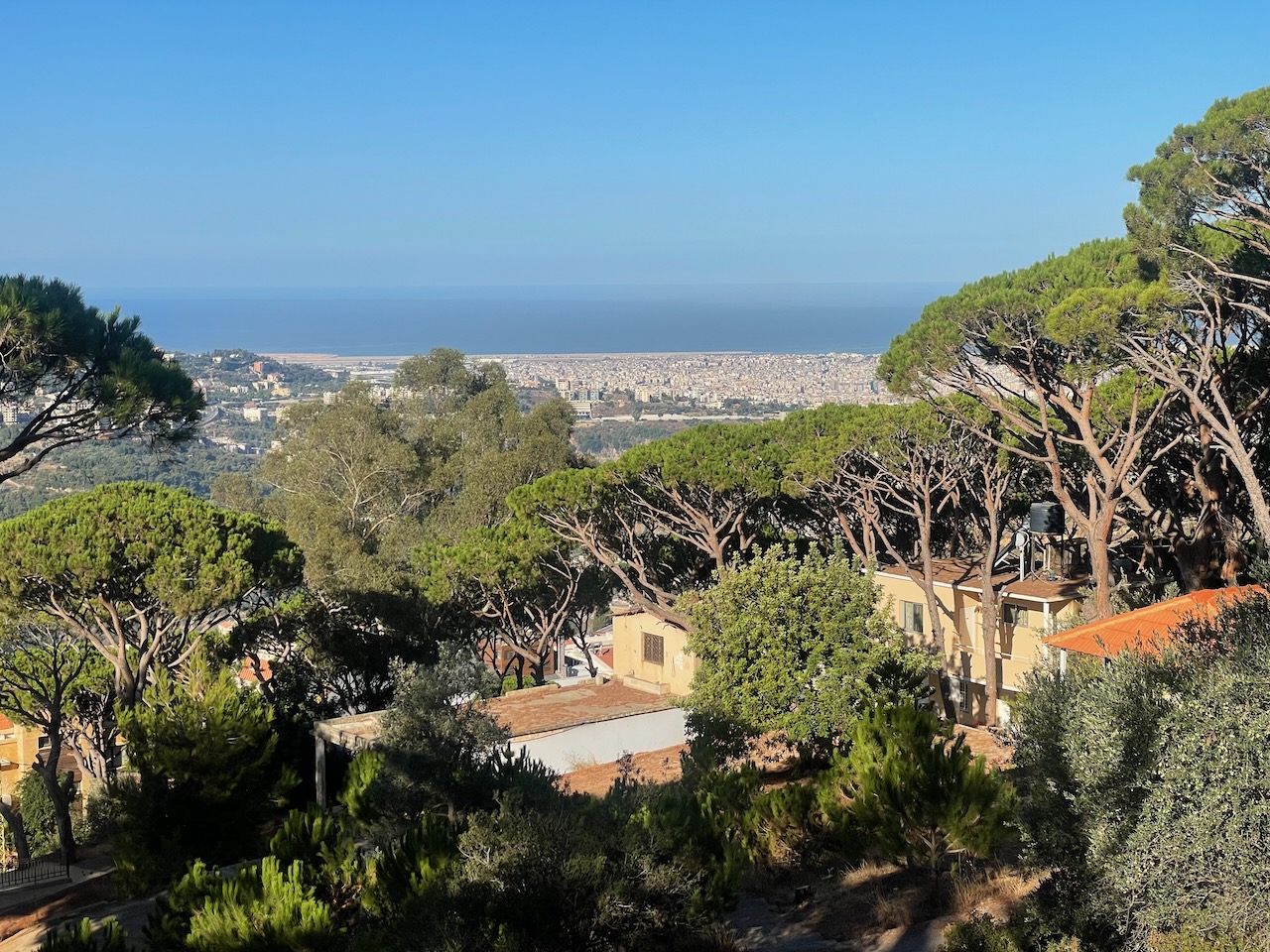
A rare day of low humidity, with a crystal-
clear view of Beirut from KCHAG.
(24 Sept. 2022 - Monteverde)

How much more surreal can things get? Yesterday the parliament met to make its first attempt at electing a president of the Republic. Hearing all the laughter and good-natured ribbing happening in the chamber, one might easily have concluded that there is little to worry about in the country, and that Lebanon is back to its glory days of the 1960s. Yet the upbeat mood in the room served only to highlight the deep disconnect between the people and their daily suffering and uncertainty on the one hand, and on the other hand those who are ensconced in the halls of power. Although this disconnect is arguably true in practically every country in the world, here it is as if a house is burning down, but the residents themselves must battle the fire alone, unassisted, running to and fro to find water to fill their basins and toss a few drops on the ever-heightening flames.

The building (at rear) where Armenian
orphan girls wove carpets after the Genocide
(17 Sept. 2022 - Ghazir)

            When people take up arms, even toy guns, and desperately enter the banks that hold their savings hostage, demanding their own money to be able to pay their own medical or business debts, it shows a deeply troubled society. They are depicted by news outlets as committing “bank heists”, as if readers were only capable of understanding Hollywood terminology. These are people struggling against the injustice and humiliation they have been fed continually for these past few years. The obliviousness of those who comfortably led Lebanon to this state, in local or international halls of power, only serves to increase our discomfort.

Reflecting on a day off, with the
help of a sculpture by local artists
(17 Sept. 2022 - Jbeil/Byblos)

            As we view the continued terror inflicted on Armenia by its un-neighborly “neighbors”, our discomfort multiplies all the more. The world today is witness to Azerbaijan’s push to impose military solutions on a weak and defeated country while the peacekeepers’ country is otherwise preoccupied. Yet once again, Armenians are demonstrating their political naïveté by rejoicing every time some Western government issues a condemnation of Azerbaijan, or a statement in support of the territorial integrity of Armenia. This same reasoning justified the international community’s lack of support for Artsakh’s Armenians during the war that began two years ago this week. Yet many Armenians the world over, in their self-imposed amnesia, continue to imagine that those statements will actually affect the reality on the ground. The reality is that this aggressor will take as much land as it can from Armenia, disrupting and destroying as many lives as it can, while big sister Turkey watches admiringly.

The streets around the Ashrafieh church &
school transformed into an Egyptian street
for a movie (30 Sept. 2022 - Geitawi)

            Meanwhile, despite the discomfort caused by events near and far, we are comforted in some measure by the beginning of a new school year. Armenian schools in both Lebanon and Syria welcomed their students back this month, providing much more than an Armenian education, as crucial as that is for the health and strength of Armenians everywhere. They are also providing a point of stability in the unstable world these children and adolescents inhabit. The daily conversations of adults around them, centering most often on continual worries about finances and the crashing currency, is being offset to a degree by the rhythm of the school day and the school week. Yes, the schools face deep financial challenges, especially if they have not yet installed a solar electric system on their grounds, and have to pour large amounts of currency into fueling their generators. Yes, this is aside from the inevitable school closures resulting from unexpected events, likely to increase as the current President’s term comes to an end. But it is an act of love and hope, based not on circumstances, but on vision and convictions.

Guitarist Ayman Jarjour transfixes the
audience with classical, Spanish and
"Oriental"-flavored pieces
(27 Sept. 2022 - Minet el Hosn)

            A moment of beauty I recently enjoyed was a guitar recital by the brother of a former student from my Haigazian teaching days. Aside from being a fundraiser for a rehabilitation center in Lebanon, the event provided a feast of musical delights, filling the church’s sanctuary for one hour with the sound of that one guitar (and the regular dings of someone unable to detach from Whatsapp). It was a gift that the guitarist gave to an audience hungry for something that would lift them up, if only for a brief time. As Fred Rogers’ mother told him when he was young and afraid, “Always look for the helpers. There’s always someone who is trying to help.”

LebCat 53: An exquisitely striped "McCat",
frequenting the location where it's most
likely to be fed - just not by me
(11 Sept. 2022 - Ain el Mreisseh)

            This is the way of the world. There are those in challenging places doing their best to help others, even at the cost of their own comfort. And there are others who seek only their own comfort, no matter how many others must suffer as a result. This is a “scalable” truth, applicable to societies as well as world powers. Though countries only occasionally enjoy peace, they are often oblivious to the role they themselves play in the natural, political or human disorder around them. More likely, though, they lack the moral grounding needed to admit their role in the hardship they cultivate.

            Yet this is the very same world into which Christ Jesus entered, into which today he leads his disciples to share words and works of comfort and hope to those truly in need of it, and to engage in the struggle for what is right, true and beautiful.   [LNB]

Wednesday, August 31, 2022

Powerless Living

52.Powerless Living (31 August 2022)

Demonstrations that closed the coastal road
on the second anniversary of the still-
uninvestigated and still-unpunished Beirut
Port blast (4 Aug. 2022 - Marfa' - Beirut)

From time to time, it almost seems as if it might be possible to get used to being without electricity every single night. I can entertain this fantasy thanks to the local generator subscription we have, which supplies us with enough power to cool our bedroom from evening until midnight, and then we can manage to sleep with just a battery-powered fan until around 4 a.m. As well, one can almost endure the powerless hours during the day, in between the times of generator supply. Almost. Because it’s not just the lights that are off for 12 of each 24-hour period, but everything gets interrupted, whether in your work life or your home life. A recent expat, living in some far-away, amazing land where there is electricity all the time (are there such places?), wrote to me yesterday: “We’re in an age where you can maybe live without lights, but not without internet.”

After two days of overflowing trash, it
seemed like a dream that collection had
resumed! And just a couple hours later:
magic! (30 Aug. 2022 - Geitawi)

            And so, today our internet access stopped. Dead. Completely. Landline phones, internet, whatever you would need to get through your workday. Striking workers? Lack of fuel? Something else? The reasons are myriad. The cellular system is (still) working, but who can afford to pay cell phone rates just to do a bit of online work or to communicate with colleagues locally or overseas? The key word here is “communication”, a common factor in all that doesn’t work in Lebanon, whether institutional or personal. Communication is what the powerful in any relationship and in any land attempt to keep within their control, and when possible, they communicate the particular version of events that they want people to think. Yet as the “powerless” in every land are increasingly able to take greater control of the story of their lives, they can communicate their stories to each other and to the outside world in a more complex, and truer, way. Except when there is no electricity. And no reliable internet. And no steady water supply. And no waste management And no government.. And hyperinflation. And no access to bank accounts. And…

After most of the grain silos collapsed this
month, a sign appeared: "No justice without
accountability" (28 Aug. 2022 - Marfa')
            One of the narratives the powerless in Lebanon are continually subjected to is how the government made this or that deal with this or that country to supply fuel to their environmentally-deadly power plants in order to add 3 or 4 more hours per day of electricity (up from 0 to 1 hours per day). And then they hear how there is this or that banking obstacle that came up. And then they hear that there is this or that infrastructure issue that came up. And then they hear that there is this or that political party that is preventing it from happening. And then they hear that the government doesn’t want to fall under American sanctions* by getting the wrong fuel from the wrong source that might pass through the wrong country. Meanwhile, threats of the country plunging into “complete darkness” continue to echo, though, as a news website recently noted, “those who have private generator subscriptions are unlikely to feel the effect of a state-wide blackout.”

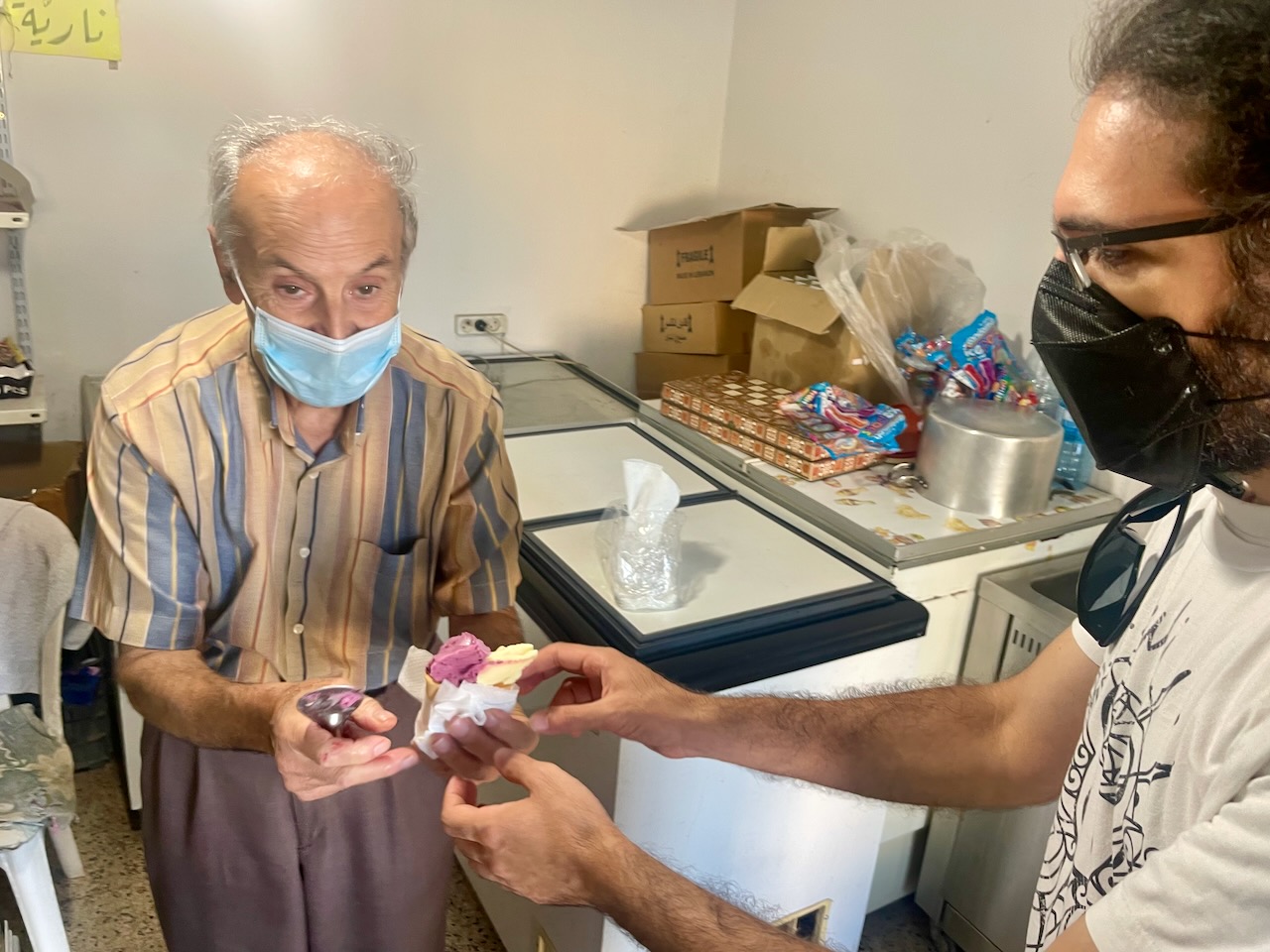
At what is possibly the best Arabic ice cream
spot in Lebanon. Says Sevag: "Excuse me,
photo is taken, please hand that over right
now." (26 July 2022 - Saghbine)


            There are many, many people here who are powerless to do anything but subsist without power. They cannot afford (as we can) to buy generator subscriptions to fill in the huge gaps in the municipal power supply. Their homes remain in the dark, and their refrigerators are useless, and their nutritional intake suffers, and their health declines, and their ability to obtain health care when they inevitably need it… vanishes. Meanwhile the young and resourceful continue leaching from the country, leaving their families and their heritage far behind…

            Yet amid all of this, today I was witness to an example of benevolent involvement in the struggles of Lebanon, as well as an intelligent grasp of the country’s needs. The Japanese Ambassador to Lebanon, H.E. Okubo Takeshi joined Lebanon’s Minister of Public Health, Firass Abiad, M.D., to dedicate equipment that the Japanese have donated to the Karagheusian Assn.’s Primary Healthcare Center in Bourj Hammoud. The Ambassador spoke of the commitment of his country to support the Lebanese people (making this important distinction in his words). Then Dr. Abiad, showing an unusual grasp (for someone in government) of the health care crisis in Lebanon, told the audience how the country for too long has invested large amounts in tertiary health care and ignored developing primary health care, thereby rendering basic health care unaffordable to people of modest means. He also described his plan to restructure the allotment of health care funds to the primary type. It was refreshing to hear someone with a vision, someone in a position of authority who is interested in improving what has been handed him, rather than blaming others for his lack of action.

Dr. Abiad addressing the audience, following
Amb. Okubo's speech  (31 Aug. 2022 -
Nor Marash - Bourj Hammoud)
            Before the program, when the Ambassador arrived and was being introduced to the clergy, I got to greet him with the phrase I had been coached on and had been practicing for a whole day, including in my sleep the previous night. “Kakka, oai dekite kouei desu.” It is a most unfortunate coincidence that this phrase begins with a word that in Japanese means “Your Excellency”, but in most of the languages I know means something quite different. The important thing is that the Ambassador understood my stumbling Japanese, “Your Excellency, it is an honor to meet you,” and responded in English with, “Very pleased to meet you, also.” The other important thing is that no one else who heard my greeting reprimanded me for saying an indelicate word to the Ambassador.

LebCat 52: "Wait, is that... a pig flying? Oh,
yes, this is Lebanon!" (31 Aug. 2022 -
Nor Marash - Bourj Hammoud)
            One of the famous Japanese sayings invoked today was “Fall down seven times, get up eight.” What more appropriate way is there than this, to think about how the powerless in this world can persevere and continue their struggle. My mind especially goes to the One who was beaten down, but rose again, he who is ever on the side of the downtrodden, Christ Jesus. He was considered powerless in the eyes of the world, but his purported “weakness” was wrongly estimated by those in power. His victory over death, and his promised Coming, are the basis for hope of all those under the weight of personal or societal failure. He is the One keeping us going, especially when the lack of power – or vision – looms large around us, whether here, in Armenia, or anywhere.

            And yes, we still cheer like Santa Claus just showed up whenever the power comes back on!   [LNB]


(*The country that does its utmost to prevent foreign meddling… by doing what they don’t want other countries doing.)


Saturday, January 22, 2022

Power-Hungry

 47.Power-Hungry (22 January 2022)
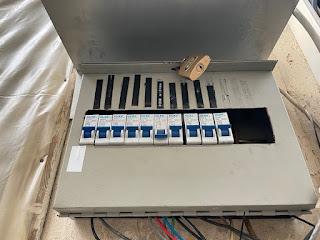
The supplemental power breaker box, with our thrown
circuit-breaker, identified as "Père Nichan".
(15 Jan. 2022 - Khalil Badawi)

Recently a friend from Armenia visited us at our home. We explained to him our happiness at finally arranging for “ishtirak”, which is a membership one gets from the neighborhood electrical generator owners, in order to fill in the 20+ hour gap in government electricity each day. “So now we have three sources of electricity: EDL (“official” power), the building generator (four hours a day most days), and “ishtirak” (except for 6 hours a night and two one-hour breaks during the day). He looked at me a bit incredulously and said, “So you’re saying that you have three different sources of power, but it still doesn’t add up to 24-hours of electricity!”

            I guess I never thought of it that way…
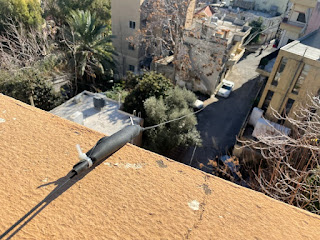
The long, long line, and the long, long trip
down to the breaker box, just beyond
that car... (18 Jan. 2022 - Geitawi-Beirut)

            While refugees are freezing under tents in the coldest parts of the country or asphyxiating from burning coal (or even plastic) indoors, the average Lebanese citizens themselves are not much better off than slabs of beef hanging in a meat locker – and who can afford meat these days? Meanwhile, the “leaders”, having given themselves an open-ended break from governing, beginning last October, are still dreamily wondering whether to resume meeting in order to rescue their ruined country. They are in no rush to do so, since the body being vivisected still has saleable parts. And each one of them lives under the illusion or delusion of being comfortably on the moral high ground. So many textbook examples of the term “power-hungry” in these parts, ranging from those internationally famous and respected on the world stage, all the way down to the mafia-esque generator operators one or two streets over.
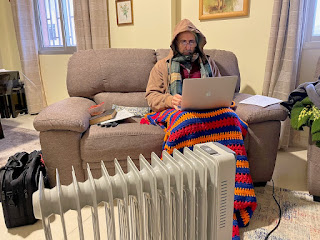
My current office - anywhere I can be near a heater.
(22 Jan. 2021 - Geitawi-Beirut)

            Yet you can find many unsung people who behave in an opposite manner, and act humanly, sharing things they could be selling to generate some income. A man who over the summer had stockpiled firewood for his village home, though currently seeking a job, decided he had enough wood to warm his house this winter, and so he started giving the excess firewood to needy families so they could stay warm. These are the people, the meek, who are the true inheritors of the land (cf. Matt. 5.5).

            The people of Lebanon have been left power hungry, in a different sense than what we usually mean. That which they need to live, to work, to learn, to take trips, to refresh, all of that which is dependent on adequate, consistent and affordable electric power is being denied them. They do not desire to control others, to bleed them dry. They just wish to live some semblance of a normal life. So what can they do? Shiver in silence, or pay a neighborhood supplier for a bit of supplementary power.
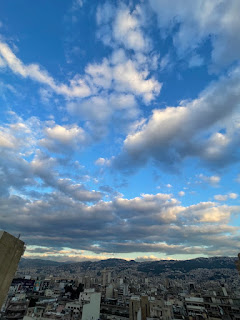
A beautiful winter sky, and a break
from the cold, stormy days.
(18 Jan. 2022 - Geitawi-Beirut)

            Now that we are in that group, we have a completely new set of electricity-usage protocols to adopt, something I call the “Ishtirak Follies”. When the supplementary electric line gets connected to your home, you can’t just go on with “business as usual”. You have to learn what you can use, and when. You have to prioritize what is required and what is optional. Heater? A primary need. Lights? Don’t overdo it, one or two is enough. Refrigerator? If it’s a newer model that draws less current, OK. TV? Possibly, but it also needs to be an energy-saving model. Water pump? Turns on automatically when the spigot is opened, and without it the water flows trickle by trickle, so yes. WiFi router? Can’t get any work done without it, so make sure there’s battery power connected to it for when the power type switches from one to the other. Computers? Keep the laptops charged when there’s “real” current, and keep an ear out for the desktop’s UPS doing excessive click-clicking like a Geiger counter – that’s your early-warning system telling you to switch off some appliances. Hot water tank? That’s a borderline need, so turn it on when there’s EDL or building generator power. Microwave? Forget about it. Electric kettle? If it has “electric” in the name, cross it off your list. HVAC units? Decide which room you want to heat and don’t turn it on; use the hot oil radiator instead (on low power), and don’t even think about how you’re going to manage in the summer heat. Clothes washer? Change into some clean clothes and wait for a couple hours of regular electricity. Vacuum cleaner? Ironing? HAHA very funny.

            “Trial & Error” is the name of the game you play in Ishtirak Follies before arriving at the esoteric knowledge of what is approved and what is taboo. If the circuit breaker (“disjoncteur” in the Lebanese dialect) is right outside your home, consider yourself lucky. Pop out the front door, walk over to the box, switch it back on, and you’re done. In our case, when an overload happens, it means you flip off whatever was on, go down 6 floors, walk to the end of the back street, walk back up 6 floors (since the building’s electricity – and thus the elevator – is off the majority of the time), and then you can enjoy your light and heater!

            Here’s a real-life example of how we’re playing Trial & Error in the Ishtirak Follies:

·      Forgetting for a moment to ask yourself “What kind of electricity are we on”, you flip the switch on the electric kettle and everything goes dark. Go down 6 floors, go to the end of the street, find the switch for your apartment and turn it back on, go back and up. You say: “Let’s keep the kettle unplugged so we don’t forget next time.”

·      Heating up some leftovers in the microwave oven, forgetting to ask that same question. “Click”, everything’s off. Down 6 floors, take a walk, click on, walk back, climb 6 floors.

·      “I wonder, can I check our electricity amperage with this meter?” Pop. Go down, go over, flip it on, come back, climb up.
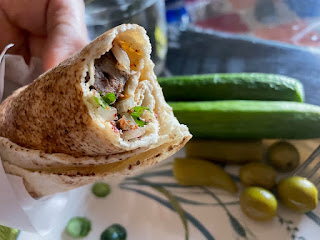
At last, my favorite liver kebab place is back
in operation! (18 Jan. 2022 - Geitawi-Beirut)

·      Electricity switches off at an odd time during daylight, so I can’t see from the balcony if others’ “ishtirak” is working. Down 6 floors, out to the box. Hmm, it’s still on. I guess the motor must be on its lunch break.

·      Two space heaters are on low power, the hot water tank is switched on, the toilet flushes, the water pump engages, and... Click! Down you go.

·      “I’ll leave the space heater on to keep things warm while I run up the street and get a falafel sandwich.” Entering the apartment with my lunch, all is dark… Oops, I left the heater on high power, I forgot to switch off the hot water tank, and the leaky toilet probably started up the water pump, sending the “ishtirak” over the edge. I decide to eat my falafel in the dark, then take my exercise trip down to the “disjoncteur”.

·      And in those brief times when the electricity comes on, we play a different game: “Kahraba (electric company) Follies”, running around and turning on the equipment that requires full power, like the washing machine, the hot water tank, heating in more than one room, etc. See above list for details.
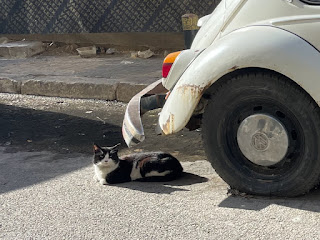
LebCat 47: Just enjoying the warmth. It's
free, so far. (11 Jan. 2022 - Mar Mikhael)

            The reason we are able to play these follies is because God has given us health and strength, and also because we are not directly at the mercy of the train wreck of the economy, unlike what most people are. Supposedly by next month there will be pipelines functioning, bringing gas from Egypt to Jordan to Syria to Lebanon, and that will reportedly enable EDL to produce more electricity, bringing the daily total of power supplied to about 10 hours, hopefully, instead of 2 to 4.

            And while all of this goes on and on, there are still individuals and groups, here as well as in other countries, who wish only well to the Lebanese. Their material support has empowered dedicated teachers, social workers, religious leaders, shopkeepers, tradespeople and regular people with beating hearts and warm consciences to reach out and bring an atmosphere of caring to the peoples’ daily life. Because of them, in these days there are still smiles, greetings to passersby, caring words and the Lord’s presence all around. It may not solve the condition of Lebanon’s electrical grid, but it will certainly renew the power, and a bit of the hope, of many. I’m thankful to God that we can be a part of that power supply!   [LNB]

Saturday, August 15, 2020

The Fifth World

37.The Fifth World (15 August 2020)
Ruined windows and doors from the Armenian Evang. Central
High School (8 Aug. 2020 - Geitawi - Beirut)

When I was an unseasoned theological student many moons ago, Maria and I came to Lebanon on a fellowship program for study in a “Third World Country”. That term is now considered uncouth, and is usually replaced by the term “developing country”, referring to those countries lacking the economic, health and educational status of those at the top of the list. Back then I was surprised that Lebanon was even on that list, because I knew it as a prosperous, if war-torn, country. But I was eager to go there (here), to learn the Armenian language and grow in my understanding of being an Armenian and experiencing Armenian Evangelical heritage firsthand. What better place than Beirut, even if it was in the midst of a civil war?

Karma isn't supposed to miss its target, except when it does
(14 Aug. 2020 - Mar Mikhael - Beirut)
            Back in the days of the Cold War people spoke about countries belonging to the First World (west of the Iron Curtain), the Second World (the Curtain’s “other” side) and the Third World (no curtain). Decades later, someone came up with the idea of the “Fourth World” to describe stateless people. Yet today, almost four decades later, Lebanon has been violently thrown backwards beyond even the Fourth World to a new category I am creating on the occasion of explosion that devastated probably one third of the capital and environs. Since August 4, here in Beirut we are now living in the Fifth World.

The restaurant's name is "This is how the world
is" (14 Aug. 2020 - Mar Mikhael - Beirut)
            We spent the entire month of July sweating through sleepless nights because the government was unable to purchase untainted fuel for their diesel-powered generating stations, or unable to offload the fuel to the power plants, or was busy suing the Algerian company that sent the bad fuel, or couldn’t broker a deal with the Central Bank to release money for paying for new shipments, or any of a dozen other reasons. The country was receiving 2 to 4 hours a day of electricity, and the rest of the time the plethora of private generators in Lebanon, including the one here at the Union headquarters where we live, were filling in the gap. And also dumping tons of particulates into the air. When 11 p.m. rolled around most generators took a break for the night, leaving us and many others to pretend to sleep while a film of sweat emerged on us like a second skin. That “treatment” lasted over 30 days, and preceded the explosion at the Beirut Port on the evening of August 4th. Strangely, since that fateful date the electric company has been providing full nighttime electricity, with some spotty coverage during the daytime. What, did somebody buy us a miracle? Is this in order to pour cold water on the protests?

Beirut's grain silos, built 1968-1970, which
shielded part of the city from the blast, but leaving
the country with a one-month supply of wheat 
(30 July & 14 Aug 2020)
            Why talk about any of this? Because it is emblematic of the woes the Fifth World imposes on its subjects. At least five decades of massive corruption and ineptitude is now shamefully on display for the world to see. And to take advantage of. Local groups are either decrying or supporting the current government or political system, depending on which power they are pandering to. In this unbelievably bad combination of circumstances (it seems that’s the most logical explanation at this point), and with the arrival of an unending chain of visiting diplomats and their entourages, the local political scene continues to polarize as each group has its turn groveling, and the length of Armenia Street/Mar Mikhael has turned into one huge NGO bazaar. It’s a day of great sorrow and humiliation for Lebanon on many, many levels.

            The deepest sorrow is reserved for the regular, non-ruling-class Lebanese people, who for decades have struggled to cope in this abnormal and exceptionally corrupt environment, and now have the dubious privilege of shedding the greatest amount of blood, sweat and tears as they witness their carefully managed homes, schools, businesses and futures explode then crumble, bit by bit, community by community, neighborhood by neighborhood, family by family. Alongside the sorrow for all of this loss there is an outpouring of rage. Some of it is opportunistic rage, but there is also the honest rage against successive iterations of “leaders” and their “handlers”. Lacking an awareness of the common good, their aim continues to be the pursuit of large amounts of wealth by wringing the country dry – or beyond dry. The pool of talented, dedicated young people, including Armenian young people, is evaporating. The country’s lifeblood is draining, leaving a drying swamp.


Part of the traditional character of the
Gemmayzeh area, now in ruins
(14 Aug. 2020 - Beirut)
           But opportunism is still at play, even in the midst of this tragedy. The classic heritage homes in Gemmayzeh and Mar Mikhael, some turned into rubble, others still standing but sorely damaged, are now the target of vultures: the “agents” (called “simsar” in Arabic) who are offering despairing homeowners a little “fresh money” in exchange for these properties. Just as was conspicuously done in post-war Beirut, turning a bustling city center into a wasteland consisting of a couple of giant structures and acres of empty parking lots, today also there is a nascent movement to do the same in these heritage neighborhoods, likely to eventually to fill them with tall, empty buildings. I have to wonder, where does all this construction money come from? Considering today’s moribund Lebanese banking system, they are likely not locally funded.

            Despite our church and youth activities being suspended, and our “gatherings” limited to the ether of the Internet, our son Sevag made his annual trip to be with us. He got PCR-ed before leaving the U.S. and PCR-ed again at the airport upon arrival, but took it all in stride. For him – and

Lego time with Sevag! (19 Jul.  2020 - Geitawi-Beirut)
for us – the important thing was to be together. We did a little touring, most significantly to the Roman ruins at Baalbek, but also spent time at home listening to LPs, reading stories to each other, looking at old pictures, playing the “Pandemic” board game (some dark humor never killed anybody, right?), going to bed at 11 p.m. when the generator got switched off, and enjoying our “extended family” from Armenia here on the top floor of our building. Their little ones took to him quite rapidly for the most part, and “Lego with Sevag” became a highly sought-after activity in our living room. It was our mini Children’s Conference – with one leader and three children!

Glass, glass and more glass; day 1 of cleaning
the apartment (5 Aug. 2020 - Geitawi, Beirut)
            As if the oddness of this visit were not enough, one evening when we went for a socially-distant visit with the Haidostian family in Haigazian University’s Mugar colonnade, what we at first thought to be an earthquake made the ground shift like a carpet being shaken out, and then a huge boom, and instantly smoke and flying glass filled the air. It was August 4, and we had been spared the terror of being at home, which is a bit over one kilometer from ground zero. By comparison, Haigazian is twice that distance, 2.4 km, from the port explosion site. Whomever we spoke with said the same things: “I thought it was an earthquake.” “I thought a bomb had gone off in the next street.” “I thought an aerial attack had started.” And so for his last two days Sevag joined us in the task of sweeping up shattered glass and assessing the damage. Just as he had shared the 2006 war on Lebanon while visiting us, now also he shared this catastrophe, making this yet another unforgettable trip as he witnessed firsthand Lebanon popping way back into the Fifth World. That’s quite a collection of unforgettables he has.

LebCat 37, poised to enjoy a crunchy morsel
(27 July 2020 - Baalbek)
           
Early in his visit Sevag was trying to solve a puzzling change in our neighborhood and environs: an absence of cats. I hadn’t noticed it until he pointed it out, and realized that my walks around the area in recent weeks had, in fact, been devoid of felines scurrying away as I passed. This made him wonder, could the rapid increase of poverty and unemployment and the growth of food insecurity in Lebanon have anything to do with these missing cats? Hmmm, makes me wonder, too.   [LNB]