Showing posts with label Arabic language. Show all posts

Friday, December 31, 2021

Motion Sickness

Motion Sickness

46.Motion Sickness (31 December 2021)

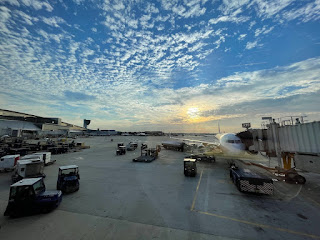
Awaiting one of our flights out of Philadelphia
(15 Oct. 2021 - Phila. Intl. Airport)
One of the constants of air travel, as well as ground travel, is the ubiquitous plastic-lined bag for the use of those experiencing stomach discomfort while being jostled back and forth, up and down, and side to side in the plane, boat, train, bus or car they are in. It also helps those around them to be able to stay clean and somewhat spared from the odor, though the poor sufferer continues to suffer what is gently referred to as “motion sickness”.

            We have been experiencing a type of “motion sickness” in recent times as we completed our required home assignment and made our way back to Lebanon last week. It was an uneventful flight, except that the airplanes were crowded cheek-to-jowl with travelers, some with masks, including those going to Lebanon. Maria and I lived through five months in the U.S. and Canada of constant travel, constant packing and unpacking, constant calculations of whether the weather would be warm or cold, along with constantly arranging flight and hotel bookings, constantly working on what kind of presentation fits a particular audience, constantly trying to wrap up paperwork and follow up on unfinished tasks in the concluding weeks when we were supposed to be “resting”. Getting back home to Beirut and its daily stresses and misery afforded us a bit of respite from the previous period!

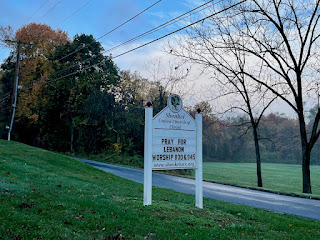
Many ordinary people want to learn, pray and
help Lebanon. (31 Oct. 2021 - Pottstown, Pa.)
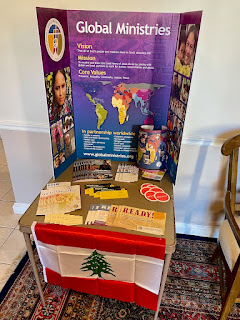
            Yet it wasn’t all misery, because we got to meet wonderful, caring people, Armenian and non-Armenian, many of whom were aware of the trials being endured by the Lebanese and the Lebanese-Armenian community. Hearing their questions, seeing their concern and willingness to do something, hearing their words of blessing and being with them in God’s presence was a gift we gratefully received. Yet it was balanced by the exhaustion of upwards of 14,000 mi / 22,000 km of traveling (aside from the 16,000 mi / 25,000 km to actually get to the US and back)! Enviable? Perhaps. I suppose it depends on who is doing the envying.

Getting the word out about Lebanon
(6 Nov 2021 - Belmont, Mass.)
            There is a TV ad that has appeared recently on Lebanese television depicting two young Lebanese boys talking about their dreams, which include going to school. It concludes with a voice-over stating, “Rights should not be just dreams.” Yet the dreams of a preponderance of people around us is not to have Lebanon become a livable country, but to leave Lebanon for a livable country. This “exit strategy” is based on yet a different kind of motion sickness: that of being made sick by a society that never experiences stability, that is continually in motion due to the profit-seeking, power struggles or whims of those in authority, whether locally, regionally or worldwide.

            On Beirut’s streets over the years, in my limited Arabic, I would often hear passersby including numbers in their conversations, assumedly regarding the price of this or that. How I wished that the conversations would revolve around ideas, or culture, or wonder at God’s creation! Today virtually all of the street conversations, and possibly also the private ones, are about the exchange rate, the cost of cheese and medicine, and the impossibility of carrying on in these conditions. One man at the exchange house said, “We’re living in an insane asylum!” I wish that my Arabic had not improved to the point where I could understand this much.

Exciting times on Home Assignment
(6 Dec. 2021 - Broomall, Pa.)
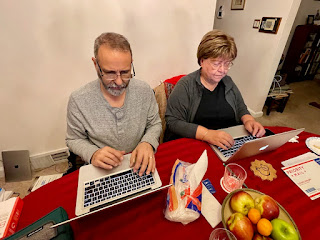
            Economic freefall produces one kind of motion sickness. Seeing dear friends and family members continually zoom away from you (and I’m not referring to screen time) can produce a similar spiritual nausea. When a family, or a community such as the Armenians, conclude that social disintegration is the best route to take, that their children must leave the country, then there is not much that can be said about the hopes for that family’s (or that people’s) future. Even if you are driven by the patriotic emotions that so often cloud Armenians’ judgment about their viability as a people, the consequences of cultural and societal disintegration cannot be dismissed. Many a person will insist on the necessity of laying hold, without delay, of the “promise of a better (economic, educational, health and secure) future elsewhere” – something that is only a promise, not a guarantee. It will apply to some lucky individuals, but what will become of collective identity? What will become of community? What will bring health and strength to the family, that place where individual and collective identity is formed and nurtured? We are in a rush toward “every man for himself”; and the shards of what was a collective hope, a concerted effort to come together to endure hardships and grow in character (such as was seen in the post-Genocide era), will become merely the subject of books and articles that very few read or care to reflect upon. Only a collective awakening to our spiritual and cultural resources can offer us a more hopeful outcome.
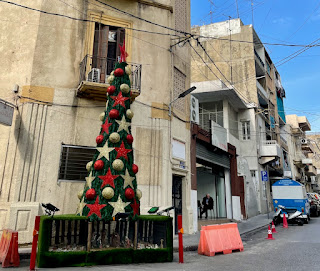
It's Christmastime in the city...
(30 Dec. 2021 - Geitawi–Beirut)

            I realize that I enjoy privileges and resources that few around me have. Yet I also have a perspective that many around me lack: that of having experienced the long-term consequences of living in a diaspora situation, in societies that are quite capable of swallowing up and homogenizing the qualities and distinctives that define a people group, including their language, creativity, spirituality, world view, and desire to survive and thrive as a unique entity. The motion sickness that we are all enduring will make it difficult, but all the more crucial, that we together take the long-term into account as well as the short- and medium-term… and listen well to each other.

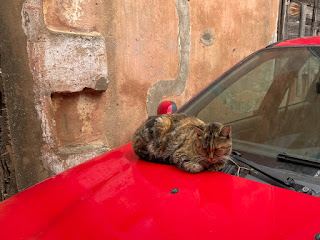
LebCat 46: You look smashing in red... I mean
on red. (28 Dec. 2021 - Mar Mikhael–Beirut)
            One of the pleasures I enjoyed during “home assignment” was getting back to exercising (which is important, considering how much I enjoyed the pleasures of overeating and gaining weight during that same period). It was a long time since I was able to go to the gym at 6:30 a.m. and get a bit of sweat going. I also got back on the mat at the aikido dojo, but quickly remembered that aspect of warmups that I dread: forward and backward rolls. I dread them because of the dizziness they cause me. But I have learned that the way to work through this sensation is, first of all, to properly position my body to roll; second, to do the rolls more frequently; and third to fix my eye and my mind on a distant, stable point. That long-distance view enables me to be steady when the world seems to be slanted this way or that.

            My prayer for Lebanon, and in particular for the Armenian people, is that we fix our eye on that unchanging Point who does not change (James 1.17), who brings calmness, steadfastness and faith in Christ in the midst of the storm, and who blesses his people in the most difficult of circumstances with the enduring riches of wisdom, truth and love.   [LNB]

Saturday, June 1, 2019

Friends and Others


26.Friends and Others (31 May 2019)
Friends gathering after a worship service at Emmanuel Church
to be with Pastor Harut Khachatryan, whom they met last
summer in Armenia. (16 May 2019 - Nor Amanos -
Baouchrieh)
They say that it’s the tough times that show who your true friends are. This doesn’t mean that those who are not really concerned about whether you exist are your enemies. It just means that they aren’t your friends. Sometimes I wish that the term “friend” weren’t so commonly used so as to dilute its meaning. After all, in the Bible the term “friend of God” (applied to Abraham in James 2.23) is intended as a special designation, just as when Jesus called the twelve “my friends” (in John 15.15). Now, a “friend” is what you get when you click on a name. And then there’s the Armenian word, “բարեկամ” (paregam), which means “one who wills good”. Well, even Armenians use the word indiscriminately. Like “Paregam (friend), move your car from in front of my shop.” Said without a smile, but with the implication that you or your car might not remain unscathed.
My friend Angele Kebab slipped and hurt her
arm a few months ago, but now is back to
making delicious sandwiches!
(24 May 2019 - Nor Hadjin - Beirut)
            A few weeks back there was a car parked in front of a nearby apartment building. We have no idea whose it was, but from Saturday afternoon until Sunday morning, for over 14 hours, its theft alarm rang. The whole night. And nobody showed up to claim it and stop it. Fortunately, I lack the tools and the know-how to stop a car alarm. So I merely spent a sleepless night listening to it. My guess is that no one called the police (and their barracks are located right above the place where this car was) to locate the owner and make it stop.  Because, why bother? Not just the police, or the neighborhood, but people in general are easily influenced by the usual things that cause people to abandon responsible behavior. Self-preservation. Gain. Running into walls. Powerful people who make and enforce their own rules. And so, the alarm just keeps ringing all night. Not friendly. But only one night.
            Our regular grocer, a young dad named Attieh (an Egyptian), has officially weighed in: my Arabic is definitely improving. He mentioned it to someone who works at the same school – a high school – where I take lessons. So of course the news got to my Arabic teacher that there’s been progress in my speech, independently verified, so she was delighted, the principal was delighted, Maria was delighted, everyone was delighted. It’s nice having a regular grocer, not just so as to be compelled to speak the language and therefore improve, but also to be treated like a friend, when the cucumbers on display are a bit too limp, or the bananas a bit too long, and he’ll open up the good stash. And brag about your Arabic to others.
A sidewalk vendor. closed for the day, displaying
various Armenian symbols. And the words, "Jesus
loves you". (29 May 2019 - Bourj Hammoud)
            Yesterday I went to buy some traditional “Ramadan bread” – there’s got to be a different name for it, but for years that’s what our family has called it – from the baker at the corner where we lived from 2000-2003, in the Zarif area. Delicious stuff, with sesame and nigella seeds, nice and soft. The neighborhood used to be very heavily Armenian-populated before the Civil War, but now only a few families remain. They remember us – Arab, Armenian, Muslim, Christian, which means you need to go around to all the shops and say hello to all the shopkeepers who used to serve you. As I walked from Haigazian to our old neighborhood I realized that I wasn’t feeling the apprehension I once had due to my (then) limited (i.e., non-existent) Arabic. Back then, I tried to take one of my boys or my wife with me so I wouldn’t get stuck not knowing what to say.
            So I strode from the bakery across the street to Maalim Toufiq and greeted him (3 kisses, the proper way), asked about his family, and he asked how I was, how Maria was, how my children were. Then he introduced me to the other men there, who also remembered us from a decade-and-a-half ago. We talked a bit, he asked again if we were visiting or staying in Lebanon. And then an older gentleman walked in – remember, this is a small “produce stand” by western standards – and he introduced me to him, I wished them each a blessed Ramadan, and was on my way. Like old friends, which we are – both old as well as friends. (But I’m older than Toufiq.)
My little flying friend, waiting on top of the exhaust fan for
someone to come to the rescue. (31 May 2019 - Geitawi, Beirut)
            Today I noticed some kind of dust on the bathroom shelf, and heard a clicking noise from the exhaust fan above the shelf when I switched on the light, like a twig was hitting the fan blades. So I called the building caretaker for us to go up and look at the exit pipe. Nothing unusual there, though just to be sure that no nests could be made there I lowered the cover so that only a few millimeters of gap remained. I went back down to clear out whatever was stuck in the pipe, pulled the fan housing, and what to my wondering eyes should appear, but a juvenile sparrow, sitting on top of the fan assembly? It must have gotten in earlier in the day when there was a greater gap on the roof, and, unable to fly back up the narrow pipe, just sat there. Except that when we turned on the light (and fan), the blades of the fan were hitting its legs and claws, as I later realized when I saw blood spatters while cleaning up the fan.
LebCat 25: Caught in the act of slashing tires,
while the lookout just looks. Hey, they’re cats.
(22 May 2019 – Qobayiat - Beirut)
            Well, a friend (“paregam”) is one who wills and does good, right? So I got a towel, hoping that it would accept my good will and not flap all around the bathroom. I grasped the bird with the towel, tightly enough that it wouldn’t fly, and showed it to Maria (of course). “Show-and-Tell” never gets old! I could feel its heart beating, but since I am not an ornithologist I have no idea if it was normal speed or racing. Also birds do a great poker face, so there was no facial expression I could read. I wondered, was this bird badly injured? Was it able to fly before it fell in? I needed to take it outside, to our patio, and see what condition it was in (junior veterinarian, reporting for duty). When I took it outside and started unwrapping the towel it immediately flew off at high speed. Without even a parting photo op. No selfies of “me and birdie”. And I was relieved to see that.
            In two days I will be conducting a choir concert performed by the “Armiss” choir. The group worked hard, and I’m praying that all goes well. We’re expecting a good-sized crowd, especially after two radio interviews, a bunch of newspaper ads, fliers in store windows, Sunday announcements, and posts on our dear “friend” repository, Facebook. My greatest satisfaction will be presenting this as a gesture of good will, of encouragement and of joy to this strained city and especially to the Armenian community. That’s what friendship is. That’s what friendship does.   [LNB]

Sunday, April 28, 2019

Show Your Colors


25.Show Your Colors (27 April 2019)
The children sang and recited on Palm Sunday. I preached. Guess
who made the bigger impact. (14 Apr. 2019 – Geitawi - Beirut)
            A couple weeks ago, as I was doing some errands on foot, two different drivers, within thirty seconds of each other, stopped me to ask directions to two different hospitals in my neighborhood. A good test of my Arabic proficiency, now that I’m back to taking lessons for the last three months (at the nearby Armenian Evangelical high school). I was able to successfully understand their questions (in Arabic) and answer them correctly (in Arabic). Anyway, I hope so. Maria put it succinctly: “The problem is you look like you’re from here, which you’re not, and I look like I’m from somewhere else, which I’m not.”
Union President Rev. Mgrdich Karagoezian delivers the
benediction at the annual Easter Sunrise (this year, "Rainrise")
Service at KCHAG Conference Center. (21 Apr. 2019 – Monteverde)
            Strange coincidence, though, that I would be asked how to get to those hospitals, when we are living (and I am working) in what used to be a third hospital in our sector (Geitawi) – the former Christian Medical Center (CMC). When it was built (exactly 70 years ago), it was the largest of the three. And it was the one that had a reputation for accepting patients that the other two hospitals would turn away for lack of money. The other two are still operating, and expanding, and they have helipads on their roofs, and they still will turn away uninsured patients without up-front money.
On the wall of the Torossian Arm. Evang.
Intermediate School: “We will remember
and demand”. (21 Apr. 2019 – Baouchrieh)
            The CMC building is no longer a hospital (since the late 70s/early 80s), but is now our church Union’s headquarters (after a decade as Haigazian’s temporary campus, until 1996). Still, it’s interesting how many people we run into – shopkeepers, taxi drivers, etc. – who remember CMC, and who were either born here or were treated here after being turned away from those other hospitals.
            (Interesting footnote: the name “CMC” now refers to a new hospital near Haigazian University on the other side of the city, though the first letter definitely stands for something else.)
            In March, the daughter of one of CMC’s founding doctors, Dr. Peter Manoogian’s daughter Kate, paid her first visit to the place since leaving Beirut, perhaps since the 70s. She took her husband, children and grandchildren around the building and had very clear memories of what each room used to be. I, too, was interested in hearing about it and tagged along for part of the “tour”. I found out, for example, that our Union’s main reception room used to be the operating room, recovery room, and autoclave room. And I found out that she and my brother-in-law used to play together in the garden (now parking lot) behind the building.
Martyrs’ Day vigil at the Genocide Memorial,
Armenian Catholic Patriarchate. (23 Apr. 2019
– Geitawi, Beirut)
            Back in January we heard that Turkish flags had been hung by night at two Armenian schools in Los Angeles. The U.S. Armenian community was in an uproar, wondering who did it, why, etc., and many reacted with fear and anger. It was going to be investigated by the police as a hate crime, though the issue disappeared from the Armenian press. (Any info? Let me know in the “Comments” section.) Here in Beirut it’s a different ball game. Literally. When a certain basketball team plays against an Armenian club (whose star players are usually U.S. athletes… but that’s another issue), the opposing team trots out Turkish flags and dances on the bleachers to taunt the Armenian fans. Nothing “accidental” or secret about it. And nothing is really done about it. So Armenians do what they are able, and continue to defiantly display their tricolor at their sporting events, churches, schools, businesses, homes, cars and cell phone cases.
Flags of the Cilician Armenian kingdoms fly each
year from this building, courtesy of the sponsors
of the “Kohar” symphony of Armenia.
(24 Apr. 2019 – Mar Mikhael, Beirut)
            Must some legislation be passed, some official action taken, every time someone is offended at something? I understand that the intent of such legislation is to avoid a trend that might eventually lead to violence. But often it’s a hairpin trigger that sets off a reaction, seen in the trend of isolating, slandering, and dis-inviting those with whom you disagree. The outcome, especially for young people, is sad: young people ill-equipped to challenge an idea dispassionately and intelligently. Even if it’s a Genocide-denier, or someone who blames religions for all the ills in the world (there are plenty of those), or someone who thinks that this or that progressive (or traditional) cause should be the litmus test of whether you should be accepted as a full-fledged human being. Open debate is supplanted by shouting, silencing or sulking.
            April is the month that Armenians enthusiastically show their colors here in Lebanon (and Syria, and a lot of other Middle Eastern countries as well). On and around April 24 Armenians become a much more visible group in Lebanon. There are many people (young, educated people) here who have no idea about what befell Armenians, Assyrians and Greeks in the early 20th century, so it’s an opportunity to let them know. And when Turkey’s president makes his idiocy and mendacity public at this time each year (this year saying that what Turkey did to Armenians last century was “reasonable”, thus owning the guilt of his ancestors), it provides an easy opener to the topic. In addition, the homebound (northbound) side of the coastal highway out of Beirut was blocked for three hours on the evening of April 24 due to a massive demonstration, walking from Bourj Hammoud to the Catholicosate in Antelias. This gave rise for many locals to utter the word “Armenians”, but not in any complimentary sense.
Shuttered businesses on Armenian Genocide Day and giant forget-
me-nots on a building. Others went to work and illuminated their
co-workers concerning the day. (24 Apr. 2019 – Bourj Hammoud)
            For my part, I got to be the main speaker at this year’s Joint Commemorative April 24th Service for the Armenian Evangelical community in Lebanon.
            Today, as I was walking home from a wedding (two young Armenians marrying – what a joy!), on the back streets between the church and home, I noticed a gentleman in a suit and tie standing in the road ahead of me. Before I got near, he asked me (in Armenian, not Arabic), “Which road leads to Bourj Hammoud?” Was it my Armenian lapel cross, or the “forget-me-not” pin from the Genocide Centennial? He was too far away to have seen them. But I felt his pain, and we fell into conversation.
LebCat 24: Plant ’em in the winter, they sprout in
the spring. (22 Apr. 2019 – AUB, Beirut)
            The streets in Geitawi are like crab’s legs; if you are near the crab’s body and you choose the wrong leg, you’ll end up in a very different place than you had hoped. I told him that descending the stairs was the best way to where he was going, and invited him to walk along with me as I was also headed in that direction. We commiserated – in Armenian – about the unregulated and unplanned ruining of architectural heritage and the proliferation of multi-storey monsters in the city. “This country will break down under the weight of all this lawlessness,” he rued.
            Maybe it was my Armenian nose. Sometimes your colors are hard to hide, even from a distance.   [LNB]

Thursday, January 24, 2019

Drip Drip Drip


22.Drip, Drip, Drip (23 January 2019)
A brief respite from the rain, the city, the daily grind… at the
Pastors’ Retreat at KCHAG. (11 Jan. 2019 – Monteverde)
            For the past two weeks, for more days than not, all we had been hearing was the sound of rain. Morning and daytime and evening and morning. Sometimes we had breaks from the wet, but we accepted the steady “drip, drip, drip” as a necessary part of the winter season. Each dark and dismal morning I would get up and look out the window to see if it were really morning, and if it were raining… again. Once we had ascertained the day had started, and once the haze had cleared for a brief respite, we would look out the other window to see a brighter, whiter quilting over Mount Sannine. What we experienced as drip, drip, drip, they received silently, in the form of heavy snowfalls.


Norma paying a visit to our balcony/rooftop.
(23 Jan. 2019 – Geitawi, Beirut)
            Our “early warning device” in our bathroom is the best indicator of the precipitation. When a single drop of rain falls, it pings on the “tarbouche” or “fez”, the cover on top of the vent pipe, giving us a more accurate weather picture than the TV or our phone apps. But it doesn’t show us the damage caused by the heavy rains, in a country whose infrastructure is not in optimal condition, and which won’t see improvement any time soon. All of this rain brought landslides to a number of areas, closing highways and causing traffic delays at every turn.
            Not only were the roads, drains and rivers unable to handle all of this, but the refugee camps, most of which are in the central portion of the country, were turned into swamp-like conditions. In some situations, the water flowing through them resembled whitewater rapids, which would not have been a problem for that farmland-turned-tent-city in “normal” days, but where in today’s world does “normal” exist?
            Schools, which closed for several days because of the storms, are now adding makeup “rain days” to the end of the school calendar. We in the city are awaiting the next deluge, and whose name will be heard over and over in the news. The big storm was “Norma”, followed by one with another Western name (which the Arab media changed to “Maryam”). Some are guessing that next, Norma’s husband, or boyfriend, or maybe even her “ex-” will show up…
The “tarbouche” on our roof. Actually looks more like a
Japanese-style wicker “kasa” hat. Which sounds pretty European
to me. But then the Japanese call Euro-style hats “boushi”.
Go figure. (10 Mar. 2018 – Geitawi, Beirut)
            Over last weekend, “drip, drip, drip” was replaced by “thump, thump, thump” – the familiar sounds of the Huey helicopters, audible from miles and miles away. Lebanon hosted an economic summit of Arab leaders earlier this month. Considering the ever-worsening economic state of Lebanon, this was probably a good thing to host, to give visibility to the problems the country and immediate region is facing. Most of those leaders said they were coming, but then after some locals tore down and burned one of the flags near the venue (and posted a video of themselves doing it, of course) to express a decades-old grievance, they canceled and sent lower-level ministers to represent them.
Graffiti that blesses and challenges passersby, long after the
artist’s death (Samuel Pashgian’s home,
22 Jan. 2019 – Geitawi, Beirut)
            But the summit went on, and again roads were closed (for security purposes), and people stayed home. So, instead of traffic jams on the ground, there was the incessant “thump, thump, thump” of the Hueys overhead. For soldiers in Vietnam in the 1960s, this meant that help was on the way. For us here in Lebanon, I’m not sure what it means.
            But the dripping sound is more analogous of things that we face, such as the steady closure of small businesses in favor of “outlet”-style stores in western-style shopping malls, and the emigration of their owners to Armenia. Like a slow leak under the kitchen sink, you don’t notice it until it’s already damaged the floor. This is just one of the indicators of how a sub-group of Lebanese society, such as the Armenian community, is being stressed. The society overall will be the worse if these small, industrious communities disintegrate.
A pointed message on an electrical post
(6 Jan. 2019 – Geitawi, Beirut)
            The slow attrition of church members, something seen around the world, can be seen here as well. People, for whatever reason, tend to leave very silently, such that only the very alert notice, and then have a window of opportunity to reach out to them. Fortunately, there is an active and committed group of church members, including many young people, who are taking note and trying to think of ways of keeping people connected and integrated to their churches and communities. They’re even thinking of ways to keep young people who find work in other regions of the Middle East to stay involved in the life of their local church, possibly making use of new technologies to bridge the physical distance. It’s exciting, and I’m looking forward to ideas that will emerge.
            I’ve resumed rehearsals for the Armiss choir, and we’re preparing to give a full concert in June. It will be hard work, especially to build their cohesion. Drop by drop (not drip by drip) we’re gathering singers, young and young-ish (my peers) to be a part of this, and hopefully for all four voices. Notice I did not liken the choir to a bucket. That was on purpose.
LebCat 21: A fat-cat, similar to the non-feline
variety so prevalent in the country, waiting for
a burger to fall to the ground.
(17 Jan. 2019 – Mar Mikhael, Beirut)
            There’s some very interesting graffiti around the city, and I don’t pretend to understand all of it. Some is ominous. Some is humorous. Some is objectionable. Some is a nuisance. And some is thought-provoking, like the wall in Hamra on which is scrawled “Free your mind – Kill your television”.
            It has been two years since we moved to Lebanon, and the excitement, the challenges and the rewards continue. It’s exciting that I am resuming my Arabic studies, after a 20-month “break”. It’s challenging to focus on just a few things, work- and personal-related, and to say “no” to a bunch of other things that legitimately need someone’s attention. (Something about praying to the Lord of the harvest…) Meanwhile, it’s rewarding to be part of a network of friends and colleagues who do their best to support each other. Early in the month I was part of our semi-annual Armenian Evangelical pastor’s retreat, in which colleagues from Syria and Lebanon came together for a 48-hour experience. It’s things like this that keep me grateful for God opening up the way for us to be here.   [LNB]

Wednesday, October 31, 2018

On My Head


19.On My Head (31 October 2018)
            One of those essential phrases anyone living in the Arab world needs to know is “on my
Inspired by Lark on the Move, you have to find
where Maria and Linda are. In the equivalent of
an ancient Roman narthex! (13 Oct. 2018 –
Baalbek, Lebanon)
head”, or, alternatively, “on my head and eyes” (3ala rassi/3ala rassi ou 3ayni). When I go to the grocer, I know he’s going to send greetings to my wife, and although I try to keep my conversation limited to onions and grapes, he inevitably throws pleasant chatter at me. Yesterday he sent the usual greetings, but I was able to fumble out an “3ala rassi” in response as I was leaving. Add that to the other things “on my head”, and you have a pretty accurate description of what’s happening in our lives these days.
            Still, even with the continually-postponed resumption of my Arabic lessons, I’m managing semi-well with what’s on my head and eyes. Although we’re no longer newcomers, we still have people looking at us as if (but denying they are thinking that) we are crazy for picking up and moving to Lebanon. But we also have people who are delighted each time they see us, and (we hope) are encouraged as much as they encourage us.
            As we become more aware of just how big a struggle it is for so many people to manage life here (although my focus is just on Armenians; it is similar for lots and lots of people), our hearts are even more broken. More frequently than before friends are sharing, quite openly, about their plans to leave Lebanon for Armenia. Others may have plans to move to Europe, the U.S. or Canada, but they tend not to share that with anyone but those closest to them.
Some young cedars of Lebanon in the background, and some
old guys (Mike and I) in the foreground. Guess which ones are
going to be around longer. (14 Oct. 2018 – Barouk, Lebanon)
            Things like not having a government (after 5+ months) doesn’t really get anyone’s attention, though it should – especially of those who are horse-trading the lives of their citizens for personal gain. Not that I’m a fan of politics, but the phrase from the 1992 U.S. presidential elections comes to mind: “The economy, stupid.” That’s what is grinding down individuals, families, communities like the Armenians, community organizations, and pretty much the entire social fabric. The biblical injunction to “pray for kings and those in authority” (I Tim. 2.2) is not just a nice, occasional add-on to personal and corporate prayers; it is an essential for us, something we continually cry out to God for him to answer. We pray not just for local authorities, but for those far, far away, too, who affect life here.
            A couple of days ago a friend mentioned how, because of the sagging economy in Lebanon, a cascading effect is happening. The central bank (just now?) has decided that it can no longer give loans to first-time homeowners, due to the economic situation and a bunch of other things. (Point of clarification: the “homes” I’m talking about are not the American-style
Bread on the cooling conveyor. Most of what you buy won’t
last the trip home-mmmm. (13 Oct. 2018 – outside Ainjar)
single-family homes with a lawn and a fence. It’s a cramped, sometimes brand-new, apartment in one of those ugly high-rises I regularly rant about.) So, with no home loan, young people are cancelling wedding plans because they won’t have a place to live aside from a room at their parents’ home. And that means all the related businesses are also suffering – those who would clothe, feed, photograph and entertain the wedding guests. And those who would sell furnishings to the newlyweds. And sell them cars. And later on, baby things. And later on, school tuitions and incidentals. (Again, I’m thinking particularly of the struggling Armenian schools and families, but it’s an overall phenomenon.) And so on, and so on. For someone like me to come in and share the message, “Place your hope in Christ!” that person must be willing to also, and first, listen to and care for those whose hope for a normal life is fleeing from them.
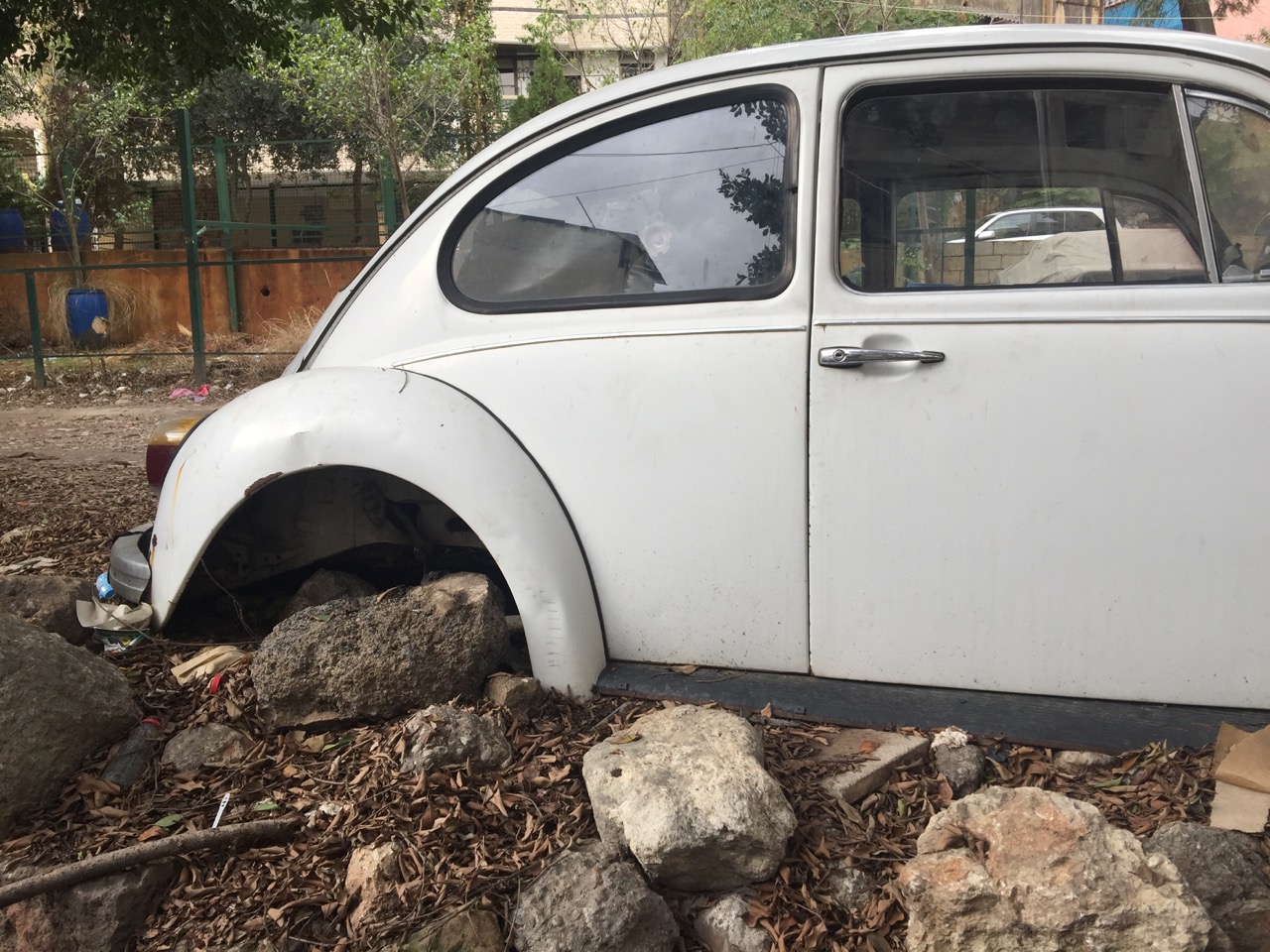
A Volkswagen from the Stone Age, complete with
prehistoric tires. (22 Oct. 2018 – Khalil Badawi, Beirut)
            But seriously, folks, reality aside (hah!), I really would rather be writing about all the interesting and fun things we’re experiencing here. And there is plenty that’s interesting and fun. Like receiving an official delegation and Armenia’s “caretaker” Prime Minister, Nigol Pashinyan, who visited the Armenian Evangelical Union leadership (interesting). Or like the visit of dear friends from Philly, Linda and Mike Sywulak (fun). They visited missionary friends of theirs in Kenya for a week, and then spent a week with us this month, getting introduced to Lebanon, its history, its natural beauty (I mean that), and its vital Christian ministries. For us, it was a welcome respite, and an occasion to reflect on our time here so far. For them, it was an opportunity to turn something abstract into a concrete picture that they can talk about and pray for.
The ashtray of no ashes. A Zen moment in a
Sassine Sq. diner. (12 Mar. 2018 –
Ashrafieh, Beirut)
            So, we got to be tourists! Finally! Nothing like visitors to provide you with an excuse to “see the sights”. We showed them all five Armenian Evangelical churches in Lebanon, plus their schools, plus the old age home (CAHL), plus KCHAG, plus more. They got to speak directly to workers in these ministries about their joys and burdens. We traveled to the ancient cities of Baalbek and Ainjar and Byblos. We visited some of the majestic Cedars of Lebanon (and witnessed the ongoing reforestation efforts). We got to see “Linda’s new favorite bakery,” with Arabic bread rolling out of the oven like big wheat pillows onto a cooling conveyor. And we got to treat them – and ourselves – to several different places that serve Arabic ice cream. All in seven days!
            Fortunately, aside from all these special events there are many things that tickle my brain on a daily basis. Like seeing an ashtray in a restaurant with no slots to hold your cigarette, and a “no smoking” symbol engraved on the side. Perfectly normal to locals – because that’s where you put your straw wrappers and zip-tops from your “pepsi” cans. Oh, and “Pepsi” is the generic name people use to refer to carbonated beverages, no matter what the label says. Like “kleenex” is for Americans.
            A frustrating bit of brain stimulus has to do with rampant Americanisms around us, like the adoption of that most worthless of American holidays, namely Halloween. In talking with a taxi driver a few weeks ago, after remarking on a huge billboard advertising some Halloween event in a predominantly Muslim area, he said, “We are forced to accept these American things because they are part of our children’s (American) textbooks. I do not like it, but my children learn it because it is there in their books.” Children carve jack-o-lanterns, dress up in skeleton costumes, and adults “dress up”, too. Thanks to social media, this vapidity (some would call it “evil”) is being copied the world over, including in Armenia.
LebCat 18 (black & white) and associates:
OK, so it’s October 31. What’s that got to do with
us? (31 Oct. 2018 – Mar Mikhael, Beirut)
            How about “Black Friday” sales in Lebanon? Its original American (and consumerist, in the worst sense) moorings are irrelevant here. It’s a catchy phrase that represents an American (and therefore, to many Lebanese, desirable) way of getting people to spend money they don’t have to buy things they don’t need. Does anyone believe that that will turn around Lebanon’s economy?
            But I have homemade fun, too, observing my environment as I walk from place to place, dodging between cars parked every which way – especially on the sidewalk – and avoiding other cars as they try to pass each other from opposite directions on a one-way street where cars are parked on both sides (welcome to my neighborhood… won’t you be my neighbor?). There are always a few cars parked in the middle of the street. Probably the driver came home very late last night, and probably there were cars between his car and the curb, though now it’s just empty space. Soon enough he’ll come down and nonchalantly get in and drive away, as if it’s the most unremarkable thing in the world to park overnight in the middle of an intersection. Recently when we were passing one of those “creative” parking jobs, a friend driving us around said (in Armenian), “One day he’s going to eat it.” Oh, it loses so much in translation!
            Now, back to my efforts at creating databases and websites and choirs and more! [LNB]