Showing posts with label KCHAG. Show all posts

Thursday, January 24, 2019

Drip Drip Drip


22.Drip, Drip, Drip (23 January 2019)
A brief respite from the rain, the city, the daily grind… at the
Pastors’ Retreat at KCHAG. (11 Jan. 2019 – Monteverde)
            For the past two weeks, for more days than not, all we had been hearing was the sound of rain. Morning and daytime and evening and morning. Sometimes we had breaks from the wet, but we accepted the steady “drip, drip, drip” as a necessary part of the winter season. Each dark and dismal morning I would get up and look out the window to see if it were really morning, and if it were raining… again. Once we had ascertained the day had started, and once the haze had cleared for a brief respite, we would look out the other window to see a brighter, whiter quilting over Mount Sannine. What we experienced as drip, drip, drip, they received silently, in the form of heavy snowfalls.


Norma paying a visit to our balcony/rooftop.
(23 Jan. 2019 – Geitawi, Beirut)
            Our “early warning device” in our bathroom is the best indicator of the precipitation. When a single drop of rain falls, it pings on the “tarbouche” or “fez”, the cover on top of the vent pipe, giving us a more accurate weather picture than the TV or our phone apps. But it doesn’t show us the damage caused by the heavy rains, in a country whose infrastructure is not in optimal condition, and which won’t see improvement any time soon. All of this rain brought landslides to a number of areas, closing highways and causing traffic delays at every turn.
            Not only were the roads, drains and rivers unable to handle all of this, but the refugee camps, most of which are in the central portion of the country, were turned into swamp-like conditions. In some situations, the water flowing through them resembled whitewater rapids, which would not have been a problem for that farmland-turned-tent-city in “normal” days, but where in today’s world does “normal” exist?
            Schools, which closed for several days because of the storms, are now adding makeup “rain days” to the end of the school calendar. We in the city are awaiting the next deluge, and whose name will be heard over and over in the news. The big storm was “Norma”, followed by one with another Western name (which the Arab media changed to “Maryam”). Some are guessing that next, Norma’s husband, or boyfriend, or maybe even her “ex-” will show up…
The “tarbouche” on our roof. Actually looks more like a
Japanese-style wicker “kasa” hat. Which sounds pretty European
to me. But then the Japanese call Euro-style hats “boushi”.
Go figure. (10 Mar. 2018 – Geitawi, Beirut)
            Over last weekend, “drip, drip, drip” was replaced by “thump, thump, thump” – the familiar sounds of the Huey helicopters, audible from miles and miles away. Lebanon hosted an economic summit of Arab leaders earlier this month. Considering the ever-worsening economic state of Lebanon, this was probably a good thing to host, to give visibility to the problems the country and immediate region is facing. Most of those leaders said they were coming, but then after some locals tore down and burned one of the flags near the venue (and posted a video of themselves doing it, of course) to express a decades-old grievance, they canceled and sent lower-level ministers to represent them.
Graffiti that blesses and challenges passersby, long after the
artist’s death (Samuel Pashgian’s home,
22 Jan. 2019 – Geitawi, Beirut)
            But the summit went on, and again roads were closed (for security purposes), and people stayed home. So, instead of traffic jams on the ground, there was the incessant “thump, thump, thump” of the Hueys overhead. For soldiers in Vietnam in the 1960s, this meant that help was on the way. For us here in Lebanon, I’m not sure what it means.
            But the dripping sound is more analogous of things that we face, such as the steady closure of small businesses in favor of “outlet”-style stores in western-style shopping malls, and the emigration of their owners to Armenia. Like a slow leak under the kitchen sink, you don’t notice it until it’s already damaged the floor. This is just one of the indicators of how a sub-group of Lebanese society, such as the Armenian community, is being stressed. The society overall will be the worse if these small, industrious communities disintegrate.
A pointed message on an electrical post
(6 Jan. 2019 – Geitawi, Beirut)
            The slow attrition of church members, something seen around the world, can be seen here as well. People, for whatever reason, tend to leave very silently, such that only the very alert notice, and then have a window of opportunity to reach out to them. Fortunately, there is an active and committed group of church members, including many young people, who are taking note and trying to think of ways of keeping people connected and integrated to their churches and communities. They’re even thinking of ways to keep young people who find work in other regions of the Middle East to stay involved in the life of their local church, possibly making use of new technologies to bridge the physical distance. It’s exciting, and I’m looking forward to ideas that will emerge.
            I’ve resumed rehearsals for the Armiss choir, and we’re preparing to give a full concert in June. It will be hard work, especially to build their cohesion. Drop by drop (not drip by drip) we’re gathering singers, young and young-ish (my peers) to be a part of this, and hopefully for all four voices. Notice I did not liken the choir to a bucket. That was on purpose.
LebCat 21: A fat-cat, similar to the non-feline
variety so prevalent in the country, waiting for
a burger to fall to the ground.
(17 Jan. 2019 – Mar Mikhael, Beirut)
            There’s some very interesting graffiti around the city, and I don’t pretend to understand all of it. Some is ominous. Some is humorous. Some is objectionable. Some is a nuisance. And some is thought-provoking, like the wall in Hamra on which is scrawled “Free your mind – Kill your television”.
            It has been two years since we moved to Lebanon, and the excitement, the challenges and the rewards continue. It’s exciting that I am resuming my Arabic studies, after a 20-month “break”. It’s challenging to focus on just a few things, work- and personal-related, and to say “no” to a bunch of other things that legitimately need someone’s attention. (Something about praying to the Lord of the harvest…) Meanwhile, it’s rewarding to be part of a network of friends and colleagues who do their best to support each other. Early in the month I was part of our semi-annual Armenian Evangelical pastor’s retreat, in which colleagues from Syria and Lebanon came together for a 48-hour experience. It’s things like this that keep me grateful for God opening up the way for us to be here.   [LNB]

Wednesday, October 31, 2018

On My Head


19.On My Head (31 October 2018)
            One of those essential phrases anyone living in the Arab world needs to know is “on my
Inspired by Lark on the Move, you have to find
where Maria and Linda are. In the equivalent of
an ancient Roman narthex! (13 Oct. 2018 –
Baalbek, Lebanon)
head”, or, alternatively, “on my head and eyes” (3ala rassi/3ala rassi ou 3ayni). When I go to the grocer, I know he’s going to send greetings to my wife, and although I try to keep my conversation limited to onions and grapes, he inevitably throws pleasant chatter at me. Yesterday he sent the usual greetings, but I was able to fumble out an “3ala rassi” in response as I was leaving. Add that to the other things “on my head”, and you have a pretty accurate description of what’s happening in our lives these days.
            Still, even with the continually-postponed resumption of my Arabic lessons, I’m managing semi-well with what’s on my head and eyes. Although we’re no longer newcomers, we still have people looking at us as if (but denying they are thinking that) we are crazy for picking up and moving to Lebanon. But we also have people who are delighted each time they see us, and (we hope) are encouraged as much as they encourage us.
            As we become more aware of just how big a struggle it is for so many people to manage life here (although my focus is just on Armenians; it is similar for lots and lots of people), our hearts are even more broken. More frequently than before friends are sharing, quite openly, about their plans to leave Lebanon for Armenia. Others may have plans to move to Europe, the U.S. or Canada, but they tend not to share that with anyone but those closest to them.
Some young cedars of Lebanon in the background, and some
old guys (Mike and I) in the foreground. Guess which ones are
going to be around longer. (14 Oct. 2018 – Barouk, Lebanon)
            Things like not having a government (after 5+ months) doesn’t really get anyone’s attention, though it should – especially of those who are horse-trading the lives of their citizens for personal gain. Not that I’m a fan of politics, but the phrase from the 1992 U.S. presidential elections comes to mind: “The economy, stupid.” That’s what is grinding down individuals, families, communities like the Armenians, community organizations, and pretty much the entire social fabric. The biblical injunction to “pray for kings and those in authority” (I Tim. 2.2) is not just a nice, occasional add-on to personal and corporate prayers; it is an essential for us, something we continually cry out to God for him to answer. We pray not just for local authorities, but for those far, far away, too, who affect life here.
            A couple of days ago a friend mentioned how, because of the sagging economy in Lebanon, a cascading effect is happening. The central bank (just now?) has decided that it can no longer give loans to first-time homeowners, due to the economic situation and a bunch of other things. (Point of clarification: the “homes” I’m talking about are not the American-style
Bread on the cooling conveyor. Most of what you buy won’t
last the trip home-mmmm. (13 Oct. 2018 – outside Ainjar)
single-family homes with a lawn and a fence. It’s a cramped, sometimes brand-new, apartment in one of those ugly high-rises I regularly rant about.) So, with no home loan, young people are cancelling wedding plans because they won’t have a place to live aside from a room at their parents’ home. And that means all the related businesses are also suffering – those who would clothe, feed, photograph and entertain the wedding guests. And those who would sell furnishings to the newlyweds. And sell them cars. And later on, baby things. And later on, school tuitions and incidentals. (Again, I’m thinking particularly of the struggling Armenian schools and families, but it’s an overall phenomenon.) And so on, and so on. For someone like me to come in and share the message, “Place your hope in Christ!” that person must be willing to also, and first, listen to and care for those whose hope for a normal life is fleeing from them.
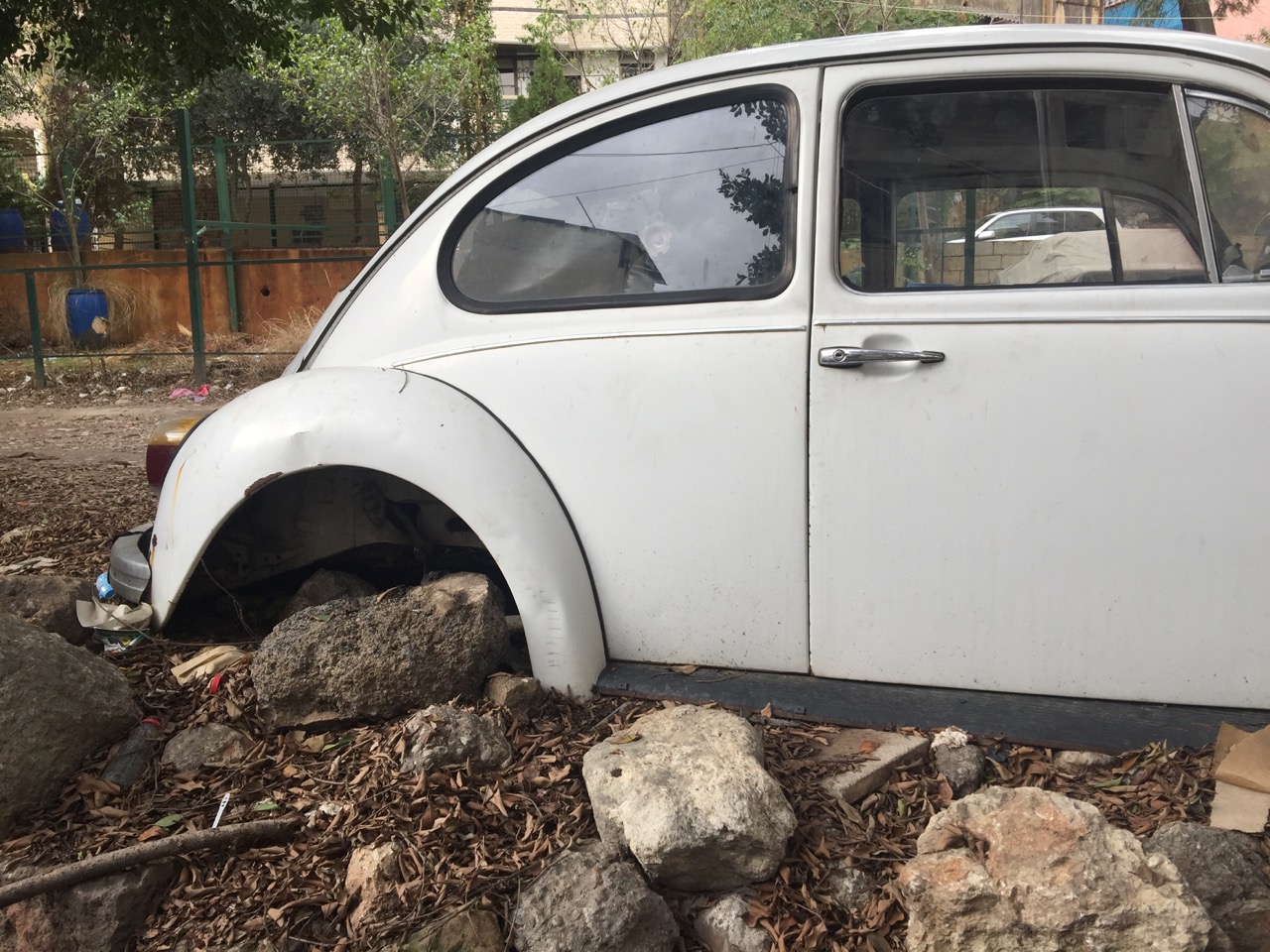
A Volkswagen from the Stone Age, complete with
prehistoric tires. (22 Oct. 2018 – Khalil Badawi, Beirut)
            But seriously, folks, reality aside (hah!), I really would rather be writing about all the interesting and fun things we’re experiencing here. And there is plenty that’s interesting and fun. Like receiving an official delegation and Armenia’s “caretaker” Prime Minister, Nigol Pashinyan, who visited the Armenian Evangelical Union leadership (interesting). Or like the visit of dear friends from Philly, Linda and Mike Sywulak (fun). They visited missionary friends of theirs in Kenya for a week, and then spent a week with us this month, getting introduced to Lebanon, its history, its natural beauty (I mean that), and its vital Christian ministries. For us, it was a welcome respite, and an occasion to reflect on our time here so far. For them, it was an opportunity to turn something abstract into a concrete picture that they can talk about and pray for.
The ashtray of no ashes. A Zen moment in a
Sassine Sq. diner. (12 Mar. 2018 –
Ashrafieh, Beirut)
            So, we got to be tourists! Finally! Nothing like visitors to provide you with an excuse to “see the sights”. We showed them all five Armenian Evangelical churches in Lebanon, plus their schools, plus the old age home (CAHL), plus KCHAG, plus more. They got to speak directly to workers in these ministries about their joys and burdens. We traveled to the ancient cities of Baalbek and Ainjar and Byblos. We visited some of the majestic Cedars of Lebanon (and witnessed the ongoing reforestation efforts). We got to see “Linda’s new favorite bakery,” with Arabic bread rolling out of the oven like big wheat pillows onto a cooling conveyor. And we got to treat them – and ourselves – to several different places that serve Arabic ice cream. All in seven days!
            Fortunately, aside from all these special events there are many things that tickle my brain on a daily basis. Like seeing an ashtray in a restaurant with no slots to hold your cigarette, and a “no smoking” symbol engraved on the side. Perfectly normal to locals – because that’s where you put your straw wrappers and zip-tops from your “pepsi” cans. Oh, and “Pepsi” is the generic name people use to refer to carbonated beverages, no matter what the label says. Like “kleenex” is for Americans.
            A frustrating bit of brain stimulus has to do with rampant Americanisms around us, like the adoption of that most worthless of American holidays, namely Halloween. In talking with a taxi driver a few weeks ago, after remarking on a huge billboard advertising some Halloween event in a predominantly Muslim area, he said, “We are forced to accept these American things because they are part of our children’s (American) textbooks. I do not like it, but my children learn it because it is there in their books.” Children carve jack-o-lanterns, dress up in skeleton costumes, and adults “dress up”, too. Thanks to social media, this vapidity (some would call it “evil”) is being copied the world over, including in Armenia.
LebCat 18 (black & white) and associates:
OK, so it’s October 31. What’s that got to do with
us? (31 Oct. 2018 – Mar Mikhael, Beirut)
            How about “Black Friday” sales in Lebanon? Its original American (and consumerist, in the worst sense) moorings are irrelevant here. It’s a catchy phrase that represents an American (and therefore, to many Lebanese, desirable) way of getting people to spend money they don’t have to buy things they don’t need. Does anyone believe that that will turn around Lebanon’s economy?
            But I have homemade fun, too, observing my environment as I walk from place to place, dodging between cars parked every which way – especially on the sidewalk – and avoiding other cars as they try to pass each other from opposite directions on a one-way street where cars are parked on both sides (welcome to my neighborhood… won’t you be my neighbor?). There are always a few cars parked in the middle of the street. Probably the driver came home very late last night, and probably there were cars between his car and the curb, though now it’s just empty space. Soon enough he’ll come down and nonchalantly get in and drive away, as if it’s the most unremarkable thing in the world to park overnight in the middle of an intersection. Recently when we were passing one of those “creative” parking jobs, a friend driving us around said (in Armenian), “One day he’s going to eat it.” Oh, it loses so much in translation!
            Now, back to my efforts at creating databases and websites and choirs and more! [LNB]

Thursday, August 30, 2018

Like an Old-Timer


17.Like an Old-Timer (29 August 2018)

Togetherness (mostly) over kebab at the Bakalians!
This time with Sevag and a bunch of friends
(20 July 2018 – Geitawi, Beirut)
         When taking some visitors around Beirut recently, I realized that I was talking like an old-timer. Remember, you don’t have to be old to talk like a senior citizen. I was pointing to this place where there used to be such-and-such school, and the other place where so-and-so used to live, and on and on. I’ve only lived about a dozen years of my life here (and not even my formative years), but here I was, talking about the place as if I had been here all my life. To be fair, I can talk in the same fashion about nearly any place I’ve lived, but this place is nowhere near where I was born.
         So, here I was giving the “insider’s tour” of our neighborhood, from the post-Genocide era, to the pre-Civil War era, to the ups and downs of the past 3 decades. It offered a strange satisfaction, a deeper sense of belonging, while at the same time reminding me of the responsibility to pass along the heritage I have inherited (and chosen), particularly the Western Armenian and Armenian Christian heritage. The fact that I might know more than most people about this background is largely irrelevant. There is so little I know, and so much catching up I have to do to begin to grasp it all… even as an old-timer… or a perceived old-timer / know-it-all.
The theme-word for this summer’s youth
conference was “dukhov” (on the hat), a Russian/
Armenia word meaning “with spirit”. Ha.
(23 June 2018 – KCHAG, Monteverdi)
         One of my new favorite spots to eat is a little hole-in-the-wall kebab sandwich place, a 10-minute walk from home. The proprietor and sole worker there is a youthful and light-hearted, 70-something Armenian woman, whose friendliness and focus on providing high-quality food is a rare commodity. Eateries in this city can be pretty snooty places, even cheap eats, but Angele easily finds a way into your heart, and you into hers. She gets up before dawn each day, chops her fresh onion and parsley, gets to the butcher for fresh meats, switches butchers if she feels they are slipping in their quality, and lines up her skewers in small quantities in the refrigerated display for her regular customers. When I stopped by she talked about how, a few days ago, Persian Armenian visitors to Lebanon kept coming back day after day, even bringing friends to eat there. Sometimes Angele recruits willing friends to help with the chopping, but she is the one and only cook. Puts the charcoal on, sets the blow-drier to intensify the flame (they keep breaking down, and her brother keeps fixing them), peels the skin off the tomatoes after she cooks them, tosses on the right amount of spices to make a delicious sandwich… and charges almost nothing for it. At every turn she thanks the Lord for helping her. “It’s enough for me to live on – that’s all I need, praise God.” In a country of debt-based living, it’s an outlook on life that a lot more people need to share.
A heart for figs that grow out of the walls of Roman temple
ruins (25 July 2018 – Niha, Beqaa)
         The summer zoomed by us. We started out serving as counselors for the youth camp, then I got to be recording secretary for the church union’s annual meeting, and in between we got to see brother-in-law Vicken for a very brief visit. After that we spent a month (sort-of together) with our son Sevag, who was making his second annual appearance here. We enjoyed Lebanon for a few days, visiting Rayaq, where a lot of Armenians settled after the Genocide, until they emigrated to Armenia in 1946. We ate the most flavorful – not sugared – Arabic ice cream (in the Beqaa village of Saghbine). Sevag then did his second annual stint as a leader at the Armenian Evangelical Children’s Conference in KCHAG while we departed for Armenia to get ready for yet another big conference… “Zoomed” is the word.
Wrapping up the Armenian Evangelical Youth Conference
(15 Aug. 2018 – Hankavan, Armenia)
         Over the past months Maria and I had been filling our days and nights as directors of the worldwide Armenia Evangelical Youth Conference, organized by the Armenian Missionary Association of America for its 100th anniversary. (Read about Day 1 through Day 14 here.) Sevag, along with the Syria & Lebanon group, joined us a few days after we arrived Yerevan, with about 140 other youth and mostly young leaders from a bunch of different countries for a two-week conference. (Read his interview in Armenian here.) The most memorable part of the plan was, predictably, the service opportunities the youth had, in teams of 4 to 10 people, heading out to various cities and villages. Each team did something different, whether helping run Vacation Bible School, or making jam, or doing housecleaning, or planting rooftop gardens, or visiting lonely elders in border villages, or refurbishing dwellings, and on and on. The conference got them culturally enriched and spiritually challenged, and then provided them an outlet to give to others a portion of what God was filling them with. Good, good times.
LebCat 16 and associates: We will soon take over your planet
with our fuzzy bodies and our laser eyes. Meanwhile you must
feed us (18 Aug. 2017 – Mar Mikhael, Beirut)
         Emerging mostly unscathed through all of this, Maria and I realized anew that this kind of leadership is something we need to encourage, advise and challenge in others. Because, simply put, we are old-timers! Happily, there are at least a few out of the youth with whom we worked throughout the summer who will likely do very well as tomorrow’s and today’s leaders.
         News update: it seems the ants noticed that they were getting very little social media traction from their antics in our apartment, so they took a break from bugging us. That and a bit of spray from a store that sells organic stuff seem to have done the trick. For now.
         September has nearly made its way back into our lives, so it’s time for both of us to hunker down again for the new academic year. With the summer conferences behind us, we can focus on the tasks we were sent here to do. While we continue to be integrated deeply into the fabric of life here. And gladly fulfill our roles as old-timers.  [LNB]

Sunday, May 6, 2018

Infestations


15.Infestations (6 May 2018)
A last-minute flier, in case you are confused by the
new electoral laws, let’s make it simple for you:
just vote for our list. (6 May 2018 – Geitawi, Beirut)
            It’s Election Day here in Lebanon. Like the movement of populations to their home towns as recorded by Luke (in Jesus’ birth narrative, 2.1-3), today people are traveling to the places where their family records are held. This is not a reflection of where they currently live, and you often hear a surprised reaction when friends learn where their friends are going to vote. Husbands and wives may even go to different polling places, too, to choose slates (or is it individuals?) for a variety of political parties vying for a majority in the Lebanese parliament.
            In the prior nine years, since the last parliamentary election, there has been a change in the already byzantine electoral laws, involving redistricting and reassigning numbers of seats for each religious sect (also byzantine), trying to move towards proportional voting, and allowing expatriates to vote in Lebanese consulates around the world (except for those who are flown in by various factions), and, well, you get my point. Grasping the “what” and “why” and “how” of all of this requires you have a Mensa membership. What is evident is that there is little talk from the candidates about change, and a lot about control. The body language in the campaign posters infesting every square meter of the city says it all: arms folded over the chest. Practically every single candidate is posed in the same fashion. There’s even a candidate whose last name means “folded” in Arabic, whose arms are folded. “You may want to know what I’m going to do if elected, but I’m not going to tell you. Just vote for my party’s list.”
Armenian Evangelical Intermediate (Torossian) School Choir at
Armenian Martyrs’ Day commemoration (24 Apr 2018 –
Bourj Hammoud)
            The joke is circulating in Lebanon that if you stand in one place for more than two minutes, someone will come along and hang an election poster on you. But behind this proliferation of multi-storey posters there is, of course, a proliferation of payments being made. Private buildings, public spaces, even taxis have all benefited from this largesse. All the while, the amount of “eyescrapers” (see blogpost 13) polluting the cityscape has skyrocketed, if such a thing were possible.
            Will this infestation of posters be cleaned up after the elections? Yesterday morning’s high winds seemed to take matters into its own hands, displacing banners hung from every highway and bridge in Beirut. My expectation is that the winners will put up new banners in place of the old, and the losers will just take them down as they figure out what to do next.
White powder that kills ants and cockroaches. Of
course it’s safe. It’s certified by the Board of
Health. Just keep it away from children. (6 May
2018 – Beirut)
            Then there’s Armenia.
            Peaceful protests in March against the infestation of self-interest, catering to oligarchs, impunity and corruption in the higher echelons of the government swelled, and by April there was a huge popular movement in the streets of Yerevan, large enough that even the popular media outlets started noticing it. We are still in the fog of it all, so we can’t say what is happening, or what is driving it, but it seems that the people have found their voice. Those currently in power are bearing the brunt of this outburst, but there is enough blame to go around for all of the corruption in all of the years since independence. It is quite entrenched, and the anticipated election of a new prime minister on May 8 will start a clock ticking for that new prime minister (Nikol Pashinyan, I assume) to clean up the house. I hope Armenia has the stamina for that cleanup to come about.
            Maria and I have our own small “infestation” battle we are waging. It is against the residents of our newly-refurbished apartment who have not heeded our memorandums that they are not welcome here. I’m talking about the ants. The little, almost invisible ants. The ones that we encounter on a regular basis. Under the countertop edges. Across the microwave. In the corner of the shower. Around Maria’s desk. On my leg. They’re ubiquitous. We have been told that it’s a seasonal problem, or that they’ll go away if everything is clean, or that this or that insecticide will stop them… but nothing has. I figure that our extermination efforts are probably poisoning us more than them. Having written this, I’m expecting an onslaught of advice, telling us what we should be doing, or what we aren’t doing. Thanks to all in advance.
Beirut International Jazz Day 2018 – the Zela Margossian
Quintet from Australia, featuring the still-amazing talent of one
of my former students from when I was pastor at the Ashrafieh
church and school (29 Apr. 2018 – Downtown Beirut)
            Yesterday we were in KCHAG planting trees. The 50 juvenile umbrella pine saplings were bought at a discount from a nursery in the south. Over 50 youth from all our churches, along with a couple dozen “mature” types, came together for this project. During our opening worship time and orientation session I got to talk a bit about how God has appointed us stewards of the land. And then we set off to the task. Enthusiasm has no age limit, so everyone got into the act. Children and youth were driven by the excitement of doing actual labor in their own campground.  The older generation was driven by the faith heritage they had experienced there, and the tangible evidence they were witnessing of it being passed along to the next generation.
            But it was the result of an infestation.
Young and old, Kessabtsi and not, joining in the fun of
tree planting at KCHAG. Note the brown, diseased pine
tree at the top of the photo (5 May 2018 – Monteverde)
            All across the region a small worm, the “pine processionary moth” larva (known here in Arabic as “doudet as-sandal) has been quietly attacking these pines, which produce not just shade and oxygen and beauty, but also the pine nuts so important to local cuisine. As you scan the horizon from KCHAG, you can see the brown tops of trees that have been infested, hundreds of them, and you know that the trees right next to them will be the next to go. This worm is not new, but its threat is at an unprecedented level. Why are they such a threat?
            Specialists say that there are two reasons, one an easy remedy, one not. The one that is not is climate change. It’s warmer here, and what used to be killed off by colder temperatures is not being eradicated. KCHAG, being below 800 meters above sea level, stays on the mild side, summer or winter. So, putting aside the important work of combating human contribution to climate change, that’s out of our hands on a local level.
LebCat 14: Excuse me. Is there some legitimate reason why you
stopped petting me? (15 Apr. 2017 – Ras Beirut)
            The “easy” remedy, the locally-based one, is actually quite difficult. This worm has a natural predator, the cuckoo bird. It loves this worm. And its flesh is inedible because it eats these bitter larvae. However, it is a bird, and in Lebanon there are hunters with rifles. Hunting is a “sport” here, one that has caused a decrease in the migratory bird population, and has heavily impacted the local ecosystem. And here in Lebanon, the hunters’ motto is, “If it flies, it dies.” If this bird were allowed to propagate, the worm infestation would be under control. So instead the KCHAG committee, with the guidance of experts, is compelled to cut down diseased trees, haul the wood away and burn it, and use a chemical spray to save the lightly affected trees.
            And also to plant new ones. Because despite all of the types of “infestation” in society and nature, there is life, and a future, and hope (Jer. 29.11-12), as long as we trust in God. [LNB]