Showing posts with label culture. Show all posts

Friday, December 31, 2021

Motion Sickness

Motion Sickness

46.Motion Sickness (31 December 2021)

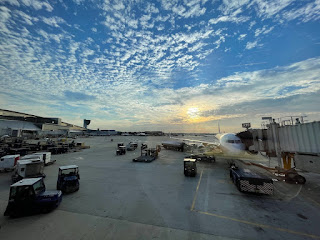
Awaiting one of our flights out of Philadelphia
(15 Oct. 2021 - Phila. Intl. Airport)
One of the constants of air travel, as well as ground travel, is the ubiquitous plastic-lined bag for the use of those experiencing stomach discomfort while being jostled back and forth, up and down, and side to side in the plane, boat, train, bus or car they are in. It also helps those around them to be able to stay clean and somewhat spared from the odor, though the poor sufferer continues to suffer what is gently referred to as “motion sickness”.

            We have been experiencing a type of “motion sickness” in recent times as we completed our required home assignment and made our way back to Lebanon last week. It was an uneventful flight, except that the airplanes were crowded cheek-to-jowl with travelers, some with masks, including those going to Lebanon. Maria and I lived through five months in the U.S. and Canada of constant travel, constant packing and unpacking, constant calculations of whether the weather would be warm or cold, along with constantly arranging flight and hotel bookings, constantly working on what kind of presentation fits a particular audience, constantly trying to wrap up paperwork and follow up on unfinished tasks in the concluding weeks when we were supposed to be “resting”. Getting back home to Beirut and its daily stresses and misery afforded us a bit of respite from the previous period!

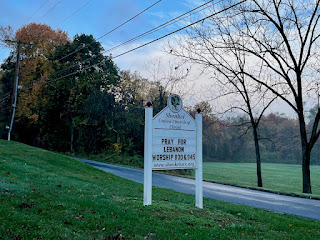
Many ordinary people want to learn, pray and
help Lebanon. (31 Oct. 2021 - Pottstown, Pa.)
            Yet it wasn’t all misery, because we got to meet wonderful, caring people, Armenian and non-Armenian, many of whom were aware of the trials being endured by the Lebanese and the Lebanese-Armenian community. Hearing their questions, seeing their concern and willingness to do something, hearing their words of blessing and being with them in God’s presence was a gift we gratefully received. Yet it was balanced by the exhaustion of upwards of 14,000 mi / 22,000 km of traveling (aside from the 16,000 mi / 25,000 km to actually get to the US and back)! Enviable? Perhaps. I suppose it depends on who is doing the envying.

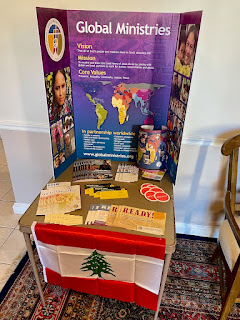
Getting the word out about Lebanon
(6 Nov 2021 - Belmont, Mass.)
            There is a TV ad that has appeared recently on Lebanese television depicting two young Lebanese boys talking about their dreams, which include going to school. It concludes with a voice-over stating, “Rights should not be just dreams.” Yet the dreams of a preponderance of people around us is not to have Lebanon become a livable country, but to leave Lebanon for a livable country. This “exit strategy” is based on yet a different kind of motion sickness: that of being made sick by a society that never experiences stability, that is continually in motion due to the profit-seeking, power struggles or whims of those in authority, whether locally, regionally or worldwide.

            On Beirut’s streets over the years, in my limited Arabic, I would often hear passersby including numbers in their conversations, assumedly regarding the price of this or that. How I wished that the conversations would revolve around ideas, or culture, or wonder at God’s creation! Today virtually all of the street conversations, and possibly also the private ones, are about the exchange rate, the cost of cheese and medicine, and the impossibility of carrying on in these conditions. One man at the exchange house said, “We’re living in an insane asylum!” I wish that my Arabic had not improved to the point where I could understand this much.

Exciting times on Home Assignment
(6 Dec. 2021 - Broomall, Pa.)
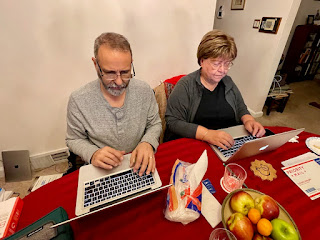
            Economic freefall produces one kind of motion sickness. Seeing dear friends and family members continually zoom away from you (and I’m not referring to screen time) can produce a similar spiritual nausea. When a family, or a community such as the Armenians, conclude that social disintegration is the best route to take, that their children must leave the country, then there is not much that can be said about the hopes for that family’s (or that people’s) future. Even if you are driven by the patriotic emotions that so often cloud Armenians’ judgment about their viability as a people, the consequences of cultural and societal disintegration cannot be dismissed. Many a person will insist on the necessity of laying hold, without delay, of the “promise of a better (economic, educational, health and secure) future elsewhere” – something that is only a promise, not a guarantee. It will apply to some lucky individuals, but what will become of collective identity? What will become of community? What will bring health and strength to the family, that place where individual and collective identity is formed and nurtured? We are in a rush toward “every man for himself”; and the shards of what was a collective hope, a concerted effort to come together to endure hardships and grow in character (such as was seen in the post-Genocide era), will become merely the subject of books and articles that very few read or care to reflect upon. Only a collective awakening to our spiritual and cultural resources can offer us a more hopeful outcome.
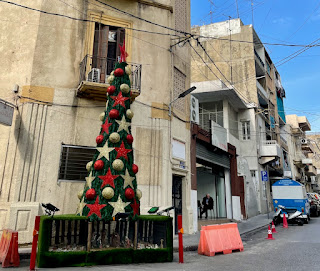
It's Christmastime in the city...
(30 Dec. 2021 - Geitawi–Beirut)

            I realize that I enjoy privileges and resources that few around me have. Yet I also have a perspective that many around me lack: that of having experienced the long-term consequences of living in a diaspora situation, in societies that are quite capable of swallowing up and homogenizing the qualities and distinctives that define a people group, including their language, creativity, spirituality, world view, and desire to survive and thrive as a unique entity. The motion sickness that we are all enduring will make it difficult, but all the more crucial, that we together take the long-term into account as well as the short- and medium-term… and listen well to each other.

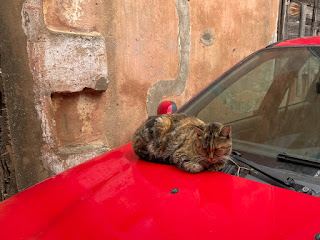
LebCat 46: You look smashing in red... I mean
on red. (28 Dec. 2021 - Mar Mikhael–Beirut)
            One of the pleasures I enjoyed during “home assignment” was getting back to exercising (which is important, considering how much I enjoyed the pleasures of overeating and gaining weight during that same period). It was a long time since I was able to go to the gym at 6:30 a.m. and get a bit of sweat going. I also got back on the mat at the aikido dojo, but quickly remembered that aspect of warmups that I dread: forward and backward rolls. I dread them because of the dizziness they cause me. But I have learned that the way to work through this sensation is, first of all, to properly position my body to roll; second, to do the rolls more frequently; and third to fix my eye and my mind on a distant, stable point. That long-distance view enables me to be steady when the world seems to be slanted this way or that.

            My prayer for Lebanon, and in particular for the Armenian people, is that we fix our eye on that unchanging Point who does not change (James 1.17), who brings calmness, steadfastness and faith in Christ in the midst of the storm, and who blesses his people in the most difficult of circumstances with the enduring riches of wisdom, truth and love.   [LNB]

Monday, February 17, 2020

Exhale


32.Exhale (16 Feb. 2020)

A building collapse due to decades of neglect by its owner.
Strangely, the ground-floor bakery survived due to renovations
by its renter. (29 Jan. 2020 – Tabaris, Beirut)
For about four months the country has been holding its breath. Actually, long before that the country had been practicing holding its breath, as the economy and policies of government upon government sagged and sagged over the years, to the point of rupture. This past week the newly-formed cabinet, still the target of some protests, received approval from parliament to begin the work of saving the country from total collapse. Lebanon has always convinced itself that it is too important for the countries of the region and the West to let it fail. And therefore, corruption, theft and mismanagement of the public sector have ruled the day for as long as people can remember. Well, surprise!
            People write and ask us how we are managing with all that’s going on in the country. Aside from the psychic stress everyone endures, we face no particular hardship, due to the special nature of our employment. But how are actual citizens faring? While walking through an upscale neighborhood last week I noticed a grown man standing next to a dumpster carefully going through garbage and removing what was edible to put in his bag. Heretofore I would only see scavengers searching for scrap items to recycle or sell; only after passing him did I realize what I had just seen. He was wise to choose a dumpster in that neighborhood, where the likelihood of good quality and quantity food waste is greater. Yes, poverty is steadily advancing, and is moving more people squarely into nutritional insecurity. This is the picture in the city, anyway.
Upper row shows the early days of the uprising, with mere
barbed wire festooning the Grand Serail and Banks St.
Lower row shows the serious concreting of the centers of
government. (Jan. & Feb. 2020 – Riad el Solh - Beirut)
            Among the political elite – and there’s an overabundance of them (too bad Lebanon can’t export them to raise a little cash allay part of the national debt) – it is in fashion to say, “Oh, I’m also against corruption. We need to join together and find out where all these stolen funds are, and make new laws, blah, blah, blah.” Lebanese who hear these speeches are disgusted by them, because of the well-known secret that those who today rail against corruption and incompetence are guilty of the very things they decry. The relevance of the Bible appears once again in these circumstances, perfectly described by the Apostle Paul: “You who teach others… do you teach yourself?” (Read Romans 2.21-23 for an excellent assessment of today’s “speechifiers”.)
This is what protestors think of Lebanon’s banks,
and what they did to express that sentiment.
(15 Jan. 2020 – Hamra - Beirut)
            Another casualty of the times is health care. If you have a chronic condition that requires regular medication, you might have to go without it for a couple of weeks until a new supply can be imported. If you are experiencing chest discomfort, you might brush it off and not see a doctor, as the healthcare system does not cover diagnostic assessments. You will eventually see the doctor, but only after an ambulance has brought you to the emergency department. Or the other door across the way. In response to all of this, more than a few doctors and some hospitals have set up weekly low- or no-cost consultation hours to help those falling through the cracks, and a number of them are even waiving their surgical fees for the truly poor. But how much longer can private citizens and organizations bear this burden?
            For years Armenian agencies have been used to taking up the slack as best they can in the absence of proper governmental services. Social service agencies have networked themselves to serve the many low- and middle-class Armenians (plus in recent years quite a few Armenian and non-Armenian refugees from unrest next door and next door to next door). The income lifelines these agencies have relied on are becoming increasingly problematic, while those they are caring for continue their need for care, irrespective of whether its being paid for.
            Also, for decades the only reliable retirement plans for Lebanese have been to either receive remittances from their emigrated children or move overseas to live with them. A third possibility exists: to keep working until you “drop dead”. No wonder there is a lack of seasoned retirees in the churches, a demographic that is the backbone of any healthy ministry.
And this is what many people feel about living
in Lebanon. (15 Feb. 2020 – Geitawi - Beirut)
            Two days ago was the fifteenth anniversary commemoration of the assassination of PM Rafiq Hariri. Sevag, Maria and I were here at the time of that explosion, and we each have our memories of that momentous day. Schools, government offices and businesses close annually in observance of the day (and not because of St. Valentine). This year’s event featured the recently-resigned PM and political heir of his assassinated father, working the crowd as if addressing a campaign rally. The event also featured a video review of what’s happened to the country and its economy for the past 30 years, with the main message of: “It wasn’t my fault”. Each new event that occurs just makes this tragi-comedy more… interesting (for those drama fans out there).
            Actually, political assassinations are a way of life here. If you look up “Assassinated Lebanese” you’ll find a whole page dedicated to this, listing at least 36 public figures eliminated here in the past 100 years. And this doesn’t include attempts that only maimed their targets. If the government declared a holiday for each assassination, my guess is that an entire extra month the country would be closed for business!
Offstage at the C.E. youth event, anxiously reviewing their
lines, right? (11 Jan. 2020 – Armenian Evangelical Church
of Ashrafieh, Geitawi - Beirut)
            Lest it appear all gloom-and-doom here, in the midst of all of this the Armenian community is managing to continue its spiritual, educational and cultural output. Recently the Gulbenkian Foundation in Portugal announced an initiative to develop the teaching and use of Western Armenian in Lebanon, which, followed by Syria, are the only places in the world where Western Armenian is a viable, daily language of family, education, and commerce. It may seem strange to westerners, or to those steeped in western thinking, that one of the callings of the Armenian church in all its forms is to maintain a strong cultural sense as it goes about its spiritual mission. Although it is valid throughout the Diaspora, it is nearly impossible to see by those who embrace the majority culture. For them, it appears that the church should be on a purely spiritual mission, often not realizing how their own Christian outlook is so deeply grounded in the dominant culture surrounding them.
            In January Armenian Evangelical youth presented (in Armenian) a post-Christmas view of the main players in Jesus’ birth narratives, reflecting not only on what was to come for them, but also helping young people think about what is to come right here where they are, and what their attitude of faith should be. I was grateful to be involved in the planning, and was thrilled to see the church filled with over 150 youth that night.
LebCat 32: This is my laptop now, since you refuse to give me
lap space. (24 Jan. 2020 – the late Beirut Cat Café,
Mar Mikhael - Beirut)
            Two nights ago a newly-published booklet containing a dozen photos and lyrics of the great Gomidas (you can look him up under “Komitas”) had its public release. The main speaker, Shaghig Khudaverdian, a lecturer at Haigazian University, who stated that the essential task for any people wishing to survive is to speak their own language and sing their own songs, and thereby continue to breathe on this earth. And as if to demonstrate this, three different Armenian school choirs (including Armenian Evangelical) took turns on stage to sing selections from Gomidas’ pen. Afterward, I had the honor of joining Armenian Apostolic and Armenian Catholic representatives in congratulating the three choral conductors, and then dedicating the publication by pouring wine over it (in Armenian the word for this literally means “wine-dedication”).
            So, here’s a toast, which in many languages, including Armenian, goes: “To life!”   [LNB]

Sunday, October 6, 2019

It's a Sign!


28.It’s a Sign! (6 Oct 2019)
Children in uniform, and parents carrying school bags. A sure
sign that fall is here. (1 Sept. 2019 – Shushi, Artsakh)
For years our family has had a running (inside) joke. When we see street signs or billboards, especially ones with the name of a city or country on it, we call out, “It’s a sign!” Perhaps not particularly funny… except that I’m a pastor, and one of the features / challenges of pastoral life is the ever-present possibility of relocation. And behind that possibility is the art of determining what constitutes a sign from God, particularly regarding a “call”, and the related relocation from ministry in one city (or country) to another. The joke is that if you are looking for a certain answer, sooner or later a “sign” will appear, confirming what you have already decided on your own. And then you can credit God for the sign. One of those Achilles’ Heels of believers everywhere.
An “old” sign, lying face down on the ground,
defeated by a new pole and by the company
that bagged a contract for replacing every. single.
pole. in the city. (18 Sept. 2019 – Khalil Badawi)
            In recent months in Beirut there has been a sprouting of metal posts and brand-new signs on sidewalks all around the city. Considering the narrowness and impassability of most sidewalks in Beirut, this has been an unwelcome intrusion to us walkers. And considering that the existing, if somewhat beaten-up, collection of traffic signs throughout the city was doing its job just fine, it makes one wonder whether there is something more behind this proliferation of poles than traffic concerns. In such an opaque and … not altogether “clean” … system as exists here, who knows? Rumors about this and a slew of other topics are pretty much all the general populace has to go on, as it tries to make sense of the rough road it has been on for decades.
Will they be able to break Mr. Sevag? An intense scavenger hunt at
the Children’s Conference. (7 Aug. 2019 – KCHAG, Monteverde)
Having the thrill of my life, leading a trained choir in concert, the
“Varanda” ensemble, while Zakar looks on. I wonder what he’s
thinking? (5 Sept. 2019 – Shushi, Artsakh)
            As a sign of how full the summer has been, two and a half months have passed since my last blog post. Why? Meetings and more meetings. Sevag’s month in Lebanon, including some vacation time with him, and a week in KCHAG, with Sevag in the children’s conference, and me in a bungalow, pretending to get studying done. Work in Armenia and time off in Artsakh. So much has come and gone. That trip to Artsakh (or Karabagh) was a memorable one, especially as Maria and I enjoyed the cultural and interpersonal riches of that region. I’ve reflected more about it in another place, but a highlight was definitely my being invited to conduct the “Varanda” childrens/youth choir in “Hayrenikis Hed” in concert.
 
Maria’s niece and family, recently relocated to
Armenia. And a penguin. (29 Aug. 2019 - Yerevan)
          
We were driven from Yerevan to Shushi by a young taxi driver who talked quite a bit about the hopefulness that is permeating Armenia since the so-called “Velvet Revolution” of last year. Yes, lots of things still need to be “fixed” in the country, but he insisted that the current government will get to it in due time. In contrast, a week later, on the taxi ride back to Armenia we had a different driver: an older, university educated man who worked in the Soviet system and the post-Soviet system, and is now witness to the current setup. His view of things was subtly skeptical, since there is movement going on, but not necessarily progress. He asked us a lot about Lebanon, and laughed, “So it seems that there are many, many similarities between the two countries!” He was referring to human potential, but moreso to the shared pitfalls.
Wait, is this town called "garlic"? The French side of the sign
reads like that Arabic word. Oops, my mistake. Good thing I’m
learning to read/understand Arabic! (10 Sept. 2019 – N. Lebanon)
            Armenia – and increasingly Armenians everywhere – speak enthusiastically about one Armenia for all. The Armenian Diaspora (the majority of Armenians in the world) is frequently relegated to a temporary and passing reality. Yet, once upon a time, in recent memory, the slogan was, “A strong Armenia with a strong Diaspora.” No more is this heard. Once upon a time Armenia had a Diaspora Ministry (usually aimed at connecting Diaspora finances to needs in the homeland). Though the channeling of resources, human and otherwise, continues, that Ministry is no more; it was closed up last year and its work subsumed into the Assistant Prime Minister’s portfolio. The Western Armenian language is a “threatened” cultural treasure, but the only serious attempts to strengthen it are coming from Diaspora organizations. (Armenia also closed its Ministry of Culture last year.) These signs betray a lack of depth of understanding of the importance of the Diaspora for Armenia as well as for Armenians everywhere. And a lack of depth in the thinking of the disorganized Diaspora as well as official Armenia.
LebCat 27: I’m looking fine… but don’t those two guys in the back
know how to pose for a selfie? (26 July 2019 – Beirut Cat Café,
Mar Mikhael - Beirut)
            Here in Lebanon, a sign that summer is over and the fall is here is the appearance of children all over the city in their school uniforms and toting their book-bags. We are all carrying another weight, though, as we closed of one of our schools this summer (shrinking income and galloping debt). It is a sign, not that Armenian Evangelical education is no longer needed, but that this vision is being challenged by other factors outside the church Union’s control. In fact, all Armenian schools outside of Armenia face this challenge. As historian Dr. Yervant Kassouny states in his recent book (Reflections on … Diasporan-Armenian Literature, 2019), “Closing an Armenian school in the Diaspora is equivalent to closing an Armenian army base in Armenia” (p. 11, translation mine). The Armenian school, along with the Armenian church and the Armenian family, is the place where this particular nation (in the cultural, not the political, sense) trains for the battle to survive and thrive in a world that works hard at homogenizing everything, not just milk.
            Keeping your eyes open, paying attention to the signs of these times, staying awake and prayerful – these are the means we employ when facing days like these. “A little sleep, a little rest, a little folding of the arms, and your poverty (including your spiritual and cultural poverty) will come upon you like an unexpected traveler, or an armed robber” (Prov. 24.33-34).   [LNB]

Saturday, July 20, 2019

Not Bad for Your Age


27.Not Bad for Your Age (20 July 2019)
Just some old guy doing climbing for the first time
in his life. (25 June 2019 – Guthrie, Oklahoma)
So, how old are you?
            I was asked this question by children and youth at summer conferences in June, when we spent a month in the U.S., traveling around various cities in the southeastern quarter of the country. It was a new world for both Maria and me, and eye-opening in terms of the differences – as well as similarities – between our “Northern” (in the U.S. sense) outlook and that of the region in which we traveled.
            The first time was by a child in Alabama, at a Disciples (CC/DOC, for those interested) camp. We were giving a presentation about Lebanon the country, and where we live, and why we are there. We showed them a map, held up the flag, talked about Lebanon in the Bible, the cedars, and so on. The 4th and 5th graders before us were listening with rapt attention. “Any questions?” I asked. You have to be a fool or very quick on your feet to open the floor to questions from children. Clearly, I was the former, not the latter. First question: “How old are you?” Ahem. This needs a clever rejoinder. “How old do you think I am?” And they started guessing. I thought I should put them out of our misery, so I picked one answer and said, “We’re in our 60s. That’s pretty old, right?” Bless them, they moved on to other questions. These children included us in their program and their hearts, even filling our “warm fuzzies” bag with notes of appreciation and gifts (of candy and chocolate!) during the week.
When it rains on your summer camp… make your own fun!
Just make sure you’re sufficiently young before the belly-flops
in the mud. (18 June 2019 – Wetumpka, Alabama)
            Maria and I were serving as counselors to junior and senior high campers during most of our time in America. Their concerns and questions were similar in some ways to those of the youth here in Lebanon, but they seemed to be facing so much more social disintegration. The family situations they described expressed a deep longing for significant relationships not just with their peers (though that was very apparent in the way they bonded with each other), but also with caring adults. This was one of the fringe benefits of being with them: to experience their warmth even with us, coming from such a distance.
Bringing insights from the Middle East to the parable of the
Good Samaritan during high school camp.
(27 June 2019 – Guthrie, Oklahoma)
            Our role was that of “mission visitors”, so we had varying amounts of time to speak directly to these youth (and adults in North Carolina, Alabama and Oklahoma) about our work and our friends and partners in the Middle East, and to challenge them to consider taking one year or many years for “overseas” ministry. In one of the camps I told the youth, “Please consider spending some time serving others elsewhere in the world. You will learn humility and grace as you go in Jesus’ name. And you will also have the opportunity to view your country (the U.S.) from a vantage point outside your usual world. You might see this country in a different light, and see yourselves as others see you.”
The message is clear: “developers” are not developing for others’
sake, but instead hoping to catch the wave of climbing
property values. (24 May 2019 – Mar Mikhael - Beirut)
            The guys in my cabin in Oklahoma were high school juniors and seniors, and many of them had known each other for years from attending this camp. A lot of them at the camp, boys and girls, were preparing to enter the military. One afternoon during cabin time (how happy I was for those rest times!) one of them asked me, “How old are you?” Not having learned my lesson from the 4th & 5th graders, I said, “Guess.” The guys said numbers which were all over the place, and that made me smile. When I finally helped them figure out the right number, the original questioner said, “Don’t take this the wrong way, but you look really good for 63. I would have thought early 50s. I mean that as a compliment.” And he was totally sincere.
            I’m not sure what to think about compliments like this, or about all those clichés about aging, or about only being as old as you feel. Good health, mobility and flexibility are important to a happy life, but sometimes I feel as if the line is being crossed over to the glorification of youthfulness. Life becomes a matter of feeling good (or young), just like churches often communicate, and not a matter of doing something that matters with your life.
Greening the concrete jungle: flowering plants after they got
their heads plucked off by passersby. (19 July 2019 –
Geitawi - Beirut)
            Again, the contrast these questions were drawing in my head was stark: we live in a place of the world where the signs of old age, the wrinkles, grey hair and bent back are still command respect in many families, even if official programs in this region do not always reflect that. Not surprisingly, it is the religious bodies here that strive to pick up the slack and care for elders – and children. It is why we have institutions like CAHL in Beirut and the Aleppo Armenian Home for the elderly, and why churches here run 5- to 8-week Vacation Bible Schools in the summer. It is why the church has its two KCHAG retreat centers, and why it operates Armenian Evangelical schools, imparting knowledge as well as Christian character with a biblical foundation. This is God’s vision for the church: to be a multi-generational family, a “home”, where respect and care is evident towards all.
Faith, beauty and hope through song at the “Armiss” choir
concert. (2 June 2019 – Beirut)
            I love old things, too. And it’s not just because I’m steadily becoming an old thing. The character that is expressed by things artistic or architectural, things that have stood the test of time, enriches my character and that of the environment. Yet I wonder if these old things can stand the test of money. As I (and others) have often lamented, the ongoing destruction of Beirut’s architectural heritage is most disconcerting. People (who knows who they are, or whether they are even local?) see land as something to profit from, and they aim to create the biggest (and often ugliest) structures they can, in order to gain the most from each square meter. In reaction to this, graffiti artists are creating pieces that express the urgency: “Old Beirut Matters”. Although those with bulldozers rule the day, perhaps sanity, and respect for heritage, will endure these times.
            A couple of days ago a woman entered the mini market I often frequent, brandishing clippers and a broken bloom, complaining to the proprietor, her neighbor, that people walking by her ground floor window boxes snap off blooms as they pass. She was frustrated at all the work she was doing to beautify this world of concrete. After she left, the proprietor turned to me, again in frustration, and said, “Am I supposed to look after her flowers?” Yet today he saw me admiring the plantings and said, “Do you like our garden?” The building across the street, where he lives, had window boxes at every window. I said, “Yes, it’s great! We need to see more green around us!”
LebCat 26: All that a cat could want – fresh garbage and
cardboard boxes! A slice of feline heaven on earth, as
Lebanon's trash crisis looms. (14 July 2019 – Geitawi - Beirut)
            The “Armiss” concert on June 2 went quite well, and had a full house. Afterwards I received many, many words of appreciation for it. The program did not include any new music, but rather traditional works, some new presentations of old music, and some old music that had not been heard for many, many years. I’m currently working on the video footage to create a DVD of the event. I hope that these sorts of events can continue bringing together what is both young and old, fresh and seasoned. Because it matters. It really does.   [LNB]