Showing posts with label banks. Show all posts

Friday, September 30, 2022

A Time for Discomfort

 53.A Time for Discomfort (30 September 2022)

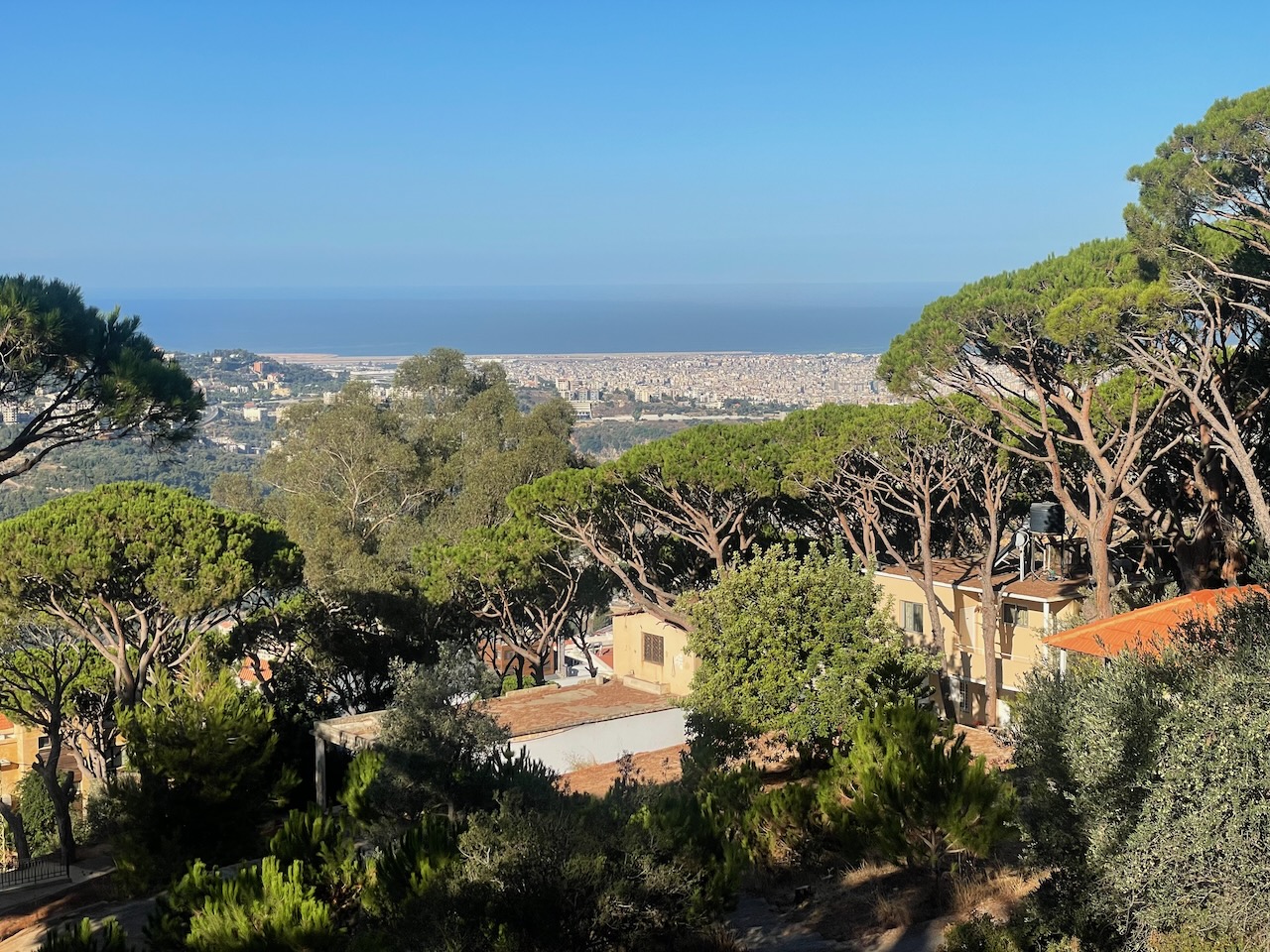
A rare day of low humidity, with a crystal-
clear view of Beirut from KCHAG.
(24 Sept. 2022 - Monteverde)

How much more surreal can things get? Yesterday the parliament met to make its first attempt at electing a president of the Republic. Hearing all the laughter and good-natured ribbing happening in the chamber, one might easily have concluded that there is little to worry about in the country, and that Lebanon is back to its glory days of the 1960s. Yet the upbeat mood in the room served only to highlight the deep disconnect between the people and their daily suffering and uncertainty on the one hand, and on the other hand those who are ensconced in the halls of power. Although this disconnect is arguably true in practically every country in the world, here it is as if a house is burning down, but the residents themselves must battle the fire alone, unassisted, running to and fro to find water to fill their basins and toss a few drops on the ever-heightening flames.

The building (at rear) where Armenian
orphan girls wove carpets after the Genocide
(17 Sept. 2022 - Ghazir)

            When people take up arms, even toy guns, and desperately enter the banks that hold their savings hostage, demanding their own money to be able to pay their own medical or business debts, it shows a deeply troubled society. They are depicted by news outlets as committing “bank heists”, as if readers were only capable of understanding Hollywood terminology. These are people struggling against the injustice and humiliation they have been fed continually for these past few years. The obliviousness of those who comfortably led Lebanon to this state, in local or international halls of power, only serves to increase our discomfort.

Reflecting on a day off, with the
help of a sculpture by local artists
(17 Sept. 2022 - Jbeil/Byblos)

            As we view the continued terror inflicted on Armenia by its un-neighborly “neighbors”, our discomfort multiplies all the more. The world today is witness to Azerbaijan’s push to impose military solutions on a weak and defeated country while the peacekeepers’ country is otherwise preoccupied. Yet once again, Armenians are demonstrating their political naïveté by rejoicing every time some Western government issues a condemnation of Azerbaijan, or a statement in support of the territorial integrity of Armenia. This same reasoning justified the international community’s lack of support for Artsakh’s Armenians during the war that began two years ago this week. Yet many Armenians the world over, in their self-imposed amnesia, continue to imagine that those statements will actually affect the reality on the ground. The reality is that this aggressor will take as much land as it can from Armenia, disrupting and destroying as many lives as it can, while big sister Turkey watches admiringly.

The streets around the Ashrafieh church &
school transformed into an Egyptian street
for a movie (30 Sept. 2022 - Geitawi)

            Meanwhile, despite the discomfort caused by events near and far, we are comforted in some measure by the beginning of a new school year. Armenian schools in both Lebanon and Syria welcomed their students back this month, providing much more than an Armenian education, as crucial as that is for the health and strength of Armenians everywhere. They are also providing a point of stability in the unstable world these children and adolescents inhabit. The daily conversations of adults around them, centering most often on continual worries about finances and the crashing currency, is being offset to a degree by the rhythm of the school day and the school week. Yes, the schools face deep financial challenges, especially if they have not yet installed a solar electric system on their grounds, and have to pour large amounts of currency into fueling their generators. Yes, this is aside from the inevitable school closures resulting from unexpected events, likely to increase as the current President’s term comes to an end. But it is an act of love and hope, based not on circumstances, but on vision and convictions.

Guitarist Ayman Jarjour transfixes the
audience with classical, Spanish and
"Oriental"-flavored pieces
(27 Sept. 2022 - Minet el Hosn)

            A moment of beauty I recently enjoyed was a guitar recital by the brother of a former student from my Haigazian teaching days. Aside from being a fundraiser for a rehabilitation center in Lebanon, the event provided a feast of musical delights, filling the church’s sanctuary for one hour with the sound of that one guitar (and the regular dings of someone unable to detach from Whatsapp). It was a gift that the guitarist gave to an audience hungry for something that would lift them up, if only for a brief time. As Fred Rogers’ mother told him when he was young and afraid, “Always look for the helpers. There’s always someone who is trying to help.”

LebCat 53: An exquisitely striped "McCat",
frequenting the location where it's most
likely to be fed - just not by me
(11 Sept. 2022 - Ain el Mreisseh)

            This is the way of the world. There are those in challenging places doing their best to help others, even at the cost of their own comfort. And there are others who seek only their own comfort, no matter how many others must suffer as a result. This is a “scalable” truth, applicable to societies as well as world powers. Though countries only occasionally enjoy peace, they are often oblivious to the role they themselves play in the natural, political or human disorder around them. More likely, though, they lack the moral grounding needed to admit their role in the hardship they cultivate.

            Yet this is the very same world into which Christ Jesus entered, into which today he leads his disciples to share words and works of comfort and hope to those truly in need of it, and to engage in the struggle for what is right, true and beautiful.   [LNB]

Monday, June 21, 2021

Two Hours Is Plenty

44.Two Hours Is Plenty (21 June 2021)

Street art around AUB
(Bliss St., Beirut - 27 May 2021)
When the foxes who have ruled the henhouse for the past three decades claim that they are going to improve henhouse conditions, like install air conditioning, or clean up the mess on the floor, it should take less than three decades to realize that this will never happen. Case in point: the endless promises up until last year that Lebanon’s decaying power grid and lengthy power cuts were going to be “fixed” – “very soon” – have passed their expiry date and are smelling rancid. Two hours a day of electricity is plenty, right? No massive popular movement emerges against these foxes – or perhaps they are wolves? “So let’s cut it down to 1-1/2 hours per day.” And on and on it goes.

And more than a few people eat at these sorts
of "food outlets" (Mar Mikhael -
Beirut - 4 June 2021)
            How bad is the electricity in Lebanon? Wait… I’ve heard this joke before. It’s so bad that their offices got blown to smithereens in the port blast last year and nobody noticed the difference. It’s so bad that even the private generator owners are complaining that their machines are working too much.

            The primary occupation of Lebanese in these times is watching, in real-time, a country rich in natural resources, human capital (especially its youth), healthy growth possibilities, history, heritage, and service industries, fall apart, bit-by-bit. It’s not a pre-occupation, because that would imply you have a job. The economy has (up to now) contracted to the point where it will take a decade or two to recover, so says the World Bank. Therefore, until and if recovery starts, “wait and watch” will be the primary work engaging Lebanese of all stripes. Possibly also the pre-occupation of the regional and international players fielding their teams in “Stadium Lebanon”.

Wounded voices from the blast zone
(Mar Mikhael - Beirut - 7 June 2021)
            Meanwhile, foreign and expatriate Lebanese partygoers looking for a bargain are flowing into the country, keeping the eating and drinking sector in business. Like vultures on carrion, nightly they noisily fill the “bar-way” – Armenia Street / rue Nahr / Mar Mikhael – near us until the wee hours of the morning. One could say, “At least they are putting  ‘fresh money’ into the economy.” But that money comes at the price of humiliation and dependency. Yesterday’s militia leaders (i.e., today’s political leaders) have treated the Lebanese this way for three or more decades, as they reinforce their place in Lebanon’s confessional-based system, offering their followers jobs, “monetary incentives”, or even COVID-19 vaccines, in exchange for unquestioning party loyalty. A similar effect can be had by narcotics.

Lines, lines everywhere
(Beirut - 14-16 June 2021)
            That currency devaluation continues by the day, and the banking system, against which the uprising began late in 2019 (before it derailed), continues to devise new ways to keep depositors’ money in their hands. This is in open defiance of international efforts to salvage Lebanon’s shipwrecked economy. Similarly, the supply of medicines, including medicines for chronic conditions, is being controlled and rationed, though it seems that there is no shortage in depots. Hospitals, deeply affected by this situation, will soon inform their chemo and dialysis patients not to come in for treatment, due to lack of supplies. Kleptomania is an addiction, and as any drug abuser can relate, you could sell anything or anyone if it got you what you crave. For Reformed theology fans, the term “total depravity” has here been replaced with utter depravity.

            Why has there been no public uprising against the perpetrators of this heartless and endless misery purposely inflicted upon the Lebanese? I refer you to “The Frog and the Kettle” analogy, which best explains the slow adjustment of the population to the deadly atmosphere around them. In previous years, as power cuts occurred, the government would announce they’re “trying to fix” the electricity (or trash, or any other) problem. Now, they don’t even bother saying anything to the public. There is no spirit or will left (so far) to hold anyone accountable. And as we all know, uprisings where mafias rule result in bloodshed.

You know your neighbors love you when they
leave onions and garlic in your mail slot!
(17 June 2021 - Geitawi - Beirut)
            One of the bright spots in this morass is one of the only governmental agencies that is working for, and not against, the people: the Health Ministry. It has an active cabinet minister who actually has the proper qualifications for the job. He makes sure the press is present during his surprise visits to hospitals, clinics, vaccination centers and medicine depots, and maintains updates on the Ministry’s website and social media, so as to increase public awareness and accountability. His recommendations for governmental policy are based on scientific and public health concerns, and not on the dictates of any religious community head. As a result, Lebanon has been able to see a vast reduction in COVID-19 cases, including a reduction in deaths from the disease. How we wish he could step out of his caretaker role and be part of the yet-to-be-formed-if-ever cabinet.

A newly-formed Armenian family exchanging
vows before a newly rebuilt stained glass
cross! (19 June 2021 - Beirut)
            Another bright spot – or rather a whole lot of bright spots – are those citizens who demonstrate humanity toward their fellow citizens, despite their own suffering. Some help to push cars that are out of gas in the waiting lines at gas stations (which dispense a few litres of fuel to a single customer as slowly as possible). Some pay a little extra at the food market so that someone else who is short of cash can buy food. Others write alerts via social media where young parents can find baby formula or diapers. In one of those online encounters the donor of some much-needed medicine refused any payment – only asking the recipient to “pray for her”. Despite the misery (and I’ve highlighted only a fraction of the spheres of corruption in which the country is drowning), the ordinary humanity of the authentic Lebanese still shines, albeit dimly.

Praying for God's blessing on the Armenian
Evangelical Central HS graduating
class (Geitawi - Beirut - 13 June 2021)

            The Armenian community here is faring as well as everyone else: not better, not worse. But in pursuing its daily life and continuing its existence, it is engaging in civil disobedience, defying the rampant corruption in which it is compelled to exist. Merely the act of rebuilding structures damaged in the port explosion (a disaster resulting from years of corruption and negligence on a staggering scale) shows that defiance. The installation of a re-imagined version of the stained glass cross in the First Armenian Evangelical Church, rededicated yesterday, is another example. Armenian schools (and Haigazian University) holding their year-end programs these weeks and prayerfully graduating their students to the next level of their education shows that same determination. Or a young Armenian couple taking their marriage vows and pledging to stand by one another no matter what the circumstances is another act of civil disobedience against the wolves running the henhouse. And for what is yet to come, faith in God’s grace will be the only way to endure.

LebCat44: What, are you going to start
charging me for chilling under this car?
(Geitawi - Beirut - 13 June 2021)
            So we are back to spending summer nights without electricity, pretending to sleep, and then dragging ourselves through the daytime, pretending we are awake. Until last week we had our neighbors with whom to commiserate, but they returned to Armenia for the summer… and have their own set of challenges to face, as Armenia decides its future leaders, and continues to be the object of interest to neighboring Canis lupus appetites, and the object of continued Western humanitarian disinterest.

            Since there is only One who holds the future, we put our trust in him alone these days. Probably not a bad idea for everyone, everywhere, to do the same, no matter the level of comfort you (currently) experience.    [LNB]

Wednesday, April 1, 2020

Cue the Locusts


33.Cue the Locusts (31 Mar. 2020)
It’s spring, but nobody’s going anywhere these days.
(24 Feb. 2020 – Geitawi - Beirut)
Here in Lebanon we look with amazement at a panicking world that, upon realizing that the novel coronavirus was not going to remain a “Chinese disease”, began by decrying the enforced confinement and “social distancing” intended to slow the advance of this nemesis, because of the perceived injuries to their liberties. The puzzlement here continued as the reality of this pandemic set in, and country after country realized that their economies were going into a deep pit because people were unable to work and therefore were cut off from the income they relied on. It may sound callous, but Lebanese, who have been in an economic downward spiral for the last several years, thanks to the greed and incompetence of their leaders, exploded with rage in October that they were not going to take it anymore. It shut down the country and the already abysmal economy, sending banks into panic over the danger to their usurious profits, whereupon they took it upon themselves to prohibit depositors from withdrawing more than a couple hundred dollars a month. The service industry, already limping along due to the lack of tourism, saw nearly a thousand restaurants close in Beirut alone, schools lost three weeks of instruction due to strikes and road closures, and specters of a return to civil war loomed in the shadows. The country was not on its knees, but rather prostrate on the ground when this virus became a local reality. How much farther down can you get?
The list of coming events at a nearby restaurant.
(23 Mar. 2020 – Qobaiyat - Beirut)
            I hope that no one would wish this situation on another, here or in any country. But it’s very tempting to say to the world, “So, how does it feel?” To face each day with fear, uncertain of what the future brings, wondering if death will snatch your friends, loved ones or even your own life? Yet there are so many people who face much greater trials than what most in the affluent world are struggling to comprehend. It is very easy to comprehend in lands under occupation, where walls are built to protect privileges. It is very easy to comprehend in places where refugees are used as political pawns. It is very easy to comprehend by those today continuing their jobs, with or without masks or gloves, who know that when the government says “lockdown” and “curfew”, it is effectively telling this subsistence-level stratum to starve to death. As many have commented, if rich people were to die from hunger, the world would find the will, the creativity and the resources to end that scourge. But those 9 million who die each year from hunger-related reasons remain out of the spotlight.
Not how a school playground is supposed to look in the
middle of the day. (24 Mar. 2020 – Geitawi - Beirut)
            Oh, did I mention? We are under a nightly curfew. The government announced, and is enforcing, a 7 p.m. to 5 a.m. curfew throughout the country. This is in addition to closing all “non-essential” businesses, that is, anything that does not sell food or medicine. And if your water tank is leaking (every household has a water tank on the roof because of the sporadic delivery of water, 30 years after the Civil War ended… sporadic, like all the other utilities), well, you won’t be able to call someone to repair it. Anyway, he might not have the parts to do repairs because the banks have had a 5-month stranglehold on the capital that is needed to import goods.
How I spent my 16th birthday – telling “Dad
jokes” at a youth/veteran C.E. youth gathering.
(29 Feb. 2020 – Armenian Evangelical Church
of Ashrafieh, Geitawi - Beirut)
            The school year has taken a body blow in this crisis-upon-crisis mode we call “the new normal”. Administrators and teachers have hastily transitioned to “online learning”, a tenuous format that might enable learning to occur. When the October protests dragged on, schools were already beginning to implement some of these methods, and it increased as the months dragged on, the strikes continued and regularly turned into violent clashes between protestors and various security forces (there are so many here I can’t keep track). Yet students as well as adults are learning quite a bit from this current in-house confinement. In some cases children are in a healthier environment. No longer do they chant, “Revolution! Revolution!” (“Thawra! Thawra!”) when being let out for recess, as if it were a game. Others are at the mercy of their abusive or neglectful parents/guardians. Those who care for the latter, such as the Armenian Evangelical Boarding School in Ainjar, constantly carry that burden in prayers for God’s mercy.
            The last couple of “normal” things I did were to deliver a talk on Hrant Dink, the Armenian journalist and activist who was assassinated in broad daylight in front of his newspaper office in Istanbul, and to attend a a wonderful lecture on Gomidas (or Komitas). Ironically, among the 300 of us sitting in the hall where that lecture/concert took place on March 8 were religious and community leaders and even a cabinet member, only one day after the government told people to avoid all crowds.
A tall tree at a nearby park, uprooted by gale-force winds
on Mar. 12. (25 Mar. 2020 – Geitawi - Beirut)
            Maria and I were already doing most of our work online since we arrived in Beirut. Except for the worship services we attend and where I assist. And except for the “Armiss” choir that I direct. And except for the committees in which we serve. Now, none of that is happening. In their place we have video conferences and work online from home. The choir rehearsals are suspended. And in place of Sunday worship services in various churches the UAECNE (our church Union) has begun broadcasting a single weekly pre-recorded program, which I am producing. (Look it up on YouTube under UAECNE.) Pastors are taking turns preaching the sermon, and I am including a variety of recorded hymns and anthems in Armenian. It is an interesting initiative that will likely continue in some form as an audiovisual ministry, and will find a home on the Union’s website (coming soon, I hope), connecting people not only across the region, but helping those who have emigrated elsewhere to maintain some connection with their roots.
LebCat 33: Look, I don’t care what the
government says about restaurants closing.
I know you’re in there. I can smell the
rotisserie chicken, OK? (13 Mar. 2020 –
Geitawi - Beirut)
            On March 12, as we were beginning our days/weeks/months of seclusion, Lebanon and the region experienced several hours of winds at speeds between 100 and 140 km/hr. The roaring sound woke us all up, as objects were being tossed from one rooftop to another. The huge flag flying on top of a nearby office building was torn from its mounts and ended up somewhere far away, perhaps in the Mediterranean? The following day everyone was out surveying the extensive damage throughout the country. Strangely, though our electricity was never interrupted – just our sleep.
            The news out of the northeast of Africa is not good. A devastating plague of locusts is destroying crops and threatening famine to countless people. Could that be next on the agenda for Lebanon? We watch… and pray.   [LNB]

Monday, February 17, 2020

Exhale


32.Exhale (16 Feb. 2020)

A building collapse due to decades of neglect by its owner.
Strangely, the ground-floor bakery survived due to renovations
by its renter. (29 Jan. 2020 – Tabaris, Beirut)
For about four months the country has been holding its breath. Actually, long before that the country had been practicing holding its breath, as the economy and policies of government upon government sagged and sagged over the years, to the point of rupture. This past week the newly-formed cabinet, still the target of some protests, received approval from parliament to begin the work of saving the country from total collapse. Lebanon has always convinced itself that it is too important for the countries of the region and the West to let it fail. And therefore, corruption, theft and mismanagement of the public sector have ruled the day for as long as people can remember. Well, surprise!
            People write and ask us how we are managing with all that’s going on in the country. Aside from the psychic stress everyone endures, we face no particular hardship, due to the special nature of our employment. But how are actual citizens faring? While walking through an upscale neighborhood last week I noticed a grown man standing next to a dumpster carefully going through garbage and removing what was edible to put in his bag. Heretofore I would only see scavengers searching for scrap items to recycle or sell; only after passing him did I realize what I had just seen. He was wise to choose a dumpster in that neighborhood, where the likelihood of good quality and quantity food waste is greater. Yes, poverty is steadily advancing, and is moving more people squarely into nutritional insecurity. This is the picture in the city, anyway.
Upper row shows the early days of the uprising, with mere
barbed wire festooning the Grand Serail and Banks St.
Lower row shows the serious concreting of the centers of
government. (Jan. & Feb. 2020 – Riad el Solh - Beirut)
            Among the political elite – and there’s an overabundance of them (too bad Lebanon can’t export them to raise a little cash allay part of the national debt) – it is in fashion to say, “Oh, I’m also against corruption. We need to join together and find out where all these stolen funds are, and make new laws, blah, blah, blah.” Lebanese who hear these speeches are disgusted by them, because of the well-known secret that those who today rail against corruption and incompetence are guilty of the very things they decry. The relevance of the Bible appears once again in these circumstances, perfectly described by the Apostle Paul: “You who teach others… do you teach yourself?” (Read Romans 2.21-23 for an excellent assessment of today’s “speechifiers”.)
This is what protestors think of Lebanon’s banks,
and what they did to express that sentiment.
(15 Jan. 2020 – Hamra - Beirut)
            Another casualty of the times is health care. If you have a chronic condition that requires regular medication, you might have to go without it for a couple of weeks until a new supply can be imported. If you are experiencing chest discomfort, you might brush it off and not see a doctor, as the healthcare system does not cover diagnostic assessments. You will eventually see the doctor, but only after an ambulance has brought you to the emergency department. Or the other door across the way. In response to all of this, more than a few doctors and some hospitals have set up weekly low- or no-cost consultation hours to help those falling through the cracks, and a number of them are even waiving their surgical fees for the truly poor. But how much longer can private citizens and organizations bear this burden?
            For years Armenian agencies have been used to taking up the slack as best they can in the absence of proper governmental services. Social service agencies have networked themselves to serve the many low- and middle-class Armenians (plus in recent years quite a few Armenian and non-Armenian refugees from unrest next door and next door to next door). The income lifelines these agencies have relied on are becoming increasingly problematic, while those they are caring for continue their need for care, irrespective of whether its being paid for.
            Also, for decades the only reliable retirement plans for Lebanese have been to either receive remittances from their emigrated children or move overseas to live with them. A third possibility exists: to keep working until you “drop dead”. No wonder there is a lack of seasoned retirees in the churches, a demographic that is the backbone of any healthy ministry.
And this is what many people feel about living
in Lebanon. (15 Feb. 2020 – Geitawi - Beirut)
            Two days ago was the fifteenth anniversary commemoration of the assassination of PM Rafiq Hariri. Sevag, Maria and I were here at the time of that explosion, and we each have our memories of that momentous day. Schools, government offices and businesses close annually in observance of the day (and not because of St. Valentine). This year’s event featured the recently-resigned PM and political heir of his assassinated father, working the crowd as if addressing a campaign rally. The event also featured a video review of what’s happened to the country and its economy for the past 30 years, with the main message of: “It wasn’t my fault”. Each new event that occurs just makes this tragi-comedy more… interesting (for those drama fans out there).
            Actually, political assassinations are a way of life here. If you look up “Assassinated Lebanese” you’ll find a whole page dedicated to this, listing at least 36 public figures eliminated here in the past 100 years. And this doesn’t include attempts that only maimed their targets. If the government declared a holiday for each assassination, my guess is that an entire extra month the country would be closed for business!
Offstage at the C.E. youth event, anxiously reviewing their
lines, right? (11 Jan. 2020 – Armenian Evangelical Church
of Ashrafieh, Geitawi - Beirut)
            Lest it appear all gloom-and-doom here, in the midst of all of this the Armenian community is managing to continue its spiritual, educational and cultural output. Recently the Gulbenkian Foundation in Portugal announced an initiative to develop the teaching and use of Western Armenian in Lebanon, which, followed by Syria, are the only places in the world where Western Armenian is a viable, daily language of family, education, and commerce. It may seem strange to westerners, or to those steeped in western thinking, that one of the callings of the Armenian church in all its forms is to maintain a strong cultural sense as it goes about its spiritual mission. Although it is valid throughout the Diaspora, it is nearly impossible to see by those who embrace the majority culture. For them, it appears that the church should be on a purely spiritual mission, often not realizing how their own Christian outlook is so deeply grounded in the dominant culture surrounding them.
            In January Armenian Evangelical youth presented (in Armenian) a post-Christmas view of the main players in Jesus’ birth narratives, reflecting not only on what was to come for them, but also helping young people think about what is to come right here where they are, and what their attitude of faith should be. I was grateful to be involved in the planning, and was thrilled to see the church filled with over 150 youth that night.
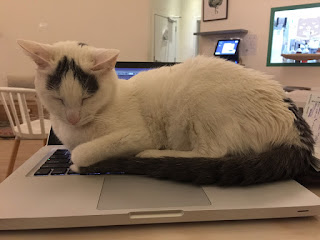
LebCat 32: This is my laptop now, since you refuse to give me
lap space. (24 Jan. 2020 – the late Beirut Cat Café,
Mar Mikhael - Beirut)
            Two nights ago a newly-published booklet containing a dozen photos and lyrics of the great Gomidas (you can look him up under “Komitas”) had its public release. The main speaker, Shaghig Khudaverdian, a lecturer at Haigazian University, who stated that the essential task for any people wishing to survive is to speak their own language and sing their own songs, and thereby continue to breathe on this earth. And as if to demonstrate this, three different Armenian school choirs (including Armenian Evangelical) took turns on stage to sing selections from Gomidas’ pen. Afterward, I had the honor of joining Armenian Apostolic and Armenian Catholic representatives in congratulating the three choral conductors, and then dedicating the publication by pouring wine over it (in Armenian the word for this literally means “wine-dedication”).
            So, here’s a toast, which in many languages, including Armenian, goes: “To life!”   [LNB]
Monday, January 6, 2020

Stormy Weather


31.Stormy Weather (5 Jan. 2020)
Stalled construction – for now – in the downtown area, center
of the protests that began on Oct. 17. (27 Dec. 2019 – Martyrs’
Square, Beirut)
It’s Christmas Eve. And it’s raining fairly steadily, as it has been for the past several weeks. Youth groups from the various Armenian Evangelical (and other Armenian) churches are preparing to spread out over the metropolitan region to visit homes and sing the good news of Christ’s revelation to mankind. Throughout the night until the early hours of the morning they will be climbing in and out of cars and vans, cramming into elevators or traipsing up flights of stairs to carol and share scripture, as well as to distribute a custom-made gift to each household. And they will enjoy the chocolates, candies and other goodies prepared by each household they visit. And get drenched to the bone. And create memories that will stay with them until their old age.
Our neighbors and we prepared snacks for the carolers to
recharge themselves before going on with their caroling.
(5 Jan. 2020 – Qobaiyat - Beirut)
            Today I found out from my son Sevag (in the U.S.) that in Aleppo this year the churches there will also be sending their youth out to carol and herald Christ’s birth. If this good news is sorely needed here in Lebanon (and it is very much needed), it is needed at least as much there. No surprise that the news went from the Middle East to the US back to the Middle East; it’s simply how the Armenian grapevine works.
Capitalizing on the tire-burning protest
movement. (21 Dec. 2019 – Nahr el Mawt)
            The season’s stormy weather seems to be the perfect analogy of what people are going through, and not just in Lebanon, but also in the region. People are teetering on the edge of a very deep cliff, and it seems certain that the country will be in freefall before too long. The dividing line between a liveable income and poverty is steadily rising, engulfing more and more people each week, and I expect that in a short while we will be seeing people focused on little else but how to get a some food on the table – if they haven’t sold the table by then. Banks are still limiting withdrawals of more than the equivalent of $300 per week, and they, as well as the exchange booths (an officially condoned, albeit black market, feature of the Lebanese economy for decades upon decades) continue to profit from the headlong fall of the Lebanese pound. Paper money (pounds, that is) is getting harder and harder to come by, and billions in local currency have steadily been relocated under the mattresses and in the coffee cans of homes throughout the country.
Some irony to chew on: poking fun at the
revolution with 22 karat gold gum.
(27 Dec. 2019 – Burj al Ghazal, Beirut)
            The other, uglier side of all of this is that for decades, politicians and businesspeople have embezzled and stolen and transferred billions in US currency out of the country, while the Central Bank has run banking affairs like an Amway franchise. Even after the uprising, when the writing was on the wall that this thievery was going to be stopped, those transfers to foreign banks did not stop. There is a reason why Lebanon has remained a “third-world” country for so long instead of developing into the jewel it has the potential to be: it’s called “greed”, described “to a T” in I Timothy 6.10.
            These unrelenting rainstorms (or snowstorms in the higher elevations) are laying bare the unkempt infrastructure of the country. Roads are being washed out, foundations are collapsing, more garbage is falling into the sea. The tourism and service industries (restaurants, etc.), which form such a great part of the (honest) income of Lebanese, have stopped dead due to the complete lack of foreign tourists and cautious spending of locals. These are not pleasant times for the country.
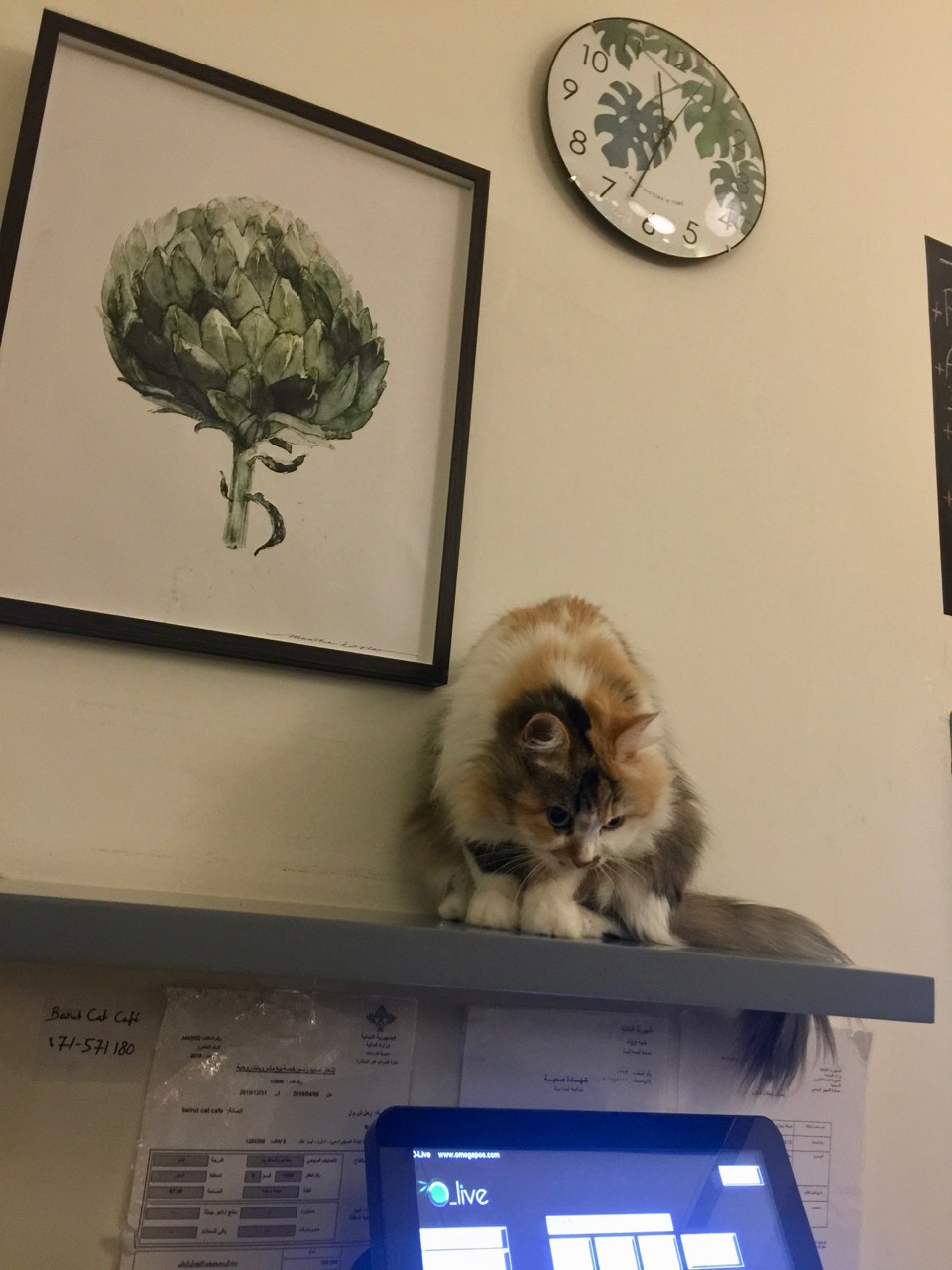
LebCat 30: On its usual perch, but appearing
more than a bit anxious. Cats can have
premonitions, right? (3 Jan. 2020 – Beirut Cat
Café, Mar Mikhael - Beirut)
            Last week a cemetery wall collapsed due to the hyper-saturation of the soil, toppling the deteriorating stone-and-cement construction onto the Damascus highway sidewalk in the Sodeco section of the city. The sadly ironic part is that it belonged to the old Beirut Jewish cemetery in a country that has almost no Jews left. Who will dare to take it upon himself to build a better retaining wall for that cemetery, I wonder? But if these storms continue, the outer wall of either the Anglo/Evangelical, French or Syriac cemeteries, all in a row, will be the next to fall. And then, maybe, the city will do a general reconstruction of all the walls – if there is any money left in their coffers.
            As business after business closes its doors, one in particular stands out for me: the Beirut Cat Café, in the Mar Mikhael area not far from us. I think of it as a “rent-a-cat” place, where for the price of a drink you can associate with willing felines for an hour or so and then leave; and if you are so inclined, you can apply to adopt one of them. Because of the impossibility of meeting their expenses in the declining Lebanese economy they are closing at the end of this month. What touches me the most about this particular place is that it represented a better side of humanity, where animals that are considered vermin can be seen in a different light. And that can have its positive effect on the way that people relate to the natural world as well as to each other. With its closing I feel that we are losing a part of our humanity, as ironic as that sounds. (Or a part of our felinity?) I hope it will open again some day soon, once these cruel storms have finished their destructive journey across the Middle East. 
LebCat 31: Blissfully unaware and uncaring at what is coming.
Probably better off that way. (3 Jan. 2020 – Beirut Cat Café,
Mar Mikhael - Beirut)
            No matter what, we will greet the coming day as we (Armenians) have always done: "Christ is born and revealed; great good news to us all!" (Krisdos dzenav yev haidnetsav; tzezi, mezi medz avedis!)    [LNB]