Showing posts with label Ottoman Turkey. Show all posts

Wednesday, May 31, 2023

Messiness

59. Messiness (31 May 2023)

Even the utility poles are puzzled.
(9 May 2023 - Geitawi, Beirut)

It’s not unusual to hear someone comment that “life is messy”. Relationships are messy. Theory applied to real life is messy. Faith in action is messy. International relations are messy. So much messiness. So frustrating.

            Local messiness – that is, life in your own neighborhood – aside from potentially being frustrating and somewhat infuriating, can also be intriguing, and even sometimes beguiling. The month of May being the “Marian” month, we often heard recorded Maronite chants loudly filling the neighborhood, both from stationary (the small church behind our building) sound systems as well as mobile ones (huge speakers sitting on a car roof, as it led a mini motorcade snaking around all of the area’s streets). Although I have all but discontinued listening to recorded music, these melodies fascinate me, even when they are Arabic words set to familiar Western hymn or orchestral tunes.

A beauty of a building in beastly
condition (16 May 2023 -
Ashrafieh, Beirut)

            The street in front of our building is the main artery connecting our neighborhood, with its two major hospitals, to the neighborhood of Mar Mikhael, the dollarized drinker’s Shangri-la. Which means in addition to the late night, loud conversations as people walk between their apartments and the bars, we also get ambulance traffic, complete with sirens. And so, yesterday the ecclesiastical chants boomed from speakers behind us while sirens wailed from the street in front of us. It was a strange effect, the messy “music” of our neighborhood, both off-putting as well as fascinating, both alarming and strangely comfortable. A moment of eternity and human fragility. In an audible way it epitomized our neighborhood as well as our lives.

            Maria occasionally says, “Everybody around here knows you, don’t they?” We, too, have become part of the backdrop of this neighborhood, sought out by producers for their movies and soap operas. When I pass through these streets seated in the back of a taxi, shopkeepers will occasionally wave to me as I go by, just proving my wife’s point. I find that being part of the local messiness allows me to wave a greeting to shopkeepers and continue on my way without feeling obligated to submit to their entreaties. No offense intended, nor taken.

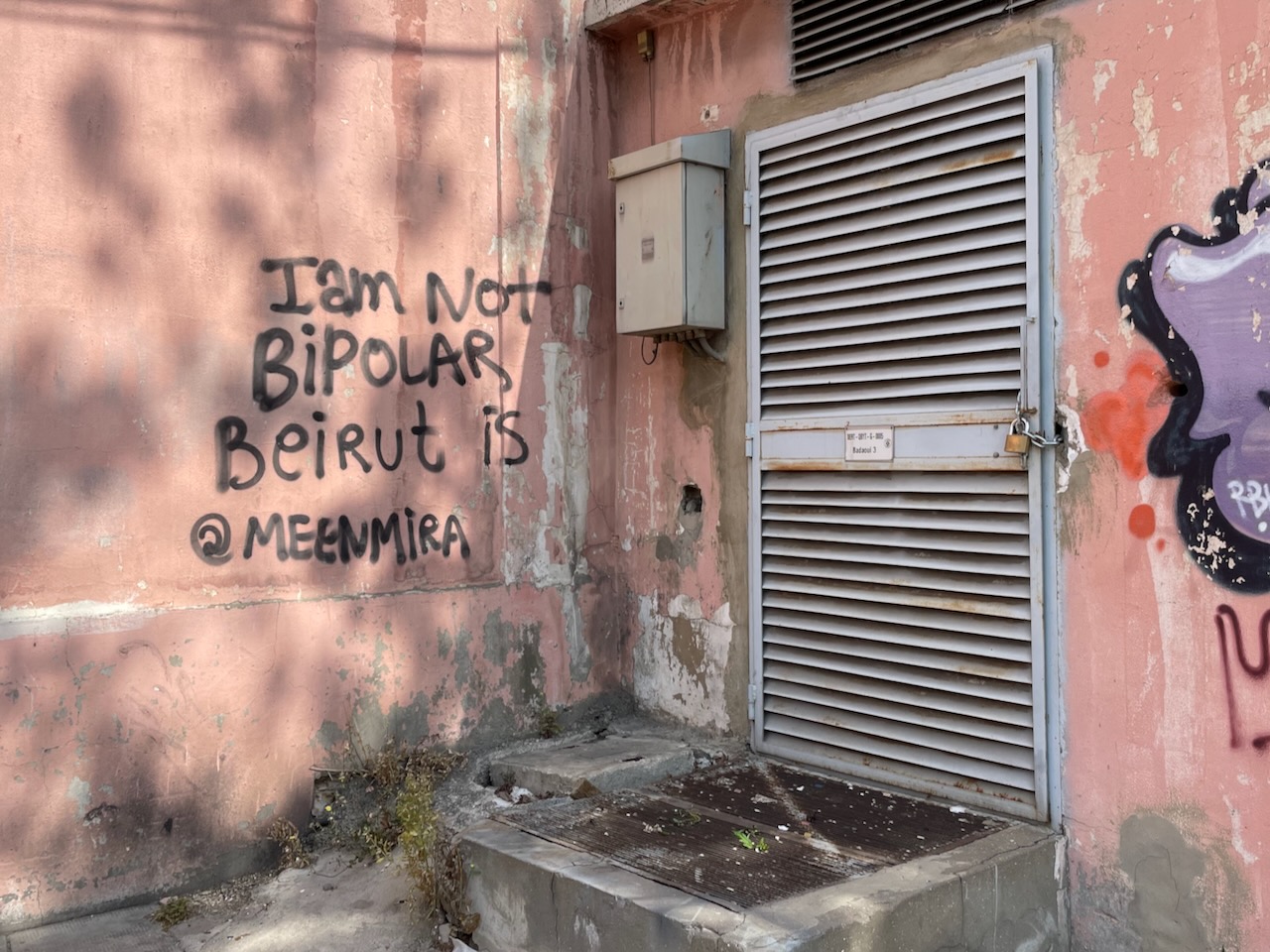
When walls talk...
(23 May 2023 - Khalil Badawi)

            A nearby bakery is run by a fellow who was formerly chef at a fancy restaurant, along with his wife and son. The menu at any local bakery throughout Beirut is very predictable: small pizza-sized manouché, with either zaatar (thyme) or cheese on top. Plus lahmbajiin (lahmajun for us Armenians), mini pizzas (with the inescapable canned corn topping) and spinach pies. Occasional variants are out there, but this is mostly it – the typical Lebanese breakfast food. This baker, however, features his wife’s home-cooked dinner entrees for lunch. Each morning I receive a photo of the whiteboard on the easel out front with the plat du jour written on it.
            One day recently I went to get two portions of this “slow food served in a hurry” – something made with flat beans, a few cubes of beef, swimming in lots of its juices. You have to understand, whenever I stop there to get the plat du jour, or even just to inquire about it, Tony (name not changed to expose the guilty) nonetheless insists on feeding me a soup spoon full of whatever the main course is. Although I’m going to be eating that exact dish in a few minutes, I am required to sample it right then and there in his shop! Well, that’s where my American logic kicks in – not pure logic, but suburban American logic, which considers this kind of behavior as unnecessary, unhygienic and imposing. You know – the logic that prohibits all the things that help people feel they are part of a community. Until now I was able to emerge from these force-feedings unscathed. But last week the plat du jour did me in. Tony placed almost the entire spoonful into my mouth, but a bit of the juice ended up running down my shirt. Not a problem, he handed me a tissue to wipe it off… So, the rest of the day I wore that badge of honor on my shirt, a tribute to our messy/friendly/business relationship. Each time he feeds me a spoonful of the plat du jour (even if I don’t buy it that day) is followed by “Good, no?” in his borderline English. To I invariably answer in my borderline Arabic: “Akeed!” (“Of course!”) or “Tayyib!” (“Tasty!). And it is! Messy and tasty!

How many languages do you need to get the
message? (30 May 2023 - Bourj Hammoud)


            I’ve experienced similar encounters all around the neighborhood, each one deepening the connection. At the falafel place up the street I am called “Abouna” (“Father”) by the owner, who also invariably hands me a piece of falafel to munch on while he makes the falafel sandwiches. A bonus! At another bakery the baker knows my usual order and rather than me ordering my usual “cocktail” (round flat bread, thin and a bit crispy, with half zaatar and half cheese), when I enter he says, “Cocktail?” and all I need to do is smile and nod. At the mini-markets around here I am also a known quantity, but I enjoy seeing the puzzled look on the shopkeepers’ faces when I show up in clergy garb, knowing I have messed up the category I have been inhabiting. The next time I enter the store they are clearly unsure about how to address me…

A mini-marathon to celebrate 80 years of
Armenian Evangelical Education!
(20 May 2023 - Ainjar)

            None of this is an excuse for the mess that passes for a government here, or the absence of public utilities that brings ever more electric wires to the mess of wires overhead to make up for that absence, or the lack of desire to pursue the common good, only the advantage of your own group's “boss” (witness the recent elections in Turkey). And I haven’t even begun to speak of the state of Armenian communities, organizations and institutions the world over, including Armenia, swimming in money and expertise (and, in the case of Armenia, tourists), but lacking the clarity that comes from a well-studied and broadly accepted national direction.

            We Armenians caught a brief glimpse of unity 105 years ago when, despite the shortcomings of officialdom, Armenian leaders organized troops and volunteers to put a stop to the genocidal enemy’s plan to overrun and annihilate Eastern Armenia along with its Western Armenian refugees. The battles in May 1918 at Bash-Abaran, Kara-Kilise and Sardarabad are a paradigm of wise strategy and unity in the midst of disarray and discouragement in the wake of the “ethnic cleansing” perpetrated by Ottoman Turkey. Today, as the same enemy continues the same genocidal efforts from Artsakh to Armenia, we are amazed at the country’s indifference towards these existential threats, and its inability to find, foster, or choose leadership with these qualities and this far-sightedness. What a mess our people are in!

LebCat 59: "This is Tony's bakery, right?
He uses cheese, right?"
(19 May 2023 - Mar Mikhael, Beirut)

            Messiness is how life is. But being a mess is simply irresponsible.

            As we do our daily adjusting to the messiness of existence and all the predictable unpredictability of life in Lebanon, we of course keep in mind the training we dutifully took as part of our appointment here, which instructed us to avoid having the same daily routine, to change our commuting routes each day, to have contingency plans at the ready, to be on the lookout for threats, and so forth. And we scratch our heads. And we trust God.   [LNB]

Thursday, February 28, 2019

Are You from Paradise?


23.Are You from Paradise? (27 February 2019)
Looking deceptively like a paradise. (23 Jan. 2019 –
Ain Mreisse, Beirut)
            No one could accuse us of moving to “paradise” in coming to Lebanon. Just to give a brief whiff of what I mean, the Armenian papers recently published a statement from the nearby Bourj Hammoud municipality explaining (or insisting) that it was not responsible for the terrible garbage smell that has been filling the air in recent weeks. The smell is originating from one of many garbage dumps the government has created up and down the coast (also inland) over the years, where every sort of trash (including millions of plastic bottles as well as chemicals that should not be put in a seaside landfill) is piled high, then flattened out into the Mediterranean, trampling underfoot international treaties and responsible ecological stewardship. And the health of all, men and women, young and old, educated and illiterate, citizens and refugees, believers and agnostics alike.
Let’s say you want to walk on a Beirut sidewalk
instead of the street. Go ahead, give it a try.
(15 Feb. 2019 – Hamra, Beirut)
            Recently Maria and I entered a store to buy something, and the shop owner, detecting that my Armenian accent was unlike the local Armenian style spoken in Bourj Hammoud, asked me (in Armenian) with a bit of a sarcastic tone, “Are you from paradise?” I don’t think he was referring to my Pennsylvania roots (I’ll wait while you look up that place name). It struck us as a strange comment to make to a customer, and it took me a moment as I tried to figure what his intent was. Maybe he was looking for a pretext for charging full price (plus) for what I was buying? So, as lightheartedly as I could muster, I pointed upwards and said, “That paradise? I hope that’s where I’m headed!” He responded by saying, “It’s all the same, there or there, it’s all the same place.”
            OK, now I was confused. So I smiled and let him go on with his… was it a rant? a dissertation? I wasn’t sure of all the ramifications of his lecture to me. But I am sure that many, many people here consider the west – and my country in particular – “paradise”. When you are assaulted by the smells of rotting corruption, and you still don’t have regular water or electricity 30 years after the end of the Civil War, how can you fault people for feeling the way they do?
Maybe try this sidewalk? Careful not to trip over
the steps. (15 Feb. 2019 – Khalil Beddawi, Beirut)
            On the other hand, we’ve been idealizing the west for a long, long time. In the 19th century, when Armenians and others were traveling to Europe and the U.S. for their education, bringing back to their homeland in the Ottoman Empire the ideals and ideas of the west, it was inevitable that discontent would result, followed by flight from the homeland. Could they have seen the endpoint of their westward movement: a dissipation and dissolution of the people called “Armenians”, especially the western-Armenian variety? That discontent and abandonment also had another by-product; it brought about an infatuation with the west, which in today’s Middle East, combined with the disgusting aromas, the ever-increasing cost of basic goods and services, and the actions of an entrenched ruling class, and you have huge numbers of people, Christians and Muslims, looking to the west – to “paradise” – as their avenue of escape. A mentor of mine, commenting on the state of affairs here since the 1975-1990 Civil War, said, “They took a paradise of a country (Lebanon) and turned it into a garbage dump.”
Students at curtain call after their Vartanants program, along
with their stage director, Sister Nariné, who was transferred to
Beirut from Philadelphia… kind of like us! (25 Feb. 2019 –
Bourj Hammoud)
            Tomorrow is the celebration of “Vartanants”, commemorating a battle the Armenians waged in A.D. 451 to resist the Persian Empire’s efforts to convert them from Christianity back to Zoroastrianism. It is considered a decisive, defining moment in our history, when somehow the Armenian people found the courage to choose death with honor, rather than a life subservient to the dominant forces of the day. But where is that courage now? Occasionally it appears, but more often than not Armenians are driven by their fears, not by their ideals or principles.
            An elderly Armenian Catholic nun spoke of this at a Vartanants school program I attended a few days ago. She remarked how she had spent two weeks at an Armenian school in the Los Angeles area, and during recess time, not once did she hear one child speak to another in Armenian. And she challenged the Lebanese-Armenian parents in attendance not to give up in imparting Christian and Armenian values to their children, first at home, and then in Armenian schools. What is happening to us? What befell us to make us this way?
  Don’t give up just yet. Try this sidewalk.
(27 Feb. 2019 – Geitawi, Beirut)
            One thing that definitely shaped us into a fear-filled people was our centuries of existence as a repressed subject people in the Ottoman Empire. Armenians survived by keeping their eyes cast down to the ground, trying their best not to provoke the harshness of the surrounding tribes, who were the real authorities in their historic Armenian lands. Those tribes, still in existence today, and still active in the same ways, considered it their right and privilege to take advantage of the industry of Armenians in agriculture and the trades. A portion of what they stole always went to the government in Constantinople, ensuring that there would be no change in this status quo. Toward the end of the 19th and beginning of the 20th centuries, when Armenians tried to organize to defend themselves and resist governmental and “irregular” terror, before and during the Genocide, they were frequently opposed by other Armenians who feared disturbing the status quo. This is how only a few Ottoman soldiers with guns were able to herd hundreds of Christians to their deaths in the Syrian desert.
            These fears are still alive and well inside of us, so that when a hint of trouble appears in this region, many of us (as well as other Christian groups) are among the first to pack up and leave. A sad contrast to our ancient Christian witness amid trials, as well as our capacity to endure as a distinctive culture group anywhere in the world, including Armenia. I wonder if Vartanants should be a day of national mourning for Armenians, in place of April 24 (i.e., Genocide Remembrance Day). Back then our forebears with their lifeblood took a stand “for Christ and for the homeland”, as the famous saying goes in Yeghishé’s “History of the Armenians”. Today? What remains of who we were?
LebCat 22: Nothing like a good morning stretch. Watch out for
what’s lurking behind the bench, though.
(18 Feb. 2019 – Qobaiyat, Beirut)
            What else, but the struggle, the urgency to continue the struggle, to seek God right where we are, and to not waste our energies seeking “paradise”. This is what every Armenian school is doing, at great cost, amid threatened funding cuts from organizations that should be increasing, not decreasing, their investment in these institutions. This is what every Armenian church is doing, though some would prefer to drop the ethnic orientation and just fit in with the local church scene. This is what every Armenian cultural activity is about, and what every Armenian choir is doing (like the Armiss choir!), what every individual does when opening up a Bible or a book in the Armenian language, or at least when reading about Armenians. “Struggle, struggle, unending struggle” is what a friend exhorted me to do when I wrote to him a few Vartanantses ago. It may not fit well in a world where people want to be entertained. But what sense is there in exchanging the weight of millennia of faith, history, culture and identity for something as ephemeral as whatever is “trending”?   [LNB]

Monday, October 23, 2017

Here and There


9.Here and There (22 October 2017)
            “Oh, so you’re from Armenia?”
            When they hear I'm Armenian, what seems to them like an easy question to answer isn’t at all. It’s asked by people who do not have a circle of Armenian friends who will eagerly fill them in on the finer points of what an Armenian is, where Armenians are from, why the Armenian Genocide is such a crucial issue to Armenians and should be to as non-Armenians, where the language is on the Indo-European language tree, what Armenians typically eat (all of which they, of course, invented), why there are fifty times (Armenian hyperbole) more Armenians outside Armenia than inside, why there has been a steady decrease of Armenians from the Armenian Republic since independence in 1991, and on and on. Really, I can’t imagine how people can get through their lives without having an Armenian tutoring them on all these issues, and so many more!
You could probably seat 5 people across in this classic
at Republic Square (4 Oct. 2017 – Yerevan)
            This summer I visited Armenia on two occasions. A mere hour and some change flight from capital to capital, Beirut to Yerevan.
            My first trip, in August, was a six-day visit, during which I led a retreat for Armenian Evangelical pastors. I was delighted to discover that the retreat was going to be held in Artsakh, in the town of Shushi, a place I have not visited in 18 years. The second trip Maria and I did together, ten days at the end of September until early October, and I was the speaker at the annual assembly of the Evangelical Church of Armenia. And this was only Maria’s second visit to Armenia, the first one having been 16 years ago. Both trips were great experiences, challenging, enjoyable, friend-filled, refreshing.
Open-air performance of Armenian folk dance
and song, “Koutan”, at the foot of the Cascade,
on the day we arrived! (28 Sept. 2017 – Yerevan)
            But the question remains: am I “from Armenia”? When I’m in Armenia, am I from “here” or “there”? “There”, of course, is the gaping hole left in the lives, culture and heritage of Western Armenia, the region that the Ottoman Empire/Turkish nationalists attempted to scrub clean of its pollutants, the Armenian people. They did a pretty good job, too, because they ruined an ancient civilization and left them to die a drawn-out, confusing death scattered across the Middle East (to be finished off later by attrition and emigration), throughout Europe (to maintain an exotic, “oriental” flavor while being re-oriented), and across the Americas (to be tossed alive into the “melting pot” while forever arguing with each other over “American-Armenian” vs. “Armenian-American”). For Western Armenians such as myself, there is an inevitable longing for something irrecoverable, bewilderment over what “Armenia” means, and the clash of familiarity with foreignness when hearing Armenian spoken in the “homeland”.
Supplying the missing “N” to the mini-market’s
name, “Bakalia” – according to Eastern Armenian
pronunciation (5 Oct. 2017 – Yerevan)
            Here’s an example: before leaving Beirut, we borrowed two SIM cards in order to use our telephones in Armenia. While feeding some money to a payment kiosk on a Yerevan street, I must have said “ayo” (yes) to something related to one of the numbers, because after congratulating me via SMS for paying that amount, it then claimed that I had only half of the amount left on that SIM card. Hmm. Time to investigate. First, I asked an acquaintance what might have happened. Was there an unpaid debt on the card that I had just paid off? He didn’t know. So I asked another acquaintance if she could call the company and ask about it. (I wanted someone who could actually understand Eastern Armenian over the phone, something I find very difficult.) She spoke to the agent, then explained something to me that I thought I understood: yes, the missing amount went to pay for something or other. But I needed to know what that something or other was, so I found an actual store run by that phone company, took a ticket, and waited my turn to speak to a live human being behind a counter. When my turn came, I asked her to explain why only half of the amount I paid was shown, and although she spoke in Armenian, it was littered with various foreign (Russian and European) words, much like the litter of Turkish, French, English, Arabic and even Kurdish words blow about our Western Armenian speech. So I asked her if she could explain it again, which she did, with a bit less patience. Then I apologized, and said, “I’m sorry, but I can’t really understand what you’re explaining. Thanks for your trouble.” And I left.
            Later on, as I mulled this over instead of going back to sleep, I figured out what had happened to the missing amount. I suppose the jumble of explanations and the various words from various languages finally sorted themselves out, and I concluded (correctly) that I had purchased a calling plan – the amount hadn’t just vanished. But it was emotionally exhausting to be in a place that didn’t exactly feel like I belonged.
            Perhaps this gave me a glimpse of the travails encountered by the latest group of “returnees” to Armenia, the Syrian-Armenians. Many sought refuge from the war in Syria, beginning in 2012, and in the intervening years some have gone on to places like Canada, others have returned to Syria, following the subsiding of military activity, and the rest have settled in Armenia. They have brought a distinct, yet Armenian, culture to the place, and one can sense it – if one happens to also be a “Western Armenian”.
Lara and us at the “Haleb” social aid organization, operating
out of a Northern Blvd. basement (6 Oct. 2017 – Yerevan)
            Maria and I met up with a young woman, Lara, from our former church in the U.S., who is now working through Birthright Armenia at an agency helping Syrian Armenians with various social needs. The restaurant we had chosen was not accepting people without reservations, so we went to one a couple of doors down. The waiter who greeted us seemed to speak a more intelligible version of Armenian, though not the Western dialect. Perhaps he was just accommodating us as Diasporan Armenians, something quite a few Yerevan natives are able to do.
            When he came to our table to take our order, he asked where we were from. “I know she (Lara) is from the U.S., but what about the two of you?” I said, “From Lebanon.” “Where in Lebanon?” “From Beirut.” “Where in Beirut?” “From Ashrafieh” (the eastern half of the city). “Where in Ashrafieh?” “From Geitawi” (a section of Ashrafieh). “Where in Geitawi?” The conversation was getting stranger by the second. “Uhhh… we live in the former CMC (Christian Medical Center) building.” “I was born in that building!” And so three Western Armenians connected on a sidewalk in Yerevan, feeling at home with each other because of the “there” that joined us together.
LebCat 8: “Excuse me, is there a law that says I have
to be inside the box?” (30 Mar. 2017 – Beirut)
            Often, when encountering people disgruntled at life in the Middle East (and in Armenia), we hear them complain about the “here” of their lives today: “This place will never straighten out.” “You can’t get anywhere if you don’t have powerful friends.” “Why bother? This isn’t our homeland anyway.” This multitude of comments are all a way of disengaging with one’s environment, and are usually followed by an announcement of departure to pursue a life “there”, far away from this region. We are amazed at how people can feel more connected to that distant, western environment than to what they consider the corrupt, future-less land of their birth, unable to see any redeeming qualities. I have no ability to read people’s minds, much less see what only God can see – their hearts. But I wonder if people can connect in a different way to the “here” of this part of the world, to experience joy and contentment in the midst of struggles, and find meaning in investing in people, albeit while dealing with undeniable hardships.
            This is something that matches our experiences “here” and “there” – when talking with those who are devotedly working to help others, they note, as we do, that the greatest need is to prepare people – leaders, especially – who will love their homeland(s) and serve with their strength, skills and wisdom for the betterment of all.
            So, Armenia, we’ll be back! We’ve made our home here, close by. We consider both places our own, and trust that they might also consider us their own. [LNB]

Sunday, April 23, 2017

Keeping Promises


4.Keeping Promises (23 April 2017)
            Since Armenians found a safe haven here in Lebanon and other Arab countries, following their branding as an “undesirable element” in their ancient, ancestral homelands, the Armenian population has been “branded” as a positive, constructive, industrious, artistically-gifted element in their respective adoptive homes. I can’t count the number of times since I’ve arrived, when people ask my name, they say, “Oh, like the (local) television personality Nishan!” I smile and nod…
The very first Armenian Genocide monument in Lebanon (erected 1929), showing bullet damage from Lebanon’s civil war (Armenian Apostolic Cemetery, Furn el Shebbak)

            Once upon Ottoman times in Turkey, Armenians were known as the “loyal nation”. They didn’t have aspirations to take over the world – they just wanted to live and flourish in their various locations, whether villages or cities. They dreamed of being able to take a deep breath without being taxed for breathing too much. But Armenians made the mistake of thinking that their overlords would modernize their thinking. Now, a hundred and two years after the Armenian Genocide, and a week after Turkey acquiesced (by only a 51% majority) to its president’s power-grab, the whole world can see how ill-prepared Turkey is to abandon its repressive ways.
            But that 49% is a hopeful sign that things are changing in Turkey, albeit slowly. Turkey will continue to jail journalists and beat protesters. It will continue to allow the wanton destruction of Armenian cultural heritage in the eastern “interior” locations (i.e., western Armenia), far from where mainstream media employees like to hang out. Turkey will continue to play with fire, hosting and lending material support to radical movements like the foreign militias who today again (as they did in March 2014) attacked the Syrian-Armenian village of Kessab. Why attack today, and why attack a village where there is no military presence? Why, except to continue the Genocide that they began over a century ago?
            It is not outside the realm of possibility that this is a “Happy Armenian Genocide Day” card from Turkey, with a postscript “thank-you” for the release of the motion picture, “The Promise,” this weekend. If, as Jesus says in John 8.32, "the truth (i.e., his truth, in its completeness) will set you free," then those who deny the truth are in a prison of their own making. A pathetic, miserable prison. A prison from which those Turkish-sponsored extremists attacked Kessab again today.
Statues of Armenian orphans seated on the ground with their food bowls, outside the Bezikian Orphans’ Museum at the “Birds’ Nest” Orphanage in Jbeil (Byblos)
            Yet, the more inflamed with denialism the Turkish leadership and their radicalized citizens become, the clearer Turkey’s picture becomes to their “friends” (like the U.S.). And who knows? Maybe that awareness will translate into action for what is right, and true, and good… but I’m not holding my breath. Every U.S. presidential candidate, pandering to the Armenian constituency, has made the promise to call it a “Genocide”, and, once elected, they have all (except for Pres. Reagan) broken that promise, for reasons they find justifiable. And so, people groups, their languages and their cultures continue to be destroyed. And not just Armenians, either.
            Maria and I went to a cinema in Ashrafieh (Beirut) this weekend to see “The Promise,” currently playing throughout Lebanon. It is worth seeing, whether by someone completely uninformed about the subject, or by people like us, for whom the narrative was a painful reminder of a history we know all too well. It weaves through its dramatic story-line vignettes of actual events and persons. One of the most powerful aspects of the story was how the main character Mikael was determined to keep his promise to his betrothed, to his home village, and to his people. Do yourself a favor; go see it.
LebCat 3 has expensive taste in cars (1 Mar. 2017)
            Tomorrow morning, April 24, the entire Lebanese Armenian community will gather in the various churches of their various denominations to observe this somber anniversary. In the evening there will be a joint rally (organized by the three Armenian political parties) at Martyrs’ Square in the center of Beirut. Non-Armenian Lebanese will take note of how many Armenian businesses there are, because they will be shuttered tomorrow in observance of the day, and most (though not all) Lebanese will comment on how much the Armenian community has contributed to the well-being of Lebanon. Armenians have indeed been fortunate in Arab countries to maintain their Armenian identity while giving back to the places that welcomed them after the Genocide. It’s quite a different experience and a different outcome than where I grew up, with Armenians forever teetering on the edge of the “melting pot”.
            My next post will be something lighter. I promise.   [LNB]