Showing posts with label adjustments. Show all posts

Wednesday, October 31, 2018

On My Head


19.On My Head (31 October 2018)
            One of those essential phrases anyone living in the Arab world needs to know is “on my
Inspired by Lark on the Move, you have to find
where Maria and Linda are. In the equivalent of
an ancient Roman narthex! (13 Oct. 2018 –
Baalbek, Lebanon)
head”, or, alternatively, “on my head and eyes” (3ala rassi/3ala rassi ou 3ayni). When I go to the grocer, I know he’s going to send greetings to my wife, and although I try to keep my conversation limited to onions and grapes, he inevitably throws pleasant chatter at me. Yesterday he sent the usual greetings, but I was able to fumble out an “3ala rassi” in response as I was leaving. Add that to the other things “on my head”, and you have a pretty accurate description of what’s happening in our lives these days.
            Still, even with the continually-postponed resumption of my Arabic lessons, I’m managing semi-well with what’s on my head and eyes. Although we’re no longer newcomers, we still have people looking at us as if (but denying they are thinking that) we are crazy for picking up and moving to Lebanon. But we also have people who are delighted each time they see us, and (we hope) are encouraged as much as they encourage us.
            As we become more aware of just how big a struggle it is for so many people to manage life here (although my focus is just on Armenians; it is similar for lots and lots of people), our hearts are even more broken. More frequently than before friends are sharing, quite openly, about their plans to leave Lebanon for Armenia. Others may have plans to move to Europe, the U.S. or Canada, but they tend not to share that with anyone but those closest to them.
Some young cedars of Lebanon in the background, and some
old guys (Mike and I) in the foreground. Guess which ones are
going to be around longer. (14 Oct. 2018 – Barouk, Lebanon)
            Things like not having a government (after 5+ months) doesn’t really get anyone’s attention, though it should – especially of those who are horse-trading the lives of their citizens for personal gain. Not that I’m a fan of politics, but the phrase from the 1992 U.S. presidential elections comes to mind: “The economy, stupid.” That’s what is grinding down individuals, families, communities like the Armenians, community organizations, and pretty much the entire social fabric. The biblical injunction to “pray for kings and those in authority” (I Tim. 2.2) is not just a nice, occasional add-on to personal and corporate prayers; it is an essential for us, something we continually cry out to God for him to answer. We pray not just for local authorities, but for those far, far away, too, who affect life here.
            A couple of days ago a friend mentioned how, because of the sagging economy in Lebanon, a cascading effect is happening. The central bank (just now?) has decided that it can no longer give loans to first-time homeowners, due to the economic situation and a bunch of other things. (Point of clarification: the “homes” I’m talking about are not the American-style
Bread on the cooling conveyor. Most of what you buy won’t
last the trip home-mmmm. (13 Oct. 2018 – outside Ainjar)
single-family homes with a lawn and a fence. It’s a cramped, sometimes brand-new, apartment in one of those ugly high-rises I regularly rant about.) So, with no home loan, young people are cancelling wedding plans because they won’t have a place to live aside from a room at their parents’ home. And that means all the related businesses are also suffering – those who would clothe, feed, photograph and entertain the wedding guests. And those who would sell furnishings to the newlyweds. And sell them cars. And later on, baby things. And later on, school tuitions and incidentals. (Again, I’m thinking particularly of the struggling Armenian schools and families, but it’s an overall phenomenon.) And so on, and so on. For someone like me to come in and share the message, “Place your hope in Christ!” that person must be willing to also, and first, listen to and care for those whose hope for a normal life is fleeing from them.
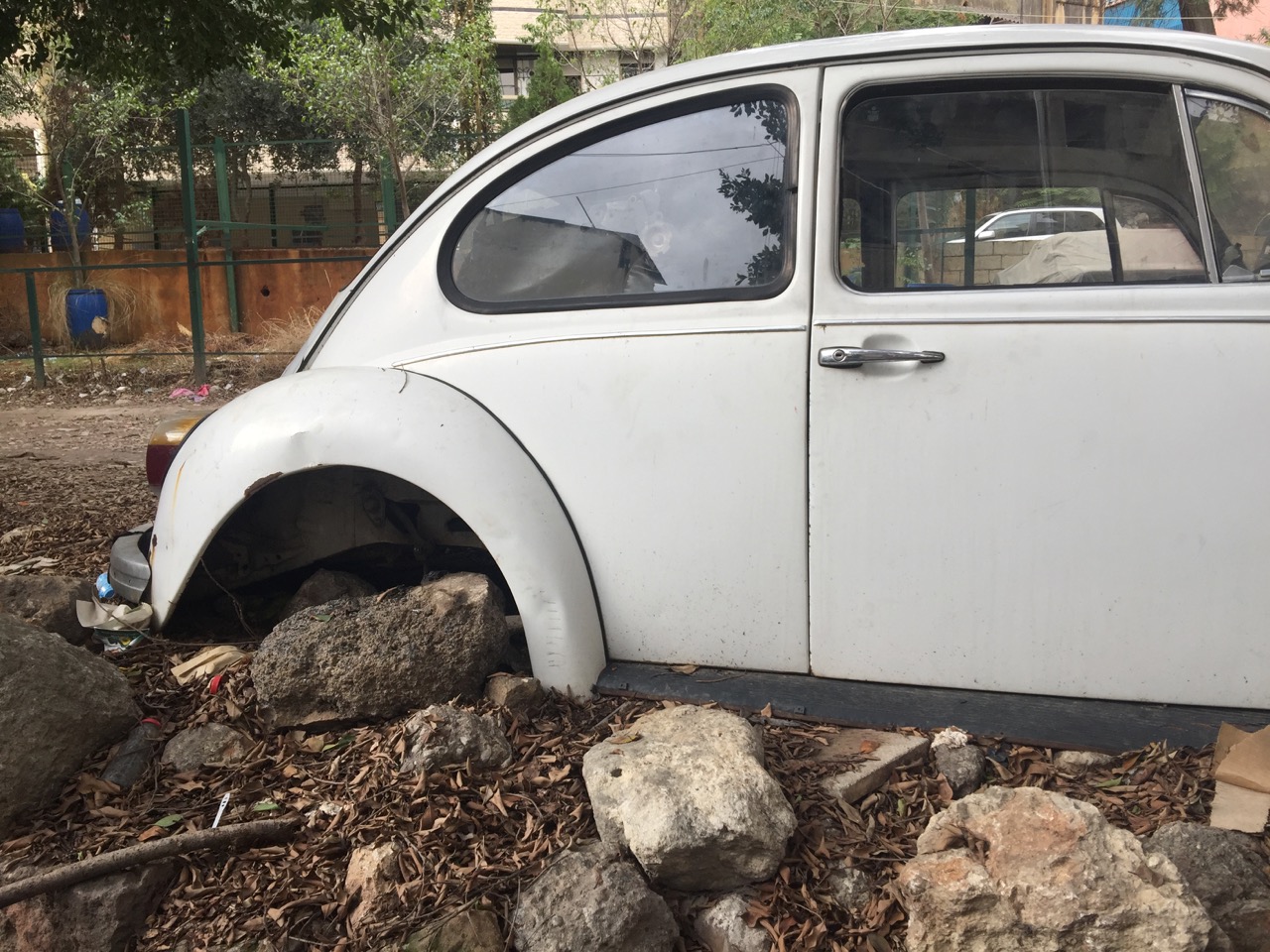
A Volkswagen from the Stone Age, complete with
prehistoric tires. (22 Oct. 2018 – Khalil Badawi, Beirut)
            But seriously, folks, reality aside (hah!), I really would rather be writing about all the interesting and fun things we’re experiencing here. And there is plenty that’s interesting and fun. Like receiving an official delegation and Armenia’s “caretaker” Prime Minister, Nigol Pashinyan, who visited the Armenian Evangelical Union leadership (interesting). Or like the visit of dear friends from Philly, Linda and Mike Sywulak (fun). They visited missionary friends of theirs in Kenya for a week, and then spent a week with us this month, getting introduced to Lebanon, its history, its natural beauty (I mean that), and its vital Christian ministries. For us, it was a welcome respite, and an occasion to reflect on our time here so far. For them, it was an opportunity to turn something abstract into a concrete picture that they can talk about and pray for.
The ashtray of no ashes. A Zen moment in a
Sassine Sq. diner. (12 Mar. 2018 –
Ashrafieh, Beirut)
            So, we got to be tourists! Finally! Nothing like visitors to provide you with an excuse to “see the sights”. We showed them all five Armenian Evangelical churches in Lebanon, plus their schools, plus the old age home (CAHL), plus KCHAG, plus more. They got to speak directly to workers in these ministries about their joys and burdens. We traveled to the ancient cities of Baalbek and Ainjar and Byblos. We visited some of the majestic Cedars of Lebanon (and witnessed the ongoing reforestation efforts). We got to see “Linda’s new favorite bakery,” with Arabic bread rolling out of the oven like big wheat pillows onto a cooling conveyor. And we got to treat them – and ourselves – to several different places that serve Arabic ice cream. All in seven days!
            Fortunately, aside from all these special events there are many things that tickle my brain on a daily basis. Like seeing an ashtray in a restaurant with no slots to hold your cigarette, and a “no smoking” symbol engraved on the side. Perfectly normal to locals – because that’s where you put your straw wrappers and zip-tops from your “pepsi” cans. Oh, and “Pepsi” is the generic name people use to refer to carbonated beverages, no matter what the label says. Like “kleenex” is for Americans.
            A frustrating bit of brain stimulus has to do with rampant Americanisms around us, like the adoption of that most worthless of American holidays, namely Halloween. In talking with a taxi driver a few weeks ago, after remarking on a huge billboard advertising some Halloween event in a predominantly Muslim area, he said, “We are forced to accept these American things because they are part of our children’s (American) textbooks. I do not like it, but my children learn it because it is there in their books.” Children carve jack-o-lanterns, dress up in skeleton costumes, and adults “dress up”, too. Thanks to social media, this vapidity (some would call it “evil”) is being copied the world over, including in Armenia.
LebCat 18 (black & white) and associates:
OK, so it’s October 31. What’s that got to do with
us? (31 Oct. 2018 – Mar Mikhael, Beirut)
            How about “Black Friday” sales in Lebanon? Its original American (and consumerist, in the worst sense) moorings are irrelevant here. It’s a catchy phrase that represents an American (and therefore, to many Lebanese, desirable) way of getting people to spend money they don’t have to buy things they don’t need. Does anyone believe that that will turn around Lebanon’s economy?
            But I have homemade fun, too, observing my environment as I walk from place to place, dodging between cars parked every which way – especially on the sidewalk – and avoiding other cars as they try to pass each other from opposite directions on a one-way street where cars are parked on both sides (welcome to my neighborhood… won’t you be my neighbor?). There are always a few cars parked in the middle of the street. Probably the driver came home very late last night, and probably there were cars between his car and the curb, though now it’s just empty space. Soon enough he’ll come down and nonchalantly get in and drive away, as if it’s the most unremarkable thing in the world to park overnight in the middle of an intersection. Recently when we were passing one of those “creative” parking jobs, a friend driving us around said (in Armenian), “One day he’s going to eat it.” Oh, it loses so much in translation!
            Now, back to my efforts at creating databases and websites and choirs and more! [LNB]

Saturday, September 29, 2018

Raise Your Voice


18.Raise Your Voice (29 September 2018)
First day of school at the Armenian Evangelical College, one of
the network of schools in Syria and Lebanon run by the Union.
Haigazian’s Philibosian Student Center (formerly “Webb”
building) is in the left background. (25 Sept. 2018 – Kantari,
Beirut. Photo courtesy of Rev. Hrayr Cholakian)
            Adjusting to a new environment takes time, and events around you or within you force you to admit that you are not “there” yet. If you are really smart, you’ll accept the fact that you will never get “there”, no matter how you define “there”. And you’ll do so sooner rather than later.
            The better part of adjusting consists of knowing how to keep your mouth shut, and continuing to observe and learn. But there are always a few things that perhaps you shouldn’t adjust to, that may be worth opening your mouth about.
            As I was trying out a new eatery (nothing to get excited about, sorry) a couple of days ago, the cashier directed me to their air-conditioned “eating room” (a separate storefront from the “ordering room”). I stuck my head inside the eating room, sniffed once, and
decided to cast my lot with the hot sun at a sidewalk table. The cashier eventually brought out my food, and asked, “It’s hot out here. Don’t you want to eat inside?” I responded with “Ma3lesh” (It’s nothing), although I did want to raise my voice in complaint to her about the cigarette stench in the eating room. O, Arabic lessons, why have I forsaken you?
A beautiful, old building that was being refurbished last year
collapsed before they were able to support its structure…
revealing another beautiful, old building. You can see the
remnants of the balconies lying askew on the ground.
(11 Sept. 2018 – Gemmazeh, Beirut)
            So, as I was eating (and sweating) on a sunny Ashrafieh sidewalk, watching cars go by, I noticed an older man (i.e., my age) on a motorcycle pulled up next to a driver’s window of a car that had stopped in the middle of the street. But he wasn’t asking for directions. He was yelling at the driver for several traffic infractions, including driving the wrong way on a one-way street, and probably almost running over the motorcyclist (who was not a traffic cop). I can only hope that he takes care not to break the same laws when no one is looking.
            I was pleased to see him making a nuisance of himself in this way, because people so often just shrug their shoulders at much of what goes on here when they should be speaking up. “Haideh Lubnan.” I hear it all the time, from friends and strangers. “This is Lebanon.” But although speaking out will never result in instantaneous or lasting changes, though it won’t turn those accustomed to decades and decades of ineffectual government and self-centered living into conscientious, law-abiding citizens. He was lighting a candle and cursing the darkness.
This is how the Union headquarters looked before
improvements began. It’s behind the trees, in case you
missed it. (6 Sept. 2018 – Geitawi, Beirut)
            Oops. I forgot that I’m not supposed to say anything but compliments about the government, as well as all other governments, save for one in particular that happens to border Lebanon. That’s what I put my signature to each year, when renewing my residence permit. But even without signing such a form, we are all facing similar pressures to keep dissent to ourselves (or, alternatively, to be loud and arrogant about our dissent and close our ears to other dissenters). This does not just concern the country of my birth, the U.S.A., for the past 17-plus years. In Armenia, post “velvet revolution”, the message being broadcast, is one, simple, unchallenged refrain: “The bad has left, the good is here; come to Armenia. ” Few dare to raise a dissenting voice concerning the “new”, save in private, or else risk ostracism. Even though they, too, care for Armenia’s well-being. It seem that criticism, especially self-criticism, is rare in today’s world, no matter what the side.
The old fence coming down, and the new going up.
(11 Sept. 2018 – Geitawi, Beirut)
            Yet people do speak up, and not just to point out flaws that they see. Here are some ways I’ve observed people in Lebanon “raising their voices”:
1. Tending your “garden”. The headquarters where I work, the Union of Armenian Evangelical Churches in the Near East, formerly an Armenian-owned hospital (the “Christian Medical Center”), got a complete makeover, 30 years after its previous one. Rev. Paul Haidostian, president of Haigazian University, is overseeing another renovation project, that of the Webb (or Philibosian Student Center) building, the university’s original structure. Someone observing the work remarked, “Do you know how encouraging it is for your neighbors to see you making improvements because you want to improve, and not because you were forced to by someone else?”
2. Getting up and getting out. After a long summer indoors (with their air conditioners), lots of locals have donned shorts and sneakers. I see them running and jogging and panting along sidewalks and streets in the city, preparing for the Nov. 11th Beirut Marathon. I’m not sure whether they’re aiming for the 8 km fun-run, the half-marathon, or the full 42.195 km thrill. I’m limiting myself to the gym.
A panorama of the newly-refurbished exterior of the Armenian
Evangelical church headquarters, formerly the “Christian
Medical Center” (27 Sept. 2018 – Geitawi, Beirut)
3. Speaking up about health and pollution dangers. People continue to gather to publicly protest the government’s mismanagement of the country’s waste disposal, especially after the recent decision to create three incineration facilities along the coast, while cancer rates continue to spike. Meanwhile, cow carcasses, presumably diseased ones tossed from ships before entering the Port of Beirut, are gently floating along our Mediterranean coast. Swimmers and divers are exposing these shameful scenes through social media posts.
4. Speaking up about abuse. The prevalence of non-Arab faces in and around the city points to the widespread use of southern-hemisphere workers in construction, sanitation and domestic labor. There is a robust network of organizations decrying the near-slavery conditions many of them are enduring at the hands (literally – please understand) of their employers. At least one of them per month commits suicide. Rather than let this “modern slavery” continue, they protest, they write commentary, they hold memorial services, all in an effort to put an end to the unregulated flow of hundreds of impoverished, southern-hemisphere “tourists” through the airport.
Just write “extra” on it. It doesn’t have to mean anything.
(28 Aug. 2018 – Geitawi, Beirut)
5. Opening Armenian schools for the new school year. Despite the continuing downward economic spiral in Lebanon, and the departure of many families (not just youth) from the country, Armenian schools of every kind have pressed forward in continuing their educational mission, and have started another school year. It is a powerful declaration of their will to survive, and a message to Armenians everywhere that the Diaspora has a reason to exist.
6. Publishing Western Armenian books. In a couple of weeks Haigazian University will hold another “Armenian Book” evening, presenting all of the books published in the Western Armenian dialect (and a few in other languages) in Lebanon in 2017. Beirut continues to let the world know that it is a cultural center for Armenians throughout the world, despite the past and present efforts to obliterate our presence in this region. (However, these Armenian books continue to cry out for people to pick them up and read them…)
7. Calling everything by a superlative. No matter what the item, it’s always better if you add the word “extra” to it. Or sometimes just name it “Extra”. This week I saw a man carrying a 50 kg (110 lb.) sack of flour to the nearby “manaqish” bakery. What was the brand of flour? “Extra”. Why not?
LebCat 17: All of these toilets are mine. And the boxes, too.
(26 Aug. 2018 – Nor Amanos, Baouchrieh)
            Raising your voice, for a Christian, usually means you are offering heartfelt praise to God. But it’s important to have a complete view of “being heard”. Christians must also cry out for the oppressed who have no voice, or challenge the idol-worshiping that is so much part and parcel of economic systems here and everywhere, or lift their voices in prayers of intercession or repentance, or raise a call to turn back from the paths of death to the ways of God. There is a time to be silent, but also a time to speak (Eccl. 3.7).
            Especially as an Armenian, there are so many more things about which I want to cry out, as I adjust to life here. And maybe I will. But this much for this time. [LNB]

[Note: Last blog’s “LebCat 16 & friends” was photographed in 2018 (not 2017) as they were dragging Sevag into their thrall.]

Monday, June 11, 2018

Something Familiar


16.Something Familiar (10 June 2018)
What? Hoagies? This isn’t Philadelphia. But not
to worry. It went out of business. (9 May
2018 – Beirut)
            I was as surprised as anyone. And all I can conclude is that people are overly polite, or they have no answers for ant infestations, or they no longer read my blog. After telling the world how bad things were in our apartment, I found that I had to approach others to solicit advice; they were not going to come to me. Even if they were also waging the same war. That’s part of my American cultural outlook, to share advice and suggestions without waiting for people to ask. Sometimes (a lot of times) it gets me in trouble. The outcome is that now we have a couple of possible solutions that we are working on. Stay tuned.


            When you leave a place where you’ve lived for a substantial amount of time, as we did last year, from time to time something kicks in that I wouldn’t call nostalgia. More like a global positioning function in your mind that either makes you notice things that look familiar, or makes you long for the familiar in your daily life. I fully realize that this happens no matter where you are at or where you have been. You try to locate yourself in the world you inhabit.
Kebab night at the Bakalians. Wrapping up a year of discipleship
meetings the right way. (8 June 2018 – Geitawi, Beirut)
            Objects are the first things to catch your attention when they remind you of something back home. Of course, “back home” is a rickety term, especially when you have made a series of major relocations, as we have. We are more than bi-cultural, and our children are moreso. To describe this, people have come up with a term called “third culture”, which doesn’t mean three cultures, but rather “neither this nor that”, neither belonging fully here nor there, but to a combination of locales and ways of thinking and being. That pretty much describes us, and can help us to identify with people like Abraham and Sara in the Old Testament, who picked up and relocated (and kept relocating) out of obedience to the divine command. Or like Moses, who fled his native Egypt as an outlaw, and named his son “Alien”. The Arabic name “Gharib” has this meaning, and once I actually met a fellow in Armenia with this name.
German pride, on the streets of Beirut. Why not?
(6 June 2018 – Mar Mikhael)
            Similarly, smells, tastes and sounds can also drag your mind back and forth, which is a particular challenge for us, because some of the smells (of food, for example) here are the same ones that filled our home when we lived in the U.S. But the thing that tugs the hardest at our hearts is the search for familiar people. Their faces, their voices, their presence. Sure, we can look at old pictures and remember, or do a video call and pretend we’re near, but the gift of being in the same room with someone dear to you… well, that’s priceless.
There’s even a Lebanese flag flying from a balcony. I guess they
didn’t hear that Lebanon didn’t qualify this time.
(2 June 2018 – Bourj Hammoud)
            Visitors from the U.S. showed up in recent weeks, with the AMAA meetings and centennial celebrations here, and they certainly enjoyed seeing us as much as we did seeing them. While I was walking to Bourj Hammoud to take care of some errands, and I cut between the cars stopped for a red light. I got slightly annoyed at one of those drivers, however, honking his horn in stopped traffic. Seriously, where was anyone going to move? As I continued walking, minding my own business, I heard, “Badveli! Badveli Nishan!” It was the honking driver. One of our visitors from the U.S., who was trying to get my attention. My annoyance quickly vaporized, and I did what any self-respecting local would: I held up traffic as we exchanged greetings, right there in the middle of the street.
A huge-screen TV stadium/pub, complete with bleacher seating,
under construction near our place, just in time for the start of
the World Cup (10 June 2018 – Mar Mikhael, Beirut)
            The other day when I opened up Facebook (bless its cold, lifeless soul), there was a picture of a family gathering in the 1990s – one of the memories Facebook thought I should be re-sharing. I didn’t. But I paused a moment to count the number of familiar faces that were no longer alive, and could only be accessed by looking at a photo or closing ones eyes and remembering. And a third of that group are no longer alive.
            Fortunately, and despite the longing for those who are separated from us by an ocean, there are a lot of others nearby whose familiar faces cheer us up immeasurably. Despite all the busy-ness of our lives here, those moments are what builds a new sense of “home” where we are. We’ll still rejoice when we go to meet loved ones arriving at the Beirut airport, like Vicken in 7 days, or Sevag in 40. But for our dear friends here (and one set of Maria’s cousins left in Lebanon) we are rapidly becoming part of their familiar surroundings. And that feels good.
The final rehearsal of the “Armiss” choir, with soloist and
flautist, before it’s “return” the next day. (2 June 2018 –
First Arm. Evang. Church, Beirut)
            A week ago it was a great experience to conduct the “Armiss” choir during the AMAA Centennial Worship Service. After an on-again/off-again decade, and a hiatus of three years, the group is back. They sang four choral pieces, and sounded cohesive, as a choir should. So many people were appreciative, and some were astonished that there are these talents in our community. Maybe they thought all the talented people had left the country? My favorite comment was, “Keep working. You have to give annual concert.”
LebCat 15: A protected species – cats on the American University
of Beirut’s campus (21 Mar. 2017 – Ras Beirut)
            Speaking of familiarity, it’s that time again. The time when you’re not sure what country you’re in, because every sort of flag is flying from all sorts of places. Yes, football’s Mondial (World Cup) is back. It’s the easiest way for Lebanese to be another nationality without the drawn-out application process. This is pretty important stuff – the church and youth retreats later this month have included the game broadcasts in their schedules, so as not to have a meeting during some of the important matches! [LNB]

Monday, January 29, 2018

The Departure Lounge


12.The Departure Lounge (28 January 2018)
The third of four groups of carolers in
front of our (and the neighbor’s)
door in the wee hours of Christmas
Day (6 Jan. 2018 – Beirut)
            We were enjoying our “last supper” with Lara, waiting for Hovig to take us to the airport for Lara’s return trip to Armenia. It had been a relaxing, fun, all-around great eight days of family time together. Suddenly, the neighbors across the hallway burst out of their apartment and began pounding on our door, hysterically screaming, “My!!! My!!! (in Arabic, “Water! Water!”). I rushed to their apartment to see what was burning, while Maria ran to our kitchen to grab a container to fill with water to douse the flame. When I reached their kitchen and saw a 26-year-old flat on her back with the family gathered around trying to rouse her, I rushed back to our place, grabbed the water from Maria and told her to go immediately and help them. That’s something I’m trained to do, after 38 years (this month) of marriage to an R.N. I consider it a finely-honed skill.
            The neighbors across the way were a Syrian-Armenian family from Damascus, who had come to Lebanon because they had been accepted by the Australian government to be relocated to Australia, albeit to a city where there is no Armenian community. Neither refugees nor tourists here in Lebanon, they consist of a widowed mother in her 50s and her three children in their 20s. Her fourth, the eldest son, had already escaped to Germany, and is working on obtaining a law degree there. They had been staying a few days here and a few days there for a month, until one of our pastors arranged for them to remain in a single place while they tried to get their affairs in order before their departure.
If it looks like we’re happy to be together, it’s because we are!
(3 Jan. 2018 – Beirut)
            Christmas Eve (January 5, that is) rolled around, and we were excited because Lara was going to bravely go out (only her third day in Beirut) with complete strangers from one of the church youth groups, to carol hither and yon in Armenian all night, something I used to do with my church’s youth 40 years ago back in Philly (albeit in English), something that stopped when members were no longer living in the vicinity of the church. We were also excited that four different churches were going to send their carolers to us, and in that way our temporary neighbors, burdened with fears from having lived in a war zone, along with the uncertainty about their impending relocation, would also enjoy the good news of Christ’s coming as each group showed up to sing (the last one arriving at 3 a.m.). And their faces were joyful! That night marked the transition from saying “hello” in passing to becoming “neighbors” in the local sense, where you stop by at any time, no invitation needed or expected, to talk and have a cup of (Arabic, of course) coffee.
            Oh, sorry… I left one of the neighbors passed out on the kitchen floor.
            So, Maria was doing her best to help this young lady wake up, while her younger sister and brother were yelling her name, and her mother was just yelling. Hysterics, in the not-funny sense. I stood at the ready, doing whatever Maria needed me to do, trying to calm down the mother, and eventually they got her up, onto a chair, and eventually into bed. But why had she passed out? Probably from not sleeping for two or three days. They had been going to a variety of local government offices for documents needed by the Australian embassy to grant them passage out of Lebanon, but they also had to travel back and forth to Damascus to get documents from there. They did that last trip to Syria in 24 hours, there and back. Lack of sleep, lack of proper food, and there you are on the kitchen floor.
Excursion with Lara to Jbeil/Byblos. Can you spot her in
this picture? (7 Jan. 2018 – Jbeil)
            Yet sharing this moment of crisis drew us even closer, as we listened to whatever they felt they could tell us. At first it was about their experiences in government offices here, trying to get their papers in order, and returning day after day, waiting from morning until evening, then being told to come back the next day. Later, they shared a bit of their past, and some of what they experienced during these seven years of war in Syria. Their neighborhood was surrounded on three sides by terror groups, giving them an unwanted front-line war experience. The mother said that one day a couple of years ago the army showed up, handed out guns to the men in her building (including her older son) and told them to defend it if Daesh (IS/ISIS/ISIL) broke through their defenses. This is a woman who had built her home bit by bit, saving up and doing improvements (like a roof and walls) as she was able, a woman who had the grit to study and sit for governmental exams at age 45 in order to get her high school diploma. She knew that this very real danger would soon reach both her sons. She called a friend who drives a taxi and told him to come by right away and whisk her older son away, out of the country, quickly, however he could. Eventually, she also sent her younger son to Lebanon, and then a few months ago, along with her daughters, joined him.
            As we sat and visited, and as they shared more and more with us, we spoke about how their lives were going to change radically in that “Western” country they were headed to. They would have peace and security, they would have cleanliness and order, but they would also be very lonely. I shared, “It’s an individualistic culture, where age, experience, family, and culture – aside from their own culture – are much maligned.” They were aware of this, and aware to some degree that they would need to adapt in many, many ways, including mastering English and gaining an education. They laughed as they related the story of a father sitting in a preparatory class given by the embassy, teaching about how to treat your children, Western-style: you musn’t hit them when you want them to do something, but explain to them why it is important to do this or that, etc., etc., etc. Yes, yes, yes, the father said he understood. But taking his child by the hand and leaving the classroom, as soon as they were outside the door, he soundly smacked him on the head for his disobedience!
For those who were worried that we haven’t yet gotten a set of
wheels, worry no more. (28 Nov. 2017 – Beirut)
            A few days ago we made another trip to the airport, this time taking this family, their eight suitcases and four carry-on bags, to leave them there to await the embassy agent who would guide them through until they boarded the airplane to their new life. It was a tearful parting, because they – and we – knew that they were not just leaving newly-found friends, but were also leaving a place of familiar comforts and terrors, and heading toward the unknown. I told them, “I’m happy for you, but I’m sad for our community. Each person who departs takes something away from us.”
            I often get the feeling that I’m living in a departure lounge. People are milling about me, doing the various tasks that are part of their daily lives, and their church and community life. But their one ear is on the public address system, waiting for their flight to be announced. Today after the worship service a fellow said to me, “You know, they all have their escape planned. All of them.”
            And now, a year after arriving, people are still asking us, “So, you’re planning to stay?” And we wonder how it is possible to be committed to a people and a place when you are mentally living in a departure lounge. Meanwhile, some, far away, are, as it were, sending text messages from those dreamed-about places to those in the lounge, saying, “What are you waiting for?”
LebCat 11: Sophisticated tastes, obviously, on
display in a jewelry store. Next to a falafel
restaurant. (28 Apr. 2017 – Burj Hammoud)
            Fortunately, there are many others here who know that a departure lounge is no place to live. We have cast our lot to be with them, to live and serve alongside them. Taking all the uncertainties and deprivations of daily life here into account, and realizing that the ill-advised and arrogant declarations of the rich and powerful elsewhere in the world are dealing crushing blows to people of all faiths and conditions in this part of the world, we are focusing on doing what is of lasting value. And there is so much to do in so many areas! …educational, cultural, environmental, and on, and on, and a great need for people who will keep their ear on God’s word, not the public address system.
            We came home from the airport that night feeling empty, feeling that loss. The day after, when the family had arrived in Australia, we sent them audio and text messages to encourage them. And we carried on with our week, praying for them, and we continue to do so. But we are resolved not to live in a departure lounge.   [LNB]