Showing posts with label revolution. Show all posts

Wednesday, April 1, 2020

Cue the Locusts


33.Cue the Locusts (31 Mar. 2020)
It’s spring, but nobody’s going anywhere these days.
(24 Feb. 2020 – Geitawi - Beirut)
Here in Lebanon we look with amazement at a panicking world that, upon realizing that the novel coronavirus was not going to remain a “Chinese disease”, began by decrying the enforced confinement and “social distancing” intended to slow the advance of this nemesis, because of the perceived injuries to their liberties. The puzzlement here continued as the reality of this pandemic set in, and country after country realized that their economies were going into a deep pit because people were unable to work and therefore were cut off from the income they relied on. It may sound callous, but Lebanese, who have been in an economic downward spiral for the last several years, thanks to the greed and incompetence of their leaders, exploded with rage in October that they were not going to take it anymore. It shut down the country and the already abysmal economy, sending banks into panic over the danger to their usurious profits, whereupon they took it upon themselves to prohibit depositors from withdrawing more than a couple hundred dollars a month. The service industry, already limping along due to the lack of tourism, saw nearly a thousand restaurants close in Beirut alone, schools lost three weeks of instruction due to strikes and road closures, and specters of a return to civil war loomed in the shadows. The country was not on its knees, but rather prostrate on the ground when this virus became a local reality. How much farther down can you get?
The list of coming events at a nearby restaurant.
(23 Mar. 2020 – Qobaiyat - Beirut)
            I hope that no one would wish this situation on another, here or in any country. But it’s very tempting to say to the world, “So, how does it feel?” To face each day with fear, uncertain of what the future brings, wondering if death will snatch your friends, loved ones or even your own life? Yet there are so many people who face much greater trials than what most in the affluent world are struggling to comprehend. It is very easy to comprehend in lands under occupation, where walls are built to protect privileges. It is very easy to comprehend in places where refugees are used as political pawns. It is very easy to comprehend by those today continuing their jobs, with or without masks or gloves, who know that when the government says “lockdown” and “curfew”, it is effectively telling this subsistence-level stratum to starve to death. As many have commented, if rich people were to die from hunger, the world would find the will, the creativity and the resources to end that scourge. But those 9 million who die each year from hunger-related reasons remain out of the spotlight.
Not how a school playground is supposed to look in the
middle of the day. (24 Mar. 2020 – Geitawi - Beirut)
            Oh, did I mention? We are under a nightly curfew. The government announced, and is enforcing, a 7 p.m. to 5 a.m. curfew throughout the country. This is in addition to closing all “non-essential” businesses, that is, anything that does not sell food or medicine. And if your water tank is leaking (every household has a water tank on the roof because of the sporadic delivery of water, 30 years after the Civil War ended… sporadic, like all the other utilities), well, you won’t be able to call someone to repair it. Anyway, he might not have the parts to do repairs because the banks have had a 5-month stranglehold on the capital that is needed to import goods.
How I spent my 16th birthday – telling “Dad
jokes” at a youth/veteran C.E. youth gathering.
(29 Feb. 2020 – Armenian Evangelical Church
of Ashrafieh, Geitawi - Beirut)
            The school year has taken a body blow in this crisis-upon-crisis mode we call “the new normal”. Administrators and teachers have hastily transitioned to “online learning”, a tenuous format that might enable learning to occur. When the October protests dragged on, schools were already beginning to implement some of these methods, and it increased as the months dragged on, the strikes continued and regularly turned into violent clashes between protestors and various security forces (there are so many here I can’t keep track). Yet students as well as adults are learning quite a bit from this current in-house confinement. In some cases children are in a healthier environment. No longer do they chant, “Revolution! Revolution!” (“Thawra! Thawra!”) when being let out for recess, as if it were a game. Others are at the mercy of their abusive or neglectful parents/guardians. Those who care for the latter, such as the Armenian Evangelical Boarding School in Ainjar, constantly carry that burden in prayers for God’s mercy.
            The last couple of “normal” things I did were to deliver a talk on Hrant Dink, the Armenian journalist and activist who was assassinated in broad daylight in front of his newspaper office in Istanbul, and to attend a a wonderful lecture on Gomidas (or Komitas). Ironically, among the 300 of us sitting in the hall where that lecture/concert took place on March 8 were religious and community leaders and even a cabinet member, only one day after the government told people to avoid all crowds.
A tall tree at a nearby park, uprooted by gale-force winds
on Mar. 12. (25 Mar. 2020 – Geitawi - Beirut)
            Maria and I were already doing most of our work online since we arrived in Beirut. Except for the worship services we attend and where I assist. And except for the “Armiss” choir that I direct. And except for the committees in which we serve. Now, none of that is happening. In their place we have video conferences and work online from home. The choir rehearsals are suspended. And in place of Sunday worship services in various churches the UAECNE (our church Union) has begun broadcasting a single weekly pre-recorded program, which I am producing. (Look it up on YouTube under UAECNE.) Pastors are taking turns preaching the sermon, and I am including a variety of recorded hymns and anthems in Armenian. It is an interesting initiative that will likely continue in some form as an audiovisual ministry, and will find a home on the Union’s website (coming soon, I hope), connecting people not only across the region, but helping those who have emigrated elsewhere to maintain some connection with their roots.
LebCat 33: Look, I don’t care what the
government says about restaurants closing.
I know you’re in there. I can smell the
rotisserie chicken, OK? (13 Mar. 2020 –
Geitawi - Beirut)
            On March 12, as we were beginning our days/weeks/months of seclusion, Lebanon and the region experienced several hours of winds at speeds between 100 and 140 km/hr. The roaring sound woke us all up, as objects were being tossed from one rooftop to another. The huge flag flying on top of a nearby office building was torn from its mounts and ended up somewhere far away, perhaps in the Mediterranean? The following day everyone was out surveying the extensive damage throughout the country. Strangely, though our electricity was never interrupted – just our sleep.
            The news out of the northeast of Africa is not good. A devastating plague of locusts is destroying crops and threatening famine to countless people. Could that be next on the agenda for Lebanon? We watch… and pray.   [LNB]

Thursday, October 24, 2019

Devils and Details


29.Devils and Details (24 Oct 2019)
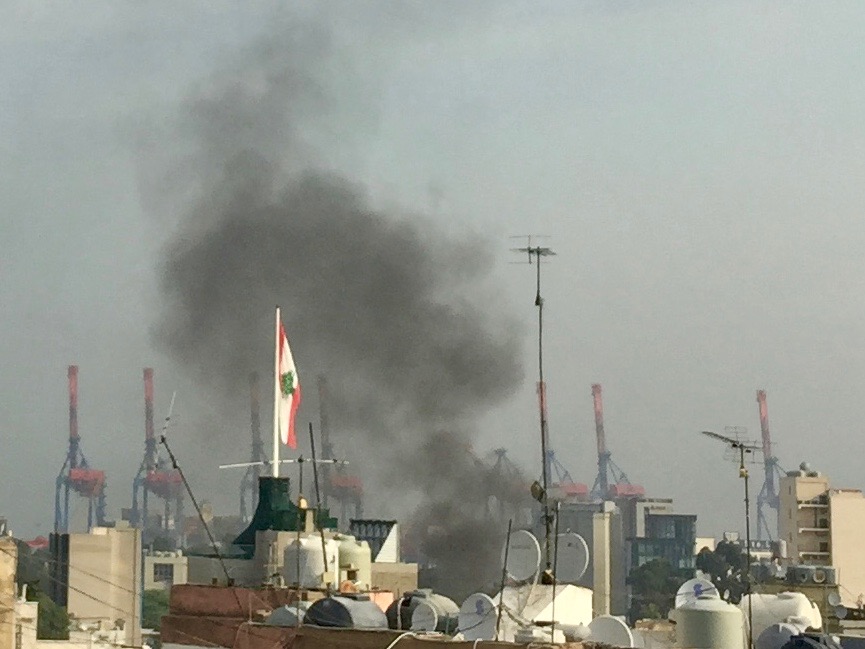
Smoke from tires burning on the Autostrade, filling the air.
(18 Oct. 2019 – Karantina - Beirut)
A week ago there was an announcement, replete with locally generated “great and unmatched wisdom”, in which the government here would begin taxing Internet-based (VoIP) communications (such as Whatsapp, Messenger, FaceTime). As many have already said, this was just the match that lit a blaze, the straw that rendered the camel a paraplegic, yet became an almost-inconsequential detail leading to the explosion of protests all across the country. The outcry and rage even targeted certain well-known leaders whom the populace heretofore has never dared to (publicly) criticize.
Shuttered businesses the entire length of the normally
busy Arax Street. (23 Oct. 2019 – Bourj Hammoud)
            So, the first couple of days we inhaled the acrid smell and particulates of burning tires, in addition to the ongoing stench of garbage dumps and polluted water. Those first few days also saw the emergence of a few disruptors who either were intent on destroying and looting private property, or reasserting the supremacy of their political party and its flags. Both types were quelled by Internal Security and Lebanese Armed Forces. Then emerged the chants of “Thawra! Thawra!” (“Revolution!” “Revolution!”). And the open-air party atmosphere. And the congenial “we’re all in this together” atmosphere.
            Later, other slogans emerged, as the
Push-back against multinational corporations… and an icon
of the protests, a woman kicking an armed guard where it
hurts. (22 Oct. 2019 – Mar Mikhael - Beirut)
demands intensified: “Kellon, ya3ni, kellon!” (“All of them, that is, all of them!”), so that no one group would think its leader exempt from the demands for a complete change in leadership – and a new political system, one not based on religious identity. If there are 3 million Lebanese in Lebanon, then thanks to television crews roaming in and among the various protests sites we are hearing what seems to be 3 million statements of discontent from young and old blocking streets and highways. Their words are crammed with emotion, seething with frustration at the struggle the average citizen has to endure for things like inadequate health care, expensive education, intermittent electricity and water, poor waste management, environmental degradation, unaffordable housing, corruption to the core, and so much more, including a sky-high national debt.
            But what has been absent is someone to take the helm of this movement and focus it into a clearly-defined direction. The prime minister gave a public address the day after the start of the protests, but it appeared to be directed to his political opponents. The president addressed the country today, a week after the start of these events. A decade and a half ago a handful of potential alternative leaders may have existed, except that they disappeared one by one in still-unsolved car bombings. Where are the new visionaries to keep Lebanese from turning against one another, expressions of which are beginning to emerge? There is only so long that an outburst can be sustained, and so what is sometimes (erroneously) compared to Armenia’s “Velvet Revolution” may take some unwanted turns in the days to come. Chanting for overall change is a start, but the devil is in the details.
The last day Lebanon was able to focus on something besides
its protests. (16 Oct. 2019 – Bourj Hammoud)
            And speaking of devils, only a few short weeks have passed since great (and locally great) powers have decided against the Kurds in northern Syria. It is such a familiar narrative; the roles now played by certain peoples and countries were played a century ago by many of the same minorities and world powers. And the story ends the same: strategic and oil interests superseding any humanitarian interest or pang of conscience. Who will be the losers in these military “games” being played out in the region? You can start with the great powers, who again squander their names as they easily abandon their local allies (We all should bring to mind how Armenian brigades and the population were betrayed by Europe). Yet a greater loss is being shouldered by the people of the land, not just Kurds, but Assyrians, Chaldeans, and, yes, Armenians. The Kurds may rebound due to sheer numbers. But what of the Christians, who are the ancient residents of that region? One of the winners no doubt will be the incipient “Islamic State Part 2”, thanks to the support of some and the negligence of others. So many devilish details, too many to keep track of, that invaders will just say “Oops” to you after the fact, as you disappear into the oblivion of genocide, deportation, migration and assimilation.
LebCat 28: A flat cardboard box is better than
no box at all. Hanging out with LebCat 13.
(3 November 2018 – Bourj Hammoud)
            But back to Lebanon. The protests continue, and roads are still blocked; sometimes by protestors, and sometimes by rainwater flooding the highways (like today) due to poor infrastructure… another burden borne by the population. But people need something beyond the protests – and they need a just resolution, without being co-opted by outside forces. They need to be able to work, to eat and send their children to school, but also to dream about the future and marry and care for and protect their homeland. Will this be a moment of historic change for Lebanon and its unity, or will it end in disarray and divisions? My hope and my prayer is that the people will continue to gather under the Lebanese flag, something all sincere religious leaders desire, and something the Bible commands us to do: “Seek the welfare of the city where I have sent you into exile, and pray to the Lord on its behalf, for in its welfare you will find your welfare” (Jer. 29.7).   [LNB]