Showing posts with label communication. Show all posts

Wednesday, August 31, 2022

Powerless Living

52.Powerless Living (31 August 2022)

Demonstrations that closed the coastal road
on the second anniversary of the still-
uninvestigated and still-unpunished Beirut
Port blast (4 Aug. 2022 - Marfa' - Beirut)

From time to time, it almost seems as if it might be possible to get used to being without electricity every single night. I can entertain this fantasy thanks to the local generator subscription we have, which supplies us with enough power to cool our bedroom from evening until midnight, and then we can manage to sleep with just a battery-powered fan until around 4 a.m. As well, one can almost endure the powerless hours during the day, in between the times of generator supply. Almost. Because it’s not just the lights that are off for 12 of each 24-hour period, but everything gets interrupted, whether in your work life or your home life. A recent expat, living in some far-away, amazing land where there is electricity all the time (are there such places?), wrote to me yesterday: “We’re in an age where you can maybe live without lights, but not without internet.”

After two days of overflowing trash, it
seemed like a dream that collection had
resumed! And just a couple hours later:
magic! (30 Aug. 2022 - Geitawi)

            And so, today our internet access stopped. Dead. Completely. Landline phones, internet, whatever you would need to get through your workday. Striking workers? Lack of fuel? Something else? The reasons are myriad. The cellular system is (still) working, but who can afford to pay cell phone rates just to do a bit of online work or to communicate with colleagues locally or overseas? The key word here is “communication”, a common factor in all that doesn’t work in Lebanon, whether institutional or personal. Communication is what the powerful in any relationship and in any land attempt to keep within their control, and when possible, they communicate the particular version of events that they want people to think. Yet as the “powerless” in every land are increasingly able to take greater control of the story of their lives, they can communicate their stories to each other and to the outside world in a more complex, and truer, way. Except when there is no electricity. And no reliable internet. And no steady water supply. And no waste management And no government.. And hyperinflation. And no access to bank accounts. And…

After most of the grain silos collapsed this
month, a sign appeared: "No justice without
accountability" (28 Aug. 2022 - Marfa')
            One of the narratives the powerless in Lebanon are continually subjected to is how the government made this or that deal with this or that country to supply fuel to their environmentally-deadly power plants in order to add 3 or 4 more hours per day of electricity (up from 0 to 1 hours per day). And then they hear how there is this or that banking obstacle that came up. And then they hear that there is this or that infrastructure issue that came up. And then they hear that there is this or that political party that is preventing it from happening. And then they hear that the government doesn’t want to fall under American sanctions* by getting the wrong fuel from the wrong source that might pass through the wrong country. Meanwhile, threats of the country plunging into “complete darkness” continue to echo, though, as a news website recently noted, “those who have private generator subscriptions are unlikely to feel the effect of a state-wide blackout.”

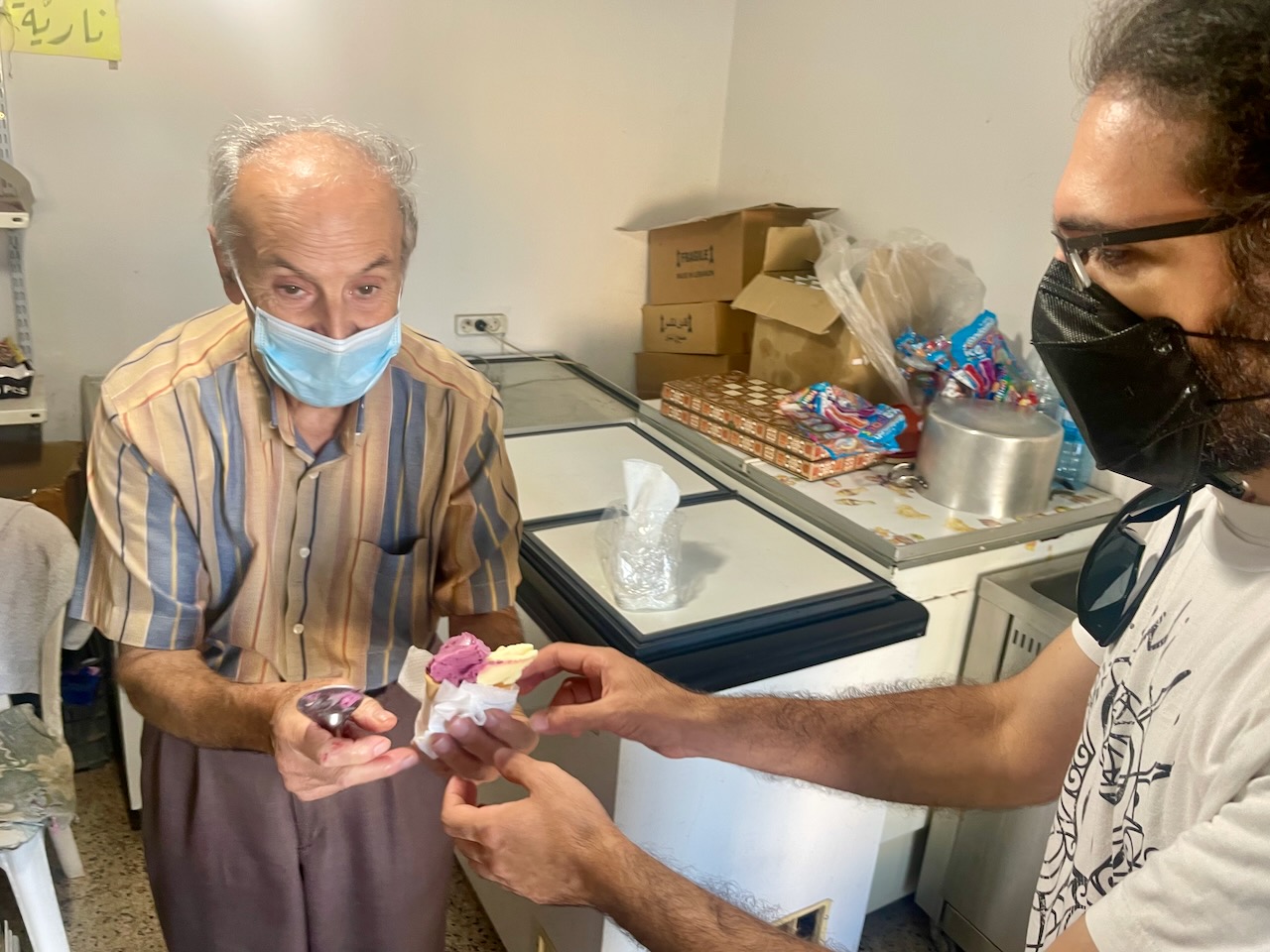
At what is possibly the best Arabic ice cream
spot in Lebanon. Says Sevag: "Excuse me,
photo is taken, please hand that over right
now." (26 July 2022 - Saghbine)


            There are many, many people here who are powerless to do anything but subsist without power. They cannot afford (as we can) to buy generator subscriptions to fill in the huge gaps in the municipal power supply. Their homes remain in the dark, and their refrigerators are useless, and their nutritional intake suffers, and their health declines, and their ability to obtain health care when they inevitably need it… vanishes. Meanwhile the young and resourceful continue leaching from the country, leaving their families and their heritage far behind…

            Yet amid all of this, today I was witness to an example of benevolent involvement in the struggles of Lebanon, as well as an intelligent grasp of the country’s needs. The Japanese Ambassador to Lebanon, H.E. Okubo Takeshi joined Lebanon’s Minister of Public Health, Firass Abiad, M.D., to dedicate equipment that the Japanese have donated to the Karagheusian Assn.’s Primary Healthcare Center in Bourj Hammoud. The Ambassador spoke of the commitment of his country to support the Lebanese people (making this important distinction in his words). Then Dr. Abiad, showing an unusual grasp (for someone in government) of the health care crisis in Lebanon, told the audience how the country for too long has invested large amounts in tertiary health care and ignored developing primary health care, thereby rendering basic health care unaffordable to people of modest means. He also described his plan to restructure the allotment of health care funds to the primary type. It was refreshing to hear someone with a vision, someone in a position of authority who is interested in improving what has been handed him, rather than blaming others for his lack of action.

Dr. Abiad addressing the audience, following
Amb. Okubo's speech  (31 Aug. 2022 -
Nor Marash - Bourj Hammoud)
            Before the program, when the Ambassador arrived and was being introduced to the clergy, I got to greet him with the phrase I had been coached on and had been practicing for a whole day, including in my sleep the previous night. “Kakka, oai dekite kouei desu.” It is a most unfortunate coincidence that this phrase begins with a word that in Japanese means “Your Excellency”, but in most of the languages I know means something quite different. The important thing is that the Ambassador understood my stumbling Japanese, “Your Excellency, it is an honor to meet you,” and responded in English with, “Very pleased to meet you, also.” The other important thing is that no one else who heard my greeting reprimanded me for saying an indelicate word to the Ambassador.

LebCat 52: "Wait, is that... a pig flying? Oh,
yes, this is Lebanon!" (31 Aug. 2022 -
Nor Marash - Bourj Hammoud)
            One of the famous Japanese sayings invoked today was “Fall down seven times, get up eight.” What more appropriate way is there than this, to think about how the powerless in this world can persevere and continue their struggle. My mind especially goes to the One who was beaten down, but rose again, he who is ever on the side of the downtrodden, Christ Jesus. He was considered powerless in the eyes of the world, but his purported “weakness” was wrongly estimated by those in power. His victory over death, and his promised Coming, are the basis for hope of all those under the weight of personal or societal failure. He is the One keeping us going, especially when the lack of power – or vision – looms large around us, whether here, in Armenia, or anywhere.

            And yes, we still cheer like Santa Claus just showed up whenever the power comes back on!   [LNB]


(*The country that does its utmost to prevent foreign meddling… by doing what they don’t want other countries doing.)


Monday, June 1, 2020

Sa Koronyan


35.“Sa Koronyan” (31 May 2020)

A March windstorm toppled the cross from the
red cupola of the Armenian Evangelical Church.
(31 May 2020 – Nor Marash - Bourj Hammoud)
Over and over again, we are hearing from medical and epidemiological experts telling us, to the best of their knowledge and experience, that we are going to be living with, not defeating the Coronavirus. It will be just one more thing that we have to take into account in our daily routine. What that means in terms of our lifestyles, our long-range plans, the economies and habits of families and countries, is still to be determined. How it will decimate minority communities, is also to be determined, although we are already getting a taste of what is to come. The Armenian community here in the Middle East, such a crucial guarantor of the continued existence of the Armenian people the world over, is facing daily traumas as it fights for its existence. In the past few days we lost yet another Armenian school, the St. Agnes Armenian Catholic School in Bourj Hammoud, while two weeks ago the last Armenian School in Jordan closed its doors. Yesterday I read that one of the two local Armenian FM radio stations was forced to go off-air and continue (hopefully) as an Internet-only station. In at least as critical a situation as we face today, Middle East Armenian families a hundred years ago went without many things, including shoes and new clothing, in order to maintain their schools and culture, and they produced vibrant and tough generations. But today people’s values and priorities are… not the same.
Experts report that a majority of mini-pizzas are displeased with
the direction of the economy. (9 May 2020 – Watwat - Beirut)
            We were scheduled for a few months of home assignment (or “furlough” in missionary parlance) in the U.S. later this year, beginning in late summer, in order to travel and inform interested church groups about the work of our partner organizations (the church union and the university). Now, all of that has come under question, and our sending body is studying the situation, examining what governments and the air travel industry will do to recover from their current state of disarray. Making any sort of prediction about travel, or saying anything else about what life will look like “A.C.” is a fool’s errand. (“B.C.” = “Before Corona/ Covid-19”; yet although it is inaccurate, I use “A.C.” = “After Corona”; it’s a better abbreviation than “W.C.” = “With Corona”, no?)
Reaching out to those in need now takes the form of leaving
clothing and shoes where they can be taken without
drawing attention to oneself. (25 May 2020 –
Khalil Badawi - Beirut)
            Tomorrow Maria will be venturing outside our home for the first time in 2 months, for a health checkup and a stop at Haigazian University. It will be interesting to hear her observations on this “release from captivity” when she returns. I know that I often dread venturing outside our home, particularly with all the protective items I am forced to wear. The Lebanese government now mandates wearing a mask when going outside, and is stressing the need to keep infection numbers low because of the lack of hospital capacity for those needing respiratory care for the virus.
            Nevertheless, my excursions outside the house have been more frequent, and not always negative. Three weeks ago a friend was driving me to do some grocery shopping, and I asked him to run by our old neighborhood, where we lived 20 years ago. What a refreshing visit, seeing old friends – the baker and the greengrocer – who asked about Maria and the boys by name, and were truly happy for this quick visit (and exhibited boundless patience with my stumbling Arabic). When we see how much we matter to people like this, who seek nothing of us but friendship, that’s when we feel truly alive, truly connected to this place.
Coronahair and coronahaircut. Apparently the barber
was quite satisfied with the job he did.
(29 May 2020 – Geitawi - Beirut)
            If it is permissible to say, I intensely dislike this plethora of online meetings and digital gatherings that are sometimes touted as the “new normal”. I doubt that it’s a generational thing, because I know of young people who say the same thing, and like me do not reject the technology, but do not also consider it universally applicable. The majority of communication that is done nonverbally is virtually (pun intended) eliminated from these electronic methods, rendering human interaction shallower, and distances farther. It’s not a small world after all. My sister as well as my son, both school teachers yet of different generations, realize how little real teaching and learning happens in this “virtual classroom space”. They know very well how struggling students need the physical presence of an instructor who can “read” their body language and step in with the necessary support, encouragement and creativity to help them move forward. This also is the case with online worship experiences, something in which I have been heavily involved in the past 2-1/2 months. We are enduring the pain of human separation, a pain that will remain for the foreseeable future, as long as “social distancing” is required.
LebCats 35: Lebanon’s success in stemming the
spread of the virus is due to high levels of
cooperation – even among cats – with social
distancing principles. (31 May 2020 –
Geitawi- Beirut)
            A fun project that came about because of a need for musical content in our worship broadcasts was a “virtual choir”. For the nine participants it was our first foray into this type of production, where the musicians, each in a different part of the world, collaborated in recording a song. Listening to the piano track we sang our parts into our computers or phones – some of us singing more than one part. Then the files went back to Washington state from Oregon, greater LA, Philadelphia and Beirut to the producer/ accompanist, who turned them all into one wonderful online vocal ensemble. Way to go Shahan, Arek, Sako, Palig, Sevag, Garin, Talar and of course Maria and me! Not a bad way to deal with this “A.C.” world!
            As I was walking around Bourj Hammoud recently, searching in vain for an open money-exchange house so that I could obtain local currency and buy some groceries, something struck my ear as one Armenian woman was commiserating with another over the current social and economic situation. She said (in Armenian), “Sa Koronyan yete asang sharounagvi…” (If this Koronya continues like this…). I was past them a few steps before I realized she was not referring to a perfume, but had Armenianized the word “corona”. Maybe the Armenian community will be able to adjust and even thrive in this “A.C.” world after all.   [LNB]

Monday, July 17, 2017

What I Really Meant Was


6.What I Really Meant Was… (16 July 2017)
Lebanese coffee manufacturer “Najjar” and its answer to the
single-serve coffee machines so popular in the west.
(30 April 2017 – Hamra, Beirut)
            For someone like me who considers coffee one of the basic food groups, being in a place like Beirut satisfies a deep longing in my heart. “Coffee hour” after church services does not consist of the watered-down version, but is simply, without question, Arabic coffee. If you want the other kind, generically called “nescafé” without the capital “n”, you have to ask specifically for it. And the reason that’s funny is because “nescafé” sounds like “half-coffee” in Arabic.
            In the U.S., someone came up with a single-service coffee machine you can put on the kitchen counter and generate fresh cups of various kinds of coffee, or if you like, various kinds of tea with a faint coffee residue flavor. And you can generate huge amounts of non-recyclable k-cups destined for landfills everywhere. The popular brand of this machine is something I pronounce “kouyrig”, which means “dear sister” in Armenian. I like my sister much, much more than these machines. Still, I was intrigued when, back in April, the local version of the “kouyrig” hit the market, claiming to consistently make the best cup of Lebanese coffee. With the same little trash-generating k-cups, in regular or cardamom flavor. As far as I know, the traditional method of cooking Arabic coffee in a pot over a fire is not in danger of being replaced.
The exact same type of Arabic coffee machine
at the place where I now take Arabic lessons!
(21 Mar. 2017 – U-Turn Center, Hamra)
            All of this brought to mind an experience I had seventeen years ago, way back in A.D. 2000, when we moved to Beirut as a family and I took up my new position as Campus Minister at Haigazian University. Imagine my delight in seeing something I had never encountered before: a hole-in-the-wall bakery on rue Mexique, next door to the University, which had a machine that brewed Arabic coffee! You put in a 500-lira coin (33 cents), chose what level of sugar you want, sat a disposable cup in the little ring (there we go with more trash-production…) and waited for the little “ibriq” (“coffee pot”) to fill with water, the correct measure of coffee, a touch of sugar, then cook the coffee, and when it was ready, it tilted on a hinge to fill up your cup! It became my new favorite hangout.
            I befriended with the woman who ran the bakery, me with my nearly non-existent Arabic, and her with her non-existent English. I found out that she was supporting her family, and that she was part Armenian, but didn't speak the language. We mostly used smiles, gestures and a few words to interact. One day I went to buy my usual cup of coffee, but when I tasted it I found it had no sugar. I drank it anyway, because you just don’t waste a good cup of coffee. Two days later, on my next visit to the baker, I decided I would be a proper customer (in my U.S. way of thinking) and inform the establishment owner of the problem with the coffee machine. And do so in Arabic (my only choice). So I said what I thought was, “The day before yesterday there was no sugar.” What actually came out of my mouth was: “There is no closed the day after tomorrow” (“Ma-fi sakkar ba3d bukra.”). I had changed “sukkar” into “sakkar”, and “the day before yesterday” wasn’t even in my Arabic vocabulary.
LebCat6 lives around the corner from our current
housing and keeps an eye… or two on comings
and goings. (2 Apr. 2017)
            Telling this story later that day caused much mirth in the Bakalian household, but generated no sympathy for my linguistic struggles. On another occasion a few years later, after Maria and I had dropped off our younger son Sevag at a summer camp, on our way back to Beirut we stopped at a bakery on the highway, and I went in to buy two bottles of water. Our older son Armen trailed behind me as I went up to the counter and asked for two bottles of water. Except that the two words I used were of two different languages: “tnayn tchoor”, one, the Arabic word for "two", and one, the Armenian word for "water". The employee looked at me puzzled as I repeated myself a bit more insistently. More puzzlement. Then he figured out what I wanted to say, and grabbed two cold bottles and set them on the counter. As I turned around, still oblivious to what I had said, I noticed my son walking away from me, back to the car where Maria was waiting, hand clasped over his mouth to prevent something from coming out. Once outside, he burst into hysterical laughter as he told his mother what I had just said. After I paid and joined them outside, I also found out. No sympathy whatsoever.
            Part of my current job description includes communications. I am supposed to facilitate connections between our church union and various groups near and far. Fortunately, this responsibility is based on my English proficiency. In English, and slightly less so in Armenian, I am usually able to say what I mean. So, I endeavor to help “decode” what others are saying, so that I understand their intent, even if the words don’t exactly match or make sense. Having been on the other side, and having had these and many other experiences of misstating what I had meant, helps me to be particularly sensitive to this. I am especially grateful that God is the One who by his Spirit “translates” our misstatements and even our frustration, exhaustion and pain into eloquent prayers. I believe that God calls us to do the same work of helping each other with our flawed attempts at communication, expressing the gentleness that is so often absent from the soulless “posts” and heartless declarations that comprise much of modern, instantaneous, worldwide “communication”.
LebCat6 (again) resting after an exhausting day on the
front-end loader. (15 Apr. 2017)
            Our summer in the city is hot and humid, and we try our best to seek out air-conditioned spaces as we do our part to serve, strengthen and encourage our friends here. We are working hard to prepare for the Christian Endeavor Youth Camp, where I am the main speaker, and the Children’s Camp, where Maria is the official “camp grandmom”. Additionally, we note that the refurbishing of our permanent living quarters has begun, and we expect that perhaps by summer’s end we will begin to make our move there. But more than all of this, we are excitedly awaiting our son Sevag’s arrival this week to spend 15 days with us here, and reconnect with the people and places that formed the world of much of his formative years.
            Finally, an encouraging event from a week ago. Following the annual general assembly of our church union, a small delegation traveled to Kessab, Syria, to rededicate the refurbished Armenian Evangelical Church in the town center. Kessab is the last remaining Armenian village from the myriad towns and cities inhabited wholly or in part by our ancestors prior to the 1915 Genocide. It is right inside the border with Turkey, and was overrun by militants entering from Turkey in March 2014, resulting in much destruction and widespread looting. Churches were especially targeted, so the reopening of this historic building was a day of celebration for all, Christian and Muslim alike, involving religious and governmental leaders. So we pray for the continued peace (or cessation of armed actions) that will promote the rebuilding of lives, homes and livelihoods across Syria and the region. [LNB]