Showing posts with label unity. Show all posts

Wednesday, May 31, 2023

Messiness

59. Messiness (31 May 2023)

Even the utility poles are puzzled.
(9 May 2023 - Geitawi, Beirut)

It’s not unusual to hear someone comment that “life is messy”. Relationships are messy. Theory applied to real life is messy. Faith in action is messy. International relations are messy. So much messiness. So frustrating.

            Local messiness – that is, life in your own neighborhood – aside from potentially being frustrating and somewhat infuriating, can also be intriguing, and even sometimes beguiling. The month of May being the “Marian” month, we often heard recorded Maronite chants loudly filling the neighborhood, both from stationary (the small church behind our building) sound systems as well as mobile ones (huge speakers sitting on a car roof, as it led a mini motorcade snaking around all of the area’s streets). Although I have all but discontinued listening to recorded music, these melodies fascinate me, even when they are Arabic words set to familiar Western hymn or orchestral tunes.

A beauty of a building in beastly
condition (16 May 2023 -
Ashrafieh, Beirut)

            The street in front of our building is the main artery connecting our neighborhood, with its two major hospitals, to the neighborhood of Mar Mikhael, the dollarized drinker’s Shangri-la. Which means in addition to the late night, loud conversations as people walk between their apartments and the bars, we also get ambulance traffic, complete with sirens. And so, yesterday the ecclesiastical chants boomed from speakers behind us while sirens wailed from the street in front of us. It was a strange effect, the messy “music” of our neighborhood, both off-putting as well as fascinating, both alarming and strangely comfortable. A moment of eternity and human fragility. In an audible way it epitomized our neighborhood as well as our lives.

            Maria occasionally says, “Everybody around here knows you, don’t they?” We, too, have become part of the backdrop of this neighborhood, sought out by producers for their movies and soap operas. When I pass through these streets seated in the back of a taxi, shopkeepers will occasionally wave to me as I go by, just proving my wife’s point. I find that being part of the local messiness allows me to wave a greeting to shopkeepers and continue on my way without feeling obligated to submit to their entreaties. No offense intended, nor taken.

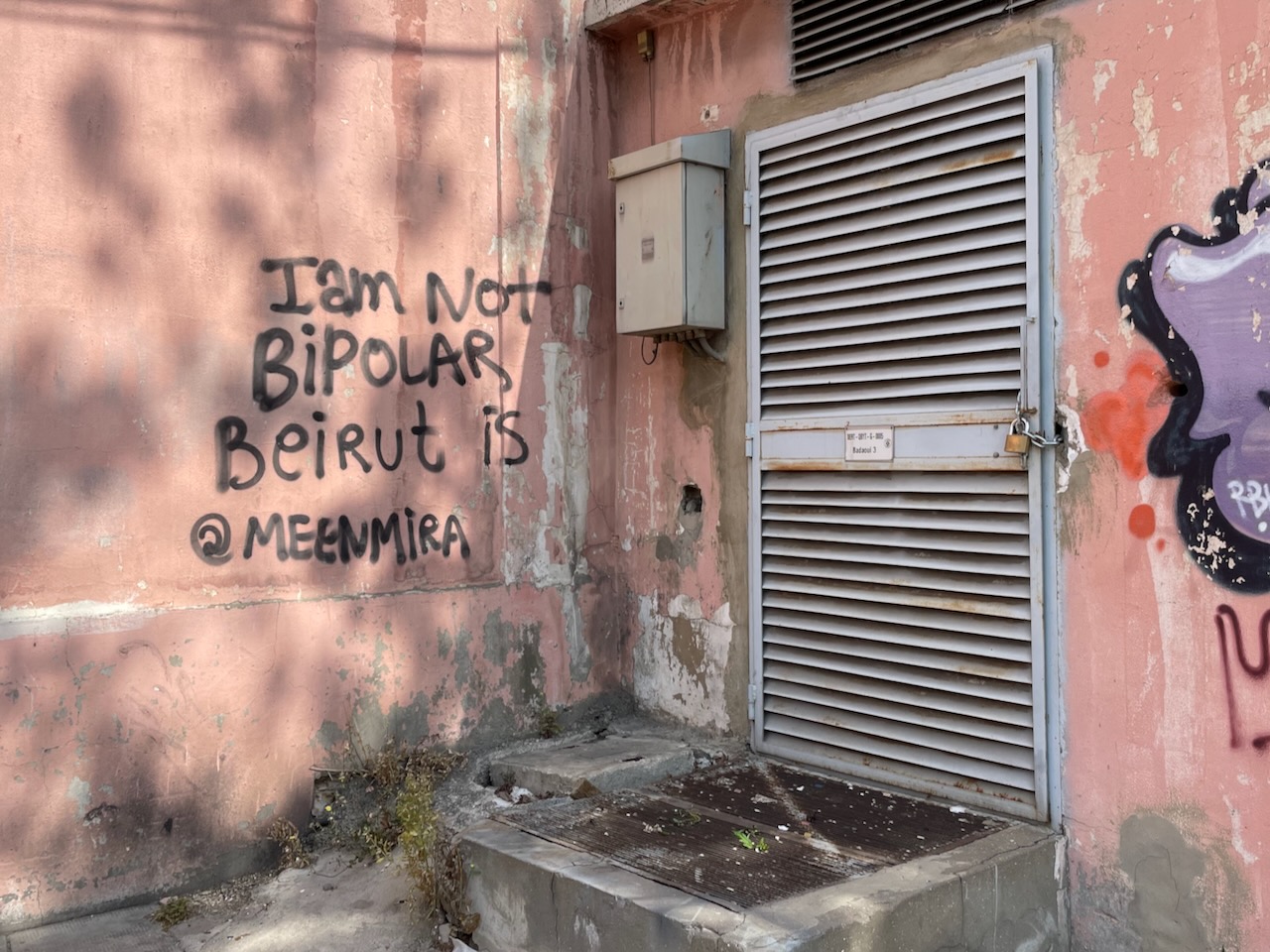
When walls talk...
(23 May 2023 - Khalil Badawi)

            A nearby bakery is run by a fellow who was formerly chef at a fancy restaurant, along with his wife and son. The menu at any local bakery throughout Beirut is very predictable: small pizza-sized manouché, with either zaatar (thyme) or cheese on top. Plus lahmbajiin (lahmajun for us Armenians), mini pizzas (with the inescapable canned corn topping) and spinach pies. Occasional variants are out there, but this is mostly it – the typical Lebanese breakfast food. This baker, however, features his wife’s home-cooked dinner entrees for lunch. Each morning I receive a photo of the whiteboard on the easel out front with the plat du jour written on it.
            One day recently I went to get two portions of this “slow food served in a hurry” – something made with flat beans, a few cubes of beef, swimming in lots of its juices. You have to understand, whenever I stop there to get the plat du jour, or even just to inquire about it, Tony (name not changed to expose the guilty) nonetheless insists on feeding me a soup spoon full of whatever the main course is. Although I’m going to be eating that exact dish in a few minutes, I am required to sample it right then and there in his shop! Well, that’s where my American logic kicks in – not pure logic, but suburban American logic, which considers this kind of behavior as unnecessary, unhygienic and imposing. You know – the logic that prohibits all the things that help people feel they are part of a community. Until now I was able to emerge from these force-feedings unscathed. But last week the plat du jour did me in. Tony placed almost the entire spoonful into my mouth, but a bit of the juice ended up running down my shirt. Not a problem, he handed me a tissue to wipe it off… So, the rest of the day I wore that badge of honor on my shirt, a tribute to our messy/friendly/business relationship. Each time he feeds me a spoonful of the plat du jour (even if I don’t buy it that day) is followed by “Good, no?” in his borderline English. To I invariably answer in my borderline Arabic: “Akeed!” (“Of course!”) or “Tayyib!” (“Tasty!). And it is! Messy and tasty!

How many languages do you need to get the
message? (30 May 2023 - Bourj Hammoud)


            I’ve experienced similar encounters all around the neighborhood, each one deepening the connection. At the falafel place up the street I am called “Abouna” (“Father”) by the owner, who also invariably hands me a piece of falafel to munch on while he makes the falafel sandwiches. A bonus! At another bakery the baker knows my usual order and rather than me ordering my usual “cocktail” (round flat bread, thin and a bit crispy, with half zaatar and half cheese), when I enter he says, “Cocktail?” and all I need to do is smile and nod. At the mini-markets around here I am also a known quantity, but I enjoy seeing the puzzled look on the shopkeepers’ faces when I show up in clergy garb, knowing I have messed up the category I have been inhabiting. The next time I enter the store they are clearly unsure about how to address me…

A mini-marathon to celebrate 80 years of
Armenian Evangelical Education!
(20 May 2023 - Ainjar)

            None of this is an excuse for the mess that passes for a government here, or the absence of public utilities that brings ever more electric wires to the mess of wires overhead to make up for that absence, or the lack of desire to pursue the common good, only the advantage of your own group's “boss” (witness the recent elections in Turkey). And I haven’t even begun to speak of the state of Armenian communities, organizations and institutions the world over, including Armenia, swimming in money and expertise (and, in the case of Armenia, tourists), but lacking the clarity that comes from a well-studied and broadly accepted national direction.

            We Armenians caught a brief glimpse of unity 105 years ago when, despite the shortcomings of officialdom, Armenian leaders organized troops and volunteers to put a stop to the genocidal enemy’s plan to overrun and annihilate Eastern Armenia along with its Western Armenian refugees. The battles in May 1918 at Bash-Abaran, Kara-Kilise and Sardarabad are a paradigm of wise strategy and unity in the midst of disarray and discouragement in the wake of the “ethnic cleansing” perpetrated by Ottoman Turkey. Today, as the same enemy continues the same genocidal efforts from Artsakh to Armenia, we are amazed at the country’s indifference towards these existential threats, and its inability to find, foster, or choose leadership with these qualities and this far-sightedness. What a mess our people are in!

LebCat 59: "This is Tony's bakery, right?
He uses cheese, right?"
(19 May 2023 - Mar Mikhael, Beirut)

            Messiness is how life is. But being a mess is simply irresponsible.

            As we do our daily adjusting to the messiness of existence and all the predictable unpredictability of life in Lebanon, we of course keep in mind the training we dutifully took as part of our appointment here, which instructed us to avoid having the same daily routine, to change our commuting routes each day, to have contingency plans at the ready, to be on the lookout for threats, and so forth. And we scratch our heads. And we trust God.   [LNB]

Tuesday, November 12, 2019

Canceled until Further Notice


30.Cancelled until Further Notice (11 Nov. 2019)
Last week all politicians’ faces adorning all buildings and
monuments (everywhere?) were removed and replaced
with the national flag. (11 Nov. 2019 – Qobaiyat - Beirut)
This morning the taxi driver asked me, “What do you think will happen here?” It came as somewhat of a surprise; first of all, that someone would ask my opinion about Lebanon’s fate, and second, that a Lebanese person would think that I, as a foreigner, would have some sort of access to privileged information that would help to prepare for what is coming. At least that was the impression I got, though I realize that people sometimes have other reasons for asking such questions.
            The country is suffering from the aggregation of so many systemic problems: a deeply entrenched patronage system (thanks to the Ottomans, then to the French, and then to the Lebanese themselves); the acceptance of corruption as an inevitable way of life; the lack of a system of holding people accountable (hardly an institution in the country functions without some “irregularities” in operations or hiring); the dependence on stop-gap measures to keep things rolling along, as they have been for decades since the end of the civil war; the partnerships of local groups with outside powers, each with its own agenda. Of course it is the bit-players, the regular citizens, who are badly buffeted in this local/international drama being enacted before our eyes.
Optimism and camaraderie ruled the day of the human chain,
which included an attempt to pass a bagged manouche sandwich 174 km (108 mi.) from Tyre to Tripoli.
(27 Oct. 2019 – Nor Hadjin - Beirut)
            My taxi driver had been let go from his 10-year employment at a local firm just last Friday. A couple of months earlier he had decided to buy a taxi car and license, to better support his young family; now he is completely dependent on this work. Will he be able to pay his car loan to the bank? And does the bank care whether he can pay? Will it pressure people like him to come up with cash he doesn’t have? For a long time I have thought about how the government and economic setup here seems perfectly designed to frustrate and discourage especially the young people, who then leave the country. And this is a particular concern affecting the Armenian community, which is in such dire need of a new wave of honest, courageous and committed young people.
            Putting aside speculation as to who or what might be behind all of this, and who stands to gain the most from a destabilized Lebanon, the idealism and dreams of young and old were expressed symbolically two Sundays ago, when thousands of Lebanese (and others) stood hand-in-hand in a human chain along the Mediterranean coast, from Tyre in the south to Tripoli in the north. It was a festive time, and brought out not only hard-core protestors, but tourists, families, young and old, men and women, visibly illustrating the dream they have of a country they can remain in and contribute to. Perhaps the image of that day will serve as an inspiration to work together to alter the trajectory the country has been on for so long.
“This is our sea!” Citizens are trying to stand up to the illegal
appropriation of the Mediterranean shoreline, in a city with
almost nil public space. (11 Nov. 2019 –
Ain el Mreisseh - Beirut)
            Yesterday a particularly delicious bit of popular protest occurred right next to the All Saints’ Anglican Church, where I preached. The church is struggling to find a pastor who is willing to come and shepherd this flock in Lebanon – and willingly endure all that one must here as part of the package. Nearby, next to the renowned St. George Bay, is a privately-owned bit of seaside which protestors took over, bringing their picnic blankets and breakfast, their fishing rods and swimming trunks. They said, “This is our sea, and we are going to enjoy it.” It appeared that they were prepared to bring their soap and towels and bathe there as well. Meanwhile, the church bulletin carried this unintentional commentary announcing a planned lecture / workshop: “The Life You’ve Always Wanted – cancelled until further notice.”
            As I traveled back home this morning and passed by the seaside showrooms usually displaying the latest and most expensive Porsches, Land Rovers, Lamborghinis, Jaguars and the like, I noticed something had changed: their glass-fronted showrooms were barren of vehicles. It’s clear that they already took steps to protect their valuable assets – those half-a-million dollar vehicles that no mere mortal in Lebanon could even dream to own. But there are plenty of people who just love to exhibit what they are able to (or appear able to) possess. It gives me pause to think that the cost of just one of those hunks of metal and plastic could lift one or two of our Armenian Evangelical schools free and clear of debt.
Garbage bins bearing the scars of the ashes and flames of the
beginning of the uprising. (9 Nov. 2019 – Mar Mikhael - Beirut)
            Drawing near to our home on the usually busy highway (today was a national holiday for the Prophet’s Birthday; plus, many gas stations are closed for lack of gasoline stocks, so the roads were practically empty), the bus approached the Électricité du Liban building. Around the entire perimeter fence was black bunting covering it, obstructing the view in or out, giving the entire block a funereal look. And blocking the street alongside were protesters in tents, vowing to stay there until the company, which receives the lion’s share of the government’s budget, provides 24-hour a day electricity. This, thirty years after the end of the Lebanese civil war.
            This morning’s taxi driver had gone to his bank last week to withdraw a sizeable amount of money from his account. No matter what he told them, they refused to release more than a small amount. So he resorted to yelling and screaming; he didn’t care what others in the bank thought. The manager sat him and his brother down, brought them coffee, tried to change their minds, and finally agreed to release a larger amount, but over a few days. This “show” is playing in bank branches throughout the country, and so the bank employee syndicate has declared that they are all going on strike as of tomorrow, until the country settles down. Yet those who have the strings in their hands are not in to be found in local branches, as we note every time someone of influence comes on TV to hold a press conference.
Some apropos theological reflection on the meaning
of this struggle. (26 Oct. 2019 – Mar Mikhael - Beirut)
            To take our minds off of the struggles of the Lebanese, we need only turn our heads a bit eastward, to see the sordid drama playing out there. Just one example is the news of the so-called “Islamic State” (The Reboot) today claiming its latest accomplishment, in the ambush and targeted murder of the (unarmed) Armenian Catholic Community Head of Qamishly, Fr. Hovsep Bedoyan and his father, as they were driving to visit the Armenian Catholic flock in Deirezzor. The IS also set off a bomb in front of his church in Qamishly at about the same time they gunned him down in his car. Before his arrest and murder Jesus quoted the prophet Zechariah, “Strike the shepherd, and the sheep will be scattered” (Mt. 26.31). This is the intent of those committing these acts – them, their sponsors, and their enablers. But rather than answer in kind, we instead pray that wherever shepherds and leaders are struck down, or when people flee in fear or discouragement, that God will provide leadership, renewing and refreshing the witness of his faithful children.
            Complementing today’s events in Syria is this week’s Turkey/US Presidential Mutual Admiration Society meeting in Washington, D.C. Do we all remember what happened last time this pas de deux took place, two years ago? How the Turkish security detail brutalized American protestors on U.S. soil, and not only escaped the country through “diplomatic immunity”, but had the charges against them dropped? It reminds us that corruption is not just a Lebanese problem, and that Turkey’s ethnic cleansing career is alive and well, and not just a thing of the past.
LebCat 29: With all the AUB students away at
protests, work as a window cleaner gets off to a
leisurely start for this cat.
(11 November 2019 – Bliss St. - Beirut)
            Contrary to the impression I may have given up to now, not all is gloomy for us, though. Our mood has been shifted from the weeks of closed schools and banks by the presence (since September) of our new neighbors in the two vacant apartments on our floor. Two young pastoral candidates and their families are here from Armenia, to serve and learn in the Union and among our Armenian Evangelical churches. They are adjusting to the uncertainties of life here while also integrating with the Armenian community and bringing their insights, skills and devotion to God to all who interact with them (a lot of the time, that’s us). What a refreshing change, that utter silence is no longer the norm in our building in the afternoons and evenings!
            I hadn’t much to say in answer to the taxi driver’s question this morning. I have no secret knowledge, nor do I own a crystal ball that tells the future. But as we conversed, I told him, “Things may get worse, I don’t know. But I do know that all of us need to be careful what we say about each other, because in the end, everyone here has to be able to live together.”    [LNB]

Thursday, October 24, 2019

Devils and Details


29.Devils and Details (24 Oct 2019)
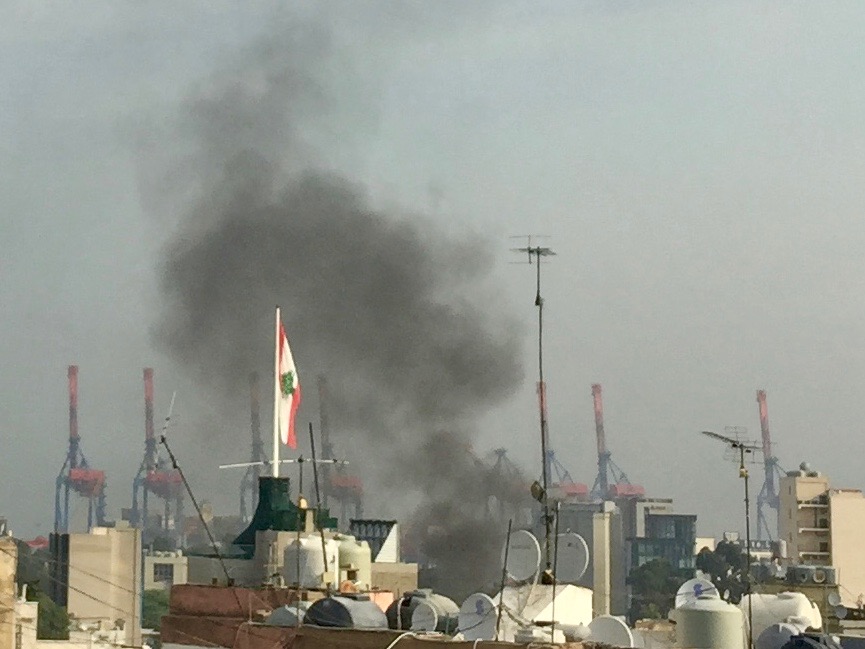
Smoke from tires burning on the Autostrade, filling the air.
(18 Oct. 2019 – Karantina - Beirut)
A week ago there was an announcement, replete with locally generated “great and unmatched wisdom”, in which the government here would begin taxing Internet-based (VoIP) communications (such as Whatsapp, Messenger, FaceTime). As many have already said, this was just the match that lit a blaze, the straw that rendered the camel a paraplegic, yet became an almost-inconsequential detail leading to the explosion of protests all across the country. The outcry and rage even targeted certain well-known leaders whom the populace heretofore has never dared to (publicly) criticize.
Shuttered businesses the entire length of the normally
busy Arax Street. (23 Oct. 2019 – Bourj Hammoud)
            So, the first couple of days we inhaled the acrid smell and particulates of burning tires, in addition to the ongoing stench of garbage dumps and polluted water. Those first few days also saw the emergence of a few disruptors who either were intent on destroying and looting private property, or reasserting the supremacy of their political party and its flags. Both types were quelled by Internal Security and Lebanese Armed Forces. Then emerged the chants of “Thawra! Thawra!” (“Revolution!” “Revolution!”). And the open-air party atmosphere. And the congenial “we’re all in this together” atmosphere.
            Later, other slogans emerged, as the
Push-back against multinational corporations… and an icon
of the protests, a woman kicking an armed guard where it
hurts. (22 Oct. 2019 – Mar Mikhael - Beirut)
demands intensified: “Kellon, ya3ni, kellon!” (“All of them, that is, all of them!”), so that no one group would think its leader exempt from the demands for a complete change in leadership – and a new political system, one not based on religious identity. If there are 3 million Lebanese in Lebanon, then thanks to television crews roaming in and among the various protests sites we are hearing what seems to be 3 million statements of discontent from young and old blocking streets and highways. Their words are crammed with emotion, seething with frustration at the struggle the average citizen has to endure for things like inadequate health care, expensive education, intermittent electricity and water, poor waste management, environmental degradation, unaffordable housing, corruption to the core, and so much more, including a sky-high national debt.
            But what has been absent is someone to take the helm of this movement and focus it into a clearly-defined direction. The prime minister gave a public address the day after the start of the protests, but it appeared to be directed to his political opponents. The president addressed the country today, a week after the start of these events. A decade and a half ago a handful of potential alternative leaders may have existed, except that they disappeared one by one in still-unsolved car bombings. Where are the new visionaries to keep Lebanese from turning against one another, expressions of which are beginning to emerge? There is only so long that an outburst can be sustained, and so what is sometimes (erroneously) compared to Armenia’s “Velvet Revolution” may take some unwanted turns in the days to come. Chanting for overall change is a start, but the devil is in the details.
The last day Lebanon was able to focus on something besides
its protests. (16 Oct. 2019 – Bourj Hammoud)
            And speaking of devils, only a few short weeks have passed since great (and locally great) powers have decided against the Kurds in northern Syria. It is such a familiar narrative; the roles now played by certain peoples and countries were played a century ago by many of the same minorities and world powers. And the story ends the same: strategic and oil interests superseding any humanitarian interest or pang of conscience. Who will be the losers in these military “games” being played out in the region? You can start with the great powers, who again squander their names as they easily abandon their local allies (We all should bring to mind how Armenian brigades and the population were betrayed by Europe). Yet a greater loss is being shouldered by the people of the land, not just Kurds, but Assyrians, Chaldeans, and, yes, Armenians. The Kurds may rebound due to sheer numbers. But what of the Christians, who are the ancient residents of that region? One of the winners no doubt will be the incipient “Islamic State Part 2”, thanks to the support of some and the negligence of others. So many devilish details, too many to keep track of, that invaders will just say “Oops” to you after the fact, as you disappear into the oblivion of genocide, deportation, migration and assimilation.
LebCat 28: A flat cardboard box is better than
no box at all. Hanging out with LebCat 13.
(3 November 2018 – Bourj Hammoud)
            But back to Lebanon. The protests continue, and roads are still blocked; sometimes by protestors, and sometimes by rainwater flooding the highways (like today) due to poor infrastructure… another burden borne by the population. But people need something beyond the protests – and they need a just resolution, without being co-opted by outside forces. They need to be able to work, to eat and send their children to school, but also to dream about the future and marry and care for and protect their homeland. Will this be a moment of historic change for Lebanon and its unity, or will it end in disarray and divisions? My hope and my prayer is that the people will continue to gather under the Lebanese flag, something all sincere religious leaders desire, and something the Bible commands us to do: “Seek the welfare of the city where I have sent you into exile, and pray to the Lord on its behalf, for in its welfare you will find your welfare” (Jer. 29.7).   [LNB]