Showing posts with label service. Show all posts

Tuesday, August 20, 2024

System Overload

62. System Overload (20 August 2024)

An artist found beauty in the colors
and shapes of Beirut rooftops and skies
(31 July 2024 - Mar Mikhael)

When you live in a country that makes you provide your own basic services – things that citizens of other countries can take for granted – you have to get good at guessing. For example, though we’ve been enjoying nearly non-stop electricity for over a year following the solar power installation on our building, there are still quirks. When the (currently nonexistent, pun intended) municipal current exceeds the normal 220 volts, a system overload occurs, and we are left in the dark. We figured out that we had to wait until the municipal power “calms down” to something under 240 volts, then switch the main power off and on to resume our electricity. Problem managed (not solved)! Other power interruptions still occur, and we’re still trying to guess why…

Finding a way to get the job done,
and nobody got hurt - I think
(29 Mar. 2024 - Geitawi)
            “Overload” is also a daily issue in a place and a community with a plethora of needs and concerns but a dearth of willing and capable hands. Those who are willing and capable can often (somewhat understandably) be very protective of their time and energy. Others may be on the job but lack the necessary capabilities. Still others are unwilling to learn or change. I regularly wonder how overloading is affecting those around me.

            So many people have left this region (the “dearly departed”) for a more balanced or safer or prosperous life, and those who haven’t (yet) left continue to care for the community and experience more system overload. Since I’m now (in a way) part of this latter group, I try not to think about the load-bearing that we are doing, and just continue to plug along. Occasionally we find a little bit of energy left to train and empower others who have the potential to work for the common good, with the hopes that they will continue to stay side-by-side with us and not take an offramp.

A sidewalk collage with a message...
whatever happens
(10 July 2024 - Gemmayzeh)
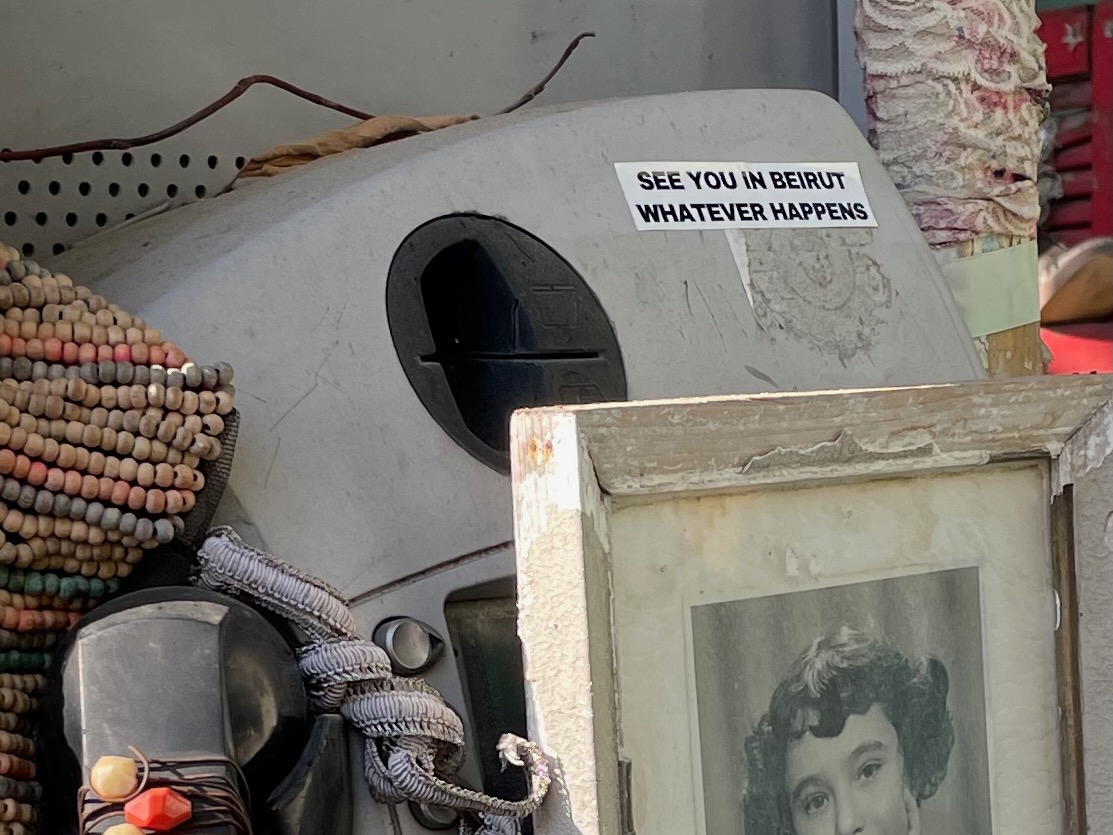
            I think that “system overload” also properly describes my thought world of the past year. I have been filled to overflowing with the barbarity and especially the counter-barbarity in the lands “South of the Border” to us; the genocidal onslaught on Armenia and Artsakh (to borrow another butcher’s words, “Who speaks nowadays of the destruction of Artsakh?”) by its neighbors, assisted by the resources of “the Middle East’s only democracy”, and emboldened by the inaction of its “friends”; the lack of depth, political sense or appreciation of heritage of those in power in the “Homeland”; the pervasive indifference and confusion of the Armenian Diaspora towards the existential threats it is facing; the diabolical contradiction between the words and actions of purported champions of human rights; all of this causes a huge “system overload” in my circuitry. Is this paragraph too long? That’s “system overload” doing its thing.
Far from Beirut's din, the peace
and majesty of the cedar forest
(22 July 2024 - Arz el Barouk)
            When surge protectors interrupt an electrical circuit, either the circuit stays off until the “reset” button is pressed, or they wait a few seconds before automatically restoring the current. Maybe all of us need surge protectors to keep us from these varieties of overloading, including the surplus data that is provided to our eyes and brains via our handheld devices. That excess of information, coupled with the lack of time to reflect on so many issues of substance, cause us to fall from our true humanity, in almost as insidious a way as Adam and Eve’s transgression did. And it may explain why in the past twelve months I’ve only managed to eke out one “Nshanakir”, and why I’ve been trying since April to write this one. Seems I’m having trouble locating the “reset” button on my surge protector.

            To switch the imagery and to do some self-correcting, something I tell those who say that they are in a pit or a rut is this: “When you find yourself stuck in a hole, the first rule is – Stop Digging.” Others may advise differently, like focusing on something positive, which may be particularly challenging when the “most moral army in the world” sends its warplanes over Beirut to terrify you, as we have been enjoying of late. Oh, right, stop digging.

            Yet searching for bright spots may be the best method to finding a way out of these many pits and potholes we encounter. Here are a few.

Newly-engaged, a bright spot needing
no electricity! (21 July 2024 - Geitawi)

            One bright spot is the occasional kind taxi driver that Maria encounters in her commute. These are usually “old-timers,” fellows who are not new to the job, who exude an attitude of politeness and caring, something in short supply these tense days. Of course, Maria has a distinct advantage over me in these exchanges, being that she can converse with them in Arabic. If nothing else, it gives me peace of mind and puts a smile in my heart when I hear that one of these gents has been her chauffeur that day.

            Another bright spot happened at a sweet shop on a hot afternoon last week, when I inadvisedly bought an ice cream cone. Almost instantly it turned into a colorful series of tributaries streaming down my hand onto the sidewalk. An employee rushed out of the store and put a stack of tissues on our table, then grabbed my cone and plopped what was left of it into a cup, speaking as if to reprimand the ice cream for making such a mess all over me. She shooed me into the store to wash up at the sink behind the counter, then made me tell her what flavors (of Arabic ice cream, of course) I had ordered. She had the ice cream server make up a new order for me in a cup, of course, with the cone sticking out of it at a rakish angle. After enjoying my ice cream I went back inside to thank her. “Walaw, walaw,” she politely dismissed my thanks. Based on her awareness and consideration, I figure she may have even told the guy inside to make sure to use cups whenever serving ice cream during Lebanon’s glorious summer heat.

LebCat 62 - "Will act cute for food"
(22 July 2024 - Deir al Qamar)
            It’s just like Fred Rogers’ mother told him as a little boy when he was frightened: “Look for the helpers. You will always find people who are helping.” Bright spots are there for those who are looking for them.

            Of course, the brightest spot was indubitably Sevag’s annual month-long visit. It became even brighter when his girlfriend Rhoda arrived from Pennsylvania the last week of his visit and they surprised us by exchanging rings in the middle of a kebab lunch with dear friends. The happiness and brightness quotient soared that day, and there was no system overload anywhere to be found! A few days later we held a formal engagement ceremony in the Armenian tradition, placing the wedding bands on their right hands and invoking God’s blessing on their growing relationship.

            Thinking upon such bright spots definitely help us to bridge the “power interruptions” of these days!   [LNB]

Tuesday, January 3, 2023

With Whom Is God Pleased

56. With Whom Is God Pleased? (3 January 2023)

A glimpse of Christmas joy in the
neighborhood, powered by
"ishtirak"
(30 Dec. 2022 - Geitawi, Beirut)

Holidays in Lebanon, especially in the winter, have fallen off my list of favorites, probably in no small part due to the lack of electricity we (and so many other Lebanese) experience at home. The offices where I work close, meaning that our building’s generator stays off. Our subscription for supplemental power covers only about half of the day, anyway, bringing inside temperatures close to what is outside. And municipal power supply continues to emulate Halley’s Comet in its rare appearances. Combining all the national holidays with the ones of various religious denominations, plus Armenian holidays, here in Lebanon we experience close to a month each year of these “off” days.

            But there is another layer of distaste. Holidays are too often turned into platforms for social and political assertiveness, rather than times of rest, reflection, redirection and rededication. Firecrackers (and bullets) fill the air over neighborhoods where a particular holiday is most observed. Not to forget the obligatory firecrackers and fireworks launched at important life events, such as funerals and weddings, or your World Cup football team scoring a goal. We were able to watch three games of this year’s football “Mondial” in early December since we were visiting Armenia for a week. There, games were broadcast on Armenian state television for anyone to view. Here was a different story, as is the case with so many things. The sounds of firecrackers and nearby fans yelling would prompt us to refresh the official website in order to see the latest scores — a somewhat anticlimactic method.

Constructing the "New Year's tree" at the
Yerevan train station
(30 Nov. 2022 - Yerevan, Armenia)

            In this particular season the biblical phrase, “Peace on earth, good will towards men,” is widely touted, or more commonly quoted simply as “Peace on earth”, without involving men (in the generic sense) or good will. The more intricate version of Luke 2.14, “Peace on earth among those with whom God is pleased,” is avoided, likely because it doesn’t fit neatly into 21st century greeting cards (i.e., social media platforms and posts), and likely also because it states that there is a God, also implying that this God makes judgments. About us. Also not fitting popular sensitivities in these oversensitive times.

A garden of Armenian letters seemingly
growing out of stones, hopefully an inspiration,
more than just a tourist attraction.
(29 Nov. 2022 - near Artashavan, Armenia)
            Whether or not it plays well in mass culture, a question sticks in my mind: With whom is God pleased these days? My immediate guess is “no one”, as evidenced by the lack of peace on earth. The lofty goal of peacemaking is left largely untouched, while nations allegedly aim for (but fail to reach) the lower goal of temporary cease-fires. Yet even where cease-fires are attained there are always those who find ways to continue their aggression.

            Since mid-December and continuing into the New Year, Azerbaijan-sponsored phony “environmental activists” have been blocking the only lifeline for food or medicine or transit that Artsakh Armenians have, the “Lachin corridor” linking it to Armenia. Add to this the Azeri government and industries that are driving all of this, entities that blithely cut off energy supplies to Artsakh in the cold of winter. Add to this the inaction of those charged with keeping the road open, allowing the situation to be created. And finally add to this the meaningless verbal bravado (and little more) of world powers, busying themselves with statements and resolutions condemning the blockade, but unwilling to intervene in a sovereign country. If all of this looks and sounds like world powers’ failure to prevent the Genocide in 1915, there’s a good reason for that. Summing it all up, it immolates the dove of peace over the flames of war.

A mural depicting Old Beirut, in a park where
an old Beirut building was torn down.
(8 Dec. 2022 - Geitawi, Beirut)
            Peacemaking can be torn apart in various ways: by individuals, societies, companies, governments, you name it. It does not have to be done in the obtuse ways that Armenia’s rapacious neighbors are so fond of. Sometimes it can be as subtle as tolerating inept (fill in the name of your favorite country) governance, or by making self-centeredness and self-indulgence a societal value, or in disdaining others in order to elevate yourself.

            Yet despite all attempts to kill it, peacemaking is alive, and peacemakers are at work. Whenever we hear about or witness a teacher who goes beyond the lesson plan and above the minimum requirements to help her class learn to relate with care for each other, there peace is being inculcated. Last week I was in a store in Bourj Hammoud when an older fellow in tattered clothes stood at the door with his hand raised in greeting - not for a handout. The Arab worker (who happens to speak Armenian) addressed him affectionately, giving and receiving words of blessing; this, too, is peace-building. When someone in the course of a conversation asks me to pray for him right there on the spot, God’s peace hovers over both of us and enables us to express more grace to others.

Christmas bazaar at the Zvartnots Center,
which brings hope and love to special needs
children.
(22 Dec. 2022 - Nor Sis, Bourj Hammoud)

            That message to the shepherds heralding “peace” at Christ’s birth is more of a challenge to self-absorbed humanity than a statement of present reality. The One whose appearance they announced made it his aim to establish peace through servanthood and a particular act of sacrifice. It grew more intense and pervasive as he grew “in stature and in God and man’s favor” . We might strain to see those around us who join him in this endeavor, but the thread that joins each instance together, shining with the angelic light seen outside ancient Bethlehem, is that of service.

            Serving others, motivated by love, produces peace. And only God himself can fill and refill that love.

LebCat 56: Since the electric company isn't
using these anyway, I'll just settle in.
(30 Dec. 2022 - Mar Mikhael, Beirut)
            Since “Armenian Christmas” is but three days away, an Armenian greeting on the occasion and a wish for God-pleasing peacemaking: Christ is born and revealed; blessed is the revelation of Christ!*   [LNB]

*Քրիստոս ծնաւ եւ յայտնեցաւ. օրհնեա՛լ է յայտնութիւնն Քրիստոսի։

Saturday, May 28, 2022

Living in DIY-land

50.Living in DIY-land (28 May 2022)


A panel here, a panel there, and Nejmeh
Square is proclaimed "open"...
(26 May 2022 - Beirut)

           In most places in the world, people pride themselves on their DIY (do-it-yourself) skills and experience. Why have other people build or fix things, when you can do it yourself? And you get a greater appreciation for how things work, and the confidence that comes from knowing that the quality of the work is up to your personal standards. Of course, this is a “first-world” issue, because in much – if not most – of the world there is no alternative to doing it yourself. It’s like those who go to the gym to stay in good physical shape because they no longer move, bend, lift, pull, push or sweat as part of their day’s work… contrasted with the rest of the world whose survival depends on their physical engagement with every aspect of their lives.

The elections came, and the elections went,
and now everyone waits to see what's next.
(14 May 2022 - Geitawi, Beirut)
            And then there’s Lebanon. I need to be circumspect about this because I signed a paper promising that I would only say nice things about Lebanon. This is a DIY society for very different reasons than the two categories mentioned above. People do a myriad of things themselves because either the function in question was never done by the authorities, or because the functions have stopped functioning, and now it’s up to you to do things like store your own money, or generate your own electricity, or import your own medicines, or provide security for your family, and so on. And if you examine the extensive network of services for the refugee population (probably a quarter of the total population), you will find networks of aid agencies, each with its particular emphasis. Essentially, today’s population is living in DIY-land.

It's amazing; every day it fills up, and every
night it gets emptied! What manner of sorcery
is this? (16 May 2022 - Geitawi, Beirut)

            There are also many functions that were never done by the state, which explains why there are so many organizations identifiable by a particular socio-religious coloring. Let’s keep in mind that this was a “gift” left by France as it ended its mandate over Lebanon in 1943; namely to create a government consisting not of capable citizens, but of mandated religious representatives, in order to make it as difficult as possible for any one group to have authority over another. Or that was the plan, anyway. It ended up being a wide gate to nepotism and cronyism, and public service jobs are bloated by people getting paid to fill quotas, not to provide services. It also made each religious grouping look out for its own, reinforcing people’s view that only one’s own group will look out for them.

Anyone want to take some for DIY crowd
control? (26 May 2022 - Beirut)

            And so each socio-religious community has its own old age home (Armenians have CAHL) and other hospital services (Armenians have the Armenian Sanatorium, and Armenian Evangelicals used to have the Christian Medical Center – housed in the building where we now live). Armenians as well as others have an assortment of relief and socio-medical centers catering mostly to their own groups. They each have their network of parochial schools and institutions of higher education. They have their own press, and their own television and radio stations. They also have their own demographic regions, though in the pre-civil war days there was more admixture between groups, blurring those lines a bit. There is not much one can point to and say, “This is for all.”

DIY noise control by the unfortunate residents
of the boisterous (until 4 a.m.) pub street, "rue
Armenie". (26 May 2022 - Mar Mikhael, Beirut)
            So, the parliamentary elections came and went. And there were small shifts in power bases, including some disorganized “revolution” people. But few are expecting significant changes. In an act of low drama, the outgoing (who is also the incoming) speaker “approved” the removal of metal and concrete barriers that have surrounded the parliament since the uprising began 2-1/2 years ago, as if to herald a new day of openness and prosperity for Lebanon and its capital city – supervised by the old guard. This, as the simple majority of hungry and unemployed citizens (and others) turns into an overwhelming majority. And as the currency continues its death-dive, something that economic experts consider to have no economic basis for occurring, only political. And as those who impoverished Lebanon continue to claim to be her saviors.

Preparing KCHAG for energy independence.
(22 May 2022 - Monteverde)

            In recent days government officials have continued to express the DIY-ness of today’s Lebanon. Some obscure decision was taken by the Central Bank, and the currency magically improved. A new electronic platform was released for shoppers to report price-gouging at supermarkets. Bank heads are advising people not to keep their cash under a single mattress, but to spread it out throughout all their bedrooms. Governmental security heads are warning people to keep their valuables in various places, and not just in one old purse in the back of a closet. The population has gradually resigned itself to the permanent absence of municipal electricity and the ever-increasing cost of diesel fuel running the DIY generators (called “ishtirak” – see Jan. 2022 blog: “Power-Hungry”) in each neighborhood, so that throughout the country solar panel installations are sprouting up, raising the hopes of some that they will be able to live somewhat “normally”.

The ultimate in DIY-ing:
a flea market! (26 May 2022 -
Nor Hadjin, Beirut)
            Surveying such rough terrain, in which the country’s DIY-ers live either with endless discouragement or self-delusion, or alternate between the two, the points of light are challenging to discern. More than any other place, I see them among teachers and others who express a heartfelt commitment to serve others. In the case of teachers, there are some so discouraged that they can no longer give what a teacher must give and a student must have. But there are many others who continue to challenge their students to think and grow, facing not just the negativity of students who say, “What’s the use?” but also that of the discouraged parents who transmit their hopelessness to their children. Once the complaint was about the ”burden” of the Armenian curriculum; now the entire curriculum is often questioned by those who only want to find a way out of their misery. Teachers are the front-line workers, who should be given standing ovations at the end of every school day, for continuing to believe in the future of the children they educate, and especially for those teachers who continue to believe in the importance of an Armenian education (a topic for another time).

LebCat 50: "If you want to run a store the
right way, you have to do it yourself!"
(17 Mar. 2022 - Geitawi, Beirut)
            Along with teachers being front-line, essential personnel, there are also those committed to serving others, whether in health care, or social work, or ministry, or even just being a good neighbor, keeping an eye out for those whom they see silently suffering. They, too, should be regularly applauded and encouraged. A doctor recently told me, “I should thank the country for teaching me how to prepare for a retirement without any money!” But he and so many others continue to use their skills and their hearts to help those around them. Lebanon is the ideal place to come and learn what it means to serve others, and to receive your reward from the One who came not to be served, but to serve. Though it is easy to slip into discouragement ourselves, Maria and I try our best to be encouragers. This is not a DIY job, because we don’t have the resources to last. Surrounding us there is the church, whose members rely on the prayers of many and renewal from above. And there is Christ, who Did It Himself, going through all of this, and more, to bring light out of the darkness!   [LNB]

Thursday, August 30, 2018

Like an Old-Timer


17.Like an Old-Timer (29 August 2018)

Togetherness (mostly) over kebab at the Bakalians!
This time with Sevag and a bunch of friends
(20 July 2018 – Geitawi, Beirut)
         When taking some visitors around Beirut recently, I realized that I was talking like an old-timer. Remember, you don’t have to be old to talk like a senior citizen. I was pointing to this place where there used to be such-and-such school, and the other place where so-and-so used to live, and on and on. I’ve only lived about a dozen years of my life here (and not even my formative years), but here I was, talking about the place as if I had been here all my life. To be fair, I can talk in the same fashion about nearly any place I’ve lived, but this place is nowhere near where I was born.
         So, here I was giving the “insider’s tour” of our neighborhood, from the post-Genocide era, to the pre-Civil War era, to the ups and downs of the past 3 decades. It offered a strange satisfaction, a deeper sense of belonging, while at the same time reminding me of the responsibility to pass along the heritage I have inherited (and chosen), particularly the Western Armenian and Armenian Christian heritage. The fact that I might know more than most people about this background is largely irrelevant. There is so little I know, and so much catching up I have to do to begin to grasp it all… even as an old-timer… or a perceived old-timer / know-it-all.
The theme-word for this summer’s youth
conference was “dukhov” (on the hat), a Russian/
Armenia word meaning “with spirit”. Ha.
(23 June 2018 – KCHAG, Monteverdi)
         One of my new favorite spots to eat is a little hole-in-the-wall kebab sandwich place, a 10-minute walk from home. The proprietor and sole worker there is a youthful and light-hearted, 70-something Armenian woman, whose friendliness and focus on providing high-quality food is a rare commodity. Eateries in this city can be pretty snooty places, even cheap eats, but Angele easily finds a way into your heart, and you into hers. She gets up before dawn each day, chops her fresh onion and parsley, gets to the butcher for fresh meats, switches butchers if she feels they are slipping in their quality, and lines up her skewers in small quantities in the refrigerated display for her regular customers. When I stopped by she talked about how, a few days ago, Persian Armenian visitors to Lebanon kept coming back day after day, even bringing friends to eat there. Sometimes Angele recruits willing friends to help with the chopping, but she is the one and only cook. Puts the charcoal on, sets the blow-drier to intensify the flame (they keep breaking down, and her brother keeps fixing them), peels the skin off the tomatoes after she cooks them, tosses on the right amount of spices to make a delicious sandwich… and charges almost nothing for it. At every turn she thanks the Lord for helping her. “It’s enough for me to live on – that’s all I need, praise God.” In a country of debt-based living, it’s an outlook on life that a lot more people need to share.
A heart for figs that grow out of the walls of Roman temple
ruins (25 July 2018 – Niha, Beqaa)
         The summer zoomed by us. We started out serving as counselors for the youth camp, then I got to be recording secretary for the church union’s annual meeting, and in between we got to see brother-in-law Vicken for a very brief visit. After that we spent a month (sort-of together) with our son Sevag, who was making his second annual appearance here. We enjoyed Lebanon for a few days, visiting Rayaq, where a lot of Armenians settled after the Genocide, until they emigrated to Armenia in 1946. We ate the most flavorful – not sugared – Arabic ice cream (in the Beqaa village of Saghbine). Sevag then did his second annual stint as a leader at the Armenian Evangelical Children’s Conference in KCHAG while we departed for Armenia to get ready for yet another big conference… “Zoomed” is the word.
Wrapping up the Armenian Evangelical Youth Conference
(15 Aug. 2018 – Hankavan, Armenia)
         Over the past months Maria and I had been filling our days and nights as directors of the worldwide Armenia Evangelical Youth Conference, organized by the Armenian Missionary Association of America for its 100th anniversary. (Read about Day 1 through Day 14 here.) Sevag, along with the Syria & Lebanon group, joined us a few days after we arrived Yerevan, with about 140 other youth and mostly young leaders from a bunch of different countries for a two-week conference. (Read his interview in Armenian here.) The most memorable part of the plan was, predictably, the service opportunities the youth had, in teams of 4 to 10 people, heading out to various cities and villages. Each team did something different, whether helping run Vacation Bible School, or making jam, or doing housecleaning, or planting rooftop gardens, or visiting lonely elders in border villages, or refurbishing dwellings, and on and on. The conference got them culturally enriched and spiritually challenged, and then provided them an outlet to give to others a portion of what God was filling them with. Good, good times.
LebCat 16 and associates: We will soon take over your planet
with our fuzzy bodies and our laser eyes. Meanwhile you must
feed us (18 Aug. 2017 – Mar Mikhael, Beirut)
         Emerging mostly unscathed through all of this, Maria and I realized anew that this kind of leadership is something we need to encourage, advise and challenge in others. Because, simply put, we are old-timers! Happily, there are at least a few out of the youth with whom we worked throughout the summer who will likely do very well as tomorrow’s and today’s leaders.
         News update: it seems the ants noticed that they were getting very little social media traction from their antics in our apartment, so they took a break from bugging us. That and a bit of spray from a store that sells organic stuff seem to have done the trick. For now.
         September has nearly made its way back into our lives, so it’s time for both of us to hunker down again for the new academic year. With the summer conferences behind us, we can focus on the tasks we were sent here to do. While we continue to be integrated deeply into the fabric of life here. And gladly fulfill our roles as old-timers.  [LNB]

Monday, October 23, 2017

Here and There


9.Here and There (22 October 2017)
            “Oh, so you’re from Armenia?”
            When they hear I'm Armenian, what seems to them like an easy question to answer isn’t at all. It’s asked by people who do not have a circle of Armenian friends who will eagerly fill them in on the finer points of what an Armenian is, where Armenians are from, why the Armenian Genocide is such a crucial issue to Armenians and should be to as non-Armenians, where the language is on the Indo-European language tree, what Armenians typically eat (all of which they, of course, invented), why there are fifty times (Armenian hyperbole) more Armenians outside Armenia than inside, why there has been a steady decrease of Armenians from the Armenian Republic since independence in 1991, and on and on. Really, I can’t imagine how people can get through their lives without having an Armenian tutoring them on all these issues, and so many more!
You could probably seat 5 people across in this classic
at Republic Square (4 Oct. 2017 – Yerevan)
            This summer I visited Armenia on two occasions. A mere hour and some change flight from capital to capital, Beirut to Yerevan.
            My first trip, in August, was a six-day visit, during which I led a retreat for Armenian Evangelical pastors. I was delighted to discover that the retreat was going to be held in Artsakh, in the town of Shushi, a place I have not visited in 18 years. The second trip Maria and I did together, ten days at the end of September until early October, and I was the speaker at the annual assembly of the Evangelical Church of Armenia. And this was only Maria’s second visit to Armenia, the first one having been 16 years ago. Both trips were great experiences, challenging, enjoyable, friend-filled, refreshing.
Open-air performance of Armenian folk dance
and song, “Koutan”, at the foot of the Cascade,
on the day we arrived! (28 Sept. 2017 – Yerevan)
            But the question remains: am I “from Armenia”? When I’m in Armenia, am I from “here” or “there”? “There”, of course, is the gaping hole left in the lives, culture and heritage of Western Armenia, the region that the Ottoman Empire/Turkish nationalists attempted to scrub clean of its pollutants, the Armenian people. They did a pretty good job, too, because they ruined an ancient civilization and left them to die a drawn-out, confusing death scattered across the Middle East (to be finished off later by attrition and emigration), throughout Europe (to maintain an exotic, “oriental” flavor while being re-oriented), and across the Americas (to be tossed alive into the “melting pot” while forever arguing with each other over “American-Armenian” vs. “Armenian-American”). For Western Armenians such as myself, there is an inevitable longing for something irrecoverable, bewilderment over what “Armenia” means, and the clash of familiarity with foreignness when hearing Armenian spoken in the “homeland”.
Supplying the missing “N” to the mini-market’s
name, “Bakalia” – according to Eastern Armenian
pronunciation (5 Oct. 2017 – Yerevan)
            Here’s an example: before leaving Beirut, we borrowed two SIM cards in order to use our telephones in Armenia. While feeding some money to a payment kiosk on a Yerevan street, I must have said “ayo” (yes) to something related to one of the numbers, because after congratulating me via SMS for paying that amount, it then claimed that I had only half of the amount left on that SIM card. Hmm. Time to investigate. First, I asked an acquaintance what might have happened. Was there an unpaid debt on the card that I had just paid off? He didn’t know. So I asked another acquaintance if she could call the company and ask about it. (I wanted someone who could actually understand Eastern Armenian over the phone, something I find very difficult.) She spoke to the agent, then explained something to me that I thought I understood: yes, the missing amount went to pay for something or other. But I needed to know what that something or other was, so I found an actual store run by that phone company, took a ticket, and waited my turn to speak to a live human being behind a counter. When my turn came, I asked her to explain why only half of the amount I paid was shown, and although she spoke in Armenian, it was littered with various foreign (Russian and European) words, much like the litter of Turkish, French, English, Arabic and even Kurdish words blow about our Western Armenian speech. So I asked her if she could explain it again, which she did, with a bit less patience. Then I apologized, and said, “I’m sorry, but I can’t really understand what you’re explaining. Thanks for your trouble.” And I left.
            Later on, as I mulled this over instead of going back to sleep, I figured out what had happened to the missing amount. I suppose the jumble of explanations and the various words from various languages finally sorted themselves out, and I concluded (correctly) that I had purchased a calling plan – the amount hadn’t just vanished. But it was emotionally exhausting to be in a place that didn’t exactly feel like I belonged.
            Perhaps this gave me a glimpse of the travails encountered by the latest group of “returnees” to Armenia, the Syrian-Armenians. Many sought refuge from the war in Syria, beginning in 2012, and in the intervening years some have gone on to places like Canada, others have returned to Syria, following the subsiding of military activity, and the rest have settled in Armenia. They have brought a distinct, yet Armenian, culture to the place, and one can sense it – if one happens to also be a “Western Armenian”.
Lara and us at the “Haleb” social aid organization, operating
out of a Northern Blvd. basement (6 Oct. 2017 – Yerevan)
            Maria and I met up with a young woman, Lara, from our former church in the U.S., who is now working through Birthright Armenia at an agency helping Syrian Armenians with various social needs. The restaurant we had chosen was not accepting people without reservations, so we went to one a couple of doors down. The waiter who greeted us seemed to speak a more intelligible version of Armenian, though not the Western dialect. Perhaps he was just accommodating us as Diasporan Armenians, something quite a few Yerevan natives are able to do.
            When he came to our table to take our order, he asked where we were from. “I know she (Lara) is from the U.S., but what about the two of you?” I said, “From Lebanon.” “Where in Lebanon?” “From Beirut.” “Where in Beirut?” “From Ashrafieh” (the eastern half of the city). “Where in Ashrafieh?” “From Geitawi” (a section of Ashrafieh). “Where in Geitawi?” The conversation was getting stranger by the second. “Uhhh… we live in the former CMC (Christian Medical Center) building.” “I was born in that building!” And so three Western Armenians connected on a sidewalk in Yerevan, feeling at home with each other because of the “there” that joined us together.
LebCat 8: “Excuse me, is there a law that says I have
to be inside the box?” (30 Mar. 2017 – Beirut)
            Often, when encountering people disgruntled at life in the Middle East (and in Armenia), we hear them complain about the “here” of their lives today: “This place will never straighten out.” “You can’t get anywhere if you don’t have powerful friends.” “Why bother? This isn’t our homeland anyway.” This multitude of comments are all a way of disengaging with one’s environment, and are usually followed by an announcement of departure to pursue a life “there”, far away from this region. We are amazed at how people can feel more connected to that distant, western environment than to what they consider the corrupt, future-less land of their birth, unable to see any redeeming qualities. I have no ability to read people’s minds, much less see what only God can see – their hearts. But I wonder if people can connect in a different way to the “here” of this part of the world, to experience joy and contentment in the midst of struggles, and find meaning in investing in people, albeit while dealing with undeniable hardships.
            This is something that matches our experiences “here” and “there” – when talking with those who are devotedly working to help others, they note, as we do, that the greatest need is to prepare people – leaders, especially – who will love their homeland(s) and serve with their strength, skills and wisdom for the betterment of all.
            So, Armenia, we’ll be back! We’ve made our home here, close by. We consider both places our own, and trust that they might also consider us their own. [LNB]