Showing posts with label explosion. Show all posts

Wednesday, August 5, 2026

Same But Different

69. Same But Different (4 August 2026)

A memorial walkway, with one olive tree for
each one who died, and their name engraved 
on a plaque (4 Aug. 2026 - Port of Beirut)
For the past six years the same scene on the coastal highway of Beirut plays like a rerun. Crowds gather on the “autostrade”, vehicle traffic is diverted from the protion astride the Port of Beirut, speeches are made and tears are shed for the hundreds killed or maimed in the 2020 disaster, for which not a single person has been held accountable. It’s always the same: crisis, death, tragedy, and no accountability.

            Maria, Sevag and I were visiting friends that day six years ago, enjoying some properly-masked, outdoor, Covid-era socialization, when in an instant the world changed. It was a day very different than the five anniversaries since: part summer beauty, part horror movie. And subsequent August fourths have been different, yet mired in the numbing sameness of impunity that blankets not just Lebanon, but all the countries of the region. How easy and how natural it is to conclude that nothing will ever change, particularly in the Middle East?

We were wondering, "What will open next to 
the Starbucks coffeeshop?" We returned to 
find that a "Latte Art" coffeeshop opened.
(18 July 2026 - Mar Mikhael-Beirut)
            After a 130-day stay in Armenia we returned home to Lebanon over two weeks ago. The reason I know that number is because each night my computer reminded me how long it had been since its last backup. So, arriving home and reconnecting the backup drive was particularly satisfying, and not the usual same-old same-old.

            Reconnecting with daily life in Beirut brought a strange sensation of being the same as any other day, like we had never left; yet something was different. Nothing seemed out of place, and we had no sense of disconnection. Everything appeared the same, save that it was cold then and stiflingly hot and humid now. Things we were following in the news since March, such as displaced families along the seaside and tent cities on open lots, were nowhere to be seen. Before our return they had been moved to other locations set up by the government, it seems. The construction of huge, meaningless structures has continued. Weddings, graduations and social activities went on without hiatus. The dollarization of the economy continued, as has emigration from Lebanon to the ostensibly “secure” West. Everything was just as it has always been. Or perhaps not.

The latest archaeological dig, right behind us;
and another dig to the left of the tall white
building. (21 July 2026 - Geitawi-Beirut)
            On the street directly behind our residence (and the church headquarters) two lots have been temporarily spared from having new apartment buildings erected on them, because Roman-era structures were found just under the surface of the soil. Archaeologists have expressed surprise at these findings, as they had no evidence that the city limits of Berytus (as it was called 2,000 years ago) extended this far east. Additionally, in these past months a Roman necropolis (cemetery) was unearthed nearby. I am sure that there is much more that could be found if there is a willingness – and funding – to do so. And the accepted history of the city will change!

One last coffee before our departure!
Smile! (15 July 2026 - Yerevan)
            One can be numbed by sameness, or near-sameness, and miss seeing the changes and developments that occur all the time. I try to take note of variations, whether in music or speech or ideas, differences that help me to maintain interest in things that seem deathly stable. Even when dealing with people who “will never change”, there, too, I can see changes, though it might be for the worse.

            “So, how was Armenia?” – I am excitedly asked by people who are tired of the daily challenges of life in Lebanon, expecting me to praise every detail of Armenia (by which they mean the Yerevan that they know from their 10-day vacations there) and do the usual, point-by-point comparisons, putting Lebanon down. When I try to point out both pros and cons, striving to present a more nuanced picture, they are often not interested, certain that the “Armenia-good/Lebanon-bad” formula is the unchanging standard. Our extended stay there enriched our appreciation both for what Armenia has, as well as what it doesn’t have. We understood more deeply that Armenia is more than a political entity; what is “Armenia” and “of Armenia” is also present in people and places outside those borders, not the least of which include Lebanon and Syria.

LebCat 69: "Oh, hello. Since you weren't
using your balcony for the 
past 4-1/2 months,
I kept all the 
strangers away, OK?" 
(26 July 2026 - Geitawi-Beirut)
            “So, what’s it like in Lebanon?” – I am also asked by those who assume it is better than life in Armenia. Their question is often tinged with regrets over the war, which may be thwarting their hopes for leaving Armenia. Others will ask how safe it is to be living in a non-Christian country and are surprised when I reveal that Arabs can also be Christian. My telling them, “It’s the same in many ways, but also different” does not convince them to appreciate the layers of understanding demanded by such questions, sure as they are that my answers will be the same as the conclusions they’ve already drawn.

            Definitely, it can be disconcerting to continually have to deal with what is familiar but not exactly what you expected. My guess is that the “same but different” principle not only keeps learning about things fresh and active, but it keeps human relationships that way, too!   [LNB]

Wednesday, August 23, 2023

Oh Wow Fives

60. Oh Wow, Fives! (23 August 2023)

Faces of loved ones sacrificed in the 2020
Port explosion – a pain and an injustice
continually ignored by authorities.
(4 Aug. 2023 - Beirut Port)

I went into a store here in Beirut to buy something, and as I prepared to pay in Lebanon’s official currency – the U.S. dollar – the cashier saw I had taken out $5 bills and exclaimed  (in English), “Oh wow, fives!” Her delight was due to the fact that as businesses, great and small, abandon the use of the Lebanese Pound, they are always in need of small denominations of U.S. currency to return change to their customers. I provided a much-needed resource to a small business, as people struggle to make their way through daily life unassisted by any authorities, swimming in that morass of disinterest and disconnection that is the country’s ruling elite. Courtesy of our son Sevag’s annual visit to us here in Lebanon, we enjoy the privilege of having small denominations of U.S. currency. Here I was, the hero of the moment, with my crumpled and discolored images of Abraham Lincoln, bringing a moment of joy in the middle of the hot, muggy summer.

But seriously, can't you tell that the
infrastructure has improved?
(11 June 2023 - Bourj Hammoud)

            One of the most distasteful aspects of my life today in Lebanon (though by no means the only one) is the necessity to focus or fixate on monetary issues. Lebanese, especially Beirutis, have always made currency exchange rates, values of precious metals, gasoline prices and more their daily small talk. Though there is so much more to life, though much greater depth is possible in conversation, but this is what one hears from each passerby, from men gathered at curbsides, from women catching their breath over a cup of coffee: the never-ending stream of analysis and “expertise” that has supplanted hopes, dreams and ideals – the very things that young and old should be actively investing in their country in order to push it toward a brighter future. Instead, materialism, reinforced by circumstances created by those in power and their cooperative external powers, is pushing the brightness out of the country just to dissolve in diasporas around the world.

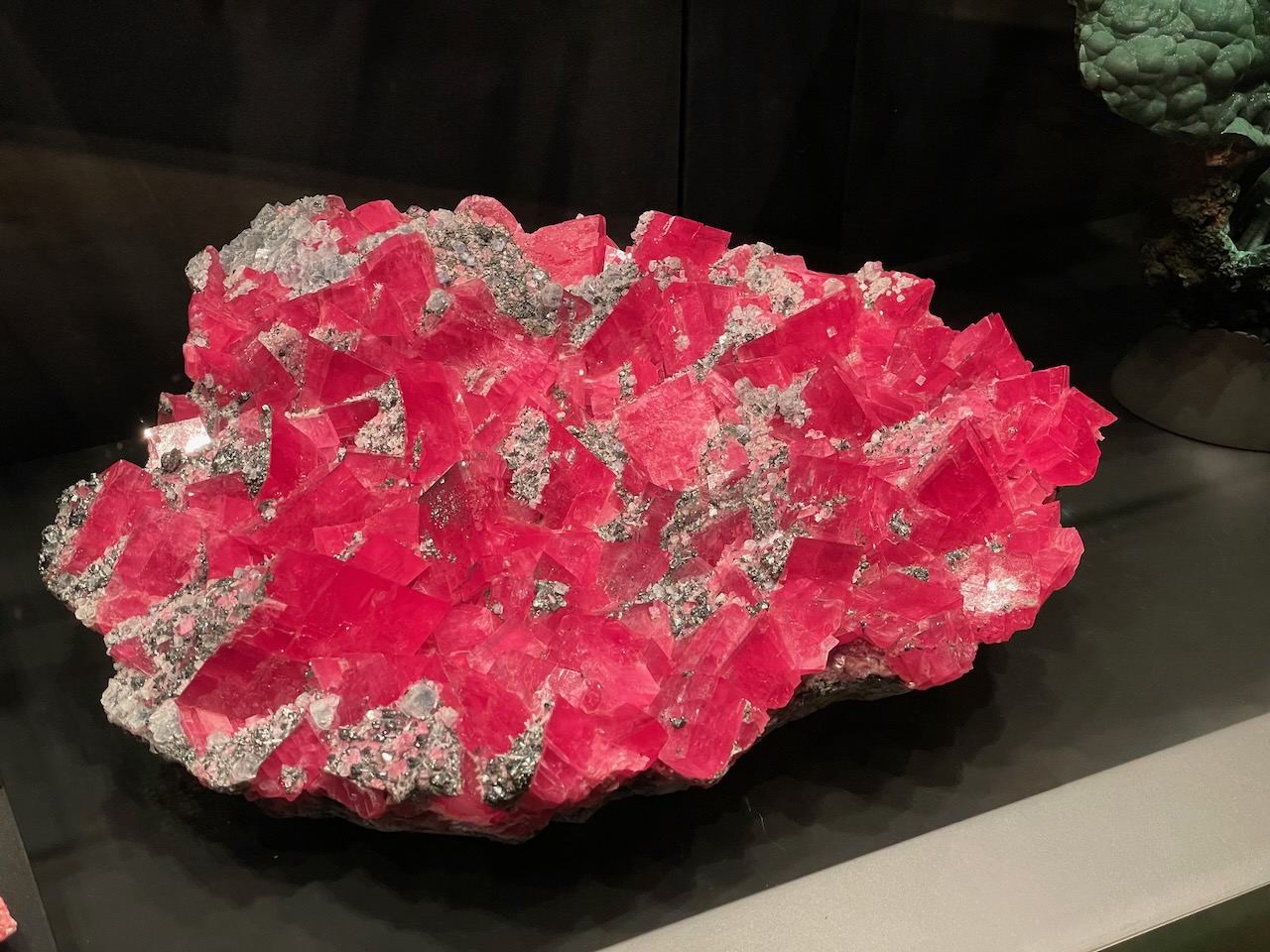
Watermelon? Strawberry gelatin? Sevag and
I puzzled over this one at the Mineral
Museum. (1 Aug. 2023 - Mathaf, Beirut)

            The impact of all of this upon the Armenian community in Syria and Lebanon is what troubles me the most. As the Dons of this kleptocracy look for new ways to fill their stomachs – most recently by a farcical “helicopter tour” of the new oil-drilling rig off the Lebanese coast –small and “unimportant” groups such as the Armenian community are left to fend for themselves. It is interesting to see how a country can continue to appear as a functioning entity while running on “autopilot”. A bit of electricity here, some trash collection there, fixing a water main when it breaks, leaving NGOs to install street lighting and traffic lights, and repair the worst potholes as highways steadily deteriorate, while many, many employees in the public sector come to work but once every one or two weeks, as their monthly salaries hardly cover the cost of transportation – this is today’s Lebanon.

When gas prices rise too high, there are
still great ways to make use of your auto!
(3 June 2023 - Ainjar)

            We’ve been noticing one of the semi-comical expressions of that while driving around various parts of the country with Sevag. It’s the “LPO mode” that auto owners have entered: “License Plate Optional”. Earlier this year I began to notice an absence of license plates of some cars on the road. Now it is probably up to 5 to 10 percent of cars. The office that processes car registrations is clearly not functioning. But in classic Lebanese manner the population is facing the situation with humor. It’s considered a badge of honor to drive an LPO car, even to the point, some say, that people will remove their license plates just to be seen as part of the LPO club!

            This summer I walked into a store in Ainjar, the mostly-Armenian village in the Bekaa valley. Whenever we’re going to be there for a few days I’ll stop in to pick a thing or two, and often times, since this is Ainjar, and since, due to my position, I can’t remain anonymous, I’ll run into people I know including people who know me since the 1990s, or the 2000s, or current times. The lady behind the counter, who does not belong to one of the aforementioned groups, asked me, in Armenian of course, “Are you Ainjartsi (her intent: “originally from Ainjar, but visiting from overseas”)? My interest piqued, I said, “No, I’m not. Why do you ask?” With no hint of malice or sarcasm, just puzzlement, she said, “Well, lots of people are very happy when they see you.”

Providing an unintentional glimpse into
the dysfunction of the country.
(4 Aug. 2023 - Tabaris, Beirut)


            Amid such a negative environment I’m glad we can have positive encounters with those we meet, and grateful that our casual interactions can be uplifting. Certainly, this is not something we can automatically produce: without God’s encouragement in our times of frustration and discouragement we would have little to share with others. As well, without organizations backing us up it would be a challenge to remain positive in the enforced misery people are subjected to each day. So, I don’t mind being mistaken for an “Ainjartsi”, and I don’t mind that (most) people are happy to see me!

            During the summer a small group of young Lebanese-Armenians in their twenties, on their own initiative, approached Haigazian University in order to present a film series, seven items in all, ranging the gamut from practically “home-made” to professionally produced. Their emphasis was on increasing the public’s knowledge of Western Armenia and elevating the use of the Western Armenian language. They delivered their introductions each evening in flawless Western Armenian as well as English, and it was clear that they cared deeply about the entire project, and plan to expand their efforts to develop other materials that would interest young Armenians in their heritage, using modern pedagogical methods in a technologically accessible way. The name with which they christened their platform is “Hnarti” /Հնարդի, combining the Armenian words for “old” and “contemporary”. Despite the hemorrhaging of young blood from the Middle East, vision and vitality can still emerge from this community.

LebCat 60: Every pharmacy should have a
watchcat at the door.
(14 Aug. 2023 - Hamra, Beirut)

            In eight weeks I’m hoping to bring the Armiss Choir back on stage to sing one or two numbers. Hopefully a couple other Lebanese choral groups will also perform. A colleague and dear friend has just published a book on a century of Lebanese-Armenian choirs (1920-2020). The dedication of the new book will happen in October, and part of the dedication program will be vocal selections. From real choirs singing in harmony. Live – which is how music is best done. So, it’s time to get things organized and underway, and to invest a bit more in the health of the country and in a couple of its modest but essential components, that is, the arts, the Lebanese-Armenian community and the Armenian Evangelical Church.

            Finally, something to talk about besides currency rates!   [LNB]

Sunday, July 31, 2022

The Land That Honor Forgot

51.The Land That Honor Forgot (31 July 2022)

Kindergarten graduation is a big deal here!
(17 June 2022 - Nor Marash)


A couple of weeks ago, as I was leading the washing-machine repairman up the steps in complete darkness, the tiny lights of our cell phones revealing the steps before us, I apologized that, after a long day of work, I had to make him walk the steps and not take the elevator. Deflecting my apology, in Arabic (and some broken Armenian, as he used to work in Bourj Hammoud) he said, “Haram, Beirut, haram that such a beautiful city as you is like this, haram!”

            “Haram” means “shame”. And supposedly the Middle East is one of the many regions throughout the world that operates around an “honor/shame” culture, something the West has great trouble grasping. Not that the West doesn’t use the term “shame”; it does, but only when attempting to shame others, and no longer as a means of self-examination or personal reform. Here, shame is part and parcel of each day, and especially in today's Lebanon, with the abundance of shameful situations. Yet although so much is shameful, those responsible for engineering this state of affairs over the years have no sense of shame… and therefore no honor.

The "Cine Vendome" steps have been
upgraded to include a playground!
(24 June 2022 - Mar Mikhael)

            As Maria, Sevag and I were driving on a “highway” through an agricultural region last week, we happened upon a two-vehicle accident, possibly a head-on collision or a side-swipe. Scattered across the road were bits of produce and wooden crates, and sprawled on the shoulder were women and men in their colorful garb, being attended to by paramedics next to a Red Cross ambulance. Men standing around were not helping traffic to get past the scene, as car after car slowed down to see what was going on, and even to chat with those on both sides of the road. What a shame to see these agricultural workers – not Lebanese, of course – who had a short while earlier been crammed into these vehicles to take them back to their camp after a day’s work. Who feels compassion for these injured women and men, even though there would be no produce in the markets if they weren’t out in the sun each day tending the fields?

Traffic jam on the Stepanavan-Vanatzor
roadway. (8 July 2022 - Armenia)

            Earlier, when driving in the other direction on this same road, we happened upon another traffic jam. There seemed to be no reason for it in such a small town, until we saw a bakery outlet with a couple hundred people in front and across the road from it, anxiously waiting for a delivery of Arabic bread. Why was there a “bread crisis”? Because the legislature was discussing the terms of international funding to enable Lebanon to buy wheat, and how much it should cost, and whether wheat subsidies should be lifted. While these men (only a handful of hardy women dare to serve in the parliament) were debating, the people were panicking, experiencing the shame of having to wait in line for bread, when their leaders have absolutely no food worries.

"Mer Shougan" (Our Market) on Arax Street,
to promote the home-based products of
Lebanese-Armenians
(10 July 2022 - Bourj Hammoud)

            And to add more shame to this scene, the army and police had to intervene to keep the order at this and so many other bakeries. Men on this side, women on that. Lebanese in this line, Syrians stand over there. Accusations intensify about who is buying up the stocks of subsidized bread to sell at twice the legal price to people who have no choice but to pay that amount, about who is smuggling bread out of the country to sell elsewhere, just as subsidized medicines are hoarded and sold in countries far from Lebanon.

            These God-given sensitivities – shame and honor – have often been misused when they are detached from personal conscience and used as weapons for controlling others. But in our current situation they are merely a veneer of words used by the powerful, devoid of meaning or effect, papering over the corruption within. John the Baptist (Matt. 3.7-12) and later Jesus Christ (Matt. 12.34-37), when confronting the corruption of their day, challenged the powerful to change direction or else face relentless justice from the God they no longer feared. Honor needs to be seen in honorable actions, not just in long-winded speeches or televised soundbites.

Facing the explosion site, memorials to
those killed in the Beirut Port blast
of 2020 (photo by SAB - 30 July 2022)
   As if fatigued from the hypocrisy and mendacity swirling around the abortive investigation of the Beirut Port Explosion of August 4, 2020, today part of the damaged grain silos collapsed in a plume of dust, debris and fungus from the fermenting grain within. These fifty-year-old silos, which held nearly the entire grain reserves of the country, are among the heroes of that unforgettable day. Their structural integrity shielded half of the city from destruction. Though inanimate, they hold a place of honor alongside the heroic first responders who were cut down on that summer evening; a level of honor that those who were sworn to protect and lead the country will never achieve – save for their total, systemic and true repentance.

            We’re finding ourselves approaching our refrigerator with trepidation, since the power (from all three sources) is off more than it is on in these hot and humid days. It used to be that stocking up the freezer and putting leftovers in the fridge put our minds at ease for coming busy days. Now we play the game “What’s That Smell?” when we open the fridge. Good smell? Thumbs up. Bad smell? To quote my college roommate’s slogan, “When in doubt, throw it out.”

            Maria and I had our first bout of CoVID-19 last month, as we were preparing to receive our son Sevag and then travel to Armenia together. See plans, apply wrench. After the readjusted Armenia trip concluded and we returned to Lebanon, Sevag had his first bout of the disease. We were grateful that we didn’t have any loss of smell or taste (refer to preceding paragraph). And grateful that we were able to provide him with at-home care.

LebCat 51: "It's simple: you climb up this
grapevine, push one of those switches down,
and then someone comes out to his balcony
and starts yelling. You meow and he throws
you a treat when he comes down to switch it
back on." (24 June 2022 - Geitawi)

            Sadly, I am getting less exercise, after realizing that the circuit breaker for our supplemental electricity could be relocated right outside our apartment door (refer to my Jan. 2022 blog) and not down a bunch of stairs and out at the end of the street. Now they easiest thing in the world is to make a mistake by turning on the hot water tank or flushing the toilet, and then saying, with a smile, “Oh well, no problem!” and just open the front door and flip the switch back on. Talk about living in the lap of luxury!

            What concerns me the most is that those among whom I work – Armenians and Lebanese – will lose their sensitivity to the tools God gives to keep their consciences alive. The poisonous examples are so very prevalent, and only with divine help and concerted mutual support will we avoid this plague, this collective degradation – whether in Armenia, in the Diaspora, or here.   [LNB]

Tuesday, August 31, 2021

45.Another World (31 August 2021)

Children's Conference restarted with two one-
day events (KCHAG, Monteverde - 24 July 2021)
It has been two-and-a-half weeks since we left Lebanon for our 5-month “Home Assignment”. The question that dogged us when we told people in Lebanon of our trip (“Are you going to come back?”) is still dogging us here in the U.S., but inverted: “Are you going to go back?” Because things are terrible in Lebanon, and even worse than they were when we flew out, people assume that our (unwise in their estimation) answer must be based only on conditions on the ground. We tell them, “Yes, Lord willing, that is our plan,” since our move there four years ago was also based on the Lord’s guidance above all else. But to those living in this world, we must be unaware of what the situation is on the ground – or in the news.

Enjoying a scavenger hunt at the conference
(KCHAG, Monteverde - 20 July 2021)
            When we think of Lebanon, we do not first of all think of the rampant corruption, the hoarding of resources, those seeking a profit from peoples’ misfortune, the long hours without electricity, the lack of sleep in the hot summer nights, the anxiety over finding food and medicine, the terrible banking system, the destruction of last year’s explosion and much, much more… We think of the people, the friends and loved ones we have, the children and young people, our colleagues, the small businesses we frequent, the churches, schools and institutions where we serve, the Armenian community we are a part of, and so much more. We also look to the coming years, to “what’s next”, the challenges ahead, the opportunity to add our strength and experience to the efforts of others, working with God to sustain life in a place and among a people whose muffled cry is: “We want to live!” The misery that their leaders are spawning all over the land must not determine our steps, but rather the One who placed this on our hearts. It won’t convince everyone questioning our planned return, but that’s the way it is.

A prickly-pear (cactus) seller finds a whole
row of customers, waiting to fill their gas
(25 July 2021 - Beirut)
            As the memory fades of the hardships we faced each day and each moment in Lebanon, it seems like we are currently living in another world. We remember that people continue to suffer even more humiliation there, but it has started to disappear from our consciousness, as we experience the luxuries of life in the U.S. Luxuries such as 24-hour electricity, uninterrupted water supply, filling a tank of gas without waiting in a long line, stable prices and currency, banks that allow you full access to your savings, fully-stocked pharmacies, the ability to plan a work day or a vacation day, heating and cooling of homes and businesses as needed, schools and universities happily planning to receive children and youth for the new school year, continuous internet at fast speeds, and on and on. We are inhabiting a parallel world from the one we left; a world where, strangely enough, things function as they were intended. Much like the world of privilege Lebanon’s leaders inhabit while they perpetuate a world of misery and humiliation for their people.

Socially-relevant graffiti, quoting
prophecy from Isaiah 6
(30 July 2021 - Beirut)
            Although it may seem so to anyone who has to endure daily deprivations, everything is not perfect in this parallel world we inhabit today. As time passes the dark side of life in the U.S. gradually reveals itself to us more starkly. One thing that has begun to creep into my consciousness is the “irrelevance” of being Armenian in this “far” Diaspora (far from the lands we were dispossessed of). With so much to do, buy, see, download, play, watch, consume, fix, replace, who has time to think about existential issues? Questions that keep some of us awake through the night are so irrelevant; questions such as, “Who am I? To whom do I belong? Do we Armenians have a collective future? What are the internal and external threats facing us? Are we our worst enemies, or are the criminal regimes surrounding Armenia? Can we work toward a coordinated Diaspora that neither ignores its own needs nor discounts those of Armenia?” One by one these concerns fade from view as I get wrapped up in the busy-ness of each day, and the many things that insist I pay attention.

            I also consider how “irrelevant” these questions now seem to many enduring great deprivations in Syria, Lebanon, and elsewhere in the “near” Diaspora, where the very visceral struggle just to subsist overtakes any considerations of national identity, of strategic planning for the future, of battling “red” or “white” genocides, of challenging globalization’s threats to us and other small nations… Each of these parallel worlds, one shiny and bright, the other dark and dreary, imposes itself on me, and on us, and makes us push aside any considerations of what truly matters, what keeps us human, what gives us meaning and identity, what can help us endure and flourish as a nation.

From every walk of life, walking to the city
center to remember those lost on August 4,
2020, and demand accountability
(4 Aug 2021 - Geitawi, Beirut)
           Even issues of faith are affected by the powers at play in these worlds. When you have every thing (emphasis on “thing”) available to you, God can become just another add-on to your life, and faith can be a pleasant – and optional – diversion. One that you meld and adjust to fit the values and standards of society. On the other hand, when you have nothing, faith can turn into a mere lifeline that you use to survive each day. Lifting your head up from the misery of each day in order to seek and do God’s will where you are right now can appear as an impossible luxury. How easily the immediate and urgent can supplant the important and foundational, and how often the temporal overwhelms the eternal. How hard it is to live in God’s world no matter what “real world” you occupy.

Portraits of the fallen in the 2020 port blast
(6 Aug 2021 - Saifi, Beirut)
            We had a full summer before we left Lebanon, including an extended stay (again) by our son Sevag, and preparation for our absence. Despite the steady decline in living conditions, we enjoyed being at home together. He had time to serve, time with friends, and time to eat bouza arabi (natural Arabic ice cream, home-made with goat’s milk). When people in his “usual” world ask him, “How was it in Lebanon? Wasn’t it dangerous? Wasn’t it difficult for you?” he simply answers them, “It was very good to be with my parents.” He, too, realizes that it is difficult for people in one world to grasp the reality of another world.

LebCat 45: Dreaming of donuts and other
easy handouts from the AUB crowd
(28 July 2021 - Bliss St., Beirut)
            Having experienced the Port Explosion of 2020 together with Sevag, we also experienced its first anniversary together. Sevag participated in a service of remembrance and prayer at Ashrafieh’s Armenian Evangelical Church, whose church and school buildings were hard hit by the blast. It was also a day for us to express our gratitude to God that we emerged safely from that maelstrom. A Christian artist from the U.S. honored the over-200 dead from the blast by preparing their portraits and pasting them around the perimeter of one of the big, empty buildings being built in downtown Beirut, a few steps away from the Martyrs’ Statue. As we walked past those portraits, gazing into their eyes brought home the pain and the reality of the loss – to their families, their communities, and their country. It’s a temporary exhibit, as those panels will be removed once the construction is completed. Hopefully their memory will not be temporary, and a new generation of those who love the truth will emerge and prevail, to pursue what is right, true and merciful in the world God so loves.    [LNB]


Monday, June 21, 2021

Two Hours Is Plenty

44.Two Hours Is Plenty (21 June 2021)

Street art around AUB
(Bliss St., Beirut - 27 May 2021)
When the foxes who have ruled the henhouse for the past three decades claim that they are going to improve henhouse conditions, like install air conditioning, or clean up the mess on the floor, it should take less than three decades to realize that this will never happen. Case in point: the endless promises up until last year that Lebanon’s decaying power grid and lengthy power cuts were going to be “fixed” – “very soon” – have passed their expiry date and are smelling rancid. Two hours a day of electricity is plenty, right? No massive popular movement emerges against these foxes – or perhaps they are wolves? “So let’s cut it down to 1-1/2 hours per day.” And on and on it goes.

And more than a few people eat at these sorts
of "food outlets" (Mar Mikhael -
Beirut - 4 June 2021)
            How bad is the electricity in Lebanon? Wait… I’ve heard this joke before. It’s so bad that their offices got blown to smithereens in the port blast last year and nobody noticed the difference. It’s so bad that even the private generator owners are complaining that their machines are working too much.

            The primary occupation of Lebanese in these times is watching, in real-time, a country rich in natural resources, human capital (especially its youth), healthy growth possibilities, history, heritage, and service industries, fall apart, bit-by-bit. It’s not a pre-occupation, because that would imply you have a job. The economy has (up to now) contracted to the point where it will take a decade or two to recover, so says the World Bank. Therefore, until and if recovery starts, “wait and watch” will be the primary work engaging Lebanese of all stripes. Possibly also the pre-occupation of the regional and international players fielding their teams in “Stadium Lebanon”.

Wounded voices from the blast zone
(Mar Mikhael - Beirut - 7 June 2021)
            Meanwhile, foreign and expatriate Lebanese partygoers looking for a bargain are flowing into the country, keeping the eating and drinking sector in business. Like vultures on carrion, nightly they noisily fill the “bar-way” – Armenia Street / rue Nahr / Mar Mikhael – near us until the wee hours of the morning. One could say, “At least they are putting  ‘fresh money’ into the economy.” But that money comes at the price of humiliation and dependency. Yesterday’s militia leaders (i.e., today’s political leaders) have treated the Lebanese this way for three or more decades, as they reinforce their place in Lebanon’s confessional-based system, offering their followers jobs, “monetary incentives”, or even COVID-19 vaccines, in exchange for unquestioning party loyalty. A similar effect can be had by narcotics.

Lines, lines everywhere
(Beirut - 14-16 June 2021)
            That currency devaluation continues by the day, and the banking system, against which the uprising began late in 2019 (before it derailed), continues to devise new ways to keep depositors’ money in their hands. This is in open defiance of international efforts to salvage Lebanon’s shipwrecked economy. Similarly, the supply of medicines, including medicines for chronic conditions, is being controlled and rationed, though it seems that there is no shortage in depots. Hospitals, deeply affected by this situation, will soon inform their chemo and dialysis patients not to come in for treatment, due to lack of supplies. Kleptomania is an addiction, and as any drug abuser can relate, you could sell anything or anyone if it got you what you crave. For Reformed theology fans, the term “total depravity” has here been replaced with utter depravity.

            Why has there been no public uprising against the perpetrators of this heartless and endless misery purposely inflicted upon the Lebanese? I refer you to “The Frog and the Kettle” analogy, which best explains the slow adjustment of the population to the deadly atmosphere around them. In previous years, as power cuts occurred, the government would announce they’re “trying to fix” the electricity (or trash, or any other) problem. Now, they don’t even bother saying anything to the public. There is no spirit or will left (so far) to hold anyone accountable. And as we all know, uprisings where mafias rule result in bloodshed.

You know your neighbors love you when they
leave onions and garlic in your mail slot!
(17 June 2021 - Geitawi - Beirut)
            One of the bright spots in this morass is one of the only governmental agencies that is working for, and not against, the people: the Health Ministry. It has an active cabinet minister who actually has the proper qualifications for the job. He makes sure the press is present during his surprise visits to hospitals, clinics, vaccination centers and medicine depots, and maintains updates on the Ministry’s website and social media, so as to increase public awareness and accountability. His recommendations for governmental policy are based on scientific and public health concerns, and not on the dictates of any religious community head. As a result, Lebanon has been able to see a vast reduction in COVID-19 cases, including a reduction in deaths from the disease. How we wish he could step out of his caretaker role and be part of the yet-to-be-formed-if-ever cabinet.

A newly-formed Armenian family exchanging
vows before a newly rebuilt stained glass
cross! (19 June 2021 - Beirut)
            Another bright spot – or rather a whole lot of bright spots – are those citizens who demonstrate humanity toward their fellow citizens, despite their own suffering. Some help to push cars that are out of gas in the waiting lines at gas stations (which dispense a few litres of fuel to a single customer as slowly as possible). Some pay a little extra at the food market so that someone else who is short of cash can buy food. Others write alerts via social media where young parents can find baby formula or diapers. In one of those online encounters the donor of some much-needed medicine refused any payment – only asking the recipient to “pray for her”. Despite the misery (and I’ve highlighted only a fraction of the spheres of corruption in which the country is drowning), the ordinary humanity of the authentic Lebanese still shines, albeit dimly.

Praying for God's blessing on the Armenian
Evangelical Central HS graduating
class (Geitawi - Beirut - 13 June 2021)

            The Armenian community here is faring as well as everyone else: not better, not worse. But in pursuing its daily life and continuing its existence, it is engaging in civil disobedience, defying the rampant corruption in which it is compelled to exist. Merely the act of rebuilding structures damaged in the port explosion (a disaster resulting from years of corruption and negligence on a staggering scale) shows that defiance. The installation of a re-imagined version of the stained glass cross in the First Armenian Evangelical Church, rededicated yesterday, is another example. Armenian schools (and Haigazian University) holding their year-end programs these weeks and prayerfully graduating their students to the next level of their education shows that same determination. Or a young Armenian couple taking their marriage vows and pledging to stand by one another no matter what the circumstances is another act of civil disobedience against the wolves running the henhouse. And for what is yet to come, faith in God’s grace will be the only way to endure.

LebCat44: What, are you going to start
charging me for chilling under this car?
(Geitawi - Beirut - 13 June 2021)
            So we are back to spending summer nights without electricity, pretending to sleep, and then dragging ourselves through the daytime, pretending we are awake. Until last week we had our neighbors with whom to commiserate, but they returned to Armenia for the summer… and have their own set of challenges to face, as Armenia decides its future leaders, and continues to be the object of interest to neighboring Canis lupus appetites, and the object of continued Western humanitarian disinterest.

            Since there is only One who holds the future, we put our trust in him alone these days. Probably not a bad idea for everyone, everywhere, to do the same, no matter the level of comfort you (currently) experience.    [LNB]