Showing posts with label independence. Show all posts

Friday, November 25, 2022

Waiving the Flag

55.Waiving the Flag (25 November 2022)

Preparing for school celebration of
Lebanon's Independence Day
(17 Nov. 2022 - Geitawi, Beirut)
Now that World Cup football (soccer for you Americans) has taken over the world for the coming four weeks, enabling some pleasant diversion from the strangeness of these times, Lebanon is once again subjected to the ineptitude of its kleptocracy. No government here means no decision-making regarding broadcasting rights for the World Cup on state television. Which means that football fans, of which there are many, will not enjoy a month away from talk shows reviewing their all-too familiar daily miseries. Daily cheering could provide positive, natural chemicals to bring health to the tired bodies in this country, without having to scour pharmacies for artificial remedies. Instead, a very few people with the financial means to do so will watch the games at home, though many of them will suffer with Lebanon’s insufferable internet speeds, with frozen screens and with dropped connections.

"Green" transportation may not exactly mean
this (14 Nov. 2022 - Ghabi, Beirut)
            A recent news report about this situation in Lebanon showed photos of Lebanese with a multitude of flags of their favorite teams while also recording the fans’ dismay at being deprived of the tournament. They could paying for a month’s cable subscription in order to watch it, but that would be tantamount to telling your family they will not eat for a month. One person quipped, “Meanwhile our politicians are probably in Qatar, watching the games live.”

            It’s not surprising that Lebanese Independence Day, November 22, passed by this week with hardly a mention. Yes, there was a smattering of interesting broadcast advertisements with the independence theme, and an event or two was held for select groups of people. As always, students participated in their schools’ programs in observance of the day. There were even small Lebanese flags planted along traffic circles and roadsides. But there were no army parades or air force fly-overs, and no grandstands because empty chairs would have had to have been placed there for officials yet to be elected/appointed. What was in abundance were the many who expressed their dismay at the use of the word “independence” in today’s reality, since it is apparent to all that Lebanon’s problems and solutions are dependency issues, dependent on other, outside players. On Independence Day 2022 the flag was waived more than it was waved.

The best way to make music is to do it
yourself (13 Nov. 2022 - Geitawi, Beirut)
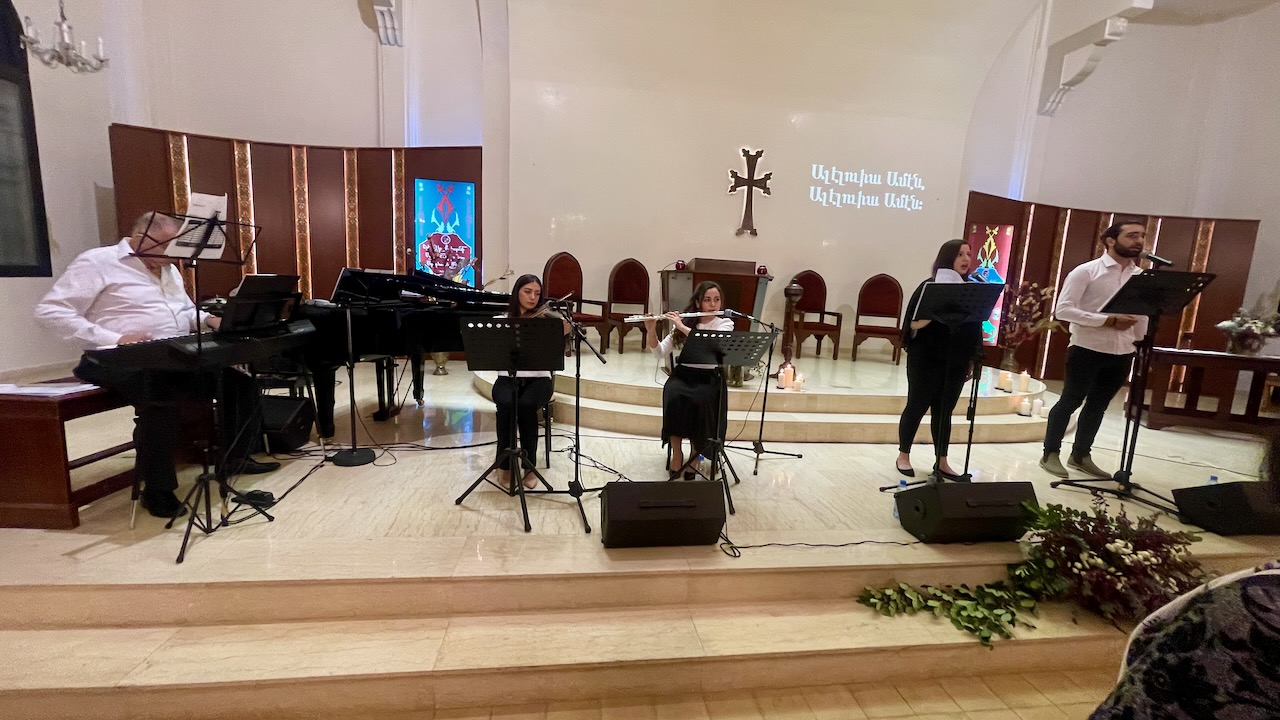
            It’s encouraging to see that despite all of this, rather than waiting for things to “get better,” people move forward to organize events and activities. This is most apparent to us in our church and university settings, though it is not limited to those circles. Concerts, plays, worship events, film premieres, lectures, debates, leadership training, conferences, infrastructure upgrades, publications, and of course, weddings! And this is just within the Lebanese-Armenian community! None of this means that conditions are improving. The economy is still floundering, the currency is still tumbling, the government is still somnabulate, and youth are still edging towards the exit doors. But there is a realization that consuming one’s time and energy in worry will not lengthen one’s days, and will only yield regrets for things undone or unattempted. So, I am glad when there are more activities that I want to attend than there is time to attend them.
An imaginary cedar of Lebanon, perched on
a narrow outcropping of rock... perhaps not
imaginary at all (29 Oct. 2022 - Gemmayzeh)
           Despite these robust signs, the present and future of the Armenian people is ever on my mind. For Armenia and Artsakh, for the near Diaspora and the far. Few Armenians learn from their past, though they study Armenian history in their school years. Names, places, events, dates, enemies are never in short supply, and swirl around in the minds of those with an Armenian education. But it is rare when your average “Hovsep” can appreciate the myriad mistakes and missteps that Armenians have made over the millennia, especially in the past century or two, up to this day, and then sketch a wiser path forward. Alongside this general concern (dare I say “worry”?) I see a glimmer of hope in my limited encounters with Armenian youth, as they wrestle with questions that their history presents, note similarities with today’s events, and ask “Can’t we do this differently?” Change will only happen when people are free to ask questions and pursue answers, not when they line up in rows and columns and follow leaders unthinkingly.

Something for children to play with on the
steps, but is anybody listening at the other
end? (17 Nov. 2022 - Mar Mikhael, Beirut)

            Leaders clothe their self-interests in patriotic rhetoric, and followers adopt that rhetoric, based on a limited knowledge of the dynamics and background. For small and unimportant peoples (like Armenia), the outcome is always in favor of those who can supply what large entities want. Mostly that means that those who have oil resources are treated with some deference, while those that don’t (like Armenia) have to figure out if they have something to offer to satisfy ravenous appetites. This is the way of the world, no matter that some consider themselves “exceptional”. And this is why the church is so important (as long as it doesn’t play political “world cup”), because it dares to love for God’s sake, not for gain.

LebCat 55: That's my nickname, and, yes,
that's my restaurant. (8 Oct. 2022 - Hamra)

           
These past few weeks we have enjoyed visits from people outside Lebanon, people who have dared to venture into this land of adventure. Our church’s annual meeting this week, usually held in the summer, hosted a group from Syria and Greece, and some of them had not been to Lebanon in years, despite being “just next door”. Earlier in the month there were visitors from Europe and the U.S., including a few who were here for the first time. We got to see our dear friend (and “boss”, as we affectionately call him) and share some relaxed time reflecting on life, work and ministry in this non-standard context. Although people tend to praise us for continuing to live and work here, as if it were just the outcome of our personal efforts, what is less visible is the support and encouragement we receive from many people, near and far, drawing us forward. And the unexplainable peace of God, helping us to keep our focus not on flag-waving and enthusiastic cheering for or against us, but on our calling from Christ himself.   [LNB]

Sunday, November 12, 2017

Bullying


10.Bullying (12 November 2017)
The street where we live, dug up for new electric cables…
we think. Our building entrance is at the far left edge
of the picture. (9 Nov. 2017 – Beirut)
            One of the popular topics in various levels of society here is “bullying”. People are trying to bring some awareness to the topic on the local scene by holding seminars to help employees in difficult work environments, or by providing training for teachers to guide children to interact with respect toward each other. It’s a tough road to walk – to live without intimidating or being intimidated – because its expression in Middle Eastern culture is pervasive, and quite accepted. Having intrinsic rights as an individual, a very Western concept, is difficult to grasp in a culture that views groups and collectives as the basic building blocks of societal existence.
            But bullying is also the way that politics is done. And not just in the Middle East. Big countries bully small countries. We use sophisticated terms to describe it, and political theorists (from big countries) create ideologies and terminology to justify it, but it’s the same behavior you on view in any playground the world over. It’s part of what makes up our “unlovable” side, the side sorely in need of redeeming.
Arabic coffee and French toast, prepared on our new oven.
It’s what’s for breakfast. (4 Nov. 2017 – Beirut)
            So here we are, 10 days away from the 74th anniversary of the independence of Lebanon. And how are we celebrating? By wondering what happened to the country’s Prime Minister, Saad al Hariri. Someone in the royal family summons him to Saudi Arabia nine days ago for some reason, and before you can say, “Pass the tabbouleh,” the very next day (the very same day a purge happened in the political halls of the kingdom) Lebanon’s Prime Minister is sitting in front of a TV camera way off in Riyadh, reading a resignation speech that sounds quite unlike what he usually says. He claims he is being bullied, or threatened, and that Lebanon is being bullied, too. But big countries bully small countries. Powerful groups bully weaker groups. This is a reality that a seminar or training cannot easily change.
Sevag's and my view of the massive demonstrations twelve
years ago, protesting, among other things, former Prime
Minister Rafiq al Hariri’s assassination. (14 Mar. 2005 – Beirut)
            A lot is being said about what is happening, both in the local media as well as international. I’m not sure what is worth reading and what isn’t. (That’s why I’m not including a bunch of links here. Better that you read for yourself what’s current.) But none of that really matters, because the outcome is that everyone here is feeling bullied, and doesn’t know what to do about it. Except, maybe, to pick themselves off the blacktop and figure out what to do now. For some it means trying to leave the playground as quickly as possible. For others, it means finding a way to stand back up and not let the bullies have their way.
            Twelve years ago, the year the current Prime Minister’s father, Rafiq al Hariri, was assassinated, the Beirut Marathon Association decided to adopt the slogan “For Lebanon”, and to push forward with this international event to show the world – but mostly the Lebanese – that life will continue. This year’s slogan is for the anniversary year, “15 Years of Running Beirut”. Now, I don’t think that means what it says, but I have a feeling that in bringing so many disparate groups together for marathons in this country, May Khalil (the marathon’s founder and tireless promoter) and her crew might do at least as good a job as the professional politicians here.
After today’s 8 km race, with a slogan we can
believe in… (12 Nov. 2017 – Beirut)
            During the Prime Minister’s absence (he has since appeared in a live TV interview this evening), the organizers decided to dedicate this year’s run to PM Saad Hariri, to show a united front across all political and religious groups. This solidarity, being carefully expressed by political opponents in the country, may keep the Lebanese from any precipitous actions against each other. That’s a good thing, and it may also keep the bullies off the playground – for a while.
            Meanwhile, I ran/walked the Marathon’s 8 km “Fun Run” today, and lived to tell about it! There were tens of thousands of people in this race, so I got to the starting line 35 minutes after the actual start of the run. It took me 70 minutes to complete the course, and I only stopped once (to say hello to my favorite falafel maker, a young Egyptian fellow who was completely surprised when I went up to shake his hand). The weather was clear and beautiful, the participants happy and friendly, almost making you forget that you are living through yet another crisis.
LebCat 10: Surveying its kingdom in ruins. Actually the house
where Maria and family lived in the early 1960s, behind the
Armenian Evangelical College. Currently totally demolished.
(12 Mar. 2017 – Beirut)
            A friend of mine said yesterday (my paraphrase), “Enough of thinking defeatist thoughts. We have to move forward with a vision, convinced that we are doing good, and God will provide the resources.” Living in this environment is teaching us that “walking by faith, not by sight” (II Cor. 5.7) is not just an admirable ideal; it is crucial for our existence as Christians, as Armenians (in our case), and as humans who are determined not to succumb to bullying – whether ideological, or financial, or cultural.
            When I signed up for today’s race, it was mostly for me – to do a run two years post-cancer, to push myself out of my sedentary lifestyle, to see what my body can take in its sixth decade. But now I think that I’m not just running for the sake of the Prime Minister; I’m really running for Lebanon.
            Read my prayer letter and pray, too. [LNB]