Showing posts with label World Cup. Show all posts

Tuesday, January 3, 2023

With Whom Is God Pleased

56. With Whom Is God Pleased? (3 January 2023)

A glimpse of Christmas joy in the
neighborhood, powered by
"ishtirak"
(30 Dec. 2022 - Geitawi, Beirut)

Holidays in Lebanon, especially in the winter, have fallen off my list of favorites, probably in no small part due to the lack of electricity we (and so many other Lebanese) experience at home. The offices where I work close, meaning that our building’s generator stays off. Our subscription for supplemental power covers only about half of the day, anyway, bringing inside temperatures close to what is outside. And municipal power supply continues to emulate Halley’s Comet in its rare appearances. Combining all the national holidays with the ones of various religious denominations, plus Armenian holidays, here in Lebanon we experience close to a month each year of these “off” days.

            But there is another layer of distaste. Holidays are too often turned into platforms for social and political assertiveness, rather than times of rest, reflection, redirection and rededication. Firecrackers (and bullets) fill the air over neighborhoods where a particular holiday is most observed. Not to forget the obligatory firecrackers and fireworks launched at important life events, such as funerals and weddings, or your World Cup football team scoring a goal. We were able to watch three games of this year’s football “Mondial” in early December since we were visiting Armenia for a week. There, games were broadcast on Armenian state television for anyone to view. Here was a different story, as is the case with so many things. The sounds of firecrackers and nearby fans yelling would prompt us to refresh the official website in order to see the latest scores — a somewhat anticlimactic method.

Constructing the "New Year's tree" at the
Yerevan train station
(30 Nov. 2022 - Yerevan, Armenia)

            In this particular season the biblical phrase, “Peace on earth, good will towards men,” is widely touted, or more commonly quoted simply as “Peace on earth”, without involving men (in the generic sense) or good will. The more intricate version of Luke 2.14, “Peace on earth among those with whom God is pleased,” is avoided, likely because it doesn’t fit neatly into 21st century greeting cards (i.e., social media platforms and posts), and likely also because it states that there is a God, also implying that this God makes judgments. About us. Also not fitting popular sensitivities in these oversensitive times.

A garden of Armenian letters seemingly
growing out of stones, hopefully an inspiration,
more than just a tourist attraction.
(29 Nov. 2022 - near Artashavan, Armenia)
            Whether or not it plays well in mass culture, a question sticks in my mind: With whom is God pleased these days? My immediate guess is “no one”, as evidenced by the lack of peace on earth. The lofty goal of peacemaking is left largely untouched, while nations allegedly aim for (but fail to reach) the lower goal of temporary cease-fires. Yet even where cease-fires are attained there are always those who find ways to continue their aggression.

            Since mid-December and continuing into the New Year, Azerbaijan-sponsored phony “environmental activists” have been blocking the only lifeline for food or medicine or transit that Artsakh Armenians have, the “Lachin corridor” linking it to Armenia. Add to this the Azeri government and industries that are driving all of this, entities that blithely cut off energy supplies to Artsakh in the cold of winter. Add to this the inaction of those charged with keeping the road open, allowing the situation to be created. And finally add to this the meaningless verbal bravado (and little more) of world powers, busying themselves with statements and resolutions condemning the blockade, but unwilling to intervene in a sovereign country. If all of this looks and sounds like world powers’ failure to prevent the Genocide in 1915, there’s a good reason for that. Summing it all up, it immolates the dove of peace over the flames of war.

A mural depicting Old Beirut, in a park where
an old Beirut building was torn down.
(8 Dec. 2022 - Geitawi, Beirut)
            Peacemaking can be torn apart in various ways: by individuals, societies, companies, governments, you name it. It does not have to be done in the obtuse ways that Armenia’s rapacious neighbors are so fond of. Sometimes it can be as subtle as tolerating inept (fill in the name of your favorite country) governance, or by making self-centeredness and self-indulgence a societal value, or in disdaining others in order to elevate yourself.

            Yet despite all attempts to kill it, peacemaking is alive, and peacemakers are at work. Whenever we hear about or witness a teacher who goes beyond the lesson plan and above the minimum requirements to help her class learn to relate with care for each other, there peace is being inculcated. Last week I was in a store in Bourj Hammoud when an older fellow in tattered clothes stood at the door with his hand raised in greeting - not for a handout. The Arab worker (who happens to speak Armenian) addressed him affectionately, giving and receiving words of blessing; this, too, is peace-building. When someone in the course of a conversation asks me to pray for him right there on the spot, God’s peace hovers over both of us and enables us to express more grace to others.

Christmas bazaar at the Zvartnots Center,
which brings hope and love to special needs
children.
(22 Dec. 2022 - Nor Sis, Bourj Hammoud)

            That message to the shepherds heralding “peace” at Christ’s birth is more of a challenge to self-absorbed humanity than a statement of present reality. The One whose appearance they announced made it his aim to establish peace through servanthood and a particular act of sacrifice. It grew more intense and pervasive as he grew “in stature and in God and man’s favor” . We might strain to see those around us who join him in this endeavor, but the thread that joins each instance together, shining with the angelic light seen outside ancient Bethlehem, is that of service.

            Serving others, motivated by love, produces peace. And only God himself can fill and refill that love.

LebCat 56: Since the electric company isn't
using these anyway, I'll just settle in.
(30 Dec. 2022 - Mar Mikhael, Beirut)
            Since “Armenian Christmas” is but three days away, an Armenian greeting on the occasion and a wish for God-pleasing peacemaking: Christ is born and revealed; blessed is the revelation of Christ!*   [LNB]

*Քրիստոս ծնաւ եւ յայտնեցաւ. օրհնեա՛լ է յայտնութիւնն Քրիստոսի։

Friday, November 25, 2022

Waiving the Flag

55.Waiving the Flag (25 November 2022)

Preparing for school celebration of
Lebanon's Independence Day
(17 Nov. 2022 - Geitawi, Beirut)
Now that World Cup football (soccer for you Americans) has taken over the world for the coming four weeks, enabling some pleasant diversion from the strangeness of these times, Lebanon is once again subjected to the ineptitude of its kleptocracy. No government here means no decision-making regarding broadcasting rights for the World Cup on state television. Which means that football fans, of which there are many, will not enjoy a month away from talk shows reviewing their all-too familiar daily miseries. Daily cheering could provide positive, natural chemicals to bring health to the tired bodies in this country, without having to scour pharmacies for artificial remedies. Instead, a very few people with the financial means to do so will watch the games at home, though many of them will suffer with Lebanon’s insufferable internet speeds, with frozen screens and with dropped connections.

"Green" transportation may not exactly mean
this (14 Nov. 2022 - Ghabi, Beirut)
            A recent news report about this situation in Lebanon showed photos of Lebanese with a multitude of flags of their favorite teams while also recording the fans’ dismay at being deprived of the tournament. They could paying for a month’s cable subscription in order to watch it, but that would be tantamount to telling your family they will not eat for a month. One person quipped, “Meanwhile our politicians are probably in Qatar, watching the games live.”

            It’s not surprising that Lebanese Independence Day, November 22, passed by this week with hardly a mention. Yes, there was a smattering of interesting broadcast advertisements with the independence theme, and an event or two was held for select groups of people. As always, students participated in their schools’ programs in observance of the day. There were even small Lebanese flags planted along traffic circles and roadsides. But there were no army parades or air force fly-overs, and no grandstands because empty chairs would have had to have been placed there for officials yet to be elected/appointed. What was in abundance were the many who expressed their dismay at the use of the word “independence” in today’s reality, since it is apparent to all that Lebanon’s problems and solutions are dependency issues, dependent on other, outside players. On Independence Day 2022 the flag was waived more than it was waved.

The best way to make music is to do it
yourself (13 Nov. 2022 - Geitawi, Beirut)
            It’s encouraging to see that despite all of this, rather than waiting for things to “get better,” people move forward to organize events and activities. This is most apparent to us in our church and university settings, though it is not limited to those circles. Concerts, plays, worship events, film premieres, lectures, debates, leadership training, conferences, infrastructure upgrades, publications, and of course, weddings! And this is just within the Lebanese-Armenian community! None of this means that conditions are improving. The economy is still floundering, the currency is still tumbling, the government is still somnabulate, and youth are still edging towards the exit doors. But there is a realization that consuming one’s time and energy in worry will not lengthen one’s days, and will only yield regrets for things undone or unattempted. So, I am glad when there are more activities that I want to attend than there is time to attend them.

An imaginary cedar of Lebanon, perched on
a narrow outcropping of rock... perhaps not
imaginary at all (29 Oct. 2022 - Gemmayzeh)
           Despite these robust signs, the present and future of the Armenian people is ever on my mind. For Armenia and Artsakh, for the near Diaspora and the far. Few Armenians learn from their past, though they study Armenian history in their school years. Names, places, events, dates, enemies are never in short supply, and swirl around in the minds of those with an Armenian education. But it is rare when your average “Hovsep” can appreciate the myriad mistakes and missteps that Armenians have made over the millennia, especially in the past century or two, up to this day, and then sketch a wiser path forward. Alongside this general concern (dare I say “worry”?) I see a glimmer of hope in my limited encounters with Armenian youth, as they wrestle with questions that their history presents, note similarities with today’s events, and ask “Can’t we do this differently?” Change will only happen when people are free to ask questions and pursue answers, not when they line up in rows and columns and follow leaders unthinkingly.

Something for children to play with on the
steps, but is anybody listening at the other
end? (17 Nov. 2022 - Mar Mikhael, Beirut)

            Leaders clothe their self-interests in patriotic rhetoric, and followers adopt that rhetoric, based on a limited knowledge of the dynamics and background. For small and unimportant peoples (like Armenia), the outcome is always in favor of those who can supply what large entities want. Mostly that means that those who have oil resources are treated with some deference, while those that don’t (like Armenia) have to figure out if they have something to offer to satisfy ravenous appetites. This is the way of the world, no matter that some consider themselves “exceptional”. And this is why the church is so important (as long as it doesn’t play political “world cup”), because it dares to love for God’s sake, not for gain.

LebCat 55: That's my nickname, and, yes,
that's my restaurant. (8 Oct. 2022 - Hamra)

           
These past few weeks we have enjoyed visits from people outside Lebanon, people who have dared to venture into this land of adventure. Our church’s annual meeting this week, usually held in the summer, hosted a group from Syria and Greece, and some of them had not been to Lebanon in years, despite being “just next door”. Earlier in the month there were visitors from Europe and the U.S., including a few who were here for the first time. We got to see our dear friend (and “boss”, as we affectionately call him) and share some relaxed time reflecting on life, work and ministry in this non-standard context. Although people tend to praise us for continuing to live and work here, as if it were just the outcome of our personal efforts, what is less visible is the support and encouragement we receive from many people, near and far, drawing us forward. And the unexplainable peace of God, helping us to keep our focus not on flag-waving and enthusiastic cheering for or against us, but on our calling from Christ himself.   [LNB]

Monday, June 11, 2018

Something Familiar


16.Something Familiar (10 June 2018)
What? Hoagies? This isn’t Philadelphia. But not
to worry. It went out of business. (9 May
2018 – Beirut)
            I was as surprised as anyone. And all I can conclude is that people are overly polite, or they have no answers for ant infestations, or they no longer read my blog. After telling the world how bad things were in our apartment, I found that I had to approach others to solicit advice; they were not going to come to me. Even if they were also waging the same war. That’s part of my American cultural outlook, to share advice and suggestions without waiting for people to ask. Sometimes (a lot of times) it gets me in trouble. The outcome is that now we have a couple of possible solutions that we are working on. Stay tuned.


            When you leave a place where you’ve lived for a substantial amount of time, as we did last year, from time to time something kicks in that I wouldn’t call nostalgia. More like a global positioning function in your mind that either makes you notice things that look familiar, or makes you long for the familiar in your daily life. I fully realize that this happens no matter where you are at or where you have been. You try to locate yourself in the world you inhabit.
Kebab night at the Bakalians. Wrapping up a year of discipleship
meetings the right way. (8 June 2018 – Geitawi, Beirut)
            Objects are the first things to catch your attention when they remind you of something back home. Of course, “back home” is a rickety term, especially when you have made a series of major relocations, as we have. We are more than bi-cultural, and our children are moreso. To describe this, people have come up with a term called “third culture”, which doesn’t mean three cultures, but rather “neither this nor that”, neither belonging fully here nor there, but to a combination of locales and ways of thinking and being. That pretty much describes us, and can help us to identify with people like Abraham and Sara in the Old Testament, who picked up and relocated (and kept relocating) out of obedience to the divine command. Or like Moses, who fled his native Egypt as an outlaw, and named his son “Alien”. The Arabic name “Gharib” has this meaning, and once I actually met a fellow in Armenia with this name.
German pride, on the streets of Beirut. Why not?
(6 June 2018 – Mar Mikhael)
            Similarly, smells, tastes and sounds can also drag your mind back and forth, which is a particular challenge for us, because some of the smells (of food, for example) here are the same ones that filled our home when we lived in the U.S. But the thing that tugs the hardest at our hearts is the search for familiar people. Their faces, their voices, their presence. Sure, we can look at old pictures and remember, or do a video call and pretend we’re near, but the gift of being in the same room with someone dear to you… well, that’s priceless.
There’s even a Lebanese flag flying from a balcony. I guess they
didn’t hear that Lebanon didn’t qualify this time.
(2 June 2018 – Bourj Hammoud)
            Visitors from the U.S. showed up in recent weeks, with the AMAA meetings and centennial celebrations here, and they certainly enjoyed seeing us as much as we did seeing them. While I was walking to Bourj Hammoud to take care of some errands, and I cut between the cars stopped for a red light. I got slightly annoyed at one of those drivers, however, honking his horn in stopped traffic. Seriously, where was anyone going to move? As I continued walking, minding my own business, I heard, “Badveli! Badveli Nishan!” It was the honking driver. One of our visitors from the U.S., who was trying to get my attention. My annoyance quickly vaporized, and I did what any self-respecting local would: I held up traffic as we exchanged greetings, right there in the middle of the street.
A huge-screen TV stadium/pub, complete with bleacher seating,
under construction near our place, just in time for the start of
the World Cup (10 June 2018 – Mar Mikhael, Beirut)
            The other day when I opened up Facebook (bless its cold, lifeless soul), there was a picture of a family gathering in the 1990s – one of the memories Facebook thought I should be re-sharing. I didn’t. But I paused a moment to count the number of familiar faces that were no longer alive, and could only be accessed by looking at a photo or closing ones eyes and remembering. And a third of that group are no longer alive.
            Fortunately, and despite the longing for those who are separated from us by an ocean, there are a lot of others nearby whose familiar faces cheer us up immeasurably. Despite all the busy-ness of our lives here, those moments are what builds a new sense of “home” where we are. We’ll still rejoice when we go to meet loved ones arriving at the Beirut airport, like Vicken in 7 days, or Sevag in 40. But for our dear friends here (and one set of Maria’s cousins left in Lebanon) we are rapidly becoming part of their familiar surroundings. And that feels good.
The final rehearsal of the “Armiss” choir, with soloist and
flautist, before it’s “return” the next day. (2 June 2018 –
First Arm. Evang. Church, Beirut)
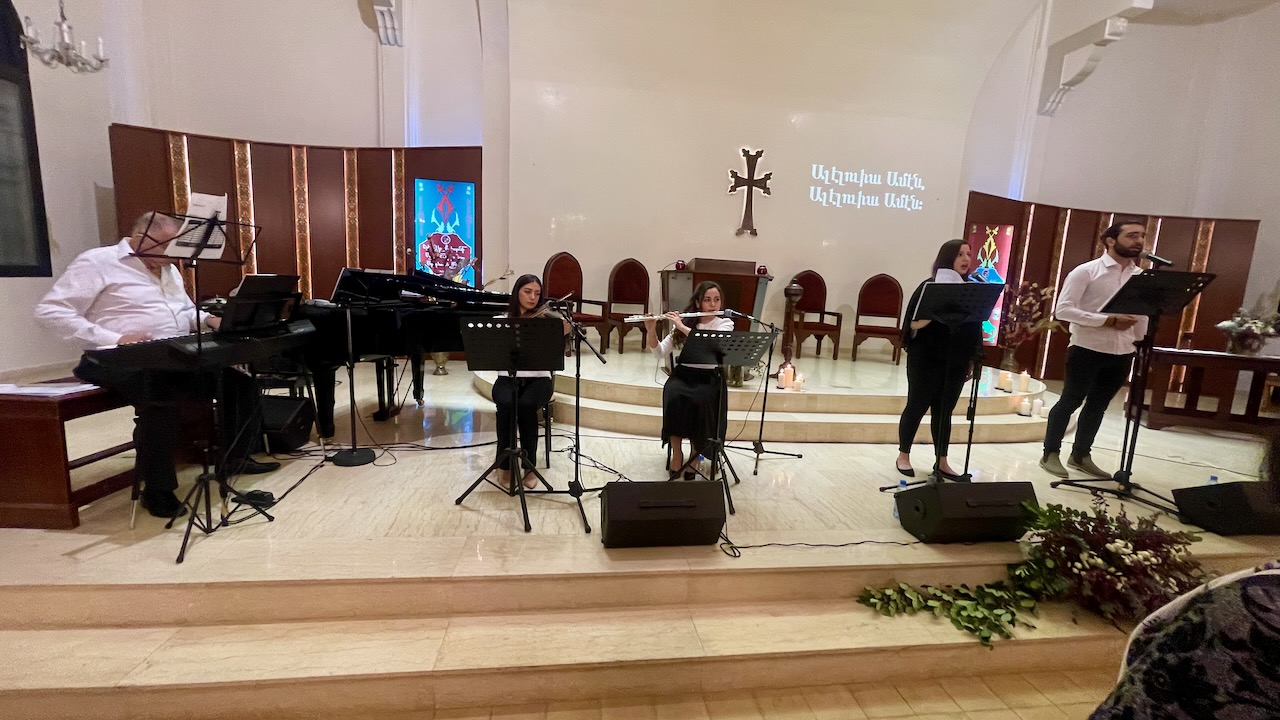
            A week ago it was a great experience to conduct the “Armiss” choir during the AMAA Centennial Worship Service. After an on-again/off-again decade, and a hiatus of three years, the group is back. They sang four choral pieces, and sounded cohesive, as a choir should. So many people were appreciative, and some were astonished that there are these talents in our community. Maybe they thought all the talented people had left the country? My favorite comment was, “Keep working. You have to give annual concert.”
LebCat 15: A protected species – cats on the American University
of Beirut’s campus (21 Mar. 2017 – Ras Beirut)
            Speaking of familiarity, it’s that time again. The time when you’re not sure what country you’re in, because every sort of flag is flying from all sorts of places. Yes, football’s Mondial (World Cup) is back. It’s the easiest way for Lebanese to be another nationality without the drawn-out application process. This is pretty important stuff – the church and youth retreats later this month have included the game broadcasts in their schedules, so as not to have a meeting during some of the important matches! [LNB]