Showing posts with label history. Show all posts

Friday, November 25, 2022

Waiving the Flag

55.Waiving the Flag (25 November 2022)

Preparing for school celebration of
Lebanon's Independence Day
(17 Nov. 2022 - Geitawi, Beirut)
Now that World Cup football (soccer for you Americans) has taken over the world for the coming four weeks, enabling some pleasant diversion from the strangeness of these times, Lebanon is once again subjected to the ineptitude of its kleptocracy. No government here means no decision-making regarding broadcasting rights for the World Cup on state television. Which means that football fans, of which there are many, will not enjoy a month away from talk shows reviewing their all-too familiar daily miseries. Daily cheering could provide positive, natural chemicals to bring health to the tired bodies in this country, without having to scour pharmacies for artificial remedies. Instead, a very few people with the financial means to do so will watch the games at home, though many of them will suffer with Lebanon’s insufferable internet speeds, with frozen screens and with dropped connections.

"Green" transportation may not exactly mean
this (14 Nov. 2022 - Ghabi, Beirut)
            A recent news report about this situation in Lebanon showed photos of Lebanese with a multitude of flags of their favorite teams while also recording the fans’ dismay at being deprived of the tournament. They could paying for a month’s cable subscription in order to watch it, but that would be tantamount to telling your family they will not eat for a month. One person quipped, “Meanwhile our politicians are probably in Qatar, watching the games live.”

            It’s not surprising that Lebanese Independence Day, November 22, passed by this week with hardly a mention. Yes, there was a smattering of interesting broadcast advertisements with the independence theme, and an event or two was held for select groups of people. As always, students participated in their schools’ programs in observance of the day. There were even small Lebanese flags planted along traffic circles and roadsides. But there were no army parades or air force fly-overs, and no grandstands because empty chairs would have had to have been placed there for officials yet to be elected/appointed. What was in abundance were the many who expressed their dismay at the use of the word “independence” in today’s reality, since it is apparent to all that Lebanon’s problems and solutions are dependency issues, dependent on other, outside players. On Independence Day 2022 the flag was waived more than it was waved.

The best way to make music is to do it
yourself (13 Nov. 2022 - Geitawi, Beirut)
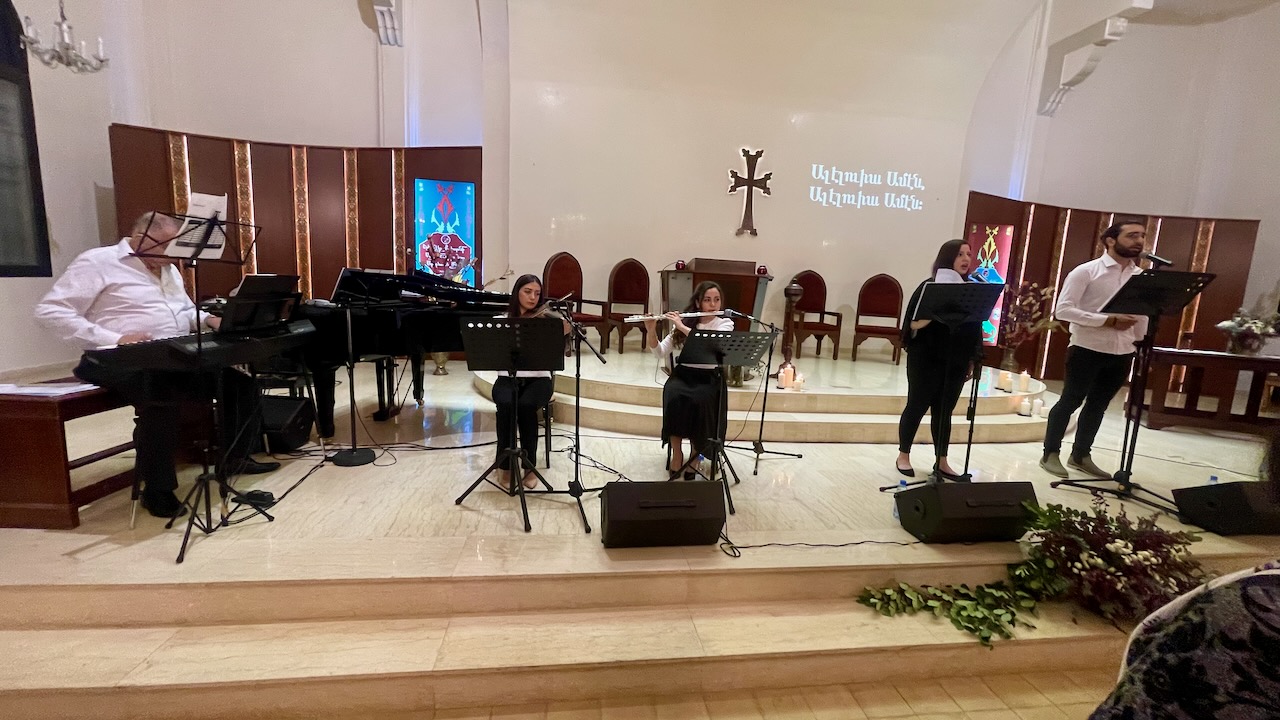
            It’s encouraging to see that despite all of this, rather than waiting for things to “get better,” people move forward to organize events and activities. This is most apparent to us in our church and university settings, though it is not limited to those circles. Concerts, plays, worship events, film premieres, lectures, debates, leadership training, conferences, infrastructure upgrades, publications, and of course, weddings! And this is just within the Lebanese-Armenian community! None of this means that conditions are improving. The economy is still floundering, the currency is still tumbling, the government is still somnabulate, and youth are still edging towards the exit doors. But there is a realization that consuming one’s time and energy in worry will not lengthen one’s days, and will only yield regrets for things undone or unattempted. So, I am glad when there are more activities that I want to attend than there is time to attend them.
An imaginary cedar of Lebanon, perched on
a narrow outcropping of rock... perhaps not
imaginary at all (29 Oct. 2022 - Gemmayzeh)
           Despite these robust signs, the present and future of the Armenian people is ever on my mind. For Armenia and Artsakh, for the near Diaspora and the far. Few Armenians learn from their past, though they study Armenian history in their school years. Names, places, events, dates, enemies are never in short supply, and swirl around in the minds of those with an Armenian education. But it is rare when your average “Hovsep” can appreciate the myriad mistakes and missteps that Armenians have made over the millennia, especially in the past century or two, up to this day, and then sketch a wiser path forward. Alongside this general concern (dare I say “worry”?) I see a glimmer of hope in my limited encounters with Armenian youth, as they wrestle with questions that their history presents, note similarities with today’s events, and ask “Can’t we do this differently?” Change will only happen when people are free to ask questions and pursue answers, not when they line up in rows and columns and follow leaders unthinkingly.

Something for children to play with on the
steps, but is anybody listening at the other
end? (17 Nov. 2022 - Mar Mikhael, Beirut)

            Leaders clothe their self-interests in patriotic rhetoric, and followers adopt that rhetoric, based on a limited knowledge of the dynamics and background. For small and unimportant peoples (like Armenia), the outcome is always in favor of those who can supply what large entities want. Mostly that means that those who have oil resources are treated with some deference, while those that don’t (like Armenia) have to figure out if they have something to offer to satisfy ravenous appetites. This is the way of the world, no matter that some consider themselves “exceptional”. And this is why the church is so important (as long as it doesn’t play political “world cup”), because it dares to love for God’s sake, not for gain.

LebCat 55: That's my nickname, and, yes,
that's my restaurant. (8 Oct. 2022 - Hamra)

           
These past few weeks we have enjoyed visits from people outside Lebanon, people who have dared to venture into this land of adventure. Our church’s annual meeting this week, usually held in the summer, hosted a group from Syria and Greece, and some of them had not been to Lebanon in years, despite being “just next door”. Earlier in the month there were visitors from Europe and the U.S., including a few who were here for the first time. We got to see our dear friend (and “boss”, as we affectionately call him) and share some relaxed time reflecting on life, work and ministry in this non-standard context. Although people tend to praise us for continuing to live and work here, as if it were just the outcome of our personal efforts, what is less visible is the support and encouragement we receive from many people, near and far, drawing us forward. And the unexplainable peace of God, helping us to keep our focus not on flag-waving and enthusiastic cheering for or against us, but on our calling from Christ himself.   [LNB]

Tuesday, June 30, 2020

The Usual


36.The Usual (30 June 2020)
Uneven stones and a gutter in the middle of the road were
replaced by a sensible street surface, courtesy of some
international funding. (13 June 2020 – Nor Marash –
Bourj Hammoud)
Imagine you, and all the people like you, got used to centuries of living your life in fear. But now your circumstances have changed. You get a chance to live in freedom. Before, you had to speak like those around you spoke, and follow the rules of the majority, the rules of the land, and not show any sign of dissatisfaction with the status quo. Now you are in a place where you are able to speak freely, build homes and businesses without worrying if they will be burned down, or whether your lives and your children’s lives will be in danger. Yes, there are some like you in other lands who still live in those conditions, but there are many more who now enjoy the freedom to flourish and grow. There have been hardships and setbacks over the years, but things are moving forward, and you feel yourself a full-fledged citizen. Still, in order to function as a minority you have to act and talk like the majority, especially if you have an opportunity to move outside your enclave.
            But recently the rhetoric in the land has changed. Some people are emboldened to speak out against you, to say that you are not full-fledged citizens, that you should limit yourself to your traditional neighborhoods. They add that those who oppressed you in the past had a right to do so, and that perhaps oppression and even attacks should be reinstituted, in order to “purify” the land, to make it more suitable for the majority. Mass gatherings are being held, and the flag of your oppressor is boldly waved as people shout praises to the names of the past, names that should only be associated with ethnic cleansing and second-class citizenship for anyone outside the ruling majority.
The revolution is on hold? Maybe, but the window washers
are not. (17 Jun 2020 – Beirut)
            Your own community cautiously raises its voice against this hate speech, and some of the majority join you in solidarity. But the winds have already fanned the flames of hate and oppression to the point of igniting open conflict, intended to draw you in to a losing scenario. Will cooler heads prevail? Or will the frustration of this “second-class” community erupt into violence?
            This is not an imaginary scenario. It is not an historical flashback to 1930s Germany, or 1950s (or perhaps present-day) America. It is not merely a sketch of the Ottoman/Turkish Empire from the late 19th century until now; it is a description of what is happening today in Lebanon. Yet it is the same ones behind the inflammatory events, hate-filled rhetoric and Turkish flag-waving; and it is the same Western powers continuing to cast indifferent gazes, or even give an occasional wink in abdication of the defense of human rights for the pursuit of strategic interests. Additionally, it makes me wonder whether that rig being built offshore, which strangely never seems to make the local news, has anything to do with all of this.
How silly of me to forget to leave my gun at home! Thanks
for the reminder. (17 June 2020 – American University
Hospital- Beirut)
            Following recent reports, locally as well as abroad from places like the U.S., has made me realize the necessity of understanding and confronting one’s own history. It is sobering to see so many people in conflict with each other, unable to read together, as equal citizens, the sad and forgotten and pain-filled pages of their own past, and then eventually reconcile to it and to one another. Meanwhile, iconoclasm proceeds apace, and not only are the statues of those deemed offensive toppled, but nearly any statue within view. It appears that in some quarters the just struggle for equal rights is being overtaken by the struggle for self-righteousness. When an offense is uncovered (and who among the human race – save for one – does not have a “past” to repent of?), the person ceases being a human and turns into a target. Soon there will be no one left to topple. Soon I fear that “history” will cease to exist or evolve as a product of dialogue, and will be relegated to “your history” and “my history”, much as we now end discussions with reference to “your truth” and “my truth” and other similar ways we avoid reflection, self-examination and growth.
Spring came and went, and we almot missed the
flowering trees! (26 June 2020 – Hamra - Beirut)
            We’re getting out and about a lot more than before. I visited what used to be called “West Beirut” for the first time in months last week, and noticed so many businesses dusty and shuttered. Strangely (or not), the curfews and what-not have not gotten in the way of construction (and destruction of heritage sites). A cursory glance around tells you that we’ve moved away from “lockdown mode” towards to the usual. I don’t say “the normal”, because so much in Lebanon needs improvement in order to qualify as “normal”. The other day as I was crossing the bridge from Beirut to Bourj Hammoud, I looked down at the Beirut River and instead of the clear stream I had been enjoying for several months, I saw once again the previously ubiquitous floating debris and waste headed to the Mediterranean. Like the rivers, roadways were also smooth-sailing these past months, but now they are back to being the usual – overcrowded – roadways. Such conflicting thoughts swirl around my mind – glad that workplaces (the surviving ones, anyway) are reopened; sad that people are back to “the usual” – polluting the natural environment.
            Despite it all, once the airport reopens (planned for tomorrow – we think) there will be an anticipated small or great crush of people wanting to come back to Lebanon for a visit. We’re all waiting to see whether the summer will bring a slight economic uptick, or will merely crown the country with a viral uptick. Meanwhile, round and round the local currency goes, where it stops (and who keeps spinning it), nobody knows. More than a few shopkeepers prefer to keep their stores shuttered rather than have to buy or sell in currency worth 1/3 of its previous value. Or was that 1/8 of its former value?
            Another thing that we anticipate when the airport is open for business again will be the departure of many Lebanese. When browsing a bookshelf full of old books being given away for free at a local Armenian bookstore, the clerk told me that more and more people are donating their libraries for giveaways. Others can now enjoy so many valuable books without charge. Sounds altruistic in this terrible economy, right? Until you ask the question, “Why?”
LebCat 36: Feline secret of social distancing: sit where
no one can sit near you. (15 Feb. 2019 – Khalil Badawi - Beirut)
            The other day I read an insightful article about the importance of the Armenian Church’s See of Cilicia in the whole dynamic of the Armenian diaspora. The author called this patriarchal center, relocated here to Lebanon after the Genocide, a resource and an anchor, something to be strategically valued by all Armenians no matter their “affiliations”. Yet one of the reactions to the article seemed to write off the Armenian community in the Middle East as if it were a “business loss”. The commenter talked about “conserving resources”, since nobody’s grandchildren would be speaking Armenian anyway. This type of thinking (sometimes overtly expressed) arises from a lack of vision, and demonstrates capitulation to the pressures of living as a minority, gasping for air because of the dominant culture’s witting or unwitting pressure on your breathing. Our desire to survive and thrive must be based on a vision of a hope and a future (Jeremiah 29.11), trusting in the One who can raise the dead.
            Tomorrow is the 174th anniversary of the Armenian Evangelical Church’s founding, and I’m once again preparing a YouTube broadcast for the church Union here. Hope and a future is what we strive for as Maria and I continue helping our church play an important part in the vitality of one small people group called Armenians. Though only a few realize the importance of even the smallest creature in nature's ecosystem, it does not diminish that creature’s need to continue for the sake of all. Just so our small nation, and our small church within that nation, and this world.   [LNB]