Showing posts with label emigration. Show all posts

Friday, December 31, 2021

Motion Sickness

Motion Sickness

46.Motion Sickness (31 December 2021)

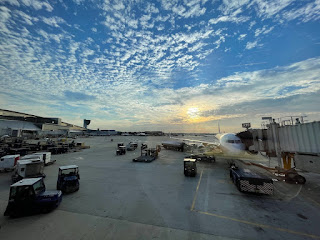
Awaiting one of our flights out of Philadelphia
(15 Oct. 2021 - Phila. Intl. Airport)
One of the constants of air travel, as well as ground travel, is the ubiquitous plastic-lined bag for the use of those experiencing stomach discomfort while being jostled back and forth, up and down, and side to side in the plane, boat, train, bus or car they are in. It also helps those around them to be able to stay clean and somewhat spared from the odor, though the poor sufferer continues to suffer what is gently referred to as “motion sickness”.

            We have been experiencing a type of “motion sickness” in recent times as we completed our required home assignment and made our way back to Lebanon last week. It was an uneventful flight, except that the airplanes were crowded cheek-to-jowl with travelers, some with masks, including those going to Lebanon. Maria and I lived through five months in the U.S. and Canada of constant travel, constant packing and unpacking, constant calculations of whether the weather would be warm or cold, along with constantly arranging flight and hotel bookings, constantly working on what kind of presentation fits a particular audience, constantly trying to wrap up paperwork and follow up on unfinished tasks in the concluding weeks when we were supposed to be “resting”. Getting back home to Beirut and its daily stresses and misery afforded us a bit of respite from the previous period!

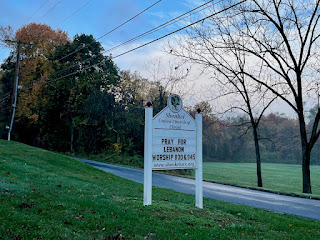
Many ordinary people want to learn, pray and
help Lebanon. (31 Oct. 2021 - Pottstown, Pa.)
            Yet it wasn’t all misery, because we got to meet wonderful, caring people, Armenian and non-Armenian, many of whom were aware of the trials being endured by the Lebanese and the Lebanese-Armenian community. Hearing their questions, seeing their concern and willingness to do something, hearing their words of blessing and being with them in God’s presence was a gift we gratefully received. Yet it was balanced by the exhaustion of upwards of 14,000 mi / 22,000 km of traveling (aside from the 16,000 mi / 25,000 km to actually get to the US and back)! Enviable? Perhaps. I suppose it depends on who is doing the envying.

Getting the word out about Lebanon
(6 Nov 2021 - Belmont, Mass.)
            There is a TV ad that has appeared recently on Lebanese television depicting two young Lebanese boys talking about their dreams, which include going to school. It concludes with a voice-over stating, “Rights should not be just dreams.” Yet the dreams of a preponderance of people around us is not to have Lebanon become a livable country, but to leave Lebanon for a livable country. This “exit strategy” is based on yet a different kind of motion sickness: that of being made sick by a society that never experiences stability, that is continually in motion due to the profit-seeking, power struggles or whims of those in authority, whether locally, regionally or worldwide.

            On Beirut’s streets over the years, in my limited Arabic, I would often hear passersby including numbers in their conversations, assumedly regarding the price of this or that. How I wished that the conversations would revolve around ideas, or culture, or wonder at God’s creation! Today virtually all of the street conversations, and possibly also the private ones, are about the exchange rate, the cost of cheese and medicine, and the impossibility of carrying on in these conditions. One man at the exchange house said, “We’re living in an insane asylum!” I wish that my Arabic had not improved to the point where I could understand this much.

Exciting times on Home Assignment
(6 Dec. 2021 - Broomall, Pa.)
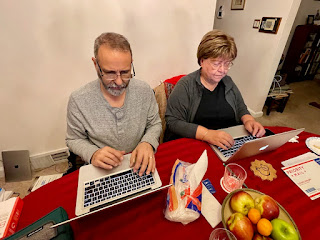
            Economic freefall produces one kind of motion sickness. Seeing dear friends and family members continually zoom away from you (and I’m not referring to screen time) can produce a similar spiritual nausea. When a family, or a community such as the Armenians, conclude that social disintegration is the best route to take, that their children must leave the country, then there is not much that can be said about the hopes for that family’s (or that people’s) future. Even if you are driven by the patriotic emotions that so often cloud Armenians’ judgment about their viability as a people, the consequences of cultural and societal disintegration cannot be dismissed. Many a person will insist on the necessity of laying hold, without delay, of the “promise of a better (economic, educational, health and secure) future elsewhere” – something that is only a promise, not a guarantee. It will apply to some lucky individuals, but what will become of collective identity? What will become of community? What will bring health and strength to the family, that place where individual and collective identity is formed and nurtured? We are in a rush toward “every man for himself”; and the shards of what was a collective hope, a concerted effort to come together to endure hardships and grow in character (such as was seen in the post-Genocide era), will become merely the subject of books and articles that very few read or care to reflect upon. Only a collective awakening to our spiritual and cultural resources can offer us a more hopeful outcome.
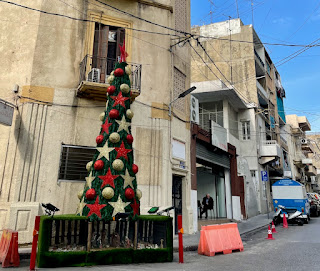
It's Christmastime in the city...
(30 Dec. 2021 - Geitawi–Beirut)

            I realize that I enjoy privileges and resources that few around me have. Yet I also have a perspective that many around me lack: that of having experienced the long-term consequences of living in a diaspora situation, in societies that are quite capable of swallowing up and homogenizing the qualities and distinctives that define a people group, including their language, creativity, spirituality, world view, and desire to survive and thrive as a unique entity. The motion sickness that we are all enduring will make it difficult, but all the more crucial, that we together take the long-term into account as well as the short- and medium-term… and listen well to each other.

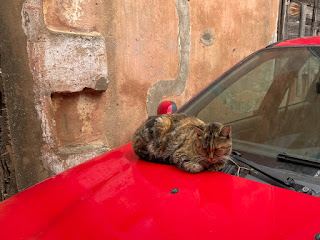
LebCat 46: You look smashing in red... I mean
on red. (28 Dec. 2021 - Mar Mikhael–Beirut)
            One of the pleasures I enjoyed during “home assignment” was getting back to exercising (which is important, considering how much I enjoyed the pleasures of overeating and gaining weight during that same period). It was a long time since I was able to go to the gym at 6:30 a.m. and get a bit of sweat going. I also got back on the mat at the aikido dojo, but quickly remembered that aspect of warmups that I dread: forward and backward rolls. I dread them because of the dizziness they cause me. But I have learned that the way to work through this sensation is, first of all, to properly position my body to roll; second, to do the rolls more frequently; and third to fix my eye and my mind on a distant, stable point. That long-distance view enables me to be steady when the world seems to be slanted this way or that.

            My prayer for Lebanon, and in particular for the Armenian people, is that we fix our eye on that unchanging Point who does not change (James 1.17), who brings calmness, steadfastness and faith in Christ in the midst of the storm, and who blesses his people in the most difficult of circumstances with the enduring riches of wisdom, truth and love.   [LNB]

Saturday, August 15, 2020

The Fifth World

37.The Fifth World (15 August 2020)
Ruined windows and doors from the Armenian Evang. Central
High School (8 Aug. 2020 - Geitawi - Beirut)

When I was an unseasoned theological student many moons ago, Maria and I came to Lebanon on a fellowship program for study in a “Third World Country”. That term is now considered uncouth, and is usually replaced by the term “developing country”, referring to those countries lacking the economic, health and educational status of those at the top of the list. Back then I was surprised that Lebanon was even on that list, because I knew it as a prosperous, if war-torn, country. But I was eager to go there (here), to learn the Armenian language and grow in my understanding of being an Armenian and experiencing Armenian Evangelical heritage firsthand. What better place than Beirut, even if it was in the midst of a civil war?

Karma isn't supposed to miss its target, except when it does
(14 Aug. 2020 - Mar Mikhael - Beirut)
            Back in the days of the Cold War people spoke about countries belonging to the First World (west of the Iron Curtain), the Second World (the Curtain’s “other” side) and the Third World (no curtain). Decades later, someone came up with the idea of the “Fourth World” to describe stateless people. Yet today, almost four decades later, Lebanon has been violently thrown backwards beyond even the Fourth World to a new category I am creating on the occasion of explosion that devastated probably one third of the capital and environs. Since August 4, here in Beirut we are now living in the Fifth World.

The restaurant's name is "This is how the world
is" (14 Aug. 2020 - Mar Mikhael - Beirut)
            We spent the entire month of July sweating through sleepless nights because the government was unable to purchase untainted fuel for their diesel-powered generating stations, or unable to offload the fuel to the power plants, or was busy suing the Algerian company that sent the bad fuel, or couldn’t broker a deal with the Central Bank to release money for paying for new shipments, or any of a dozen other reasons. The country was receiving 2 to 4 hours a day of electricity, and the rest of the time the plethora of private generators in Lebanon, including the one here at the Union headquarters where we live, were filling in the gap. And also dumping tons of particulates into the air. When 11 p.m. rolled around most generators took a break for the night, leaving us and many others to pretend to sleep while a film of sweat emerged on us like a second skin. That “treatment” lasted over 30 days, and preceded the explosion at the Beirut Port on the evening of August 4th. Strangely, since that fateful date the electric company has been providing full nighttime electricity, with some spotty coverage during the daytime. What, did somebody buy us a miracle? Is this in order to pour cold water on the protests?

Beirut's grain silos, built 1968-1970, which
shielded part of the city from the blast, but leaving
the country with a one-month supply of wheat 
(30 July & 14 Aug 2020)
            Why talk about any of this? Because it is emblematic of the woes the Fifth World imposes on its subjects. At least five decades of massive corruption and ineptitude is now shamefully on display for the world to see. And to take advantage of. Local groups are either decrying or supporting the current government or political system, depending on which power they are pandering to. In this unbelievably bad combination of circumstances (it seems that’s the most logical explanation at this point), and with the arrival of an unending chain of visiting diplomats and their entourages, the local political scene continues to polarize as each group has its turn groveling, and the length of Armenia Street/Mar Mikhael has turned into one huge NGO bazaar. It’s a day of great sorrow and humiliation for Lebanon on many, many levels.

            The deepest sorrow is reserved for the regular, non-ruling-class Lebanese people, who for decades have struggled to cope in this abnormal and exceptionally corrupt environment, and now have the dubious privilege of shedding the greatest amount of blood, sweat and tears as they witness their carefully managed homes, schools, businesses and futures explode then crumble, bit by bit, community by community, neighborhood by neighborhood, family by family. Alongside the sorrow for all of this loss there is an outpouring of rage. Some of it is opportunistic rage, but there is also the honest rage against successive iterations of “leaders” and their “handlers”. Lacking an awareness of the common good, their aim continues to be the pursuit of large amounts of wealth by wringing the country dry – or beyond dry. The pool of talented, dedicated young people, including Armenian young people, is evaporating. The country’s lifeblood is draining, leaving a drying swamp.


Part of the traditional character of the
Gemmayzeh area, now in ruins
(14 Aug. 2020 - Beirut)
           But opportunism is still at play, even in the midst of this tragedy. The classic heritage homes in Gemmayzeh and Mar Mikhael, some turned into rubble, others still standing but sorely damaged, are now the target of vultures: the “agents” (called “simsar” in Arabic) who are offering despairing homeowners a little “fresh money” in exchange for these properties. Just as was conspicuously done in post-war Beirut, turning a bustling city center into a wasteland consisting of a couple of giant structures and acres of empty parking lots, today also there is a nascent movement to do the same in these heritage neighborhoods, likely to eventually to fill them with tall, empty buildings. I have to wonder, where does all this construction money come from? Considering today’s moribund Lebanese banking system, they are likely not locally funded.

            Despite our church and youth activities being suspended, and our “gatherings” limited to the ether of the Internet, our son Sevag made his annual trip to be with us. He got PCR-ed before leaving the U.S. and PCR-ed again at the airport upon arrival, but took it all in stride. For him – and

Lego time with Sevag! (19 Jul.  2020 - Geitawi-Beirut)
for us – the important thing was to be together. We did a little touring, most significantly to the Roman ruins at Baalbek, but also spent time at home listening to LPs, reading stories to each other, looking at old pictures, playing the “Pandemic” board game (some dark humor never killed anybody, right?), going to bed at 11 p.m. when the generator got switched off, and enjoying our “extended family” from Armenia here on the top floor of our building. Their little ones took to him quite rapidly for the most part, and “Lego with Sevag” became a highly sought-after activity in our living room. It was our mini Children’s Conference – with one leader and three children!

Glass, glass and more glass; day 1 of cleaning
the apartment (5 Aug. 2020 - Geitawi, Beirut)
            As if the oddness of this visit were not enough, one evening when we went for a socially-distant visit with the Haidostian family in Haigazian University’s Mugar colonnade, what we at first thought to be an earthquake made the ground shift like a carpet being shaken out, and then a huge boom, and instantly smoke and flying glass filled the air. It was August 4, and we had been spared the terror of being at home, which is a bit over one kilometer from ground zero. By comparison, Haigazian is twice that distance, 2.4 km, from the port explosion site. Whomever we spoke with said the same things: “I thought it was an earthquake.” “I thought a bomb had gone off in the next street.” “I thought an aerial attack had started.” And so for his last two days Sevag joined us in the task of sweeping up shattered glass and assessing the damage. Just as he had shared the 2006 war on Lebanon while visiting us, now also he shared this catastrophe, making this yet another unforgettable trip as he witnessed firsthand Lebanon popping way back into the Fifth World. That’s quite a collection of unforgettables he has.

LebCat 37, poised to enjoy a crunchy morsel
(27 July 2020 - Baalbek)
           
Early in his visit Sevag was trying to solve a puzzling change in our neighborhood and environs: an absence of cats. I hadn’t noticed it until he pointed it out, and realized that my walks around the area in recent weeks had, in fact, been devoid of felines scurrying away as I passed. This made him wonder, could the rapid increase of poverty and unemployment and the growth of food insecurity in Lebanon have anything to do with these missing cats? Hmmm, makes me wonder, too.   [LNB]

Tuesday, June 30, 2020

The Usual


36.The Usual (30 June 2020)
Uneven stones and a gutter in the middle of the road were
replaced by a sensible street surface, courtesy of some
international funding. (13 June 2020 – Nor Marash –
Bourj Hammoud)
Imagine you, and all the people like you, got used to centuries of living your life in fear. But now your circumstances have changed. You get a chance to live in freedom. Before, you had to speak like those around you spoke, and follow the rules of the majority, the rules of the land, and not show any sign of dissatisfaction with the status quo. Now you are in a place where you are able to speak freely, build homes and businesses without worrying if they will be burned down, or whether your lives and your children’s lives will be in danger. Yes, there are some like you in other lands who still live in those conditions, but there are many more who now enjoy the freedom to flourish and grow. There have been hardships and setbacks over the years, but things are moving forward, and you feel yourself a full-fledged citizen. Still, in order to function as a minority you have to act and talk like the majority, especially if you have an opportunity to move outside your enclave.
            But recently the rhetoric in the land has changed. Some people are emboldened to speak out against you, to say that you are not full-fledged citizens, that you should limit yourself to your traditional neighborhoods. They add that those who oppressed you in the past had a right to do so, and that perhaps oppression and even attacks should be reinstituted, in order to “purify” the land, to make it more suitable for the majority. Mass gatherings are being held, and the flag of your oppressor is boldly waved as people shout praises to the names of the past, names that should only be associated with ethnic cleansing and second-class citizenship for anyone outside the ruling majority.
The revolution is on hold? Maybe, but the window washers
are not. (17 Jun 2020 – Beirut)
            Your own community cautiously raises its voice against this hate speech, and some of the majority join you in solidarity. But the winds have already fanned the flames of hate and oppression to the point of igniting open conflict, intended to draw you in to a losing scenario. Will cooler heads prevail? Or will the frustration of this “second-class” community erupt into violence?
            This is not an imaginary scenario. It is not an historical flashback to 1930s Germany, or 1950s (or perhaps present-day) America. It is not merely a sketch of the Ottoman/Turkish Empire from the late 19th century until now; it is a description of what is happening today in Lebanon. Yet it is the same ones behind the inflammatory events, hate-filled rhetoric and Turkish flag-waving; and it is the same Western powers continuing to cast indifferent gazes, or even give an occasional wink in abdication of the defense of human rights for the pursuit of strategic interests. Additionally, it makes me wonder whether that rig being built offshore, which strangely never seems to make the local news, has anything to do with all of this.
How silly of me to forget to leave my gun at home! Thanks
for the reminder. (17 June 2020 – American University
Hospital- Beirut)
            Following recent reports, locally as well as abroad from places like the U.S., has made me realize the necessity of understanding and confronting one’s own history. It is sobering to see so many people in conflict with each other, unable to read together, as equal citizens, the sad and forgotten and pain-filled pages of their own past, and then eventually reconcile to it and to one another. Meanwhile, iconoclasm proceeds apace, and not only are the statues of those deemed offensive toppled, but nearly any statue within view. It appears that in some quarters the just struggle for equal rights is being overtaken by the struggle for self-righteousness. When an offense is uncovered (and who among the human race – save for one – does not have a “past” to repent of?), the person ceases being a human and turns into a target. Soon there will be no one left to topple. Soon I fear that “history” will cease to exist or evolve as a product of dialogue, and will be relegated to “your history” and “my history”, much as we now end discussions with reference to “your truth” and “my truth” and other similar ways we avoid reflection, self-examination and growth.
Spring came and went, and we almot missed the
flowering trees! (26 June 2020 – Hamra - Beirut)
            We’re getting out and about a lot more than before. I visited what used to be called “West Beirut” for the first time in months last week, and noticed so many businesses dusty and shuttered. Strangely (or not), the curfews and what-not have not gotten in the way of construction (and destruction of heritage sites). A cursory glance around tells you that we’ve moved away from “lockdown mode” towards to the usual. I don’t say “the normal”, because so much in Lebanon needs improvement in order to qualify as “normal”. The other day as I was crossing the bridge from Beirut to Bourj Hammoud, I looked down at the Beirut River and instead of the clear stream I had been enjoying for several months, I saw once again the previously ubiquitous floating debris and waste headed to the Mediterranean. Like the rivers, roadways were also smooth-sailing these past months, but now they are back to being the usual – overcrowded – roadways. Such conflicting thoughts swirl around my mind – glad that workplaces (the surviving ones, anyway) are reopened; sad that people are back to “the usual” – polluting the natural environment.
            Despite it all, once the airport reopens (planned for tomorrow – we think) there will be an anticipated small or great crush of people wanting to come back to Lebanon for a visit. We’re all waiting to see whether the summer will bring a slight economic uptick, or will merely crown the country with a viral uptick. Meanwhile, round and round the local currency goes, where it stops (and who keeps spinning it), nobody knows. More than a few shopkeepers prefer to keep their stores shuttered rather than have to buy or sell in currency worth 1/3 of its previous value. Or was that 1/8 of its former value?
            Another thing that we anticipate when the airport is open for business again will be the departure of many Lebanese. When browsing a bookshelf full of old books being given away for free at a local Armenian bookstore, the clerk told me that more and more people are donating their libraries for giveaways. Others can now enjoy so many valuable books without charge. Sounds altruistic in this terrible economy, right? Until you ask the question, “Why?”
LebCat 36: Feline secret of social distancing: sit where
no one can sit near you. (15 Feb. 2019 – Khalil Badawi - Beirut)
            The other day I read an insightful article about the importance of the Armenian Church’s See of Cilicia in the whole dynamic of the Armenian diaspora. The author called this patriarchal center, relocated here to Lebanon after the Genocide, a resource and an anchor, something to be strategically valued by all Armenians no matter their “affiliations”. Yet one of the reactions to the article seemed to write off the Armenian community in the Middle East as if it were a “business loss”. The commenter talked about “conserving resources”, since nobody’s grandchildren would be speaking Armenian anyway. This type of thinking (sometimes overtly expressed) arises from a lack of vision, and demonstrates capitulation to the pressures of living as a minority, gasping for air because of the dominant culture’s witting or unwitting pressure on your breathing. Our desire to survive and thrive must be based on a vision of a hope and a future (Jeremiah 29.11), trusting in the One who can raise the dead.
            Tomorrow is the 174th anniversary of the Armenian Evangelical Church’s founding, and I’m once again preparing a YouTube broadcast for the church Union here. Hope and a future is what we strive for as Maria and I continue helping our church play an important part in the vitality of one small people group called Armenians. Though only a few realize the importance of even the smallest creature in nature's ecosystem, it does not diminish that creature’s need to continue for the sake of all. Just so our small nation, and our small church within that nation, and this world.   [LNB]

Wednesday, October 31, 2018

On My Head


19.On My Head (31 October 2018)
            One of those essential phrases anyone living in the Arab world needs to know is “on my
Inspired by Lark on the Move, you have to find
where Maria and Linda are. In the equivalent of
an ancient Roman narthex! (13 Oct. 2018 –
Baalbek, Lebanon)
head”, or, alternatively, “on my head and eyes” (3ala rassi/3ala rassi ou 3ayni). When I go to the grocer, I know he’s going to send greetings to my wife, and although I try to keep my conversation limited to onions and grapes, he inevitably throws pleasant chatter at me. Yesterday he sent the usual greetings, but I was able to fumble out an “3ala rassi” in response as I was leaving. Add that to the other things “on my head”, and you have a pretty accurate description of what’s happening in our lives these days.
            Still, even with the continually-postponed resumption of my Arabic lessons, I’m managing semi-well with what’s on my head and eyes. Although we’re no longer newcomers, we still have people looking at us as if (but denying they are thinking that) we are crazy for picking up and moving to Lebanon. But we also have people who are delighted each time they see us, and (we hope) are encouraged as much as they encourage us.
            As we become more aware of just how big a struggle it is for so many people to manage life here (although my focus is just on Armenians; it is similar for lots and lots of people), our hearts are even more broken. More frequently than before friends are sharing, quite openly, about their plans to leave Lebanon for Armenia. Others may have plans to move to Europe, the U.S. or Canada, but they tend not to share that with anyone but those closest to them.
Some young cedars of Lebanon in the background, and some
old guys (Mike and I) in the foreground. Guess which ones are
going to be around longer. (14 Oct. 2018 – Barouk, Lebanon)
            Things like not having a government (after 5+ months) doesn’t really get anyone’s attention, though it should – especially of those who are horse-trading the lives of their citizens for personal gain. Not that I’m a fan of politics, but the phrase from the 1992 U.S. presidential elections comes to mind: “The economy, stupid.” That’s what is grinding down individuals, families, communities like the Armenians, community organizations, and pretty much the entire social fabric. The biblical injunction to “pray for kings and those in authority” (I Tim. 2.2) is not just a nice, occasional add-on to personal and corporate prayers; it is an essential for us, something we continually cry out to God for him to answer. We pray not just for local authorities, but for those far, far away, too, who affect life here.
            A couple of days ago a friend mentioned how, because of the sagging economy in Lebanon, a cascading effect is happening. The central bank (just now?) has decided that it can no longer give loans to first-time homeowners, due to the economic situation and a bunch of other things. (Point of clarification: the “homes” I’m talking about are not the American-style
Bread on the cooling conveyor. Most of what you buy won’t
last the trip home-mmmm. (13 Oct. 2018 – outside Ainjar)
single-family homes with a lawn and a fence. It’s a cramped, sometimes brand-new, apartment in one of those ugly high-rises I regularly rant about.) So, with no home loan, young people are cancelling wedding plans because they won’t have a place to live aside from a room at their parents’ home. And that means all the related businesses are also suffering – those who would clothe, feed, photograph and entertain the wedding guests. And those who would sell furnishings to the newlyweds. And sell them cars. And later on, baby things. And later on, school tuitions and incidentals. (Again, I’m thinking particularly of the struggling Armenian schools and families, but it’s an overall phenomenon.) And so on, and so on. For someone like me to come in and share the message, “Place your hope in Christ!” that person must be willing to also, and first, listen to and care for those whose hope for a normal life is fleeing from them.
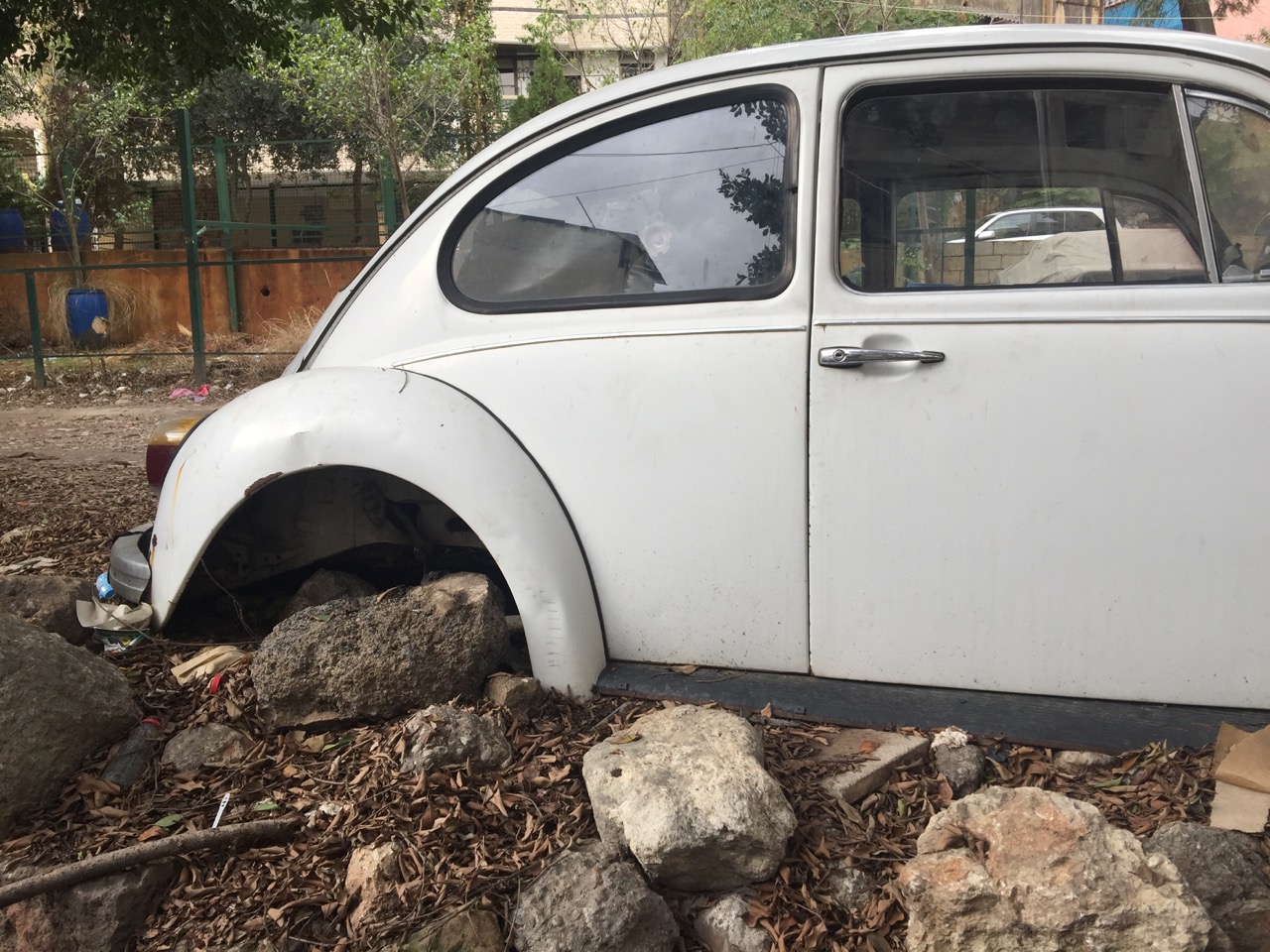
A Volkswagen from the Stone Age, complete with
prehistoric tires. (22 Oct. 2018 – Khalil Badawi, Beirut)
            But seriously, folks, reality aside (hah!), I really would rather be writing about all the interesting and fun things we’re experiencing here. And there is plenty that’s interesting and fun. Like receiving an official delegation and Armenia’s “caretaker” Prime Minister, Nigol Pashinyan, who visited the Armenian Evangelical Union leadership (interesting). Or like the visit of dear friends from Philly, Linda and Mike Sywulak (fun). They visited missionary friends of theirs in Kenya for a week, and then spent a week with us this month, getting introduced to Lebanon, its history, its natural beauty (I mean that), and its vital Christian ministries. For us, it was a welcome respite, and an occasion to reflect on our time here so far. For them, it was an opportunity to turn something abstract into a concrete picture that they can talk about and pray for.
The ashtray of no ashes. A Zen moment in a
Sassine Sq. diner. (12 Mar. 2018 –
Ashrafieh, Beirut)
            So, we got to be tourists! Finally! Nothing like visitors to provide you with an excuse to “see the sights”. We showed them all five Armenian Evangelical churches in Lebanon, plus their schools, plus the old age home (CAHL), plus KCHAG, plus more. They got to speak directly to workers in these ministries about their joys and burdens. We traveled to the ancient cities of Baalbek and Ainjar and Byblos. We visited some of the majestic Cedars of Lebanon (and witnessed the ongoing reforestation efforts). We got to see “Linda’s new favorite bakery,” with Arabic bread rolling out of the oven like big wheat pillows onto a cooling conveyor. And we got to treat them – and ourselves – to several different places that serve Arabic ice cream. All in seven days!
            Fortunately, aside from all these special events there are many things that tickle my brain on a daily basis. Like seeing an ashtray in a restaurant with no slots to hold your cigarette, and a “no smoking” symbol engraved on the side. Perfectly normal to locals – because that’s where you put your straw wrappers and zip-tops from your “pepsi” cans. Oh, and “Pepsi” is the generic name people use to refer to carbonated beverages, no matter what the label says. Like “kleenex” is for Americans.
            A frustrating bit of brain stimulus has to do with rampant Americanisms around us, like the adoption of that most worthless of American holidays, namely Halloween. In talking with a taxi driver a few weeks ago, after remarking on a huge billboard advertising some Halloween event in a predominantly Muslim area, he said, “We are forced to accept these American things because they are part of our children’s (American) textbooks. I do not like it, but my children learn it because it is there in their books.” Children carve jack-o-lanterns, dress up in skeleton costumes, and adults “dress up”, too. Thanks to social media, this vapidity (some would call it “evil”) is being copied the world over, including in Armenia.
LebCat 18 (black & white) and associates:
OK, so it’s October 31. What’s that got to do with
us? (31 Oct. 2018 – Mar Mikhael, Beirut)
            How about “Black Friday” sales in Lebanon? Its original American (and consumerist, in the worst sense) moorings are irrelevant here. It’s a catchy phrase that represents an American (and therefore, to many Lebanese, desirable) way of getting people to spend money they don’t have to buy things they don’t need. Does anyone believe that that will turn around Lebanon’s economy?
            But I have homemade fun, too, observing my environment as I walk from place to place, dodging between cars parked every which way – especially on the sidewalk – and avoiding other cars as they try to pass each other from opposite directions on a one-way street where cars are parked on both sides (welcome to my neighborhood… won’t you be my neighbor?). There are always a few cars parked in the middle of the street. Probably the driver came home very late last night, and probably there were cars between his car and the curb, though now it’s just empty space. Soon enough he’ll come down and nonchalantly get in and drive away, as if it’s the most unremarkable thing in the world to park overnight in the middle of an intersection. Recently when we were passing one of those “creative” parking jobs, a friend driving us around said (in Armenian), “One day he’s going to eat it.” Oh, it loses so much in translation!
            Now, back to my efforts at creating databases and websites and choirs and more! [LNB]