Showing posts with label identity. Show all posts

Friday, April 24, 2026

Letters from Exile

 68. Letters from Exile (24 April 2026)

Year upon year this awareness is inculcated
in the hearts of the next generation
(24 April 2026 - Yerevan)
It has been 52 days since our “exit” from Beirut at the outbreak of the latest war on Lebanon, at the behest of our mission board. We have settled into a somewhat regular existence here in Yerevan, Armenia, contributing what we can online to the churches and institutions we were called to serve, while also offering occasional support in person to the Armenian Evangelical church union here. There are quite a few around us, clergy and others, whom we know from time they have spent in Beirut. There are also those who have sought refuge here in Armenia, sort-of “exiles” from their homelands.

Though in the distance, Ararat is an integral 
part of the Genocide Memorial
(24 April 2026 - Yerevan)
            “Homeland” is a contested concept for Armenians. The expectation of many non-Armenians is that Armenians the world over, without exception, consider today’s Republic of Armenia as their “homeland”. True, it is the only political entity that can be found on a modern map that provides that particular identity. Yet it also can be seen in the equivalency held by many Armenians as well, insisting that Armenians everywhere must think and feel that Armenia is their only homeland. However, many others, and possibly a majority of Armenians, carry a dual loyalty. They hold today’s Armenia in a special place in their self-understanding, while also remaining deeply rooted in their Diaspora homelands. Additionally, they often bear yet a third, precious “homeland” in their hearts, one that is rooted in the soil of Western Armenia. So, an Armenian who was born and raised in the Middle East can be deeply connected to the Republic of Armenia, visiting it often and caring about its present and future; and said person may also feel a strange magnetic pull when visiting various sites in today’s Turkey and seeing the people and places from which their parents, grandparents and even great-grandparents were driven. They are – that is, we are – ever children of exile, the descendants of those whose roots were pulled from their native soil, whose roots have been repeatedly replanted: belonging to more than one homeland, yet not fully belonging to any of them.

The ECA/AMAA delegation presenting their 
floral wreaths (24 April 2026 - Yerevan)
            Today, Armenian Martyrs’ Day, as we recall for the 111th time national displacement and loss, and inhabit the collective trauma that is yet a further, possibly universal, “homeland” for Armenians, I cannot help but experience regret. I regret all of the fragile root tendrils my elders carried, tendrils that I could have cared for in my childhood and adolescence, but did not, or was not encouraged to. Because collective amnesia (not just by the perpetrators, but also by those who suffered) is sometimes the only way to deal with a history too ugly to recall. Still, those tender roots that I did cultivate over the years have nevertheless sustained me and helped me to bear days like today, in such a situation in which we find ourselves. One thing that this extended stay in Armenia has shown me (the longest stretch we have ever had in Armenia), is that with God’s help my heart can stretch such that I can call this place “homeland”, while also calling Lebanon “home,” and the United States, too. Each has its own flavor and its own pull. Each has its own frustrations and disappointments. I do not have to close my heart towards two of them in order to embrace the third. This is not a revelation, of course; it is what it means to be a “third-culture” kid. (Look it up.)
Assyrian-Armenians preparing to ascend to 
the Genocide memorial; a shared struggle 
(24 April 2026 - Yerevan)

            Today I joined my Armenian Evangelical colleagues and friends, and mixed together with many Armenians, Armenian-Assyrians, Armenian-Yezdis, along with a smattering of Europeans and Americans (aside from me, that is), to make the long climb to the Genocide Memorial, the “Fortress of Swallows”, and remember, and reconnect, and rededicate ourselves to our rightful place among the living, and refuse to be a relic or an oddity in this world. I pray my descendants, whether by blood or by choice, will honor their ancestors by carrying forward a legacy of wisdom, sacrifice, service, creativity and faith. Easier said than done.

A symbol of what is, can, and should be 
Lebanon: Lent and Ramadan fasting 
on the same days this year 
(21 Feb. 2026 - Port of Beirut)
            Last week we ran into friends from Artsakh, friends we hadn’t seen since before the Armenian population was blockaded in 2023 and then “allowed” by Azerbaijan to abandon their centuries-old homeland. Seeing them and hearing about their children and grandchildren was heartwarming and hopeful, and they seemed to be adjusting, bit by bit, to their new homeland, Armenia. We weren’t completely lost as we conversed, since they spoke to us in Yerevan Armenian rather than their Artsakh dialect. That is, until a friend of theirs from Stepanakert approached, and they immediately switched to the language of their homeland!

LebCat(s) 68 - The butcher's window; 
better than watching CatTV 
(27 Feb. 2026 - Mar Mikhael, Beirut)
            This friend said to me, “I am sad for our lost homeland, but you know what makes me sadder? Seeing the way things are today in Armenia.” I asked him to say a little more, and he obliquely hinted at the divisions that are making Armenians intolerant of one another, dividing into factions and thinking the worst of others. Being that there are parliamentary elections in 44 days, this atmosphere will likely only intensify and will be unlikely to recede following that day.

            As our exile from Lebanon grows longer, we are also concerned about that which is dividing the people in our Lebanese homeland, and the increasing intolerance we are catching wind of. Certainly, nobody wants the country’s misery to continue, misery that has only grown in the thirty-five or so years since the end of the Civil War. But not tolerating unrest and war cannot be at the cost of the intolerance of others, people who also call Lebanon their homeland.

            And as God teaches in such times of exile, we are learning to seek the peace of the cities of our repeated displacements (Jerem. 29.7) and to hold each place in our hearts as a beloved homeland.   [LNB]

Tuesday, February 28, 2023

Dead Foxes

57. Dead Foxes (28 February 2023)

Commemorating 35 years since Azerbaijan
began targeting Armenians for
extermination. (26 Feb. 2023 - Beirut)

Earlier this month, while driving along the coastal highway, I slowed down behind a line of cars and trucks exiting and noticed an animal lying alongside the roadway, obviously dead. From a distance I could tell it was too large to be a cat, too small to be a dog, and my guess was confirmed as I slowly crept alongside… a red fox. I was happy and sad at the same time; happy that there is still wildlife in this overbuilt metro area, and sad that it met this fate. I realize that those in rural places might not share my dismay, considering the losses they may incur because of foxes. Here this death is sadly poignant. While actual foxes become road kill, human foxes are left alive. And the “fox hunters” trying to pursue this latter kind are systematically eliminated, and the foxes pretending to be humans continue their sadistic rule over the henhouse.

Empty since the port blast, Lebanon's electric
company building - gutted, just like the service
it provides (20 Feb. 2023 - Mar Mikhael-Beirut)

            One of the more insidious of that species is now facing a “natural disaster” of his own making. Over the years he granted waivers for poorly constructed housing in exchange for ballot-box loyalty, so that he could establish full political control. That narcissism transformed the tragedy of this region’s February 6 earthquake into an unmitigated disaster. Will he be held accountable for the crimes he is now heaping upon the corrupt lower-level operatives? Not if the spin doctors around him can do their psyops job well, and transform this fox’s image into, let’s say, that of a pussy-cat. A devout, embattled fighter for the rights of the ordinary citizen. A strong leader his country needs to rebuild it and make it proud. Any of a raft of addictive lies that people in so many lands believe, sad to say.
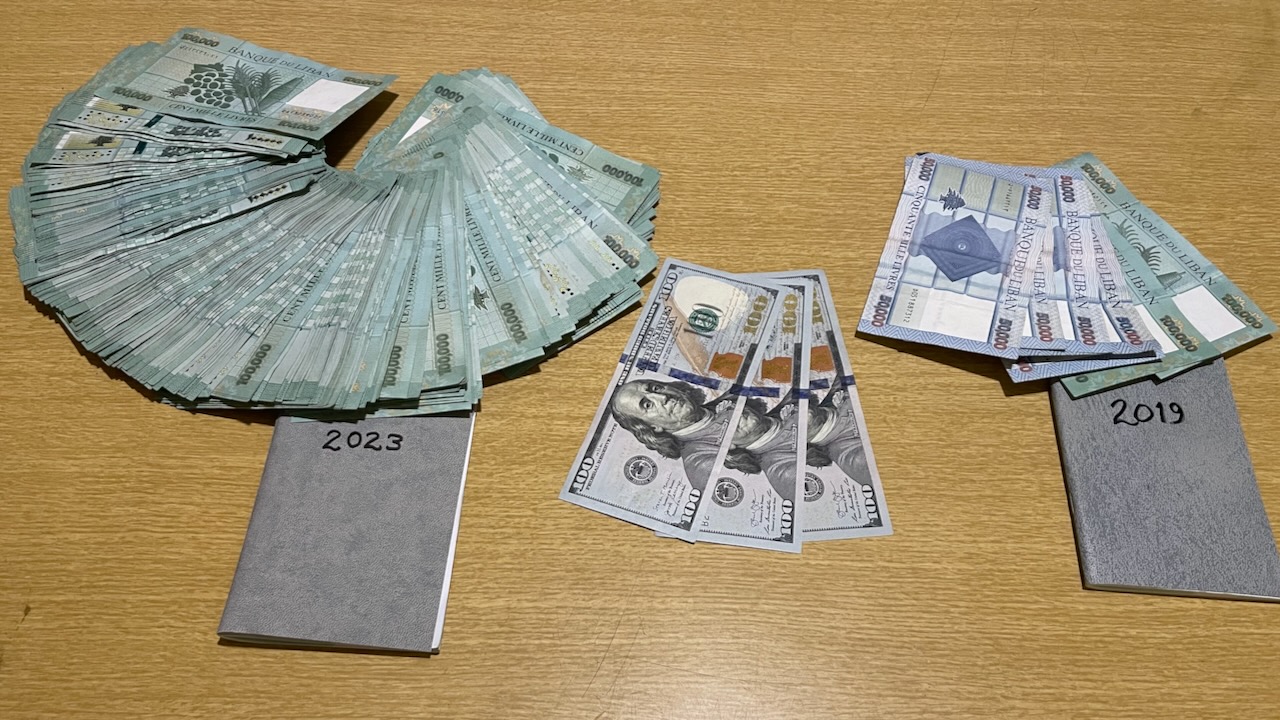
The value of $300 in local currency, in
2019 (right) and 2023 (27 Feb. 2023 - Beirut)


Meanwhile, others try to dodge the traffic that would run them over and put an end to their positive impact. Though contributing to the betterment of society, and though they are not the ones able to cause a fundamental, systemic change in the status quo, yet their activity is nonetheless significant in the long term. Unlike the wealthy foxes who continue to find ways to launder their money or sink it into building more empty buildings in the capital, they are a different sort of investor. They sink their time and effort into human capital; into teaching students to think, into inculcating character and faith into young people, into creating cultural riches to feed the souls of generations yet unborn. The anniversaries of the region’s Armenian institutions (churches, schools and so forth) are reminders of the deep investment our forebears made to rebuild and sustain a broken nation after the Genocide, making the Middle East’s Armenian communities the powerhouse of the Diaspora. And it continues to serve in that capacity, feeding and nurturing Armenian identity but with a frighteningly small number of visionary laborers engaged in this crucial work.

As spring approaches, tree branches and
neighborhood generators begin to
sprout offshoots
(27 Feb. 2023 - Bourj Hammoud)

            Who are they? First of all, they are teachers of all subjects and in all manners. Especially focusing on language, history and culture, they might be using state-of-the-art methods and materials, or they might be solidly stuck in the 19th century in their approach, but at least they are making an effort. Others who develop new, relevant materials for various grade and knowledge levels are also part of that army, along with those who digitize existing materials (a special shout-out to the Armenian National Library in this regard). Then there is anyone making a difference in just one child’s or adult’s awareness or self-awareness of his (or her) identity as an Armenian. I would also include “influencers”, who know how to make effective use of information media and place it or disseminate it in easy-to-find locations. Really, in our world so full of foxes, all Armenians should be engaged in this effort on the micro or macro scale, and spend less time self-absorbed in things that do not satisfy (see Isaiah 55.1-2) or edify, such as self-promotion on social media platforms.

A reminder to continue being visionary,
despite it all
(28 Feb. 2023 - Gemmayzeh-Beirut)

            I’ve noticed that Armenians (myself included) tend to put things in life-or-death terms; maybe it is because Armenians, like nearly all minorities, face life-or-death realities much more frequently than majority populations. Majority populations and those intent on a homogenized, globalized mono-culture, tend to object to this existential angst, seeing it as unnecessary (which it isn’t) or disruptive (which it must be). The angst felt among Armenians here in the Middle East is because they are battered and dishonored, treated as collateral damage by the major foxes and their sub-foxes who play at political and financial war. As it was a century ago, so it is today. Enabled by a disengaged international community, foxes circle around Armenia and Artsakh, drooling over the thought of ruling over an emptied henhouse, expertly using propaganda, lies, threats and a sham “protest” to lay hold of the remainder of the Armenian homeland devoid of Armenians.

LebCat 57: Hard at work receiving phone bill
payments. This may explain a few things about
the system. (28 Feb. 2023 -
Geitawi-Beirut)
            When the Lord Jesus faced off against the oppression his people were bearing, he dared call the ruler of that day a “fox” (Lk. 13.32). It was a calculated, public insult, and a challenge to his duplicitous authority. Despite the deadly actions of all manners of foxes, God will accomplish his purposes, he will bring hope and healing to the downtrodden, and will revitalize life within all who trust in his Son.   [LNB]

Friday, December 31, 2021

Motion Sickness

Motion Sickness

46.Motion Sickness (31 December 2021)

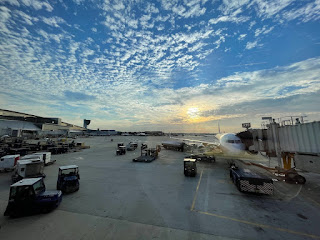
Awaiting one of our flights out of Philadelphia
(15 Oct. 2021 - Phila. Intl. Airport)

One of the constants of air travel, as well as ground travel, is the ubiquitous plastic-lined bag for the use of those experiencing stomach discomfort while being jostled back and forth, up and down, and side to side in the plane, boat, train, bus or car they are in. It also helps those around them to be able to stay clean and somewhat spared from the odor, though the poor sufferer continues to suffer what is gently referred to as “motion sickness”.

            We have been experiencing a type of “motion sickness” in recent times as we completed our required home assignment and made our way back to Lebanon last week. It was an uneventful flight, except that the airplanes were crowded cheek-to-jowl with travelers, some with masks, including those going to Lebanon. Maria and I lived through five months in the U.S. and Canada of constant travel, constant packing and unpacking, constant calculations of whether the weather would be warm or cold, along with constantly arranging flight and hotel bookings, constantly working on what kind of presentation fits a particular audience, constantly trying to wrap up paperwork and follow up on unfinished tasks in the concluding weeks when we were supposed to be “resting”. Getting back home to Beirut and its daily stresses and misery afforded us a bit of respite from the previous period!

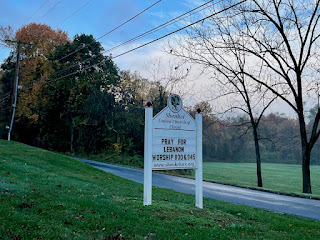
Many ordinary people want to learn, pray and
help Lebanon. (31 Oct. 2021 - Pottstown, Pa.)

            Yet it wasn’t all misery, because we got to meet wonderful, caring people, Armenian and non-Armenian, many of whom were aware of the trials being endured by the Lebanese and the Lebanese-Armenian community. Hearing their questions, seeing their concern and willingness to do something, hearing their words of blessing and being with them in God’s presence was a gift we gratefully received. Yet it was balanced by the exhaustion of upwards of 14,000 mi / 22,000 km of traveling (aside from the 16,000 mi / 25,000 km to actually get to the US and back)! Enviable? Perhaps. I suppose it depends on who is doing the envying.

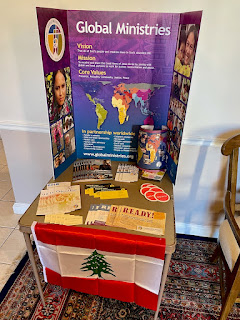
Getting the word out about Lebanon
(6 Nov 2021 - Belmont, Mass.)

            There is a TV ad that has appeared recently on Lebanese television depicting two young Lebanese boys talking about their dreams, which include going to school. It concludes with a voice-over stating, “Rights should not be just dreams.” Yet the dreams of a preponderance of people around us is not to have Lebanon become a livable country, but to leave Lebanon for a livable country. This “exit strategy” is based on yet a different kind of motion sickness: that of being made sick by a society that never experiences stability, that is continually in motion due to the profit-seeking, power struggles or whims of those in authority, whether locally, regionally or worldwide.

            On Beirut’s streets over the years, in my limited Arabic, I would often hear passersby including numbers in their conversations, assumedly regarding the price of this or that. How I wished that the conversations would revolve around ideas, or culture, or wonder at God’s creation! Today virtually all of the street conversations, and possibly also the private ones, are about the exchange rate, the cost of cheese and medicine, and the impossibility of carrying on in these conditions. One man at the exchange house said, “We’re living in an insane asylum!” I wish that my Arabic had not improved to the point where I could understand this much.

Exciting times on Home Assignment
(6 Dec. 2021 - Broomall, Pa.)

            Economic freefall produces one kind of motion sickness. Seeing dear friends and family members continually zoom away from you (and I’m not referring to screen time) can produce a similar spiritual nausea. When a family, or a community such as the Armenians, conclude that social disintegration is the best route to take, that their children must leave the country, then there is not much that can be said about the hopes for that family’s (or that people’s) future. Even if you are driven by the patriotic emotions that so often cloud Armenians’ judgment about their viability as a people, the consequences of cultural and societal disintegration cannot be dismissed. Many a person will insist on the necessity of laying hold, without delay, of the “promise of a better (economic, educational, health and secure) future elsewhere” – something that is only a promise, not a guarantee. It will apply to some lucky individuals, but what will become of collective identity? What will become of community? What will bring health and strength to the family, that place where individual and collective identity is formed and nurtured? We are in a rush toward “every man for himself”; and the shards of what was a collective hope, a concerted effort to come together to endure hardships and grow in character (such as was seen in the post-Genocide era), will become merely the subject of books and articles that very few read or care to reflect upon. Only a collective awakening to our spiritual and cultural resources can offer us a more hopeful outcome.
It's Christmastime in the city...
(30 Dec. 2021 - Geitawi–Beirut)

            I realize that I enjoy privileges and resources that few around me have. Yet I also have a perspective that many around me lack: that of having experienced the long-term consequences of living in a diaspora situation, in societies that are quite capable of swallowing up and homogenizing the qualities and distinctives that define a people group, including their language, creativity, spirituality, world view, and desire to survive and thrive as a unique entity. The motion sickness that we are all enduring will make it difficult, but all the more crucial, that we together take the long-term into account as well as the short- and medium-term… and listen well to each other.

LebCat 46: You look smashing in red... I mean
on red. (28 Dec. 2021 - Mar Mikhael–Beirut)

            One of the pleasures I enjoyed during “home assignment” was getting back to exercising (which is important, considering how much I enjoyed the pleasures of overeating and gaining weight during that same period). It was a long time since I was able to go to the gym at 6:30 a.m. and get a bit of sweat going. I also got back on the mat at the aikido dojo, but quickly remembered that aspect of warmups that I dread: forward and backward rolls. I dread them because of the dizziness they cause me. But I have learned that the way to work through this sensation is, first of all, to properly position my body to roll; second, to do the rolls more frequently; and third to fix my eye and my mind on a distant, stable point. That long-distance view enables me to be steady when the world seems to be slanted this way or that.

            My prayer for Lebanon, and in particular for the Armenian people, is that we fix our eye on that unchanging Point who does not change (James 1.17), who brings calmness, steadfastness and faith in Christ in the midst of the storm, and who blesses his people in the most difficult of circumstances with the enduring riches of wisdom, truth and love.   [LNB]

Sunday, April 28, 2019

Show Your Colors


25.Show Your Colors (27 April 2019)
The children sang and recited on Palm Sunday. I preached. Guess
who made the bigger impact. (14 Apr. 2019 – Geitawi - Beirut)
            A couple weeks ago, as I was doing some errands on foot, two different drivers, within thirty seconds of each other, stopped me to ask directions to two different hospitals in my neighborhood. A good test of my Arabic proficiency, now that I’m back to taking lessons for the last three months (at the nearby Armenian Evangelical high school). I was able to successfully understand their questions (in Arabic) and answer them correctly (in Arabic). Anyway, I hope so. Maria put it succinctly: “The problem is you look like you’re from here, which you’re not, and I look like I’m from somewhere else, which I’m not.”
Union President Rev. Mgrdich Karagoezian delivers the
benediction at the annual Easter Sunrise (this year, "Rainrise")
Service at KCHAG Conference Center. (21 Apr. 2019 – Monteverde)
            Strange coincidence, though, that I would be asked how to get to those hospitals, when we are living (and I am working) in what used to be a third hospital in our sector (Geitawi) – the former Christian Medical Center (CMC). When it was built (exactly 70 years ago), it was the largest of the three. And it was the one that had a reputation for accepting patients that the other two hospitals would turn away for lack of money. The other two are still operating, and expanding, and they have helipads on their roofs, and they still will turn away uninsured patients without up-front money.
On the wall of the Torossian Arm. Evang.
Intermediate School: “We will remember
and demand”. (21 Apr. 2019 – Baouchrieh)
            The CMC building is no longer a hospital (since the late 70s/early 80s), but is now our church Union’s headquarters (after a decade as Haigazian’s temporary campus, until 1996). Still, it’s interesting how many people we run into – shopkeepers, taxi drivers, etc. – who remember CMC, and who were either born here or were treated here after being turned away from those other hospitals.
            (Interesting footnote: the name “CMC” now refers to a new hospital near Haigazian University on the other side of the city, though the first letter definitely stands for something else.)
            In March, the daughter of one of CMC’s founding doctors, Dr. Peter Manoogian’s daughter Kate, paid her first visit to the place since leaving Beirut, perhaps since the 70s. She took her husband, children and grandchildren around the building and had very clear memories of what each room used to be. I, too, was interested in hearing about it and tagged along for part of the “tour”. I found out, for example, that our Union’s main reception room used to be the operating room, recovery room, and autoclave room. And I found out that she and my brother-in-law used to play together in the garden (now parking lot) behind the building.
Martyrs’ Day vigil at the Genocide Memorial,
Armenian Catholic Patriarchate. (23 Apr. 2019
– Geitawi, Beirut)
            Back in January we heard that Turkish flags had been hung by night at two Armenian schools in Los Angeles. The U.S. Armenian community was in an uproar, wondering who did it, why, etc., and many reacted with fear and anger. It was going to be investigated by the police as a hate crime, though the issue disappeared from the Armenian press. (Any info? Let me know in the “Comments” section.) Here in Beirut it’s a different ball game. Literally. When a certain basketball team plays against an Armenian club (whose star players are usually U.S. athletes… but that’s another issue), the opposing team trots out Turkish flags and dances on the bleachers to taunt the Armenian fans. Nothing “accidental” or secret about it. And nothing is really done about it. So Armenians do what they are able, and continue to defiantly display their tricolor at their sporting events, churches, schools, businesses, homes, cars and cell phone cases.
Flags of the Cilician Armenian kingdoms fly each
year from this building, courtesy of the sponsors
of the “Kohar” symphony of Armenia.
(24 Apr. 2019 – Mar Mikhael, Beirut)
            Must some legislation be passed, some official action taken, every time someone is offended at something? I understand that the intent of such legislation is to avoid a trend that might eventually lead to violence. But often it’s a hairpin trigger that sets off a reaction, seen in the trend of isolating, slandering, and dis-inviting those with whom you disagree. The outcome, especially for young people, is sad: young people ill-equipped to challenge an idea dispassionately and intelligently. Even if it’s a Genocide-denier, or someone who blames religions for all the ills in the world (there are plenty of those), or someone who thinks that this or that progressive (or traditional) cause should be the litmus test of whether you should be accepted as a full-fledged human being. Open debate is supplanted by shouting, silencing or sulking.
            April is the month that Armenians enthusiastically show their colors here in Lebanon (and Syria, and a lot of other Middle Eastern countries as well). On and around April 24 Armenians become a much more visible group in Lebanon. There are many people (young, educated people) here who have no idea about what befell Armenians, Assyrians and Greeks in the early 20th century, so it’s an opportunity to let them know. And when Turkey’s president makes his idiocy and mendacity public at this time each year (this year saying that what Turkey did to Armenians last century was “reasonable”, thus owning the guilt of his ancestors), it provides an easy opener to the topic. In addition, the homebound (northbound) side of the coastal highway out of Beirut was blocked for three hours on the evening of April 24 due to a massive demonstration, walking from Bourj Hammoud to the Catholicosate in Antelias. This gave rise for many locals to utter the word “Armenians”, but not in any complimentary sense.
Shuttered businesses on Armenian Genocide Day and giant forget-
me-nots on a building. Others went to work and illuminated their
co-workers concerning the day. (24 Apr. 2019 – Bourj Hammoud)
            For my part, I got to be the main speaker at this year’s Joint Commemorative April 24th Service for the Armenian Evangelical community in Lebanon.
            Today, as I was walking home from a wedding (two young Armenians marrying – what a joy!), on the back streets between the church and home, I noticed a gentleman in a suit and tie standing in the road ahead of me. Before I got near, he asked me (in Armenian, not Arabic), “Which road leads to Bourj Hammoud?” Was it my Armenian lapel cross, or the “forget-me-not” pin from the Genocide Centennial? He was too far away to have seen them. But I felt his pain, and we fell into conversation.
LebCat 24: Plant ’em in the winter, they sprout in
the spring. (22 Apr. 2019 – AUB, Beirut)
            The streets in Geitawi are like crab’s legs; if you are near the crab’s body and you choose the wrong leg, you’ll end up in a very different place than you had hoped. I told him that descending the stairs was the best way to where he was going, and invited him to walk along with me as I was also headed in that direction. We commiserated – in Armenian – about the unregulated and unplanned ruining of architectural heritage and the proliferation of multi-storey monsters in the city. “This country will break down under the weight of all this lawlessness,” he rued.
            Maybe it was my Armenian nose. Sometimes your colors are hard to hide, even from a distance.   [LNB]

Friday, November 30, 2018

Strange New World


20.Strange New World (29 November 2018)
The Legend: Jim’s Steaks. Worth the wait in the cold
in a line out the door and around the corner.
(23 Nov. 2018 – Philadelphia, Pa.)
            Last night we flew back in to Lebanon, back to the familiar yet strange place we call home, returning from a “strange, New World,” to borrow the words spoken by Captain James T. Kirk of the starship Enterprise.
            Several weeks ago an opportunity opened up for Maria to receive some software training for her work at Haigazian University, so we decided it was time to take some vacation, making this our first trip back to the U.S. and to my family there since we moved to Lebanon early in 2017. It was also our first trip to Toronto (and to Maria’s family) since then.
Family reunion! Lara K. and her “Beirut family”. Thanks, Dan,
for taking the photo. (20 Nov. 2018 – Broomall, Pa.)
            The first strange thing to me was how “un-strange” so much of it was, right down to the roadways and the potholes, in the same spots I had left them in January 2017. It seemed as if I had only been away from the U.S. for two months, not almost two years. And worshiping with the congregation and singing in the choir at the Armenian Martyrs’ Congregational Church in Havertown, Pa., where I used to be the pastor, only strengthened my feeling of never having been away.
            Being with family was another one of those strange-but-not situations. I suppose that if our separation had been five years it would not have felt like it had been only a short while. But then I wonder about those dear to me, from whom I am separated by death, whose faces carry that almost-forgotten quality to my eye. Yet because of our common faith in Jesus we have the hope of an everlasting reunion. Now that will be a strange feeling!
New car “vending machines”. Order online, and the lift
brings  your order, as if it were a bottle of soda.
(27 Nov. 2018 – Philadelphia, Pa.)
            When Maria and I went into the supermarket in suburban Philadelphia, we were bewildered by the varieties and sub-varieties of practically everything one could imagine, in a store with enough floor space and stock to contain several of the largest supermarkets in Lebanon. We also felt the intensity of advertising in the U.S., and how it shapes you into someone who consumes and buys and buys more as a way of life. It is something we were able to clearly perceive as strange only because of the distance we had had from America these two years.
            But also strange – yet not – were the tents sitting on city sidewalks, which our son Sevag pointed out to us in the neighborhood where he is a high school teacher. In Lebanon I would have accepted that sight as something quite normal in present-day Lebanon – refugees are a part of life in the “new Middle East” promised us by an earlier U.S. administration. There in that section of Philadelphia the tents on city sidewalks belonged to the homeless, refugees of a different sort, indicative of a societal malaise that gets little attention.
Homeless encampment on a sidewalk in the
Kensington area. (27 Nov. 2018 – Philadelphia, Pa.)
            After only a few days in the U.S., another strange feeling beset me: I was forgetting who I was as an Armenian. In that short time my environment was so decidedly American that it was very easy for me to “revert” to the identity I grew up with and maintained, that is, until the 8th grade when I chose for a book report that so shocked me (my grandmother’s copy of Rev. Abraham Hartunian’s Neither to Laugh nor to Weep) that I realized I had to learn what it meant to be Armenian, and then relentlessly pursue it. I know that some prefer to reconcile everything into everything else, to find the “both/and” in every situation, but when you are part of a minority culture, that melding means the obliteration of your culture. Your existence becomes a mere “decoration” or something “exotic” for the majority culture to enjoy, and otherwise ignore. And that is a hard road to travel if you are a young person wanting to be true to his language and heritage.
A snowstorm welcoming us to Canada. And almost keeping our
plane from landing. (16 Nov. 2018 – Toronto, Ont.)
            What sadly wasn’t so strange to me was the refrain heard over and over, wherever we went (and wherever we are): “We need leaders. Where are the new leaders?” Churches need pastors. Schools need teachers. Community and cultural organizations need visionaries. And they all need donors who believe in their mission and will give generously. I told people that they will not appear magically from some far-away place, but will grow up from within the Armenian churches, schools and community, if they are taught and learn to value their faith and heritage in the face of the intoxicating effect of the “new” and “exciting” all around them.
The best place to be – with children and youth. Thanks, John P.,
for the photo. (25 Nov. 2018 – Havertown, Pa.)
            The most joyful moment I spent occurred during the worship service at my former church. As I had done for nearly 10 years when serving there, I piped a tune to bring the children to the chancel steps, where I would sit and give the children’s message. There are only a few children in that church, so I expected two or three. But some of the high-schoolers, who years ago had been part of this group of little ones, got up, and then others, and before long a big group of “kids” was gathered around me, sitting on the floor in front of me. I was floored… and thankful to God for the seeds of faith growing in those youth, who love their church and their faith so much.
LebCat 19: Double surveillance, with LebCat 17 checking out
the lower level (28 Oct. 2018 – Nor Amanos, Bouchrieh)
            When Lebanon celebrated its 75th Independence Day, following the news from afar we experienced a strange mix of emotions: wishing we were there, glad we weren’t caught in the incredible traffic jams from closed roads into the capital, as the army practiced for the parade, hearing the pain in so many social media posts about the day-to-day struggles of regular people, while the elite classes disregard their role in creating misery and hopelessness and a lack of desire to celebrate anything.
            Engagement in life’s challenges should not be a strange thing for a Christian (or for any human being), whether Armenian or not. The Apostle Peter in I Peter 2.11-12 was on to something when he exhorted the church to live as “strangers and sojourners” regarding fleshly entrapments, which is a far cry from advocating for a disengaged, “holy huddle” in order to wait for Christ’s Second Coming. That engagement is what will keep us vital and focused as we interface with the strangeness of the worlds we inhabit.   [LNB]