Showing posts with label social media. Show all posts

Sunday, April 30, 2023

Hesaid-Shesaid Disease

58. Hesaid-Shesaid Disease (30 April 2023)

It's springtime, and the Mediterranean is not
too cold for a swim. (2 Apr. 2023 - AUB, Beirut)

Supermarkets in the U.S. have (or used to have) bulletin boards near the entrance, a place to post community activity announcements, job advertisements, lost dog posters, Fire Prevention Week fliers, you name it. Occasionally I would notice someone standing and examining each notice; but usually these bulletin boards were merely something to pass on your way out or your way into the store. Now, times have changed, and the bulletin board as well as its relative, the newspaper gossip column, have transformed into a new, electronic format, eagerly consumed by people the world over.

Lake Laziza – stagnant waters
collecting in the site of yet another
useless construction project.
(27 Mar. 2023 - Mar Mikhael)

            Social media platforms guide the thinking of so many people, young and old. Sometimes it guides its users to access well-thought-out writings about important issues or events. Often it entices us into habits that divert us from looking deeply or critically into topics. I would propose that our God-given minds and consciences are also “platforms” to help us consider what is true, or beautiful, or healthy, as well as what is “good, acceptable and perfect” (cf. Romans 12.2). The condition of today’s “marketplace of ideas” – a condition that predates the Internet – swarms with lies and half-truths, as well as with vested interests, mixed together with Truth. Separating the worthwhile from the worthless is akin to trying to separate the ingredients of a tabbouleh salad once it is mixed.

            But effort must be spent in separating the good and bad, no matter how painstaking the task. The discipline of deep thinking, including research and debate, is crucial to avoiding a relativism, antagonism and shallowness. And it is a rare, perhaps endangered, species.

Another sign of spring, high in the mountains
of Lebanon (10 Mar. 2023 - Azzounieh)

            At one time newspapers and periodicals bristled with the pointed tips of journalistic and academic inquiry. They played an essential role in in piercing shells of deceit and kept the “He said-She said Disease”, so prevalent in partisan and entertainment “news”. It pushed back the waves of mendacity of the powerful, and challenged vested interests. Where there should be courageous truth-telling, too often news reports are filled with “he said this, but, on the other hand, she said that”. A shrug of the shoulders, and on to the next story.

             And this is why April is the bitterest month for Armenians. They suffer from the “Hesaid-Shesaid Disease” that runs rampant in popular and populist media. Their just cause, and the unacknowledged and unpunished crime against them, has been turned into a target of the propaganda war by those responsible – the governments of Turkey and Azerbaijan. The Armenian nation, in its struggling Eastern portion, and its exiled Western portion, has been seated at a table replete with impotent statements of sympathy from world powers demonstrating their prowess in verbal gymnastics.
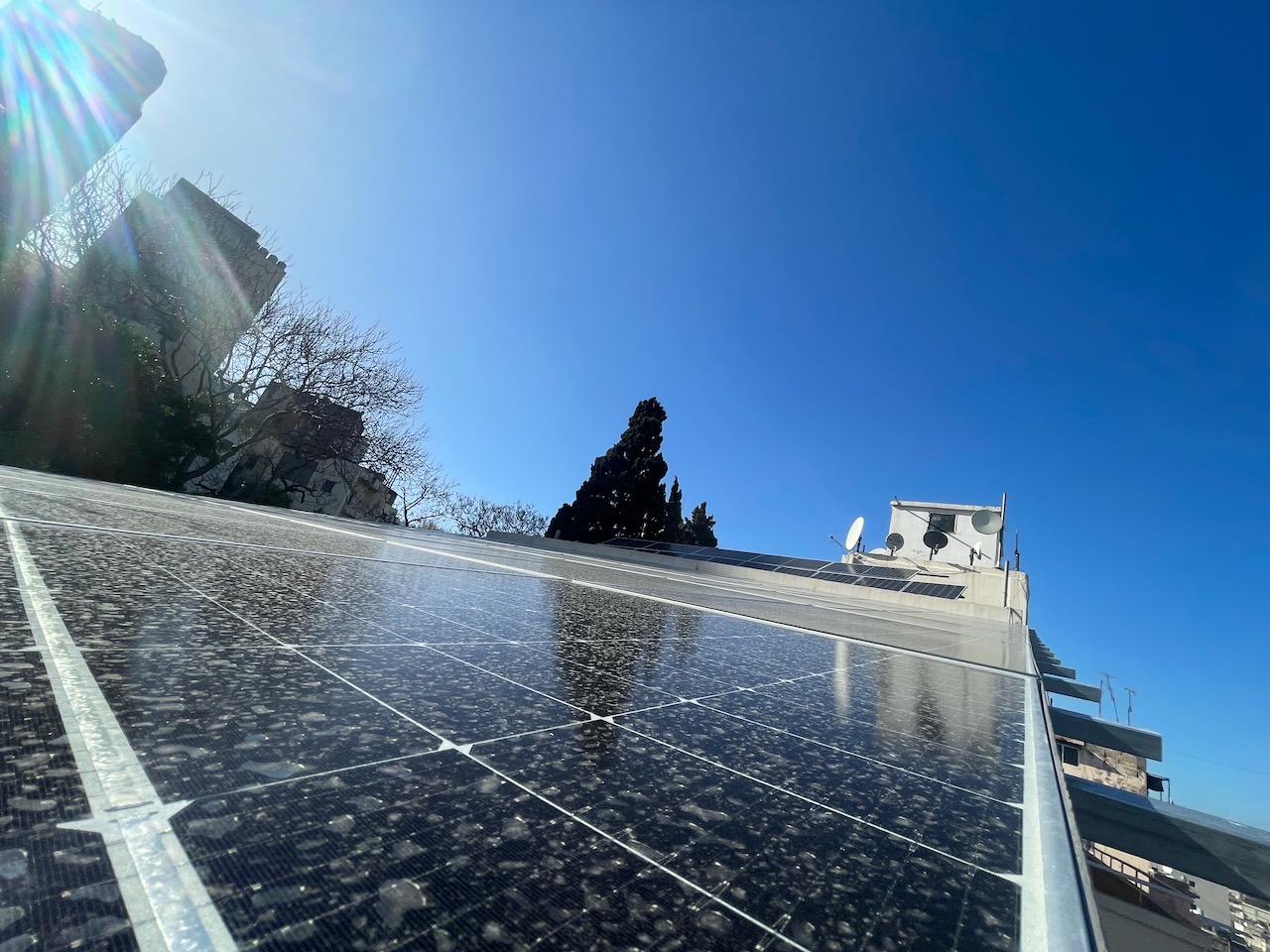
And this is why we now have 24-hour
electricity. And a working elevator.
(6 Apr. 2023 - Geitawi, Beirut)

           Caught in such a worldwide web as this, it is no wonder that militant groups have emerged from among all subjugated people groups, and not just from Armenians. Those who are silenced or sidelined from public forums can often see no other way than this: to force the powerful to pay attention to (and sometimes feel on their own skin) the injustices that are freely roaming the streets of every city and country, easily ignored by an otherwise occupied public. Sadly, the chronic disenfranchisement of such people groups leads to their disarray, dismemberment and dissolution, something widely observed among my people. 

        Allowing “Hesaid-Shesaid Disease” to spread unchecked may be intentional. It enables genocidal regimes to bend the wills of “great powers” who don’t want to endanger their access to resources. It allows Turkey and Azerbaijan to declare historic Armenian lands and culture as its own. It emboldens them to claim that Armenia and Armenians never existed. It gives them a green light to persist in their genocidal policies, both “soft genocide” and “hard genocide”. It gives credence to Hitler’s dismissal of concerns over his genocide against the Polish people, telling his generals in 1939 to abandon their humanitarian scruples: “Who speaks nowadays of the annihilation of the Armenians?”

Armenian scouts headed to their Saturday
meeting, while street lights are being
replaced with solar-powered LED fixtures.
(15 Apr. 2023 - Khalil Bedawi, Beirut)

            The disease has no cure. It is as old as the dialogue between Adam and God in the Garden of Eden (cf. Genesis 3.9-13) and ingrained within the human heart. Although it cannot be eradicated, it can – and must – be kept at bay. As mentioned earlier, deep and rigorous thinking is one of the necessary treatment regimens. Another is careful and considerate listening, something that takes time and commitment. And time is one of the casualties of the information/entertainment glut engulfing the world. The third treatment is to “make love your aim” or to “follow the way of love” (cf. I Corinthians 14.1). Loving others as yourself. Loving the truth. Loving (including a fear of) God. 

LebCat 58 - Not sure how I got into this
building (UAECNE HQ). Could you provide
me with an escape route? Please?
(26 Mar. 2023 - Geitawi, Beirut)
                            April 24th – Armenian Genocide Remembrance Day – has come and gone, with various and sundry observances here in Lebanon and in many places throughout the world. It was noted by the diseased as well. The governor of Istanbul forbade its observance for the second year in a row. Azerbaijan increased its propaganda about the nefarious designs of the Armenian government, and intensified its military aggression against Armenia and Artsakh. Therefore, I have no choice but to do my part to combat this disease with faith in God, for the sake of my descendants and the inheritance of their rightful legacy.   [LNB]

Saturday, September 29, 2018

Raise Your Voice


18.Raise Your Voice (29 September 2018)
First day of school at the Armenian Evangelical College, one of
the network of schools in Syria and Lebanon run by the Union.
Haigazian’s Philibosian Student Center (formerly “Webb”
building) is in the left background. (25 Sept. 2018 – Kantari,
Beirut. Photo courtesy of Rev. Hrayr Cholakian)
            Adjusting to a new environment takes time, and events around you or within you force you to admit that you are not “there” yet. If you are really smart, you’ll accept the fact that you will never get “there”, no matter how you define “there”. And you’ll do so sooner rather than later.
            The better part of adjusting consists of knowing how to keep your mouth shut, and continuing to observe and learn. But there are always a few things that perhaps you shouldn’t adjust to, that may be worth opening your mouth about.
            As I was trying out a new eatery (nothing to get excited about, sorry) a couple of days ago, the cashier directed me to their air-conditioned “eating room” (a separate storefront from the “ordering room”). I stuck my head inside the eating room, sniffed once, and
decided to cast my lot with the hot sun at a sidewalk table. The cashier eventually brought out my food, and asked, “It’s hot out here. Don’t you want to eat inside?” I responded with “Ma3lesh” (It’s nothing), although I did want to raise my voice in complaint to her about the cigarette stench in the eating room. O, Arabic lessons, why have I forsaken you?
A beautiful, old building that was being refurbished last year
collapsed before they were able to support its structure…
revealing another beautiful, old building. You can see the
remnants of the balconies lying askew on the ground.
(11 Sept. 2018 – Gemmazeh, Beirut)
            So, as I was eating (and sweating) on a sunny Ashrafieh sidewalk, watching cars go by, I noticed an older man (i.e., my age) on a motorcycle pulled up next to a driver’s window of a car that had stopped in the middle of the street. But he wasn’t asking for directions. He was yelling at the driver for several traffic infractions, including driving the wrong way on a one-way street, and probably almost running over the motorcyclist (who was not a traffic cop). I can only hope that he takes care not to break the same laws when no one is looking.
            I was pleased to see him making a nuisance of himself in this way, because people so often just shrug their shoulders at much of what goes on here when they should be speaking up. “Haideh Lubnan.” I hear it all the time, from friends and strangers. “This is Lebanon.” But although speaking out will never result in instantaneous or lasting changes, though it won’t turn those accustomed to decades and decades of ineffectual government and self-centered living into conscientious, law-abiding citizens. He was lighting a candle and cursing the darkness.
This is how the Union headquarters looked before
improvements began. It’s behind the trees, in case you
missed it. (6 Sept. 2018 – Geitawi, Beirut)
            Oops. I forgot that I’m not supposed to say anything but compliments about the government, as well as all other governments, save for one in particular that happens to border Lebanon. That’s what I put my signature to each year, when renewing my residence permit. But even without signing such a form, we are all facing similar pressures to keep dissent to ourselves (or, alternatively, to be loud and arrogant about our dissent and close our ears to other dissenters). This does not just concern the country of my birth, the U.S.A., for the past 17-plus years. In Armenia, post “velvet revolution”, the message being broadcast, is one, simple, unchallenged refrain: “The bad has left, the good is here; come to Armenia. ” Few dare to raise a dissenting voice concerning the “new”, save in private, or else risk ostracism. Even though they, too, care for Armenia’s well-being. It seem that criticism, especially self-criticism, is rare in today’s world, no matter what the side.
The old fence coming down, and the new going up.
(11 Sept. 2018 – Geitawi, Beirut)
            Yet people do speak up, and not just to point out flaws that they see. Here are some ways I’ve observed people in Lebanon “raising their voices”:
1. Tending your “garden”. The headquarters where I work, the Union of Armenian Evangelical Churches in the Near East, formerly an Armenian-owned hospital (the “Christian Medical Center”), got a complete makeover, 30 years after its previous one. Rev. Paul Haidostian, president of Haigazian University, is overseeing another renovation project, that of the Webb (or Philibosian Student Center) building, the university’s original structure. Someone observing the work remarked, “Do you know how encouraging it is for your neighbors to see you making improvements because you want to improve, and not because you were forced to by someone else?”
2. Getting up and getting out. After a long summer indoors (with their air conditioners), lots of locals have donned shorts and sneakers. I see them running and jogging and panting along sidewalks and streets in the city, preparing for the Nov. 11th Beirut Marathon. I’m not sure whether they’re aiming for the 8 km fun-run, the half-marathon, or the full 42.195 km thrill. I’m limiting myself to the gym.
A panorama of the newly-refurbished exterior of the Armenian
Evangelical church headquarters, formerly the “Christian
Medical Center” (27 Sept. 2018 – Geitawi, Beirut)
3. Speaking up about health and pollution dangers. People continue to gather to publicly protest the government’s mismanagement of the country’s waste disposal, especially after the recent decision to create three incineration facilities along the coast, while cancer rates continue to spike. Meanwhile, cow carcasses, presumably diseased ones tossed from ships before entering the Port of Beirut, are gently floating along our Mediterranean coast. Swimmers and divers are exposing these shameful scenes through social media posts.
4. Speaking up about abuse. The prevalence of non-Arab faces in and around the city points to the widespread use of southern-hemisphere workers in construction, sanitation and domestic labor. There is a robust network of organizations decrying the near-slavery conditions many of them are enduring at the hands (literally – please understand) of their employers. At least one of them per month commits suicide. Rather than let this “modern slavery” continue, they protest, they write commentary, they hold memorial services, all in an effort to put an end to the unregulated flow of hundreds of impoverished, southern-hemisphere “tourists” through the airport.
Just write “extra” on it. It doesn’t have to mean anything.
(28 Aug. 2018 – Geitawi, Beirut)
5. Opening Armenian schools for the new school year. Despite the continuing downward economic spiral in Lebanon, and the departure of many families (not just youth) from the country, Armenian schools of every kind have pressed forward in continuing their educational mission, and have started another school year. It is a powerful declaration of their will to survive, and a message to Armenians everywhere that the Diaspora has a reason to exist.
6. Publishing Western Armenian books. In a couple of weeks Haigazian University will hold another “Armenian Book” evening, presenting all of the books published in the Western Armenian dialect (and a few in other languages) in Lebanon in 2017. Beirut continues to let the world know that it is a cultural center for Armenians throughout the world, despite the past and present efforts to obliterate our presence in this region. (However, these Armenian books continue to cry out for people to pick them up and read them…)
7. Calling everything by a superlative. No matter what the item, it’s always better if you add the word “extra” to it. Or sometimes just name it “Extra”. This week I saw a man carrying a 50 kg (110 lb.) sack of flour to the nearby “manaqish” bakery. What was the brand of flour? “Extra”. Why not?
LebCat 17: All of these toilets are mine. And the boxes, too.
(26 Aug. 2018 – Nor Amanos, Baouchrieh)
            Raising your voice, for a Christian, usually means you are offering heartfelt praise to God. But it’s important to have a complete view of “being heard”. Christians must also cry out for the oppressed who have no voice, or challenge the idol-worshiping that is so much part and parcel of economic systems here and everywhere, or lift their voices in prayers of intercession or repentance, or raise a call to turn back from the paths of death to the ways of God. There is a time to be silent, but also a time to speak (Eccl. 3.7).
            Especially as an Armenian, there are so many more things about which I want to cry out, as I adjust to life here. And maybe I will. But this much for this time. [LNB]

[Note: Last blog’s “LebCat 16 & friends” was photographed in 2018 (not 2017) as they were dragging Sevag into their thrall.]

Sunday, August 27, 2017

Humans


7.Humans (27 August 2017)

Random human, being
confused by his electronic
device. (28 July 2017 –
Brummana, Lebanon)
            Humans, especially in recent years, have forgotten the importance of networks. Things like “social media” have clumsily reintroduced the concept to people in the thrall of their electronic devices. But it is still not networking at its optimal, because it eliminates the face-to-face element that is the foundation of any society, human or otherwise. Like that thing called “church”, and those who pretend that their on-line gatherings are an appropriate substitute for fellowship. Or like that fellow, Mark Whatsisberg, who thinks that Facebook is going to replace community groups like churches and associations.
Human bringing goods to
his apartment. He didn’t
have any food; I sniffed
as he walked past. (26
Jul. 2017 – NEST, Beirut)
            Anyway, humans are like that. I should know. I’ve been following one of them for the past eight months… I and my network here in Beirut, that is. You see, we cats look like loners, but we’re really very much in touch (especially when we’re hissing at each other). In case you were wondering, I’m “LebCat 6”, according to Human, who’s been following me and my network.
Human sitting on a chair,
as he does for hours each day.
(18 Aug. 2017, Geitawi, Beirut)
            A couple months back, when a fellow cat sleeping on someone’s keyboard in the U.S. caught a glimpse of this page, and my photos, out of the corner of his eye (you thought he was snoring, didn’t you?), he alerted me, and we immediately informed our teams to increase their surveillance of Human. And we “borrowed”, shall we say, this blog in order to make our voice heard to all of you “socially-networked” humans.
Human carrying Clanging
Metal Thing (3 Aug. 2017 –
Monteverde, Lebanon)
            Since our street has been dug up for the past two months (the street next to where Human lives), my routine has been messed up, to say the least. I’ve had to rely on my colleagues to keep tabs on what’s been going on. And we’ve noticed that Human has been harder to track, harder than usual. My contacts have noted his comings and goings, sometimes in another part of the city, sometimes outside the city, and sometimes pretty far away. He was sighted in Canada a couple of months ago, blowing into some curved yellow metal thing, and just a few weeks back Human callously interrupted my colleague in Shushi (in Artsakh) while she was grooming herself, simply because he wanted to take her picture. Canada, Armenia, Lebanon – seems he’s been getting around. Sometime in late July/early August, he was also spotted in the hills outside Beirut, with a group of other humans, wearing short pants. I don’t know if he was trying to evade us with a clever disguise, but we don’t bother with externals. Smell is what matters, not looks.
Fuzzy Human attempting to deceive
one of our agents with buza 3rabi.
(7 Aug. 2017 – Ashrafieh, Beirut)
            We’ve also noted that Human spends a lot of time going back and forth in the city. And wiping off his sweat with a piece of cloth. They haven’t learned the secret of wearing a fur coat the whole year. It’s a built-in, grow-it-yourself sweat rag – pure genius, whoever thought it up. Humans have so much to learn about what true genius is.
           Human lives with Another Human, about whom we don’t know much, because she keeps avoiding us. But we keep tabs on her, too. For a few weeks this summer a third one appeared at their apartment, Fuzzy Human; the three of them were spotted in and around the city quite a bit. Fuzzy Human tried to offer his “buza 3rabi” (Arabic ice cream) to our colleague, but, come on, everyone knows that there’s no milk in it, so what’s the point? Meats and dairy products – that’s the stuff we like. We also like whatever else you humans feed us, like canned food or table scraps. Anything that will spare us from having to hunt for our own food. You may call it “lazy”. We call it “smart”. Smarter than those phones you clutch all the time.
Our colleague, after being rudely interrupted
while grooming, by Human seeking a photo
op. (15 Aug. 2017, Shushi, Artsakh)
            Our network has been following the news, and is convinced that humans are having increased difficulties because they do not truly network. Theirs is a utilitarian motivation, and they rely on each other only when they need something from another human. In our recent information-gathering operations, the only time we noticed a change in this mode of relation was this summer, according to our agent in KCHAG, the humans’ conference center in the hills above Mansourieh. There humans would sit together, talk and laugh, seemingly just for the enjoyment of being together. And they would also sit in groups and read from a thick Book, and gather inside a building and sing songs to Someone. Nothing significant for them to gain from doing all that, yet they looked like they were actually enjoying life, for a change.
            So, there may be hope for them after all. As long as they keep their networks healthy. And that’s all I have to say.
            Pretty soon Human will have figured out that we’ve hacked his blog. And he’ll change his password, and think he’s locked us cats out.
            That’s OK. Let him think that. We know better. [LNBCAT]