Showing posts with label ice cream. Show all posts

Tuesday, August 20, 2024

System Overload

62. System Overload (20 August 2024)

An artist found beauty in the colors
and shapes of Beirut rooftops and skies
(31 July 2024 - Mar Mikhael)

When you live in a country that makes you provide your own basic services – things that citizens of other countries can take for granted – you have to get good at guessing. For example, though we’ve been enjoying nearly non-stop electricity for over a year following the solar power installation on our building, there are still quirks. When the (currently nonexistent, pun intended) municipal current exceeds the normal 220 volts, a system overload occurs, and we are left in the dark. We figured out that we had to wait until the municipal power “calms down” to something under 240 volts, then switch the main power off and on to resume our electricity. Problem managed (not solved)! Other power interruptions still occur, and we’re still trying to guess why…

Finding a way to get the job done,
and nobody got hurt - I think
(29 Mar. 2024 - Geitawi)
            “Overload” is also a daily issue in a place and a community with a plethora of needs and concerns but a dearth of willing and capable hands. Those who are willing and capable can often (somewhat understandably) be very protective of their time and energy. Others may be on the job but lack the necessary capabilities. Still others are unwilling to learn or change. I regularly wonder how overloading is affecting those around me.

            So many people have left this region (the “dearly departed”) for a more balanced or safer or prosperous life, and those who haven’t (yet) left continue to care for the community and experience more system overload. Since I’m now (in a way) part of this latter group, I try not to think about the load-bearing that we are doing, and just continue to plug along. Occasionally we find a little bit of energy left to train and empower others who have the potential to work for the common good, with the hopes that they will continue to stay side-by-side with us and not take an offramp.

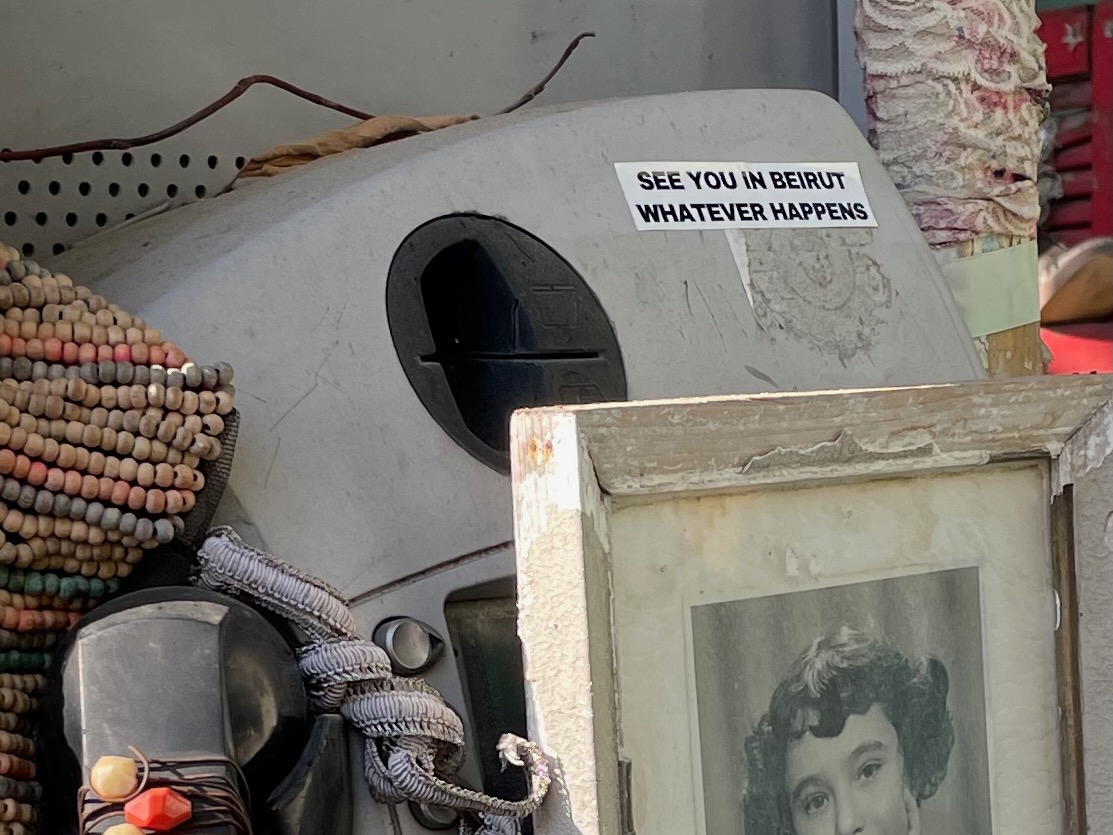
A sidewalk collage with a message...
whatever happens
(10 July 2024 - Gemmayzeh)
            I think that “system overload” also properly describes my thought world of the past year. I have been filled to overflowing with the barbarity and especially the counter-barbarity in the lands “South of the Border” to us; the genocidal onslaught on Armenia and Artsakh (to borrow another butcher’s words, “Who speaks nowadays of the destruction of Artsakh?”) by its neighbors, assisted by the resources of “the Middle East’s only democracy”, and emboldened by the inaction of its “friends”; the lack of depth, political sense or appreciation of heritage of those in power in the “Homeland”; the pervasive indifference and confusion of the Armenian Diaspora towards the existential threats it is facing; the diabolical contradiction between the words and actions of purported champions of human rights; all of this causes a huge “system overload” in my circuitry. Is this paragraph too long? That’s “system overload” doing its thing.
Far from Beirut's din, the peace
and majesty of the cedar forest
(22 July 2024 - Arz el Barouk)
            When surge protectors interrupt an electrical circuit, either the circuit stays off until the “reset” button is pressed, or they wait a few seconds before automatically restoring the current. Maybe all of us need surge protectors to keep us from these varieties of overloading, including the surplus data that is provided to our eyes and brains via our handheld devices. That excess of information, coupled with the lack of time to reflect on so many issues of substance, cause us to fall from our true humanity, in almost as insidious a way as Adam and Eve’s transgression did. And it may explain why in the past twelve months I’ve only managed to eke out one “Nshanakir”, and why I’ve been trying since April to write this one. Seems I’m having trouble locating the “reset” button on my surge protector.

            To switch the imagery and to do some self-correcting, something I tell those who say that they are in a pit or a rut is this: “When you find yourself stuck in a hole, the first rule is – Stop Digging.” Others may advise differently, like focusing on something positive, which may be particularly challenging when the “most moral army in the world” sends its warplanes over Beirut to terrify you, as we have been enjoying of late. Oh, right, stop digging.

            Yet searching for bright spots may be the best method to finding a way out of these many pits and potholes we encounter. Here are a few.

Newly-engaged, a bright spot needing
no electricity! (21 July 2024 - Geitawi)

            One bright spot is the occasional kind taxi driver that Maria encounters in her commute. These are usually “old-timers,” fellows who are not new to the job, who exude an attitude of politeness and caring, something in short supply these tense days. Of course, Maria has a distinct advantage over me in these exchanges, being that she can converse with them in Arabic. If nothing else, it gives me peace of mind and puts a smile in my heart when I hear that one of these gents has been her chauffeur that day.

            Another bright spot happened at a sweet shop on a hot afternoon last week, when I inadvisedly bought an ice cream cone. Almost instantly it turned into a colorful series of tributaries streaming down my hand onto the sidewalk. An employee rushed out of the store and put a stack of tissues on our table, then grabbed my cone and plopped what was left of it into a cup, speaking as if to reprimand the ice cream for making such a mess all over me. She shooed me into the store to wash up at the sink behind the counter, then made me tell her what flavors (of Arabic ice cream, of course) I had ordered. She had the ice cream server make up a new order for me in a cup, of course, with the cone sticking out of it at a rakish angle. After enjoying my ice cream I went back inside to thank her. “Walaw, walaw,” she politely dismissed my thanks. Based on her awareness and consideration, I figure she may have even told the guy inside to make sure to use cups whenever serving ice cream during Lebanon’s glorious summer heat.

LebCat 62 - "Will act cute for food"
(22 July 2024 - Deir al Qamar)
            It’s just like Fred Rogers’ mother told him as a little boy when he was frightened: “Look for the helpers. You will always find people who are helping.” Bright spots are there for those who are looking for them.

            Of course, the brightest spot was indubitably Sevag’s annual month-long visit. It became even brighter when his girlfriend Rhoda arrived from Pennsylvania the last week of his visit and they surprised us by exchanging rings in the middle of a kebab lunch with dear friends. The happiness and brightness quotient soared that day, and there was no system overload anywhere to be found! A few days later we held a formal engagement ceremony in the Armenian tradition, placing the wedding bands on their right hands and invoking God’s blessing on their growing relationship.

            Thinking upon such bright spots definitely help us to bridge the “power interruptions” of these days!   [LNB]

Wednesday, October 31, 2018

On My Head


19.On My Head (31 October 2018)
            One of those essential phrases anyone living in the Arab world needs to know is “on my
Inspired by Lark on the Move, you have to find
where Maria and Linda are. In the equivalent of
an ancient Roman narthex! (13 Oct. 2018 –
Baalbek, Lebanon)
head”, or, alternatively, “on my head and eyes” (3ala rassi/3ala rassi ou 3ayni). When I go to the grocer, I know he’s going to send greetings to my wife, and although I try to keep my conversation limited to onions and grapes, he inevitably throws pleasant chatter at me. Yesterday he sent the usual greetings, but I was able to fumble out an “3ala rassi” in response as I was leaving. Add that to the other things “on my head”, and you have a pretty accurate description of what’s happening in our lives these days.
            Still, even with the continually-postponed resumption of my Arabic lessons, I’m managing semi-well with what’s on my head and eyes. Although we’re no longer newcomers, we still have people looking at us as if (but denying they are thinking that) we are crazy for picking up and moving to Lebanon. But we also have people who are delighted each time they see us, and (we hope) are encouraged as much as they encourage us.
            As we become more aware of just how big a struggle it is for so many people to manage life here (although my focus is just on Armenians; it is similar for lots and lots of people), our hearts are even more broken. More frequently than before friends are sharing, quite openly, about their plans to leave Lebanon for Armenia. Others may have plans to move to Europe, the U.S. or Canada, but they tend not to share that with anyone but those closest to them.
Some young cedars of Lebanon in the background, and some
old guys (Mike and I) in the foreground. Guess which ones are
going to be around longer. (14 Oct. 2018 – Barouk, Lebanon)
            Things like not having a government (after 5+ months) doesn’t really get anyone’s attention, though it should – especially of those who are horse-trading the lives of their citizens for personal gain. Not that I’m a fan of politics, but the phrase from the 1992 U.S. presidential elections comes to mind: “The economy, stupid.” That’s what is grinding down individuals, families, communities like the Armenians, community organizations, and pretty much the entire social fabric. The biblical injunction to “pray for kings and those in authority” (I Tim. 2.2) is not just a nice, occasional add-on to personal and corporate prayers; it is an essential for us, something we continually cry out to God for him to answer. We pray not just for local authorities, but for those far, far away, too, who affect life here.
            A couple of days ago a friend mentioned how, because of the sagging economy in Lebanon, a cascading effect is happening. The central bank (just now?) has decided that it can no longer give loans to first-time homeowners, due to the economic situation and a bunch of other things. (Point of clarification: the “homes” I’m talking about are not the American-style
Bread on the cooling conveyor. Most of what you buy won’t
last the trip home-mmmm. (13 Oct. 2018 – outside Ainjar)
single-family homes with a lawn and a fence. It’s a cramped, sometimes brand-new, apartment in one of those ugly high-rises I regularly rant about.) So, with no home loan, young people are cancelling wedding plans because they won’t have a place to live aside from a room at their parents’ home. And that means all the related businesses are also suffering – those who would clothe, feed, photograph and entertain the wedding guests. And those who would sell furnishings to the newlyweds. And sell them cars. And later on, baby things. And later on, school tuitions and incidentals. (Again, I’m thinking particularly of the struggling Armenian schools and families, but it’s an overall phenomenon.) And so on, and so on. For someone like me to come in and share the message, “Place your hope in Christ!” that person must be willing to also, and first, listen to and care for those whose hope for a normal life is fleeing from them.
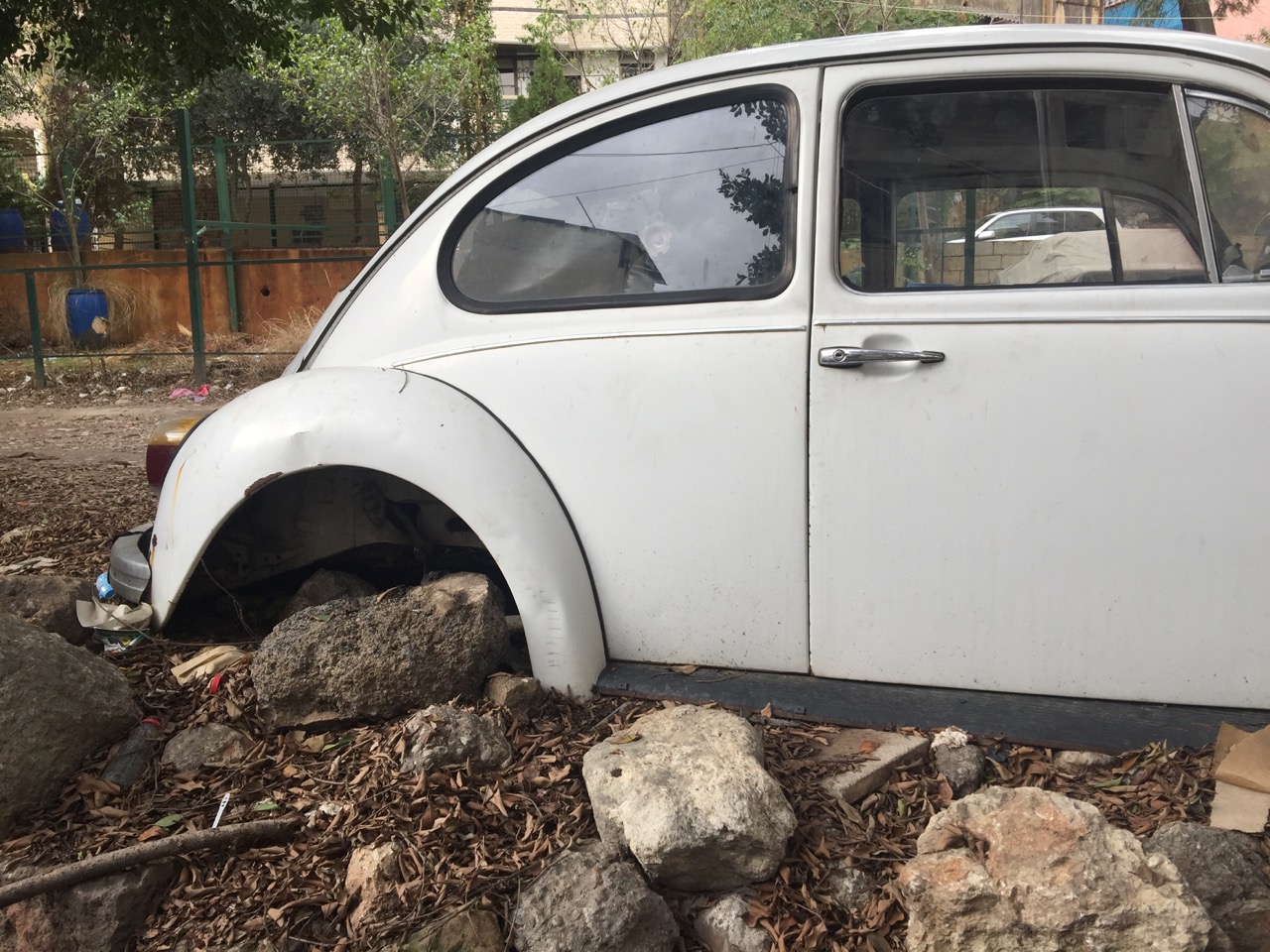
A Volkswagen from the Stone Age, complete with
prehistoric tires. (22 Oct. 2018 – Khalil Badawi, Beirut)
            But seriously, folks, reality aside (hah!), I really would rather be writing about all the interesting and fun things we’re experiencing here. And there is plenty that’s interesting and fun. Like receiving an official delegation and Armenia’s “caretaker” Prime Minister, Nigol Pashinyan, who visited the Armenian Evangelical Union leadership (interesting). Or like the visit of dear friends from Philly, Linda and Mike Sywulak (fun). They visited missionary friends of theirs in Kenya for a week, and then spent a week with us this month, getting introduced to Lebanon, its history, its natural beauty (I mean that), and its vital Christian ministries. For us, it was a welcome respite, and an occasion to reflect on our time here so far. For them, it was an opportunity to turn something abstract into a concrete picture that they can talk about and pray for.
The ashtray of no ashes. A Zen moment in a
Sassine Sq. diner. (12 Mar. 2018 –
Ashrafieh, Beirut)
            So, we got to be tourists! Finally! Nothing like visitors to provide you with an excuse to “see the sights”. We showed them all five Armenian Evangelical churches in Lebanon, plus their schools, plus the old age home (CAHL), plus KCHAG, plus more. They got to speak directly to workers in these ministries about their joys and burdens. We traveled to the ancient cities of Baalbek and Ainjar and Byblos. We visited some of the majestic Cedars of Lebanon (and witnessed the ongoing reforestation efforts). We got to see “Linda’s new favorite bakery,” with Arabic bread rolling out of the oven like big wheat pillows onto a cooling conveyor. And we got to treat them – and ourselves – to several different places that serve Arabic ice cream. All in seven days!
            Fortunately, aside from all these special events there are many things that tickle my brain on a daily basis. Like seeing an ashtray in a restaurant with no slots to hold your cigarette, and a “no smoking” symbol engraved on the side. Perfectly normal to locals – because that’s where you put your straw wrappers and zip-tops from your “pepsi” cans. Oh, and “Pepsi” is the generic name people use to refer to carbonated beverages, no matter what the label says. Like “kleenex” is for Americans.
            A frustrating bit of brain stimulus has to do with rampant Americanisms around us, like the adoption of that most worthless of American holidays, namely Halloween. In talking with a taxi driver a few weeks ago, after remarking on a huge billboard advertising some Halloween event in a predominantly Muslim area, he said, “We are forced to accept these American things because they are part of our children’s (American) textbooks. I do not like it, but my children learn it because it is there in their books.” Children carve jack-o-lanterns, dress up in skeleton costumes, and adults “dress up”, too. Thanks to social media, this vapidity (some would call it “evil”) is being copied the world over, including in Armenia.
LebCat 18 (black & white) and associates:
OK, so it’s October 31. What’s that got to do with
us? (31 Oct. 2018 – Mar Mikhael, Beirut)
            How about “Black Friday” sales in Lebanon? Its original American (and consumerist, in the worst sense) moorings are irrelevant here. It’s a catchy phrase that represents an American (and therefore, to many Lebanese, desirable) way of getting people to spend money they don’t have to buy things they don’t need. Does anyone believe that that will turn around Lebanon’s economy?
            But I have homemade fun, too, observing my environment as I walk from place to place, dodging between cars parked every which way – especially on the sidewalk – and avoiding other cars as they try to pass each other from opposite directions on a one-way street where cars are parked on both sides (welcome to my neighborhood… won’t you be my neighbor?). There are always a few cars parked in the middle of the street. Probably the driver came home very late last night, and probably there were cars between his car and the curb, though now it’s just empty space. Soon enough he’ll come down and nonchalantly get in and drive away, as if it’s the most unremarkable thing in the world to park overnight in the middle of an intersection. Recently when we were passing one of those “creative” parking jobs, a friend driving us around said (in Armenian), “One day he’s going to eat it.” Oh, it loses so much in translation!
            Now, back to my efforts at creating databases and websites and choirs and more! [LNB]

Thursday, August 30, 2018

Like an Old-Timer


17.Like an Old-Timer (29 August 2018)

Togetherness (mostly) over kebab at the Bakalians!
This time with Sevag and a bunch of friends
(20 July 2018 – Geitawi, Beirut)
         When taking some visitors around Beirut recently, I realized that I was talking like an old-timer. Remember, you don’t have to be old to talk like a senior citizen. I was pointing to this place where there used to be such-and-such school, and the other place where so-and-so used to live, and on and on. I’ve only lived about a dozen years of my life here (and not even my formative years), but here I was, talking about the place as if I had been here all my life. To be fair, I can talk in the same fashion about nearly any place I’ve lived, but this place is nowhere near where I was born.
         So, here I was giving the “insider’s tour” of our neighborhood, from the post-Genocide era, to the pre-Civil War era, to the ups and downs of the past 3 decades. It offered a strange satisfaction, a deeper sense of belonging, while at the same time reminding me of the responsibility to pass along the heritage I have inherited (and chosen), particularly the Western Armenian and Armenian Christian heritage. The fact that I might know more than most people about this background is largely irrelevant. There is so little I know, and so much catching up I have to do to begin to grasp it all… even as an old-timer… or a perceived old-timer / know-it-all.
The theme-word for this summer’s youth
conference was “dukhov” (on the hat), a Russian/
Armenia word meaning “with spirit”. Ha.
(23 June 2018 – KCHAG, Monteverdi)
         One of my new favorite spots to eat is a little hole-in-the-wall kebab sandwich place, a 10-minute walk from home. The proprietor and sole worker there is a youthful and light-hearted, 70-something Armenian woman, whose friendliness and focus on providing high-quality food is a rare commodity. Eateries in this city can be pretty snooty places, even cheap eats, but Angele easily finds a way into your heart, and you into hers. She gets up before dawn each day, chops her fresh onion and parsley, gets to the butcher for fresh meats, switches butchers if she feels they are slipping in their quality, and lines up her skewers in small quantities in the refrigerated display for her regular customers. When I stopped by she talked about how, a few days ago, Persian Armenian visitors to Lebanon kept coming back day after day, even bringing friends to eat there. Sometimes Angele recruits willing friends to help with the chopping, but she is the one and only cook. Puts the charcoal on, sets the blow-drier to intensify the flame (they keep breaking down, and her brother keeps fixing them), peels the skin off the tomatoes after she cooks them, tosses on the right amount of spices to make a delicious sandwich… and charges almost nothing for it. At every turn she thanks the Lord for helping her. “It’s enough for me to live on – that’s all I need, praise God.” In a country of debt-based living, it’s an outlook on life that a lot more people need to share.
A heart for figs that grow out of the walls of Roman temple
ruins (25 July 2018 – Niha, Beqaa)
         The summer zoomed by us. We started out serving as counselors for the youth camp, then I got to be recording secretary for the church union’s annual meeting, and in between we got to see brother-in-law Vicken for a very brief visit. After that we spent a month (sort-of together) with our son Sevag, who was making his second annual appearance here. We enjoyed Lebanon for a few days, visiting Rayaq, where a lot of Armenians settled after the Genocide, until they emigrated to Armenia in 1946. We ate the most flavorful – not sugared – Arabic ice cream (in the Beqaa village of Saghbine). Sevag then did his second annual stint as a leader at the Armenian Evangelical Children’s Conference in KCHAG while we departed for Armenia to get ready for yet another big conference… “Zoomed” is the word.
Wrapping up the Armenian Evangelical Youth Conference
(15 Aug. 2018 – Hankavan, Armenia)
         Over the past months Maria and I had been filling our days and nights as directors of the worldwide Armenia Evangelical Youth Conference, organized by the Armenian Missionary Association of America for its 100th anniversary. (Read about Day 1 through Day 14 here.) Sevag, along with the Syria & Lebanon group, joined us a few days after we arrived Yerevan, with about 140 other youth and mostly young leaders from a bunch of different countries for a two-week conference. (Read his interview in Armenian here.) The most memorable part of the plan was, predictably, the service opportunities the youth had, in teams of 4 to 10 people, heading out to various cities and villages. Each team did something different, whether helping run Vacation Bible School, or making jam, or doing housecleaning, or planting rooftop gardens, or visiting lonely elders in border villages, or refurbishing dwellings, and on and on. The conference got them culturally enriched and spiritually challenged, and then provided them an outlet to give to others a portion of what God was filling them with. Good, good times.
LebCat 16 and associates: We will soon take over your planet
with our fuzzy bodies and our laser eyes. Meanwhile you must
feed us (18 Aug. 2017 – Mar Mikhael, Beirut)
         Emerging mostly unscathed through all of this, Maria and I realized anew that this kind of leadership is something we need to encourage, advise and challenge in others. Because, simply put, we are old-timers! Happily, there are at least a few out of the youth with whom we worked throughout the summer who will likely do very well as tomorrow’s and today’s leaders.
         News update: it seems the ants noticed that they were getting very little social media traction from their antics in our apartment, so they took a break from bugging us. That and a bit of spray from a store that sells organic stuff seem to have done the trick. For now.
         September has nearly made its way back into our lives, so it’s time for both of us to hunker down again for the new academic year. With the summer conferences behind us, we can focus on the tasks we were sent here to do. While we continue to be integrated deeply into the fabric of life here. And gladly fulfill our roles as old-timers.  [LNB]

Sunday, August 27, 2017

Humans


7.Humans (27 August 2017)

Random human, being
confused by his electronic
device. (28 July 2017 –
Brummana, Lebanon)
            Humans, especially in recent years, have forgotten the importance of networks. Things like “social media” have clumsily reintroduced the concept to people in the thrall of their electronic devices. But it is still not networking at its optimal, because it eliminates the face-to-face element that is the foundation of any society, human or otherwise. Like that thing called “church”, and those who pretend that their on-line gatherings are an appropriate substitute for fellowship. Or like that fellow, Mark Whatsisberg, who thinks that Facebook is going to replace community groups like churches and associations.
Human bringing goods to
his apartment. He didn’t
have any food; I sniffed
as he walked past. (26
Jul. 2017 – NEST, Beirut)
            Anyway, humans are like that. I should know. I’ve been following one of them for the past eight months… I and my network here in Beirut, that is. You see, we cats look like loners, but we’re really very much in touch (especially when we’re hissing at each other). In case you were wondering, I’m “LebCat 6”, according to Human, who’s been following me and my network.
Human sitting on a chair,
as he does for hours each day.
(18 Aug. 2017, Geitawi, Beirut)
            A couple months back, when a fellow cat sleeping on someone’s keyboard in the U.S. caught a glimpse of this page, and my photos, out of the corner of his eye (you thought he was snoring, didn’t you?), he alerted me, and we immediately informed our teams to increase their surveillance of Human. And we “borrowed”, shall we say, this blog in order to make our voice heard to all of you “socially-networked” humans.
Human carrying Clanging
Metal Thing (3 Aug. 2017 –
Monteverde, Lebanon)
            Since our street has been dug up for the past two months (the street next to where Human lives), my routine has been messed up, to say the least. I’ve had to rely on my colleagues to keep tabs on what’s been going on. And we’ve noticed that Human has been harder to track, harder than usual. My contacts have noted his comings and goings, sometimes in another part of the city, sometimes outside the city, and sometimes pretty far away. He was sighted in Canada a couple of months ago, blowing into some curved yellow metal thing, and just a few weeks back Human callously interrupted my colleague in Shushi (in Artsakh) while she was grooming herself, simply because he wanted to take her picture. Canada, Armenia, Lebanon – seems he’s been getting around. Sometime in late July/early August, he was also spotted in the hills outside Beirut, with a group of other humans, wearing short pants. I don’t know if he was trying to evade us with a clever disguise, but we don’t bother with externals. Smell is what matters, not looks.
Fuzzy Human attempting to deceive
one of our agents with buza 3rabi.
(7 Aug. 2017 – Ashrafieh, Beirut)
            We’ve also noted that Human spends a lot of time going back and forth in the city. And wiping off his sweat with a piece of cloth. They haven’t learned the secret of wearing a fur coat the whole year. It’s a built-in, grow-it-yourself sweat rag – pure genius, whoever thought it up. Humans have so much to learn about what true genius is.
           Human lives with Another Human, about whom we don’t know much, because she keeps avoiding us. But we keep tabs on her, too. For a few weeks this summer a third one appeared at their apartment, Fuzzy Human; the three of them were spotted in and around the city quite a bit. Fuzzy Human tried to offer his “buza 3rabi” (Arabic ice cream) to our colleague, but, come on, everyone knows that there’s no milk in it, so what’s the point? Meats and dairy products – that’s the stuff we like. We also like whatever else you humans feed us, like canned food or table scraps. Anything that will spare us from having to hunt for our own food. You may call it “lazy”. We call it “smart”. Smarter than those phones you clutch all the time.
Our colleague, after being rudely interrupted
while grooming, by Human seeking a photo
op. (15 Aug. 2017, Shushi, Artsakh)
            Our network has been following the news, and is convinced that humans are having increased difficulties because they do not truly network. Theirs is a utilitarian motivation, and they rely on each other only when they need something from another human. In our recent information-gathering operations, the only time we noticed a change in this mode of relation was this summer, according to our agent in KCHAG, the humans’ conference center in the hills above Mansourieh. There humans would sit together, talk and laugh, seemingly just for the enjoyment of being together. And they would also sit in groups and read from a thick Book, and gather inside a building and sing songs to Someone. Nothing significant for them to gain from doing all that, yet they looked like they were actually enjoying life, for a change.
            So, there may be hope for them after all. As long as they keep their networks healthy. And that’s all I have to say.
            Pretty soon Human will have figured out that we’ve hacked his blog. And he’ll change his password, and think he’s locked us cats out.
            That’s OK. Let him think that. We know better. [LNBCAT]