Showing posts with label friends. Show all posts

Wednesday, May 31, 2023

Messiness

59. Messiness (31 May 2023)

Even the utility poles are puzzled.
(9 May 2023 - Geitawi, Beirut)

It’s not unusual to hear someone comment that “life is messy”. Relationships are messy. Theory applied to real life is messy. Faith in action is messy. International relations are messy. So much messiness. So frustrating.

            Local messiness – that is, life in your own neighborhood – aside from potentially being frustrating and somewhat infuriating, can also be intriguing, and even sometimes beguiling. The month of May being the “Marian” month, we often heard recorded Maronite chants loudly filling the neighborhood, both from stationary (the small church behind our building) sound systems as well as mobile ones (huge speakers sitting on a car roof, as it led a mini motorcade snaking around all of the area’s streets). Although I have all but discontinued listening to recorded music, these melodies fascinate me, even when they are Arabic words set to familiar Western hymn or orchestral tunes.

A beauty of a building in beastly
condition (16 May 2023 -
Ashrafieh, Beirut)

            The street in front of our building is the main artery connecting our neighborhood, with its two major hospitals, to the neighborhood of Mar Mikhael, the dollarized drinker’s Shangri-la. Which means in addition to the late night, loud conversations as people walk between their apartments and the bars, we also get ambulance traffic, complete with sirens. And so, yesterday the ecclesiastical chants boomed from speakers behind us while sirens wailed from the street in front of us. It was a strange effect, the messy “music” of our neighborhood, both off-putting as well as fascinating, both alarming and strangely comfortable. A moment of eternity and human fragility. In an audible way it epitomized our neighborhood as well as our lives.

            Maria occasionally says, “Everybody around here knows you, don’t they?” We, too, have become part of the backdrop of this neighborhood, sought out by producers for their movies and soap operas. When I pass through these streets seated in the back of a taxi, shopkeepers will occasionally wave to me as I go by, just proving my wife’s point. I find that being part of the local messiness allows me to wave a greeting to shopkeepers and continue on my way without feeling obligated to submit to their entreaties. No offense intended, nor taken.

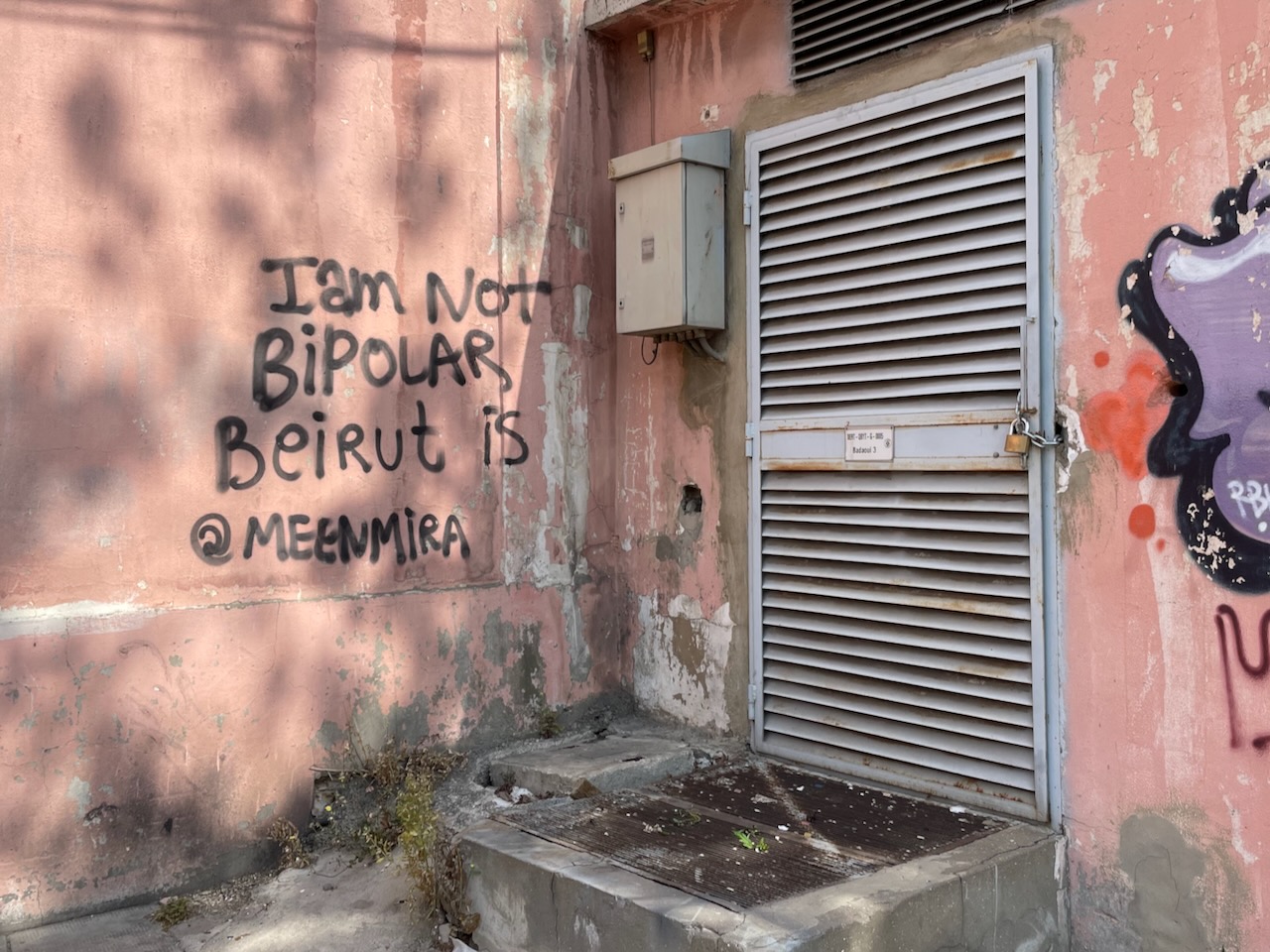
When walls talk...
(23 May 2023 - Khalil Badawi)

            A nearby bakery is run by a fellow who was formerly chef at a fancy restaurant, along with his wife and son. The menu at any local bakery throughout Beirut is very predictable: small pizza-sized manouché, with either zaatar (thyme) or cheese on top. Plus lahmbajiin (lahmajun for us Armenians), mini pizzas (with the inescapable canned corn topping) and spinach pies. Occasional variants are out there, but this is mostly it – the typical Lebanese breakfast food. This baker, however, features his wife’s home-cooked dinner entrees for lunch. Each morning I receive a photo of the whiteboard on the easel out front with the plat du jour written on it.
            One day recently I went to get two portions of this “slow food served in a hurry” – something made with flat beans, a few cubes of beef, swimming in lots of its juices. You have to understand, whenever I stop there to get the plat du jour, or even just to inquire about it, Tony (name not changed to expose the guilty) nonetheless insists on feeding me a soup spoon full of whatever the main course is. Although I’m going to be eating that exact dish in a few minutes, I am required to sample it right then and there in his shop! Well, that’s where my American logic kicks in – not pure logic, but suburban American logic, which considers this kind of behavior as unnecessary, unhygienic and imposing. You know – the logic that prohibits all the things that help people feel they are part of a community. Until now I was able to emerge from these force-feedings unscathed. But last week the plat du jour did me in. Tony placed almost the entire spoonful into my mouth, but a bit of the juice ended up running down my shirt. Not a problem, he handed me a tissue to wipe it off… So, the rest of the day I wore that badge of honor on my shirt, a tribute to our messy/friendly/business relationship. Each time he feeds me a spoonful of the plat du jour (even if I don’t buy it that day) is followed by “Good, no?” in his borderline English. To I invariably answer in my borderline Arabic: “Akeed!” (“Of course!”) or “Tayyib!” (“Tasty!). And it is! Messy and tasty!

How many languages do you need to get the
message? (30 May 2023 - Bourj Hammoud)


            I’ve experienced similar encounters all around the neighborhood, each one deepening the connection. At the falafel place up the street I am called “Abouna” (“Father”) by the owner, who also invariably hands me a piece of falafel to munch on while he makes the falafel sandwiches. A bonus! At another bakery the baker knows my usual order and rather than me ordering my usual “cocktail” (round flat bread, thin and a bit crispy, with half zaatar and half cheese), when I enter he says, “Cocktail?” and all I need to do is smile and nod. At the mini-markets around here I am also a known quantity, but I enjoy seeing the puzzled look on the shopkeepers’ faces when I show up in clergy garb, knowing I have messed up the category I have been inhabiting. The next time I enter the store they are clearly unsure about how to address me…

A mini-marathon to celebrate 80 years of
Armenian Evangelical Education!
(20 May 2023 - Ainjar)

            None of this is an excuse for the mess that passes for a government here, or the absence of public utilities that brings ever more electric wires to the mess of wires overhead to make up for that absence, or the lack of desire to pursue the common good, only the advantage of your own group's “boss” (witness the recent elections in Turkey). And I haven’t even begun to speak of the state of Armenian communities, organizations and institutions the world over, including Armenia, swimming in money and expertise (and, in the case of Armenia, tourists), but lacking the clarity that comes from a well-studied and broadly accepted national direction.

            We Armenians caught a brief glimpse of unity 105 years ago when, despite the shortcomings of officialdom, Armenian leaders organized troops and volunteers to put a stop to the genocidal enemy’s plan to overrun and annihilate Eastern Armenia along with its Western Armenian refugees. The battles in May 1918 at Bash-Abaran, Kara-Kilise and Sardarabad are a paradigm of wise strategy and unity in the midst of disarray and discouragement in the wake of the “ethnic cleansing” perpetrated by Ottoman Turkey. Today, as the same enemy continues the same genocidal efforts from Artsakh to Armenia, we are amazed at the country’s indifference towards these existential threats, and its inability to find, foster, or choose leadership with these qualities and this far-sightedness. What a mess our people are in!

LebCat 59: "This is Tony's bakery, right?
He uses cheese, right?"
(19 May 2023 - Mar Mikhael, Beirut)

            Messiness is how life is. But being a mess is simply irresponsible.

            As we do our daily adjusting to the messiness of existence and all the predictable unpredictability of life in Lebanon, we of course keep in mind the training we dutifully took as part of our appointment here, which instructed us to avoid having the same daily routine, to change our commuting routes each day, to have contingency plans at the ready, to be on the lookout for threats, and so forth. And we scratch our heads. And we trust God.   [LNB]

Saturday, June 1, 2019

Friends and Others


26.Friends and Others (31 May 2019)
Friends gathering after a worship service at Emmanuel Church
to be with Pastor Harut Khachatryan, whom they met last
summer in Armenia. (16 May 2019 - Nor Amanos -
Baouchrieh)
They say that it’s the tough times that show who your true friends are. This doesn’t mean that those who are not really concerned about whether you exist are your enemies. It just means that they aren’t your friends. Sometimes I wish that the term “friend” weren’t so commonly used so as to dilute its meaning. After all, in the Bible the term “friend of God” (applied to Abraham in James 2.23) is intended as a special designation, just as when Jesus called the twelve “my friends” (in John 15.15). Now, a “friend” is what you get when you click on a name. And then there’s the Armenian word, “բարեկամ” (paregam), which means “one who wills good”. Well, even Armenians use the word indiscriminately. Like “Paregam (friend), move your car from in front of my shop.” Said without a smile, but with the implication that you or your car might not remain unscathed.
My friend Angele Kebab slipped and hurt her
arm a few months ago, but now is back to
making delicious sandwiches!
(24 May 2019 - Nor Hadjin - Beirut)
            A few weeks back there was a car parked in front of a nearby apartment building. We have no idea whose it was, but from Saturday afternoon until Sunday morning, for over 14 hours, its theft alarm rang. The whole night. And nobody showed up to claim it and stop it. Fortunately, I lack the tools and the know-how to stop a car alarm. So I merely spent a sleepless night listening to it. My guess is that no one called the police (and their barracks are located right above the place where this car was) to locate the owner and make it stop.  Because, why bother? Not just the police, or the neighborhood, but people in general are easily influenced by the usual things that cause people to abandon responsible behavior. Self-preservation. Gain. Running into walls. Powerful people who make and enforce their own rules. And so, the alarm just keeps ringing all night. Not friendly. But only one night.
            Our regular grocer, a young dad named Attieh (an Egyptian), has officially weighed in: my Arabic is definitely improving. He mentioned it to someone who works at the same school – a high school – where I take lessons. So of course the news got to my Arabic teacher that there’s been progress in my speech, independently verified, so she was delighted, the principal was delighted, Maria was delighted, everyone was delighted. It’s nice having a regular grocer, not just so as to be compelled to speak the language and therefore improve, but also to be treated like a friend, when the cucumbers on display are a bit too limp, or the bananas a bit too long, and he’ll open up the good stash. And brag about your Arabic to others.
A sidewalk vendor. closed for the day, displaying
various Armenian symbols. And the words, "Jesus
loves you". (29 May 2019 - Bourj Hammoud)
            Yesterday I went to buy some traditional “Ramadan bread” – there’s got to be a different name for it, but for years that’s what our family has called it – from the baker at the corner where we lived from 2000-2003, in the Zarif area. Delicious stuff, with sesame and nigella seeds, nice and soft. The neighborhood used to be very heavily Armenian-populated before the Civil War, but now only a few families remain. They remember us – Arab, Armenian, Muslim, Christian, which means you need to go around to all the shops and say hello to all the shopkeepers who used to serve you. As I walked from Haigazian to our old neighborhood I realized that I wasn’t feeling the apprehension I once had due to my (then) limited (i.e., non-existent) Arabic. Back then, I tried to take one of my boys or my wife with me so I wouldn’t get stuck not knowing what to say.
            So I strode from the bakery across the street to Maalim Toufiq and greeted him (3 kisses, the proper way), asked about his family, and he asked how I was, how Maria was, how my children were. Then he introduced me to the other men there, who also remembered us from a decade-and-a-half ago. We talked a bit, he asked again if we were visiting or staying in Lebanon. And then an older gentleman walked in – remember, this is a small “produce stand” by western standards – and he introduced me to him, I wished them each a blessed Ramadan, and was on my way. Like old friends, which we are – both old as well as friends. (But I’m older than Toufiq.)
My little flying friend, waiting on top of the exhaust fan for
someone to come to the rescue. (31 May 2019 - Geitawi, Beirut)
            Today I noticed some kind of dust on the bathroom shelf, and heard a clicking noise from the exhaust fan above the shelf when I switched on the light, like a twig was hitting the fan blades. So I called the building caretaker for us to go up and look at the exit pipe. Nothing unusual there, though just to be sure that no nests could be made there I lowered the cover so that only a few millimeters of gap remained. I went back down to clear out whatever was stuck in the pipe, pulled the fan housing, and what to my wondering eyes should appear, but a juvenile sparrow, sitting on top of the fan assembly? It must have gotten in earlier in the day when there was a greater gap on the roof, and, unable to fly back up the narrow pipe, just sat there. Except that when we turned on the light (and fan), the blades of the fan were hitting its legs and claws, as I later realized when I saw blood spatters while cleaning up the fan.
LebCat 25: Caught in the act of slashing tires,
while the lookout just looks. Hey, they’re cats.
(22 May 2019 – Qobayiat - Beirut)
            Well, a friend (“paregam”) is one who wills and does good, right? So I got a towel, hoping that it would accept my good will and not flap all around the bathroom. I grasped the bird with the towel, tightly enough that it wouldn’t fly, and showed it to Maria (of course). “Show-and-Tell” never gets old! I could feel its heart beating, but since I am not an ornithologist I have no idea if it was normal speed or racing. Also birds do a great poker face, so there was no facial expression I could read. I wondered, was this bird badly injured? Was it able to fly before it fell in? I needed to take it outside, to our patio, and see what condition it was in (junior veterinarian, reporting for duty). When I took it outside and started unwrapping the towel it immediately flew off at high speed. Without even a parting photo op. No selfies of “me and birdie”. And I was relieved to see that.
            In two days I will be conducting a choir concert performed by the “Armiss” choir. The group worked hard, and I’m praying that all goes well. We’re expecting a good-sized crowd, especially after two radio interviews, a bunch of newspaper ads, fliers in store windows, Sunday announcements, and posts on our dear “friend” repository, Facebook. My greatest satisfaction will be presenting this as a gesture of good will, of encouragement and of joy to this strained city and especially to the Armenian community. That’s what friendship is. That’s what friendship does.   [LNB]

Wednesday, October 31, 2018

On My Head


19.On My Head (31 October 2018)
            One of those essential phrases anyone living in the Arab world needs to know is “on my
Inspired by Lark on the Move, you have to find
where Maria and Linda are. In the equivalent of
an ancient Roman narthex! (13 Oct. 2018 –
Baalbek, Lebanon)
head”, or, alternatively, “on my head and eyes” (3ala rassi/3ala rassi ou 3ayni). When I go to the grocer, I know he’s going to send greetings to my wife, and although I try to keep my conversation limited to onions and grapes, he inevitably throws pleasant chatter at me. Yesterday he sent the usual greetings, but I was able to fumble out an “3ala rassi” in response as I was leaving. Add that to the other things “on my head”, and you have a pretty accurate description of what’s happening in our lives these days.
            Still, even with the continually-postponed resumption of my Arabic lessons, I’m managing semi-well with what’s on my head and eyes. Although we’re no longer newcomers, we still have people looking at us as if (but denying they are thinking that) we are crazy for picking up and moving to Lebanon. But we also have people who are delighted each time they see us, and (we hope) are encouraged as much as they encourage us.
            As we become more aware of just how big a struggle it is for so many people to manage life here (although my focus is just on Armenians; it is similar for lots and lots of people), our hearts are even more broken. More frequently than before friends are sharing, quite openly, about their plans to leave Lebanon for Armenia. Others may have plans to move to Europe, the U.S. or Canada, but they tend not to share that with anyone but those closest to them.
Some young cedars of Lebanon in the background, and some
old guys (Mike and I) in the foreground. Guess which ones are
going to be around longer. (14 Oct. 2018 – Barouk, Lebanon)
            Things like not having a government (after 5+ months) doesn’t really get anyone’s attention, though it should – especially of those who are horse-trading the lives of their citizens for personal gain. Not that I’m a fan of politics, but the phrase from the 1992 U.S. presidential elections comes to mind: “The economy, stupid.” That’s what is grinding down individuals, families, communities like the Armenians, community organizations, and pretty much the entire social fabric. The biblical injunction to “pray for kings and those in authority” (I Tim. 2.2) is not just a nice, occasional add-on to personal and corporate prayers; it is an essential for us, something we continually cry out to God for him to answer. We pray not just for local authorities, but for those far, far away, too, who affect life here.
            A couple of days ago a friend mentioned how, because of the sagging economy in Lebanon, a cascading effect is happening. The central bank (just now?) has decided that it can no longer give loans to first-time homeowners, due to the economic situation and a bunch of other things. (Point of clarification: the “homes” I’m talking about are not the American-style
Bread on the cooling conveyor. Most of what you buy won’t
last the trip home-mmmm. (13 Oct. 2018 – outside Ainjar)
single-family homes with a lawn and a fence. It’s a cramped, sometimes brand-new, apartment in one of those ugly high-rises I regularly rant about.) So, with no home loan, young people are cancelling wedding plans because they won’t have a place to live aside from a room at their parents’ home. And that means all the related businesses are also suffering – those who would clothe, feed, photograph and entertain the wedding guests. And those who would sell furnishings to the newlyweds. And sell them cars. And later on, baby things. And later on, school tuitions and incidentals. (Again, I’m thinking particularly of the struggling Armenian schools and families, but it’s an overall phenomenon.) And so on, and so on. For someone like me to come in and share the message, “Place your hope in Christ!” that person must be willing to also, and first, listen to and care for those whose hope for a normal life is fleeing from them.
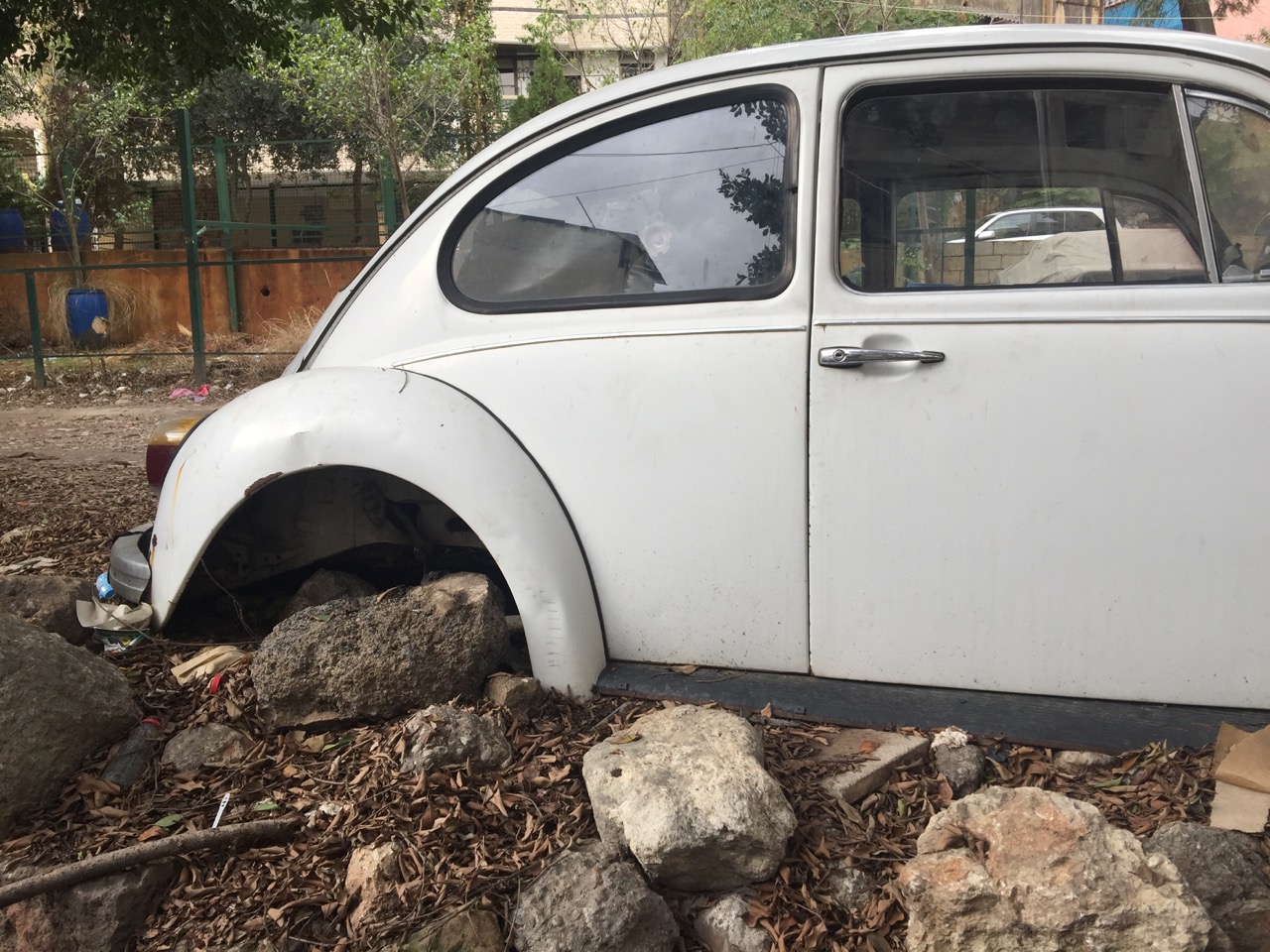
A Volkswagen from the Stone Age, complete with
prehistoric tires. (22 Oct. 2018 – Khalil Badawi, Beirut)
            But seriously, folks, reality aside (hah!), I really would rather be writing about all the interesting and fun things we’re experiencing here. And there is plenty that’s interesting and fun. Like receiving an official delegation and Armenia’s “caretaker” Prime Minister, Nigol Pashinyan, who visited the Armenian Evangelical Union leadership (interesting). Or like the visit of dear friends from Philly, Linda and Mike Sywulak (fun). They visited missionary friends of theirs in Kenya for a week, and then spent a week with us this month, getting introduced to Lebanon, its history, its natural beauty (I mean that), and its vital Christian ministries. For us, it was a welcome respite, and an occasion to reflect on our time here so far. For them, it was an opportunity to turn something abstract into a concrete picture that they can talk about and pray for.
The ashtray of no ashes. A Zen moment in a
Sassine Sq. diner. (12 Mar. 2018 –
Ashrafieh, Beirut)
            So, we got to be tourists! Finally! Nothing like visitors to provide you with an excuse to “see the sights”. We showed them all five Armenian Evangelical churches in Lebanon, plus their schools, plus the old age home (CAHL), plus KCHAG, plus more. They got to speak directly to workers in these ministries about their joys and burdens. We traveled to the ancient cities of Baalbek and Ainjar and Byblos. We visited some of the majestic Cedars of Lebanon (and witnessed the ongoing reforestation efforts). We got to see “Linda’s new favorite bakery,” with Arabic bread rolling out of the oven like big wheat pillows onto a cooling conveyor. And we got to treat them – and ourselves – to several different places that serve Arabic ice cream. All in seven days!
            Fortunately, aside from all these special events there are many things that tickle my brain on a daily basis. Like seeing an ashtray in a restaurant with no slots to hold your cigarette, and a “no smoking” symbol engraved on the side. Perfectly normal to locals – because that’s where you put your straw wrappers and zip-tops from your “pepsi” cans. Oh, and “Pepsi” is the generic name people use to refer to carbonated beverages, no matter what the label says. Like “kleenex” is for Americans.
            A frustrating bit of brain stimulus has to do with rampant Americanisms around us, like the adoption of that most worthless of American holidays, namely Halloween. In talking with a taxi driver a few weeks ago, after remarking on a huge billboard advertising some Halloween event in a predominantly Muslim area, he said, “We are forced to accept these American things because they are part of our children’s (American) textbooks. I do not like it, but my children learn it because it is there in their books.” Children carve jack-o-lanterns, dress up in skeleton costumes, and adults “dress up”, too. Thanks to social media, this vapidity (some would call it “evil”) is being copied the world over, including in Armenia.
LebCat 18 (black & white) and associates:
OK, so it’s October 31. What’s that got to do with
us? (31 Oct. 2018 – Mar Mikhael, Beirut)
            How about “Black Friday” sales in Lebanon? Its original American (and consumerist, in the worst sense) moorings are irrelevant here. It’s a catchy phrase that represents an American (and therefore, to many Lebanese, desirable) way of getting people to spend money they don’t have to buy things they don’t need. Does anyone believe that that will turn around Lebanon’s economy?
            But I have homemade fun, too, observing my environment as I walk from place to place, dodging between cars parked every which way – especially on the sidewalk – and avoiding other cars as they try to pass each other from opposite directions on a one-way street where cars are parked on both sides (welcome to my neighborhood… won’t you be my neighbor?). There are always a few cars parked in the middle of the street. Probably the driver came home very late last night, and probably there were cars between his car and the curb, though now it’s just empty space. Soon enough he’ll come down and nonchalantly get in and drive away, as if it’s the most unremarkable thing in the world to park overnight in the middle of an intersection. Recently when we were passing one of those “creative” parking jobs, a friend driving us around said (in Armenian), “One day he’s going to eat it.” Oh, it loses so much in translation!
            Now, back to my efforts at creating databases and websites and choirs and more! [LNB]

Tuesday, April 11, 2017

Donkeys and Questions


3.Donkeys and Questions (11 April 2017)
A racehorse, far from the Beirut Hippodrome
            Two days ago, on Palm Sunday, as Maria and I were making our way by car on the coastal highway to a nearby Starbucks for a post-worship cappuccino, our driver (and friend) said, “Get your camera ready.” We were right next to a McDonalds restaurant when we saw what he meant: a jockey was leading a horse. With a saddle. On the highway. Why? That’s easy to answer. It’s because the sidewalk isn’t big enough for a horse to walk on, of course.
            Asking the question “why” is not only one of the most valuable ways of learning, it is also the key concept of the past several weeks in my Arabic class. We are learning that in order to answer “why”, there are at least six ways of saying “because” in Arabic. Why? Because there are so many different reasons things happen. And because we are practicing our becauses just because. There’s so much more to learn . . .
My Arabic study-buddy, Hilmar, at a café (in Ain Mreisse), which uses old sewing-machine legs as tables
            You know the claim (or hoax) that there are a hundred different words for “snow” in some Eskimo languages. Why? Supporters of this claim say that it’s because snow is an important part of their lives (global warming notwithstanding). Well, we found out that there are five (and counting) ways of saying “friend” in Arabic. Why? Because friendships and relationships are so important in this culture. People you know and people you don’t know all get involved in your life, and some become your friends. Whether they are helping you park a car or stopping you on the street so you can help them find an address, I’m learning to value those relationships over what I used to consider my “rights”. Like the right to walk on a sidewalk without finding a car parked on it, or the right to pull out of a parking lot without finding a parked car blocking the exit. Or the right to have things go my way, or that my way is of course the right way. Did all of that sound very Western? It should, because that’s where I learned about “rights”, but not so much about the surpassing value of relationships. In this new environment it’s time for me to tell myself, as that arbiter of world conformity, Apple, used to say in its advertisements: “Think Different”.
            So why did we see a horse, and not a donkey, on Palm Sunday here in Lebanon? Well, it’s a fine horse, don’t you think? And anyway, we’re going to learn a children’s song in Arabic class that tells us “everybody has a car, but grandfather (jiddo) has a donkey.”
            We saw something else, too, this Palm Sunday. This unholy week. Blood and death in Egypt, attacks intended to exterminate Christians from a land that has been their home since Christianity was new. We have dear friends there, and we mourn, and we ask “why”. Especially, we ask “why” in our prayers to God, because we know that the only satisfactory answer to that question is something that doesn’t sound much like an answer: “Why? Rely on my grace. It’s sufficient.” (Check it out in II Corinthians 12.8-10.)
            And only a few days before that, we heard of a chemical attack in Syria, that was followed by an aerial attack on Syria. Why? Lots of answers are being offered, but little proof or sound reasoning. Why? Who needs proof when you’ve got bombs? No matter which of the five words for “friends” in Arabic we use, we nonetheless have many of them in Syria. What will come next, and how will they endure the unrelenting pressure on them to abandon their homes, livelihoods and roots. And why should they have to?
            In the aftermath of this week of horror, Pope Francis’ words this Palm Sunday are the sanest and most sobering thoughts I can pass along: “May the Lord convert the heart of those who sow terror, violence and death… and also the heart of those who make weapons and trade in them.”
LebCat 2 (11 Feb. 2017)
            Now it’s spring in Beirut, which means before long the snow will melt from atop Mount Sannine, and we probably won’t see rain (to speak of) until the fall. Yet since it’s early spring, everything is still green – a delight to the eye, and a balm for the soul.
            So, I offer you the next LebCat, caught in action (cat-action, that is) atop a car, a couple of streets over from where we live. I’d love to know what you think is in its “thought balloon”! [LNB]