Showing posts with label Turkey. Show all posts

Monday, November 11, 2024

Who Are You Fooling

64. Who Are You Fooling? (11 November 2024)

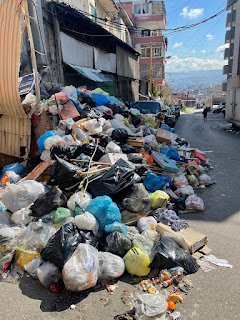
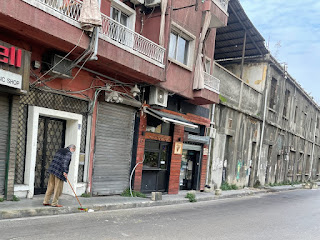
A side street in autumnal Beirut
(4 Nov. 2024 - Gemmayzeh)

We’ve been telling people, “We will only be gone for four months,” as we prepare for our mandated “home assignment.” We’re going to the U.S. to have meetings and travel around to talk about our work, as well as to have our term agreement renewed. This was all supposed to happen next summer, but as Lebanon’s stability and safety became more questionable, and as Israel spread more and more misery around, our supporting bodies moved that four-month excursion to a fairly immediate departure, just four days from now. When we say to our colleagues and friends, “We’ll be back in four months,” are we fooling anyone with this hopeful but uncertain declaration? Who knows what monstrosities are yet to be perpetrated on peoples indigenous to the region, with the bloody complicity of the government of “the land of the free and the home of the brave”? Who are we fooling except ourselves?

Even Lebanon's cargo holders are painfully
crying "Akh!" (20 Oct. 2024 - Yerevan)

            Genocide, or “ethnic cleansing”, or “ensuring our security”, or the legion of other names assigned to it is so commonplace that we are no longer repulsed by the word – except when you are the one promulgating this policy. Exterminating those in the way of your expansionist designs is acceptable practice around the world, whether by Israel or Azerbaijan or Turkey (the ones that most immediately impact me as an Armenian, also linked together by their cooperative genocidal efforts). Brutality obliterates morality, and all the hand-wringing in the world will not protect the rescuers and witnesses trying to bring a modicum of humanity to this misery. As Israel targets hospitals, ambulances and journalists, and laughingly destroys families and lands, and as Azerbaijan (with Israeli technology) and Turkey destroy Armenian architectural heritage, convert churches to mosques or lying about their origin, they prepare themselves to richly receive the wrath of God (see Romans 1).

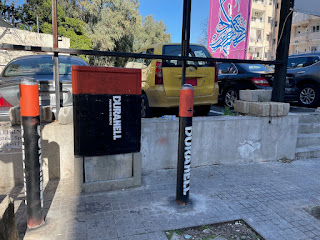
Political parties marking out their
territory, just like it was... 50 years ago.
(11 Nov. 2024 - Geitawi)

            Also puzzling are the regular announcements of an imminent cease-fire, an imminent end to hostilities in Gaza, the West Bank and Lebanon. Is the intent to fool a gullible public somewhere in the world? Or to raise hopes among those subjected to this sub-humanity, so as to shatter those hopes completely? Depending on who you talk to, this war will either be over in a couple of weeks, or will continue until Lebanon is also annexed and ceases to exist except on 20th century maps.

            What causes me the most pain is seeing the long-term effects of this attack on Lebanon and the impotence or unwillingness to confront it, particularly as it relates to inter-communal relations. Apparently one of the aims of this war is to create internecine strife, pitting one community or demographic against another, trading blame, scapegoating, and so forth. It’s the “divide-and-conquer” approach of any occupying power throughout history.

Hopefully these children will be
just as enthusiastic about
actually reading.
(25 Oct. 2024 - Yerevan)

            Coming to an even more personal level, the wartime conditions further threaten and weaken the Armenian community of the country and region, and therefore the church, moreso than it already was last fall. Rather than us thinking ahead and building towards a more healthy and stable society, we are witnesses to the dismantling of what has been built for the last century. The saddest of all is the dismantling of families. Armenian parents actively encouraging their children to emigrate. Armenians with dual nationalities permanently, not temporarily, relocating. Skyrocketing numbers of divorces among Armenians. Rampant substance abuse, physical, sexual and mental abuse, wasting of income on legal and non-sanctioned gambling.

            Those of us in positions of responsibility must now focus on disasters at the expense of other non-urgent but important issues. Recalling the post-Genocide period, when the Armenian people were subject to similar stresses, the people in leadership intentionally looked at the community’s long-term needs and urgencies, not just immediate relief work, and built a legacy that endures till today. In this crisis if we must find a way not only to ameliorating people’s suffering from the war, but moreso to plan with faith for the future of what is the most important center of the Armenian Diaspora. Without visioning and planning we are only fooling ourselves into thinking that this community will continue its existence.

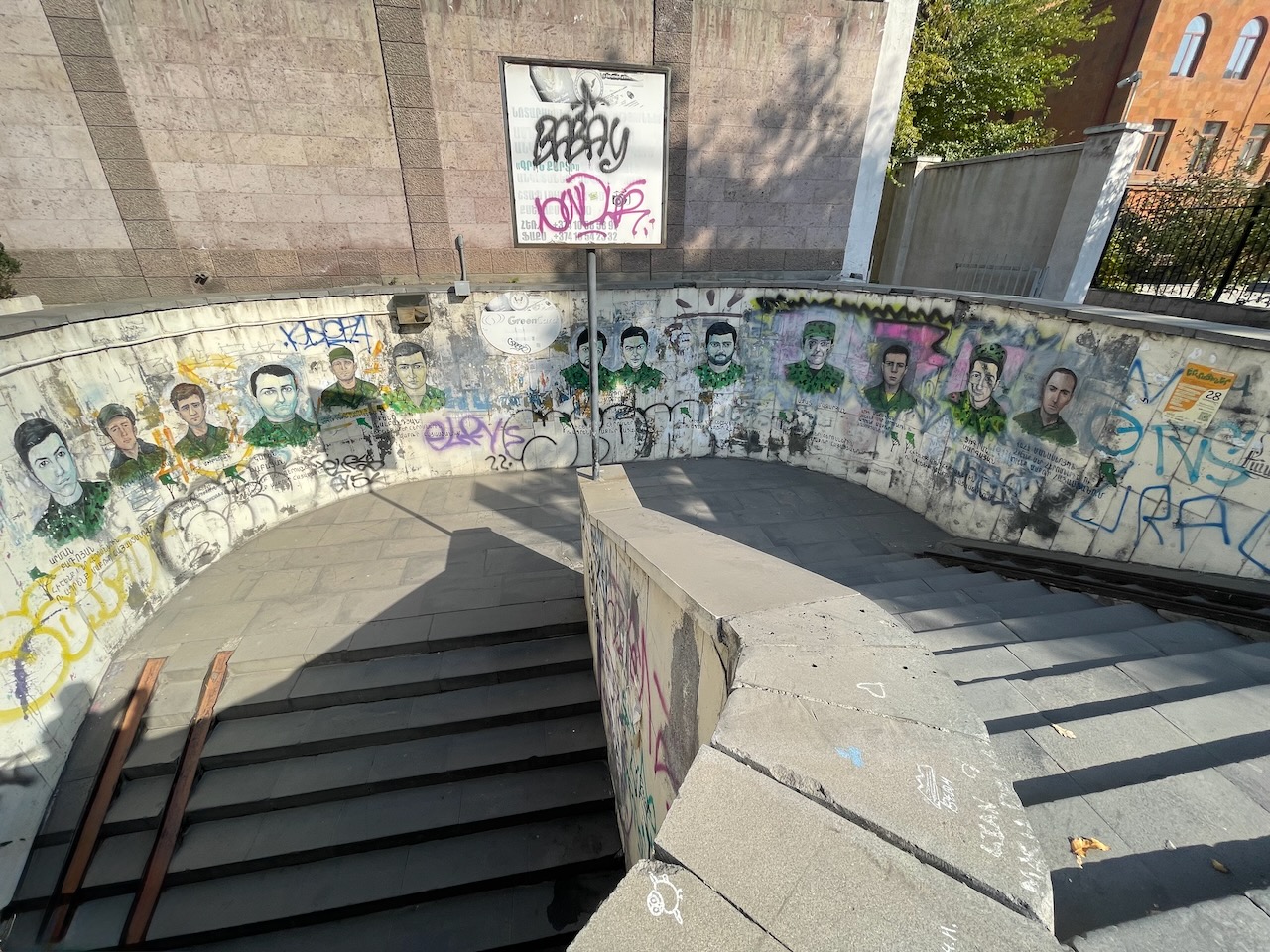
The faces and names of soldiers who fought
and died in the Artsakh war and
deportation, graffitied all over
the capital. (2 Nov. 2024 - Yerevan)
            One cannot help but feel a change in the capital, after the influx of a million internally displaced people on top of the three million residents of the metro area. Cars parked everywhere. Unfamiliar faces and dress. Arguments, fights and much worse over “squatters rights”. Generators catching fire from overloads while municipal electricity is scarcely supplied. The diffidence of what few police and army personnel are still visible. If Lebanon was a DIY country (see my previous post), then this is a DIY war, where the population is left alone to figure things out and survive by their own wits or connections, while bosses continue their decades old, self-serving political wrangling as usual.
            And when the war inevitably ends, what then? Will things magically return to their previous state, and people effortlessly drift back to their flattened villages? Will massacred families and clans magically reappear and reclaim their birthright? How much can one country fool itself? I say “one country”, although Lebanon is not really one country but an amalgam of tribes living within one political boundary. The building and rebuilding of society and the development of a healthy social contract where none are marginalized is one of the greatest challenges facing Lebanon in the coming decades, and is something that has been waiting to be addressed for its entire history.

LebCat 64: Intensely focused on birds
flying around... and certainly aware that
it is only a reflection? But they're so close!
(9 Nov. 2024 - Bourj Hammoud)

            Meanwhile, our friends’ faces bear fearful and questioning looks when we tell them about our change in plans. “You must know something, that’s why you’re going,” they say outright or imply non-verbally. Try as we may, we are unable to assure them that we have no insider knowledge about what is to come, something that contradicts their doubts concerning why we are leaving now instead of later. We cannot fool them into thinking otherwise, nor do we want to. And we hope we are not the fools, either. Only through hope in God can we look forward to their fears being disproved.

            So, without any self-deception, but with faith and hope we lovingly say that in four months we will be willing and able to return and continue our part in that work, “with God’s permission”, as the Arabic saying goes (“bi’izn Allah”).   [LNB]


Monday, February 28, 2022

Relatively Speaking


48.Relatively Speaking (28 February 2022)

Covering up the damage to buildings, while in the
distance Mt. Sannine shines with winter snow.
(13 Feb. 2022 - Marfa'-Beirut)


The world is quite busy with the current war in Ukraine, with pundits making statements and analyses and so forth. Aside from all the tragedy, a war can be very helpful to bring focus to people’s lives, and it helps news outlets to know how to fill their pages. Officialdom is also busy with making an assortment of punishments, which will then turn into reality. The story told in the “West” is that they are making the world safe for democracy. Why do I feel like I’m reading a superhero comic book? The story in the “East” is probably being told in a similar way, with the protagonists and the antagonists being swapped. Although details may seem crystal clear to partisans on one side or the other (especially to those touting the significance of cell phones to record and disseminate “information” about the war in “real time”), the only clear and indisputable facts are that armies are fighting and people are dying and being displaced.

One of the ever-present, never-
resolved crises.
(11 Feb. 2022 - Geitawi-Beirut)


            And this arouses a raft of thoughts and questions and “what-if”s in me. Especially, as an Armenian, I can’t help but make comparisons and contrasts between what is happening today and the punishing war on Artsakh by Turkey & Azerbaijan 16 months ago. The war on Artsakh is not a thing of the past, but is continuing in various forms to this day. Now that a similar (but only relatively) operation has broken out nearby, these musings have asserted themselves more forcefully. Musings about the role that Ukraine played in assisting Azerbaijan’s and Turkey’s armies in their onslaught against Artsakh. Or the call to foreigners to fight alongside Ukraine, only slightly similar to Diasporan Armenians wishing to travel to Armenia fight Artsakh’s aggressors. Or the complicated web of business, military and energy connections between ostensible adversaries, such as what we see between Russia and Turkey, relative to their actual mutual dependencies and co-dependencies. And not least of all, the diffidence exhibited by Russia and the West towards Armenia’s desperate struggle to not be overwhelmed by overwhelming force, contrasted with the intense engagement by those same players in the current crisis to prevent overwhelming force to be used.

When asked what makes the Lebanese keep on going,
refer them to this picture.
(12 Feb. 2022 - Mar Mikhael-Beirut)


            It is telling how Europeans express their shock at such barbarity and brutality in “their” Europe, while accepting that same barbarity as an unfortunate given in “uncivilized” places like the Caucasus and the Middle East. It is also telling to see the speed with which Europeans opened their doors and borders, contrasting sharply with the begrudging and reluctant acceptance policies for those knocking on the door who are black, brown or other than “European-looking”. Welcoming the stranger is easy when the stranger looks, speaks and worships like you, but not so much when the only thing you have in common is the stranger’s humanity. Imposing an economic and military barrage on your opponent may seem noble, until you take into account the financial dependencies that exist between Ukraine (that are almost totally absent in Armenia’s case) and its defenders and offenders; then the nobility of the actions begins to appear tarnished. Additionally, the two countries (Armenia and Ukraine) are probably on relatively equal footing in the “who is more corrupt” game; but that corruption is overlooked when those leaders lean in the direction you want and have the goods you want. The next thing you know, the posse comes riding over the hill to save the day.

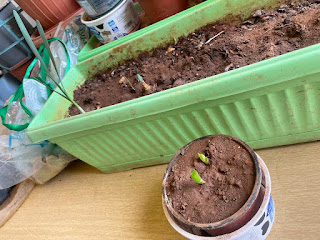
Out of barren soil, spring somehow emerges!
(28 Feb. 2022 - Geitawi, Beirut)


            One of the things that saddens me the most is to hear the same vainglory from Ukraine as what we heard from Armenia and Artsakh in 2020: “We will win because we are committed. We will win because we are Ukrainians/Armenians. We will win because we are fighting for self-determination,” and other such foolish expressions. Armenians were defeated because they enjoyed living in the past far more than they loved preparing for the future. This will always be the fatal flaw Armenians must realize they have if they want to continue existing above ground, and not six feet under. Ukraine’s fatal flaws and its future trajectory have yet to be seen – as of this writing, anyway.

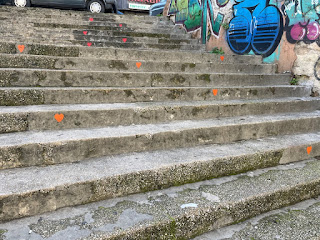
Hearts appear here and there in the neighborhood. Also
kindness, here and there.
(25 Jan. 2022 - Mar Mikhael-Beirut)


            For comic relief (although it is tragicomedy), Turkey’s boss has been quite bellicose about NATO needing to act more decisively against Russia, its best frenemy. “The West needs to do more than give advice,” he said, though that advice-and-no-action approach of the West served him quite well in his war against Armenia, and in the current “normalization” talks happening between the two countries. He speaks these tough-guy words against Russia while also keeping his country’s military drone business with Ukraine humming along. Not to forget Ukraine’s white phosphorus sales to Azerbaijan, used against Artsakh in 2020. There’s enough hypocrisy to go around, so that every single country in the world can have a nice, big slice of the pie!


A local Armenian shopkeeper, keeping more than just
his own shop clean. (22 Feb. 2022 - Qobayiat-Beirut)


            Relatively speaking, what appears to be very similar in these two acts of aggression can be both relatively similar and completely dissimilar, all at the same time. Maybe when books are written about this in 20 or 30 years we’ll be able to figure it out better – that is, if people can still think or read (or write) in 20 or 30 years…

            Spring is trying mightily to make a difference in the cold, rainy days we’ve been living through. Meanwhile, I’m getting a lot less exercise than I did last month. That’s because we’re getting a lot better at assessing our power use and not overloading the supplementary power line, resulting in throwing the circuit breaker down a ways away (cf. Blog 48: “Power-Hungry”). We had a meter installed that shows our consumption, so now we know when we are near the 10A borderline and when we have enough room to turn on a second heater. It’s quite a luxurious feeling not having to run up and down all those steps; so now I’m at a loss as to what to do to stay in shape. But living in a building without an elevator (most of the time) will at the least help my fitness plan a bit.

LebCat 48: You may kiss my paw if you wish.
But just once. (5 Feb. 2022 - Geitawi-Beirut)


At the joint Vartanants commemoration here in Beirut last week the irony of it occurred to many of us: the same day we were commemorating a war Armenians fought (and lost) in A.D. 451, a new war had broken out. Well, to be fair, the war in Ukraine did not just break out in a single day – it had plenty of time to fester. And the Vartanants battle did not last just one day, nor did it end in defeat, as those with only a partial knowledge of history like to say. It was the opening battle in a 33-year war that ended in Persia granting Armenia the freedom to worship Christ. As we continue to ride the bumpy road to who-knows-where in Lebanon, I think the key idea is to trust God and persevere. There’s relatively little else that we can do than that, and that may actually be the best thing that we can do.   [LNB]

Monday, April 12, 2021

A Soapless Shave

43.A Soapless Shave (12 April 2021)

One more crumbling building in the
port area, swathed in scaffolding,
awaiting rescue.
(7 Apr. 2021 - Karantina-Beirut)
Last month, while the country was still in the throes of a total lockdown in order to stem the spread of the coronavirus, I made a sneak visit to the barber. As if conducting an illicit transaction, I walked towards his shop and happened to see him (or rather, he saw me) in his parked car. He rolled down his window. “Kiifak! I have to run an errand. I’ll meet you there in 10 minutes.” Since I know that “10 minutes” is not to be taken literally in Lebanon, I showed up in 20 minutes. Looking this way and that, he lifted the rolling shutters (the “daraba”) of his tiny shop, just high enough for us to fold ourselves in half and scurry in, then pulled it down behind us. He did his standard men’s haircut (the only one in his repertoire), and finished with a scissors-trim of my beard, and a scraping off of the unwanted hairs outside the “beard zone”. And did so with a straight razor, of course. With water.

            But anyone who has handled a razor knows that one must also use a thing called “soap”. But not this day. Could it have had something to do with the lockdown? I’m not sure. Perhaps if a policeman had come along, banging on the daraba, demanding to know if barbering was happening inside, the barber could have legitimately said, “No, I am not barbering,” since one does not shave without soap, right? Because if you are shaving someone without soap, your intent is to inflict as much pain as possible on the hapless person draped with a sheet and confined to your barber chair (i.e., me), and not to produce a smiling, satisfied customer.

The frustration, disillusionment and hope
expressed in graffiti on the barrier wall
at the port. (7 Apr. 2021 - Beirut)
            I was, in fact, experiencing on my own skin the oft-used proverb spoken by Western Armenians (and in Turkish, of course): saboun-souz terash (սապուն-սուզ թրաշ), meaning “a soapless shave”. Its meaning is not self-evident, whether in Turkish or in translation. It is not a reference to the pain such a shave induces, but rather to one who does not use all that is required for a task. It conveys a range of meanings that include “insincerity”, “hypocrisy”, “deceptiveness” and, ironically, “buttering up someone”. Hey, I would have even settled for butter to compensate for the missing soap!

            Shaving without soap is something existing all around us, especially when the subject is politics. The claims of Lebanese politicians, each the servant of some wealthy, unseen master locally, or in the region, or in powerful states, fits this phrase. One of them insists that he is honest and concerned for the suffering of the Lebanese people, while another says that no, he, not the other, is the one who truly has the people at heart, and on it goes. (And if you don’t like my use of the generic singular pronoun, I encourage you take a closer look at Lebanese politics.) Their concern for the poor is touching, except that none of them know the pain of those families who are reducing their daily meals to two a day, and then to one. None of them (no, not one) know the misery of those who sell their household possessions, piece by piece, in order to pay school or university tuition. Or the shame of having to receive handout after handout from NGOs, while the heads of the banking association and the Central Bank governor, in their grotesque charade, waste day after precious day pointing fingers at one another while the Lebanese Pound continues its downward spiral, and hyperinflation its upward spiral. A shave of the head as well as the beard, without any soap.

A traditional ibriq made of recycled
glass recovered from the Aug. 4 blast.
(27 Feb. 2021 - Geitawi-Beirut)
            The phrase is also clear in the pronouncements of the leaders of the countries that organized and conducted the latest episode of their genocidal program to eliminate Armenia and Armenians from existence. (This is not hyperbole, nor “Armenian hysteria”, but an old, cold-blooded agenda.) Turkey’s president recently spoke in support of the Armenian Prime Minister when cries for the latter’s resignation swelled in the past few months. It was indeed surreal: a neo-sultan who claims to be the keeper of peace and stability in the region, who also guaranteed Azerbaijan’s dominance in last fall’s war on Artsakh, also claims to wish to have “normal” relations with Armenia. Meanwhile, it pursues territorial advances in the Caucasus and encourages its “little brother” there to desecrate and destroy Armenian culture, just as it did in historic Armenian lands in the century since the Armenian Genocide. A shave that produces bloody wounds, over which world powers express sympathy, but are unwilling to stop.

A biblically-appropriate house built upon the
rock, with a beautiful view of Lebanon's
true beauty. (8 Apr. 2021 - Hammana)
            Not only all this, but the saying is further evident in the endless venting of rhetoric of various Armenian leaders, in and outside Armenia, in order to justify themselves and rally their supporters. No evidence of depth or far-sightedness shows, no plan or vision for mature state-building emerges; all one sees is the appearance of love of country, without substance. This posturing is a daily feature in the country and the Diaspora, while emigration continues unabated. Little did we know three decades ago that today the Armenian people would be so far from having a strong homeland; farther in many ways than their condition during the Soviet era. A barber who has forgotten that one needs soap in order to give a shave without injury.

A few of the hundreds of olive trees newly
planted on the Armenian Evangelical Church
campus, next to the Christian Endeavor Hall.
(2 Apr. 2021 - Ainjar)
            Maria and I had forgotten what the world looked like outside of our concrete home in our concrete neighborhood of our concrete city. The opportunity came thanks to the COVID-19 vaccine, for which we traveled 40 km (25 mi) to Azounieh last week. Trees! Wildflowers! Mountains! Snow! Villages! Fresh air! Orchards! Goats! Narrow, old streets! Speed bumps! It was almost too much to take in at one time. But we took it in, and enjoyed every moment, despite the presence of a pair of contrails far above our heads, evidence of daily airspace violations over Lebanon in order to raid Syria. Both Maria and I received our first shot, and since then already got notification for the follow-up shot in a few weeks. We'll take that, hoping for as few side-effects as we experienced this time, and enjoy a welcome reprise of our “natural” Lebanon tour.

A traditional and oft-seen do-it-yourself
parade through our neighborhood. Literally,
a Good Friday Caravan (get it?).
(2 Apr. 2021 - Geitawi, Beirut)
            Actually, for me it was the second time in one week that I was able to escape the city, having traveled to Ainjar to lead the Armenian Evangelical Church’s Maundy Thursday communion service. Something about springtime buds appearing on fruit trees fills you with wonder and even hope. And seeing so many boarding school youth in attendance, along with walking around to note new developments on the church & school campus (and being with the pastor and his family) impacted me positively as well. On the trip back to Beirut on Good Friday I even saw snow falling, for the first time in four years! Turns out it’s the same as I remember it.

            A few days ago I took a walk back to the site of the port explosion. Seeing the quantity of repair and restoration yet to be done is staggering. And the Lebanese are feeling it all the more as lengthy, daily power cuts pile on top of the crashing economy, the political intransigence, the pandemic, and the social despair. It has been difficult for me to think during the past few months, difficult to know how to express myself, as evidenced by my lack of writing.

LebCat 43: It's spring, and kittens are in bloom.
Mom and her three future LebCats.
(6 Apr. 2021 - Qobaiyat, Beirut)
            But we celebrated Easter! Yes, it was an online service for us (we’re being very cautious), though many others went in-person, ostensibly with official permission. Remembering Christ’s victory over the enemies of sin and death is a great encouragement in places and times such as this. A few of our church youth succinctly captured the “upward call” we have towards the Lord Jesus in a short video they created in place of the traditional Easter sunrise service at KCHAG conference center. Our hearts continue to long for the day when we can come together to proclaim the resurrection; but even that inward longing within us can shine a light outward, and bring healing in the dark and pain-filled places of this world.   [LNB]

Sunday, November 29, 2020

Know Thyself

40.Know Thyself (29 November 2020)

No Independence Day celebrations on Nov. 22,
but a large, hand-painted flag was hung over
the damaged buildings in central Beirut
(24 Nov. 2020 - Beirut)
Sunday morning in Beirut… the last day of a two-week lockdown, with hints of more to come

after the New Year’s holiday, since the COVID-positive test percentages are not decreasing. A sunny day, and all is still, as driving is forbidden on Sundays. No sounds but the loudspeakers broadcasting church services, mostly the Armenian Apostolic liturgy from churches in Nor Hadjin, Khalil Badawi, even across the Beirut River from Bourj Hammoud. Church bells and chants… and the sound of Israeli drones. They’re up there practically every day; yet on quiet days like today their sound can even be heard inside, behind closed doors and windows.

            My mind drifts from our balcony in Beirut to those Armenian soldiers in Artsakh (the correct historical name; but if you are a big fan of Soviet nomenclature, you can go ahead and call it “Nagorno-Karabakh”), soldiers in their trenches and posts, some of whom we have a close personal connection to, trying to fight a conventional war against drones similar to what we hear all the time. Bought from the same country, not coincidentally, as well as from another nemesis of Armenians, Turkey. The Turkish ones are made from components imported from all over the world, Europe, Canada, U.S., and others. All sold to countries that hold their hand over their heart and swear that the technology will never, ever, ever be used against unarmed civilians.

Businesses, large and small, closing
permanently. So, why bother replacing
window glass? (31 Oct. 2020-Accaoui, Beirut)

           
Oh, it was a bloody war, and many civilized and uncivilized countries had a part in it and bear responsibility, if they do any self-examination: those who indignantly protested against it (but did little else), and those who said, “Hey, Armenians, don’t take it personally – it’s just business”; that sponsor and importer of Islamist militias and Turkic settlers into the Caucasus; those who promoted the anti-Armenian propaganda and lies emanating from Azerbaijan and Turkey; and not to forget those who had other “strategic” interests to pursue and couldn’t really be bothered by the dismemberment of an ancient people from their soil. It was just another news story in a media and online environment that has many interesting wars and disasters and flashpoints to flit to and from. Everyone in the news-ish industry was able to leave it behind after the infamous Armenian-Azeri-Russian cease-fire document of November 10.

All 970 of my office books, back in our moving
boxes from 2017, waiting for the refurbishing
to finish (2020-11-20 - Geitawi, Beirut)


But Armenians haven’t moved on. They can’t. The sorrow, shame, disgust, self-loathing, recriminations, protests, calls for resignation, fund-raising, speech-making, mourning, desperation, search for abducted soldiers and citizens, belated attempts to have countries recognize the Republic of Artsakh, appeals to human rights groups, appeals to cultural preservation organizations, more sorrow, more shame, and on and on… have swallowed up Armenians’ souls worldwide. I have felt that we Armenians are now living inside a horror movie whose plot continues to unfold, with no ending and no credits. Like many others, I am wishing to awake from this nightmare and find that it was not, in fact, a re-creation of the human devastation of the 1915-1923 Genocide and the subsequent decades of cultural genocide. It’s quite strange, when you think about it—complaining about being in a nightmare while unable to sleep properly.

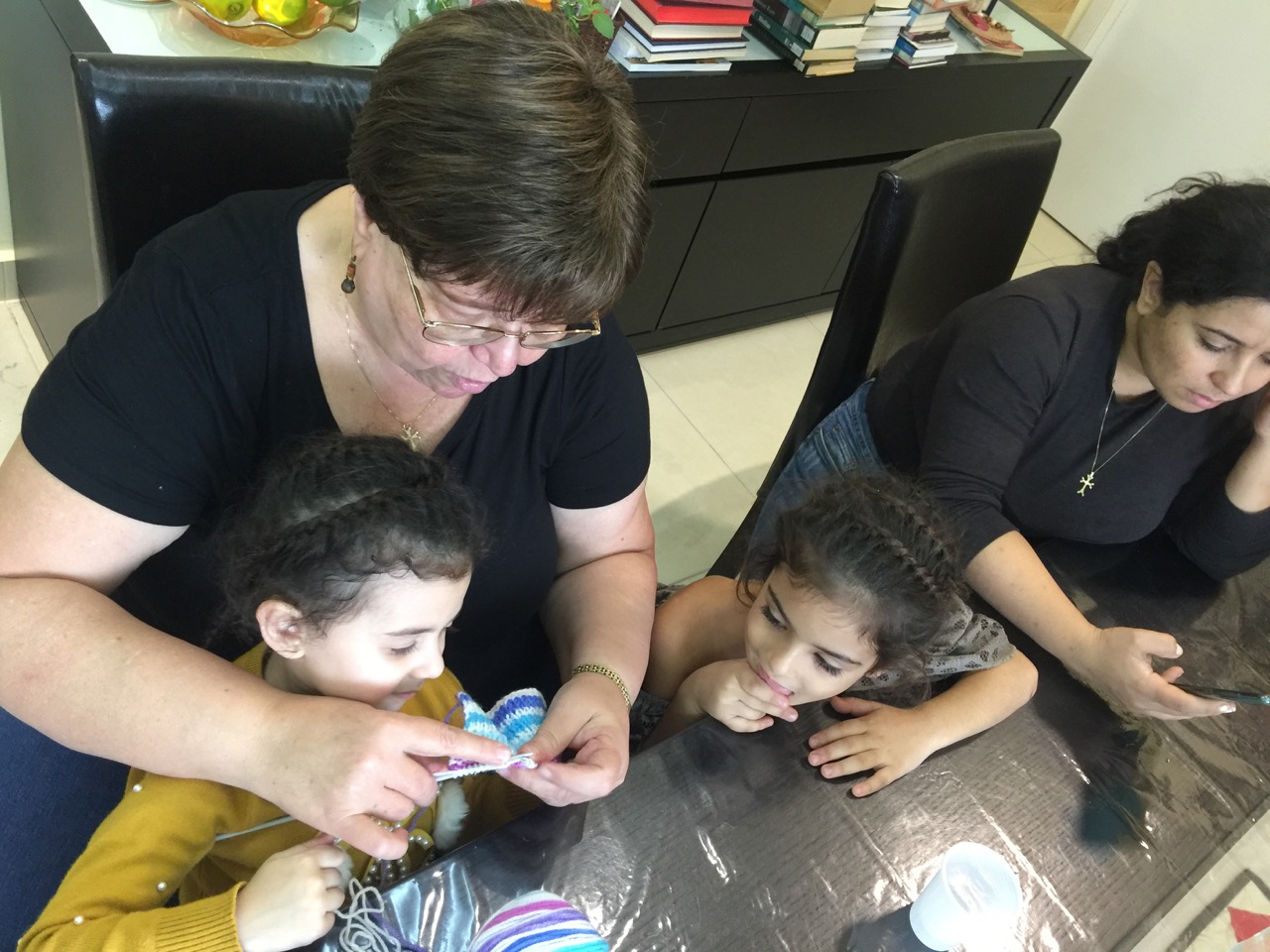
Maria showing the neighbor girls how to knit,
while one of the moms awaits some news
from Artsakh (15 Nov. 2020 - Geitawi, Beirut)

           
In the context of this national disaster I am forced to come to terms with the ancient saying, “Know thyself”. Before knowing your friend or your enemy, it is necessary to know yourself deeply – what drives you, what confounds you, what blinds you. Knowing one’s friend or even one’s enemy can provide an important window into this crucial self-knowledge. And since Armenians apparently have more of the latter than the former, it would follow that knowing ourselves should be a fairly direct matter, one to which we can readily apply ourselves. However, this 44-day war clearly showed how little we know our friends (such as they are), or our enemies (who were more than we realized), or even ourselves (who think that songs and poetry can win wars). Our flawed understanding of how to live in this sin-filled world expressed itself grotesquely in the self-confident misinformation shared with Armenians the world over each evening by the army’s press spokesman. He invariably ended with the words: “Don’t worry – we are winning.” It also appeared very clearly in the self-justifying speeches of Armenian leaders after the cease-fire treaty was signed. It was more subtly expressed in the three decades of public theft and unaccountability since Armenia’s “independence”, and in their lack of preparation for this inevitable attack by Azerbaijan and Turkey. It was seen in the century-and-a-half old, romantic, self-deluded attitude of certainty that the West will come to the rescue of Armenians “because of our dark eyes”. It is seen now in the rapid implementation of road construction, cultural destruction and appropriation, and ongoing propaganda disinformation spread by Azerbaijan. It is visible in the dazed finger-pointing and calls of “traitor” by one Armenian to another. We have not known ourselves or our weaknesses; we only see our accomplishments. And we have blinded ourselves with the pride that we are somehow valuable to this world’s powers that be.

Christmas trees on each balcony, but no glass
(24 Nov. 2020 - Beirut)

           
Not only this, but our theology has reflected that same misunderstanding. We have a long list of why we think God will play favorites and give us advantages that he won’t afford other nations. This is not to say that we do not have a unique, valuable, irreplaceable cultural and religious heritage, a history that predates the “winners” of this war, and a multiplicity of things of which we can rightly be proud. But that cannot be the basis of a hope-filled, faith-filled, self-giving Christian nation. As well, none of those treasures or that history can form the basis of an intelligent, balanced, and farsighted strategy of nation-building. Will we know ourselves more fully as a result of this catastrophe? Even if it only be “as through a mirror, dimly”, we have no choice but to make the effort.

The bird never stood a chance.
(26 Nov. 2020 - Geitawi, Beirut)

           
Watching the American election from overseas was akin to watching a fan’s amateurish remake of “Survivor”. Days upon days, weeks upon weeks of bewildering events and announcements before and following Election Day provided an unwelcome diversion from the depressing news that was crushing us – and only us, it seems – each day. Whatever transpires in Washington these next several weeks will do little to improve the lot of the millions around the world, struggling just to stay alive, including Lebanon and Armenia. Meanwhile, will America come to know itself, and see who and what it is clearly from within; and also learn something from those on the outside, from those upon whom it makes not just an impression, but an indelible imprint for good or ill?

            Here in Lebanon the same ancient question applies: do we know ourselves? Do we understand what drives us to see some things and ignore other things, both good and bad? Do we note that we are being made to play by “rules” that have been at work since the end of the Civil War, rules that keep communities divided and competing with each other for privileges? A few days ago the caretaker Interior Minister said, “95% of Lebanon’s judiciary is corrupt”, to which, tragi-comically the judiciary responded, announcing that it was going to prosecute him for making such a statement. As Armenians say, “If I say ‘leb’, you should understand ‘leblebou’ (chick peas).” It was his polite way of saying that the system is rotten to the core. Will anything be done to remedy this? Can anything actually be done? To which I say, “Who runs Sicily these days?”

LebCat 40 - "Don't make me get up, I just found a
nice, warm spot." (19 Nov. 2020 - Geitawi, Beirut)

           
Following the disaster here in Lebanon the cabinet had enough integrity to resign. They knew that they no longer had credibility with its citizens, and could not in good conscience stay in their positions. The theater that subsequently is (still) playing out here in the capital is another story, a story in which “everyone, that means everyone (kullon, ya3ni kullon)” is back on stage. Compare and contrast this with what happened following the strategic disaster in Armenia… What more can I say?

            Somehow it seems appropriate that in this maelstrom we were able to gather with our neighbors (including our three families in our building – a sort of permanent “quarantine”) for a Thanksgiving meal, complete with a turkey imported from the U.S. Tensions and uncertainties were temporarily suspended, even though we all felt the sorrow over the death of our neighbor’s brother during military service in Shushi. We enjoyed the blessings God has granted us and knew this about ourselves: during this season of isolation we have not been abandoned by God or by one another.   [LNB]

Friday, October 30, 2020

Where Credit Is Due

39.Where Credit Is Due (29 October 2020)

A hotel clad in metal sheeting, similar to what Beirut’s
banks did to guard against protestors. But this has a
message. (28 Oct. 2020 - Downtown Beirut)
Here from crisis-ridden Beirut, as Maria and I look anxiously toward war-stricken Armenia and Artsakh (Karabagh), while living in a world reeling from a pandemic, while refugees flow unabated from their impoverished and unstable homelands like tributaries of a sorrowful river, and while second-class citizenship in “first-world” countries hangs like a cloud of fear over people of color, we struggle to comprehend how quickly we got mired in misery so early in this ill-fated century.

            They say that one should avoid speaking ill of the dead. Yet, it is impossible to avoid recounting the dead people who prepared this dish that this region is “eating” today. One of those dead people of course is Josef Stalin, who in the early 1920s tried to win the support of Turkey, as well as cut down the aspirations of the Armenians struggling to their feet after the Genocide, and perceived as a risk to the Soviets, capable of asserting themselves at some point in the future. Well, guess what? Here we are in that future, and the nightmare that Father Stalin and Beria (both Georgians, btw) cooked up for us has come true. Those two demons are peacefully decomposing, and we are struggling to exist. Their calculated act of “giving” historically Armenian regions to the rule of Turks or Turkic peoples set up the scenario that is playing out today.

Someone with a musical sense of
humor created a group that is
trying hard to cover up Beirut's
wounded heritage buildings before
the winter rains wreak their havoc.
(29 Oct. 2020 - Gemmayzeh, Beirut)
            To those who rely on others to think for themselves (including those who play at editorial roles), I am compelled to remind them that Stalin never gave non-Armenian lands to Armenians; it was always the other way around. (Please, please, don’t take my word for it; read some history for yourself to check what I’m saying.) The Azeris got Artsakh and Nakhichevan. The Georgians got Javakhk. The Turks got Kars and Ardahan. And Europe and the United States got their oil access.

            Oil access for the West plays such a central role in the sordid history of the Middle East, but is too often footnoted, ignored or denied. From a safe distance people (including Diasporan Armenians) shake their heads and say, “Why is there never peace in the Middle East?” Is it because Middle Easterners are wild and untamed people, unable to be as wise or developed as Europeans or Americans (or other regional allies)? Or, as history has shown, is it because the West has for at least 200 years been in a tug-of-war (emphasis on the “war”) over who will be able to benefit the most from the reserves of crude oil that regrettably exist in abundance underneath the surface of these lands? Figuratively as well as literally, oil lies under the surface of so much of the Middle East, but it is pumped out and taken away from our view, so that discussions of current events ever remain on the top layer.

Lots of banners in lots of languages, expressing
hope that Lebanon will overcome its
overwhelming difficulties (29 Oct. 2020 -
Gemmayzeh, Beirut)
            There was a recent interview with chess grandmaster Garry Kasparov, born in Baku, Azerbaijan SSR, to an Armenian mother. He likened Stalin’s incomprehensible and unjustifiable assignments of Armenian territory to a chess game, which Stalin expected to end in stalemate, since of course the USSR was going to last forever. Stalin’s aim was also to bring Turkey to the Soviet side, but the West moved Turkey’s piece on the chess board, granting it concession after concession, including their promised protectorate of a Cilician Armenian homeland. If shame existed in western culture, those countries would be hanging their heads right now.

            But since Armenians have no natural resources for outside countries to exploit, it remains ever the pawn in these international playing boards. Realizing this fact is not defeatism but realism, and if fully comprehended can enable Armenia and Armenians to formulate their strategy – hopefully – in dealing with this “Game of Thrones”. It has brought about unprecedented unity among Armenians worldwide, though sometimes tainted by fervent devotion to one or another political party in their countries of residence. Armenians are hearing the war being waged against them in the Caucasus portrayed as a “conflict” between equal forces, a “dispute”, something that they have been going at for “a looooong time”, an action of “rebels” in a “disputed territory”, and the deliberate targeting of civilian infrastructure (residences, churches, hospitals, schools, museums, etc.) as either accidental or “Armenian propaganda”. Anyone with the ability and the will to think and dig deeply will see how preposterous these statements are.

For obvious post-blast reasons, Salaam
Sweets, our favorite Arabic ice-cream shop,
moved from its original location. About the
same distance from us, thankfully.
(24 Sept. 2020 - Mar Mitr, Beirut)
           Thinking for oneself is an uphill battle in this world, where people have access to so much information – true, false, partly true, blatantly but boldly false, or too nuanced to survive in social media feeds. My highly unscientific view ascribes this allergy to deep thinking to the lack of a reading public. No longer do (many) people have the appetite or patience it takes to read a book or an extended essay. If something can’t be grabbed in a short glance as you scroll down your devices, then it’s “very complicated”. Our reward for adjusting our human capabilities to the least common denominator is that we have leaders and followers who are apparently incapable of thinking of the common good, and pour their efforts into shouting down or shaming anything or anyone who says differently. For this, we must give ourselves the credit.

Refurbishing, refurbishing, refurbishing. One
day I will get back into my office. (28 Oct. 2020
- Geitawi, Beirut)
            We are viewing all of this in a Lebanese context. One year has passed on the “revolution” – a year largely of failures, and a few bright spots of hope. Those who might have taken a different tack and led the country out of its sub-sub-divisions into a common goal for the benefit of all were sidelined and ultimately rejected by the established parties and powers. So, to no one’s surprise, the prime minister who resigned a year ago at the start of the “uprising” is back, and working on forming a “new” cabinet.

            Taking a walk through the broken streets of today’s Beirut brings upon me a heaviness that is difficult to describe. I noticed this early on that I am viscerally affected by what I see, and I audibly wince as I look about. It puzzled me for a while, but it made me realize that this amount of destruction displayed before your eyes draws you into the pain of others. Add this to your own pain, and you have to express it somehow. My expression is audible. And mental. There is still no credible explanation as to whom we can give the credit for the ruination of Beirut, or of Lebanon.

LebCat 39: Pre-freshman enrollment
in the AUB "Cat Club" is now open.
(22 Oct. 2020 - Bliss St., Beirut)
           
Rarely in my life (so far) have my exhausted days and sleepless nights been so filled with the sorrows of existence. It has turned my heart with a renewed and urgent focus toward a scripture that was my favorite from childhood: “God is our refuge and strength; a very present help in trouble” (Psalm 46.1). If we experience any peace in this world or in our lives, the credit is due to the Lor
d.   [LNB]