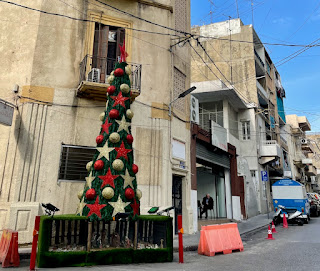
Saturday, April 30, 2022

The Same Playbook

49.The Same Playbook (30 April 2022)

Facing the electric company and registering
his opinion with no ambiguity
(28 March 2022 - Gemmayzeh, Beirut)


One of the most distressing feelings one might have is when it seems like someone, near or far to your heart, has obtained a copy of the script of your life and is reenacting the worst scenes in it, sometimes with only slight variations. There is nothing you can do to affect the outcome except to watch helplessly (or avert your eyes) and hope for the best. You know the story line, because you went through it once – or perhaps copied from someone else’s playbook before you, and at that time you didn’t listen to anyone’s advice to take a different direction. The saying in Armenian (and other languages) is true: a person learns from his own purse. Rare is the one who learns from another’s hard lessons.

The children showing the people how to
worship (10 April 2022 - Geitawi, Beirut)

            It seems that this is also true on a larger scale, with entities such as organizations and even entire nations following a preset script. The Armenian nation presents an interesting example of this, as it takes up its old playbook and reenacts the worst days of its own history. In general, its behavior is fueled by a strange bit of amnesia as to the reasons for it suffering what it did in the past, combined with an inability or unwillingness to chart a different course for the future. The country of Armenia, ever at the mercy of greater powers, is struggling to continue its existence, while it suffers setback after setback following its disastrous defeat in 2020. The Armenian people, part of the larger entity called “the nation”, are sometimes filled with concern over what is happening, and sometimes are profoundly disinterested over what seems (to them) will not really affect them. An acquaintance from Armenia recently said that these days are probably more dangerous than the post-Genocide days. I concur, because the post-Genocide generation knew that they needed to forge an identity and pursue that in all aspects of their life; we of today’s generation are so fragmented and individualistic that we cannot be bothered to see where our indifference and disunity will lead us.

Easter morning, the pied piper of... KCHAG?
(17 April 2022 - Monteverde)

            I had the good fortune of never having been a serious participant in any sports activity. Always one of the last to be chosen when picking teams in or out of school, I early on put aside any delusion that I possessed sports-related skills. I focused on the arts and music (but not on studying). But, whether you use the playbook or the script image, this is a helpful way to view today’s disastrous world, and to see important connections between seemingly disparate events. The “who-cares-we’re-a-failed-state” playbook had been in use by local leaders long before the economy crashed, though it was never publicized. It is still the primary one driving current events and directing local actors to perform well for their masters. The population has picked up the well-worn copy of the “vote-for-your-party-not your-country” as it nears parliamentary elections in May, following which those elected will be using the “it’s-their-fault” playbook when daily life fails to improve. Those outside Lebanon use the “benevolent-state” playbook, announcing their full support for local reforms while maintaining policies that undermine any possibility of improvement in any area.

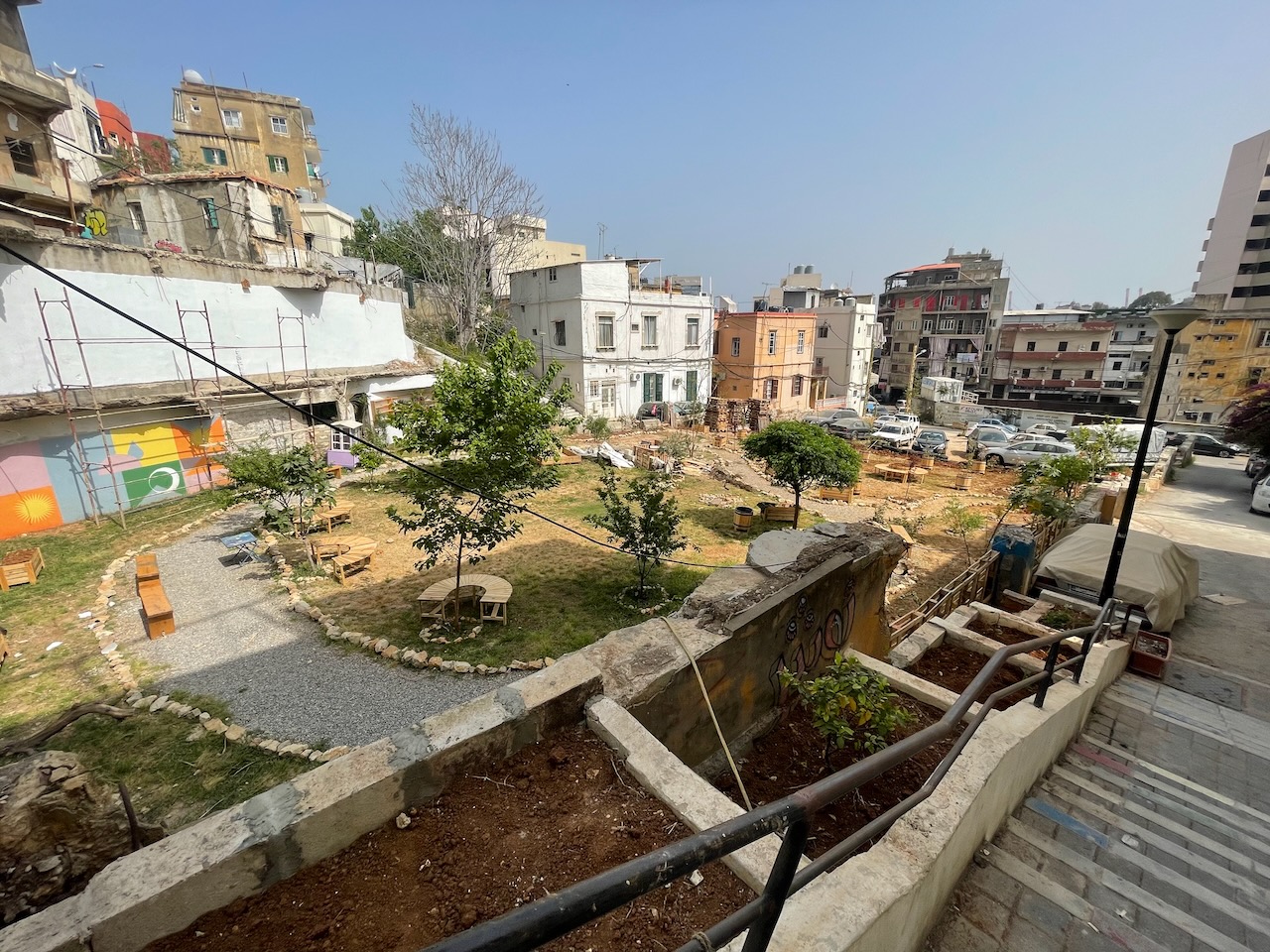
An "illegal" green space developing on the
grounds of the former Laziza brewery.
Greenery appears to be illegal in Beirut
(28 April 2022 - Geitawi, Beirut)

            During the current European war the “bomb-into-submission” and “everyone-is-our-enemy” playbook is the one in use, connecting today’s aggressors to the aggressors in the Artsakh war of 2020, and so many other wars, including the Ottomans’ war against its Armenian citizens a century ago. The “territorial-integrity” playbook is in heavy use in Ukraine, just as it was by Azerbaijan (and by the sympathetic but impotent friends of Armenia) when Artsakh was being attacked. The “black-and-white” playbook is opened frequently in the West (and for the West), in order to explain the intricacies of wars and security actions to those with limited interest or ability to discern grayscale shades. And the “your-oil-is-more-important-than-you” playbook is probably the only one shared by every single major power, no matter in which direction their guns are pointed or shipped. The “ideological-high-ground” playbook is also frequently read from, though the actors never take the stage. It is a grand drama and a high-stakes game that we are witnessing, based on a series of playbooks that will make the world the same as it has ever been, or ever will be.
Naming the evil that allows
disasters, destroying people and
their heritage (30 April 2022 -
Mar Nicola, Beirut)

            Fortunately – and I say this sincerely – there are weak and unimportant people in the world. These are the ones who I consider to be able to make real and lasting change. They are the ones who interface with their neighbors each day and look into their eyes with perception and compassion. This is not to praise interpersonal relations in general. The other day a small shopkeeper spoke of how some homemade food distributors in Lebanese villages easily take advantage of people like her by following the fluctuations in local currency against the dollar, then collecting payment well above the day’s street value, saying, “If you don’t want to pay, then I’ll find someone else to sell to.” Despite my insistence that I pay the current value of my purchase, she refused to take more from me than the outdated prices listed on her shelves.

God hears, but do we?
(8 April 2022 - Mar Mikhael, Beirut)

            My guess is that the difference lies in whether people have an actual, human relationship with each other, and not a transactional one. It’s the same with the church. Do I share a gospel message with someone because it’s expected of me, because it’s a requirement, because I consider my religion superior and his inferior or completely wrong? Or do I truly care for the other person as someone created in God’s image, whom God loves as much as he loves me? That person-to-person playbook is the one that brings true hope and opens hearts to receive the actual good news. It may be crass to characterize Jesus’ ministry in this way, but the gospel is so full of these kinds of interpersonal “detours” that Jesus took as he shared the gospel of God’s kingdom and the promised new life in that kingdom, that it must be an integral part of the message. My conclusion is that God has put his playbook into our hands and sent us from the church to the world. One who plays according to this script stands little chance of preventing the “rulers of this age” to seize the day; but in God’s timing, living this way will undermine every earthly power.

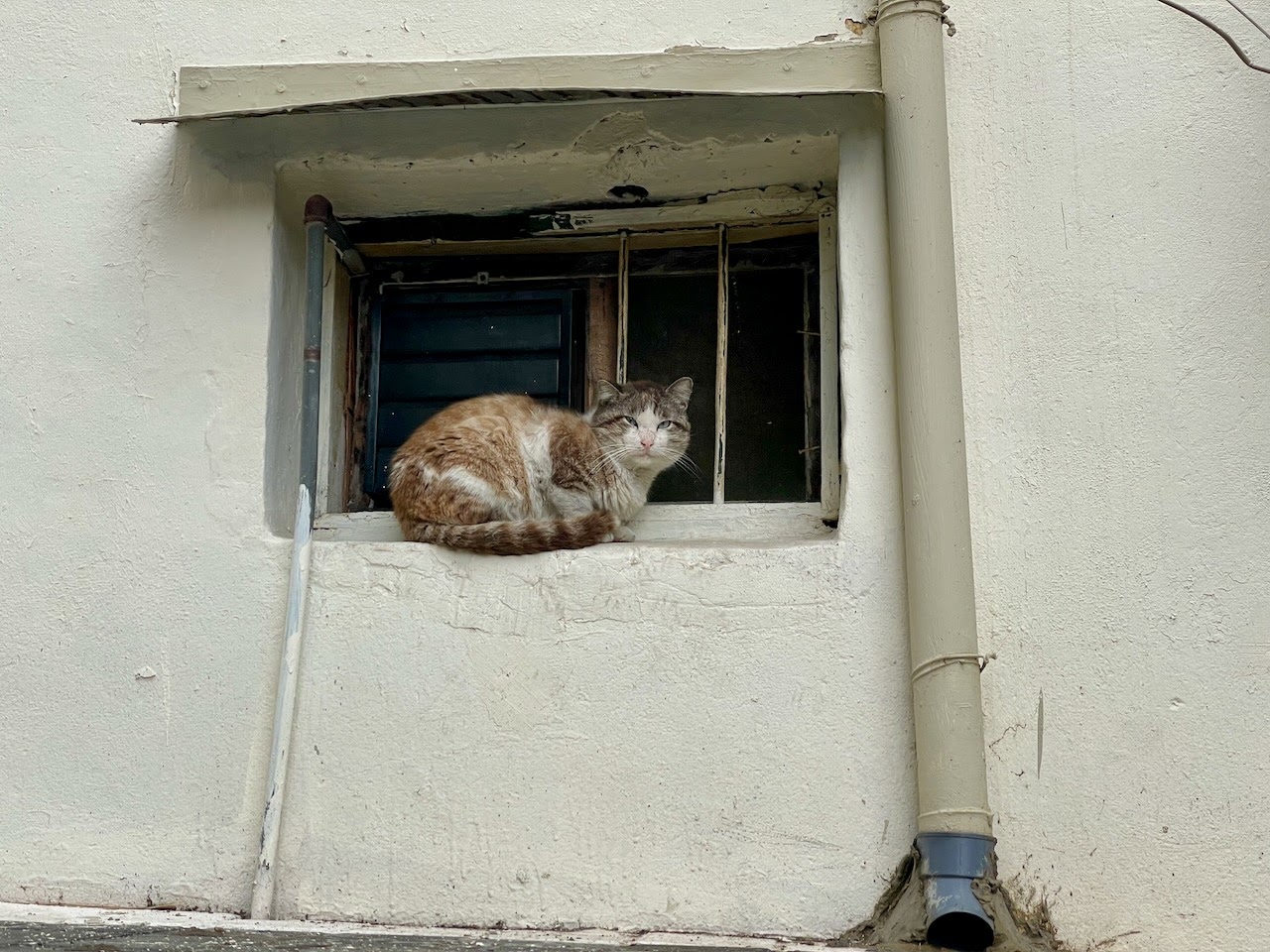
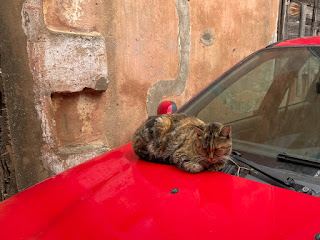
LebCat 49: Go find your own ledge!
(24 March 2022 - Geitawi, Beirut)

            We have been encouraged in recent weeks by young people in the Armenian community who, despite the discouragement and fear so prevalent in the country, have chosen life. Some have made engagement pledges to one another, others have brought newborns into the world and surrounded them with love, and all of them have taken these risky steps relying on God’s provision. God’s hand is certainly guiding them, and as they grow as families, the joy of the Lord is giving them – and us – strength.

            Once upon a time in Lebanon, when paying for groceries, if there were a few piastres (or liras) left to round up the total, the cashier would toss a pack of 2 pieces of chewing gum into your order. In recent years it became the whole box of gum, and then progressed to a sachet of instant coffee. Today as I was buying fruit from my friendly fruit-cart pusher, “Abou Mawz”, he announced 8,000 lira for a half-kilo of bananas. Then he winked and said he would make it 10,000, as I nodded and he tossed another banana on the scale. Imagine… fruit as small change. But that’s the playbook regular Lebanese people have long used. And it’s the playbook that even those most desperate to leave the country will be searching for, and not finding, in their newly-adopted homelands.   [LNB]

Monday, February 28, 2022

Relatively Speaking


48.Relatively Speaking (28 February 2022)

Covering up the damage to buildings, while in the
distance Mt. Sannine shines with winter snow.
(13 Feb. 2022 - Marfa'-Beirut)


The world is quite busy with the current war in Ukraine, with pundits making statements and analyses and so forth. Aside from all the tragedy, a war can be very helpful to bring focus to people’s lives, and it helps news outlets to know how to fill their pages. Officialdom is also busy with making an assortment of punishments, which will then turn into reality. The story told in the “West” is that they are making the world safe for democracy. Why do I feel like I’m reading a superhero comic book? The story in the “East” is probably being told in a similar way, with the protagonists and the antagonists being swapped. Although details may seem crystal clear to partisans on one side or the other (especially to those touting the significance of cell phones to record and disseminate “information” about the war in “real time”), the only clear and indisputable facts are that armies are fighting and people are dying and being displaced.

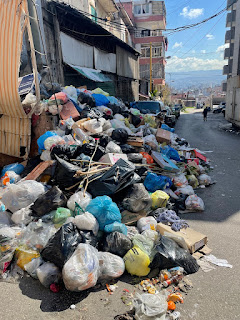
One of the ever-present, never-
resolved crises.
(11 Feb. 2022 - Geitawi-Beirut)


            And this arouses a raft of thoughts and questions and “what-if”s in me. Especially, as an Armenian, I can’t help but make comparisons and contrasts between what is happening today and the punishing war on Artsakh by Turkey & Azerbaijan 16 months ago. The war on Artsakh is not a thing of the past, but is continuing in various forms to this day. Now that a similar (but only relatively) operation has broken out nearby, these musings have asserted themselves more forcefully. Musings about the role that Ukraine played in assisting Azerbaijan’s and Turkey’s armies in their onslaught against Artsakh. Or the call to foreigners to fight alongside Ukraine, only slightly similar to Diasporan Armenians wishing to travel to Armenia fight Artsakh’s aggressors. Or the complicated web of business, military and energy connections between ostensible adversaries, such as what we see between Russia and Turkey, relative to their actual mutual dependencies and co-dependencies. And not least of all, the diffidence exhibited by Russia and the West towards Armenia’s desperate struggle to not be overwhelmed by overwhelming force, contrasted with the intense engagement by those same players in the current crisis to prevent overwhelming force to be used.

When asked what makes the Lebanese keep on going,
refer them to this picture.
(12 Feb. 2022 - Mar Mikhael-Beirut)


            It is telling how Europeans express their shock at such barbarity and brutality in “their” Europe, while accepting that same barbarity as an unfortunate given in “uncivilized” places like the Caucasus and the Middle East. It is also telling to see the speed with which Europeans opened their doors and borders, contrasting sharply with the begrudging and reluctant acceptance policies for those knocking on the door who are black, brown or other than “European-looking”. Welcoming the stranger is easy when the stranger looks, speaks and worships like you, but not so much when the only thing you have in common is the stranger’s humanity. Imposing an economic and military barrage on your opponent may seem noble, until you take into account the financial dependencies that exist between Ukraine (that are almost totally absent in Armenia’s case) and its defenders and offenders; then the nobility of the actions begins to appear tarnished. Additionally, the two countries (Armenia and Ukraine) are probably on relatively equal footing in the “who is more corrupt” game; but that corruption is overlooked when those leaders lean in the direction you want and have the goods you want. The next thing you know, the posse comes riding over the hill to save the day.

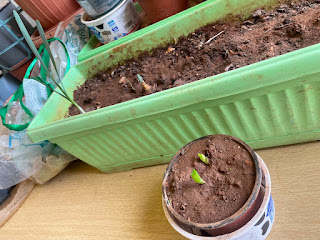
Out of barren soil, spring somehow emerges!
(28 Feb. 2022 - Geitawi, Beirut)


            One of the things that saddens me the most is to hear the same vainglory from Ukraine as what we heard from Armenia and Artsakh in 2020: “We will win because we are committed. We will win because we are Ukrainians/Armenians. We will win because we are fighting for self-determination,” and other such foolish expressions. Armenians were defeated because they enjoyed living in the past far more than they loved preparing for the future. This will always be the fatal flaw Armenians must realize they have if they want to continue existing above ground, and not six feet under. Ukraine’s fatal flaws and its future trajectory have yet to be seen – as of this writing, anyway.

Hearts appear here and there in the neighborhood. Also
kindness, here and there.
(25 Jan. 2022 - Mar Mikhael-Beirut)


            For comic relief (although it is tragicomedy), Turkey’s boss has been quite bellicose about NATO needing to act more decisively against Russia, its best frenemy. “The West needs to do more than give advice,” he said, though that advice-and-no-action approach of the West served him quite well in his war against Armenia, and in the current “normalization” talks happening between the two countries. He speaks these tough-guy words against Russia while also keeping his country’s military drone business with Ukraine humming along. Not to forget Ukraine’s white phosphorus sales to Azerbaijan, used against Artsakh in 2020. There’s enough hypocrisy to go around, so that every single country in the world can have a nice, big slice of the pie!


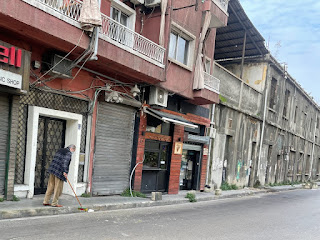
A local Armenian shopkeeper, keeping more than just
his own shop clean. (22 Feb. 2022 - Qobayiat-Beirut)


            Relatively speaking, what appears to be very similar in these two acts of aggression can be both relatively similar and completely dissimilar, all at the same time. Maybe when books are written about this in 20 or 30 years we’ll be able to figure it out better – that is, if people can still think or read (or write) in 20 or 30 years…

            Spring is trying mightily to make a difference in the cold, rainy days we’ve been living through. Meanwhile, I’m getting a lot less exercise than I did last month. That’s because we’re getting a lot better at assessing our power use and not overloading the supplementary power line, resulting in throwing the circuit breaker down a ways away (cf. Blog 48: “Power-Hungry”). We had a meter installed that shows our consumption, so now we know when we are near the 10A borderline and when we have enough room to turn on a second heater. It’s quite a luxurious feeling not having to run up and down all those steps; so now I’m at a loss as to what to do to stay in shape. But living in a building without an elevator (most of the time) will at the least help my fitness plan a bit.

LebCat 48: You may kiss my paw if you wish.
But just once. (5 Feb. 2022 - Geitawi-Beirut)


At the joint Vartanants commemoration here in Beirut last week the irony of it occurred to many of us: the same day we were commemorating a war Armenians fought (and lost) in A.D. 451, a new war had broken out. Well, to be fair, the war in Ukraine did not just break out in a single day – it had plenty of time to fester. And the Vartanants battle did not last just one day, nor did it end in defeat, as those with only a partial knowledge of history like to say. It was the opening battle in a 33-year war that ended in Persia granting Armenia the freedom to worship Christ. As we continue to ride the bumpy road to who-knows-where in Lebanon, I think the key idea is to trust God and persevere. There’s relatively little else that we can do than that, and that may actually be the best thing that we can do.   [LNB]

Saturday, January 22, 2022

Power-Hungry

 47.Power-Hungry (22 January 2022)

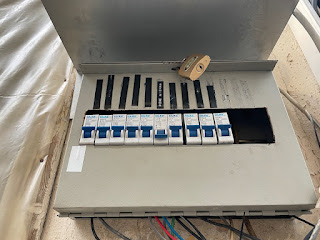
The supplemental power breaker box, with our thrown
circuit-breaker, identified as "Père Nichan".
(15 Jan. 2022 - Khalil Badawi)

Recently a friend from Armenia visited us at our home. We explained to him our happiness at finally arranging for “ishtirak”, which is a membership one gets from the neighborhood electrical generator owners, in order to fill in the 20+ hour gap in government electricity each day. “So now we have three sources of electricity: EDL (“official” power), the building generator (four hours a day most days), and “ishtirak” (except for 6 hours a night and two one-hour breaks during the day). He looked at me a bit incredulously and said, “So you’re saying that you have three different sources of power, but it still doesn’t add up to 24-hours of electricity!”

            I guess I never thought of it that way…

The long, long line, and the long, long trip
down to the breaker box, just beyond
that car... (18 Jan. 2022 - Geitawi-Beirut)

            While refugees are freezing under tents in the coldest parts of the country or asphyxiating from burning coal (or even plastic) indoors, the average Lebanese citizens themselves are not much better off than slabs of beef hanging in a meat locker – and who can afford meat these days? Meanwhile, the “leaders”, having given themselves an open-ended break from governing, beginning last October, are still dreamily wondering whether to resume meeting in order to rescue their ruined country. They are in no rush to do so, since the body being vivisected still has saleable parts. And each one of them lives under the illusion or delusion of being comfortably on the moral high ground. So many textbook examples of the term “power-hungry” in these parts, ranging from those internationally famous and respected on the world stage, all the way down to the mafia-esque generator operators one or two streets over.

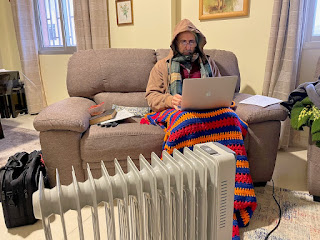
My current office - anywhere I can be near a heater.
(22 Jan. 2021 - Geitawi-Beirut)

            Yet you can find many unsung people who behave in an opposite manner, and act humanly, sharing things they could be selling to generate some income. A man who over the summer had stockpiled firewood for his village home, though currently seeking a job, decided he had enough wood to warm his house this winter, and so he started giving the excess firewood to needy families so they could stay warm. These are the people, the meek, who are the true inheritors of the land (cf. Matt. 5.5).

            The people of Lebanon have been left power hungry, in a different sense than what we usually mean. That which they need to live, to work, to learn, to take trips, to refresh, all of that which is dependent on adequate, consistent and affordable electric power is being denied them. They do not desire to control others, to bleed them dry. They just wish to live some semblance of a normal life. So what can they do? Shiver in silence, or pay a neighborhood supplier for a bit of supplementary power.

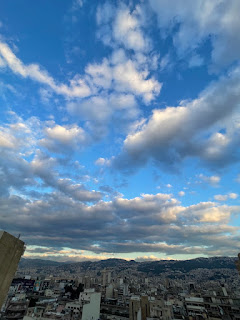
A beautiful winter sky, and a break
from the cold, stormy days.
(18 Jan. 2022 - Geitawi-Beirut)

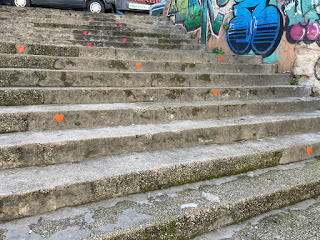
            Now that we are in that group, we have a completely new set of electricity-usage protocols to adopt, something I call the “Ishtirak Follies”. When the supplementary electric line gets connected to your home, you can’t just go on with “business as usual”. You have to learn what you can use, and when. You have to prioritize what is required and what is optional. Heater? A primary need. Lights? Don’t overdo it, one or two is enough. Refrigerator? If it’s a newer model that draws less current, OK. TV? Possibly, but it also needs to be an energy-saving model. Water pump? Turns on automatically when the spigot is opened, and without it the water flows trickle by trickle, so yes. WiFi router? Can’t get any work done without it, so make sure there’s battery power connected to it for when the power type switches from one to the other. Computers? Keep the laptops charged when there’s “real” current, and keep an ear out for the desktop’s UPS doing excessive click-clicking like a Geiger counter – that’s your early-warning system telling you to switch off some appliances. Hot water tank? That’s a borderline need, so turn it on when there’s EDL or building generator power. Microwave? Forget about it. Electric kettle? If it has “electric” in the name, cross it off your list. HVAC units? Decide which room you want to heat and don’t turn it on; use the hot oil radiator instead (on low power), and don’t even think about how you’re going to manage in the summer heat. Clothes washer? Change into some clean clothes and wait for a couple hours of regular electricity. Vacuum cleaner? Ironing? HAHA very funny.

            “Trial & Error” is the name of the game you play in Ishtirak Follies before arriving at the esoteric knowledge of what is approved and what is taboo. If the circuit breaker (“disjoncteur” in the Lebanese dialect) is right outside your home, consider yourself lucky. Pop out the front door, walk over to the box, switch it back on, and you’re done. In our case, when an overload happens, it means you flip off whatever was on, go down 6 floors, walk to the end of the back street, walk back up 6 floors (since the building’s electricity – and thus the elevator – is off the majority of the time), and then you can enjoy your light and heater!

            Here’s a real-life example of how we’re playing Trial & Error in the Ishtirak Follies:

·      Forgetting for a moment to ask yourself “What kind of electricity are we on”, you flip the switch on the electric kettle and everything goes dark. Go down 6 floors, go to the end of the street, find the switch for your apartment and turn it back on, go back and up. You say: “Let’s keep the kettle unplugged so we don’t forget next time.”

·      Heating up some leftovers in the microwave oven, forgetting to ask that same question. “Click”, everything’s off. Down 6 floors, take a walk, click on, walk back, climb 6 floors.

·      “I wonder, can I check our electricity amperage with this meter?” Pop. Go down, go over, flip it on, come back, climb up.

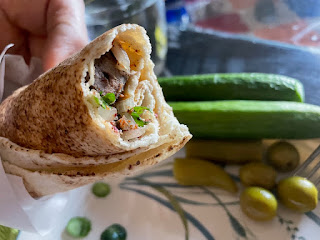
At last, my favorite liver kebab place is back
in operation! (18 Jan. 2022 - Geitawi-Beirut)

·      Electricity switches off at an odd time during daylight, so I can’t see from the balcony if others’ “ishtirak” is working. Down 6 floors, out to the box. Hmm, it’s still on. I guess the motor must be on its lunch break.

·      Two space heaters are on low power, the hot water tank is switched on, the toilet flushes, the water pump engages, and... Click! Down you go.

·      “I’ll leave the space heater on to keep things warm while I run up the street and get a falafel sandwich.” Entering the apartment with my lunch, all is dark… Oops, I left the heater on high power, I forgot to switch off the hot water tank, and the leaky toilet probably started up the water pump, sending the “ishtirak” over the edge. I decide to eat my falafel in the dark, then take my exercise trip down to the “disjoncteur”.

·      And in those brief times when the electricity comes on, we play a different game: “Kahraba (electric company) Follies”, running around and turning on the equipment that requires full power, like the washing machine, the hot water tank, heating in more than one room, etc. See above list for details.

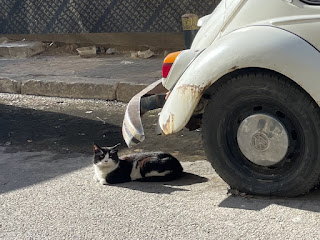
LebCat 47: Just enjoying the warmth. It's
free, so far. (11 Jan. 2022 - Mar Mikhael)

            The reason we are able to play these follies is because God has given us health and strength, and also because we are not directly at the mercy of the train wreck of the economy, unlike what most people are. Supposedly by next month there will be pipelines functioning, bringing gas from Egypt to Jordan to Syria to Lebanon, and that will reportedly enable EDL to produce more electricity, bringing the daily total of power supplied to about 10 hours, hopefully, instead of 2 to 4.

            And while all of this goes on and on, there are still individuals and groups, here as well as in other countries, who wish only well to the Lebanese. Their material support has empowered dedicated teachers, social workers, religious leaders, shopkeepers, tradespeople and regular people with beating hearts and warm consciences to reach out and bring an atmosphere of caring to the peoples’ daily life. Because of them, in these days there are still smiles, greetings to passersby, caring words and the Lord’s presence all around. It may not solve the condition of Lebanon’s electrical grid, but it will certainly renew the power, and a bit of the hope, of many. I’m thankful to God that we can be a part of that power supply!   [LNB]

Friday, December 31, 2021

Motion Sickness

Motion Sickness

46.Motion Sickness (31 December 2021)

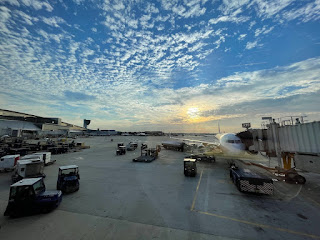
Awaiting one of our flights out of Philadelphia
(15 Oct. 2021 - Phila. Intl. Airport)

One of the constants of air travel, as well as ground travel, is the ubiquitous plastic-lined bag for the use of those experiencing stomach discomfort while being jostled back and forth, up and down, and side to side in the plane, boat, train, bus or car they are in. It also helps those around them to be able to stay clean and somewhat spared from the odor, though the poor sufferer continues to suffer what is gently referred to as “motion sickness”.

            We have been experiencing a type of “motion sickness” in recent times as we completed our required home assignment and made our way back to Lebanon last week. It was an uneventful flight, except that the airplanes were crowded cheek-to-jowl with travelers, some with masks, including those going to Lebanon. Maria and I lived through five months in the U.S. and Canada of constant travel, constant packing and unpacking, constant calculations of whether the weather would be warm or cold, along with constantly arranging flight and hotel bookings, constantly working on what kind of presentation fits a particular audience, constantly trying to wrap up paperwork and follow up on unfinished tasks in the concluding weeks when we were supposed to be “resting”. Getting back home to Beirut and its daily stresses and misery afforded us a bit of respite from the previous period!

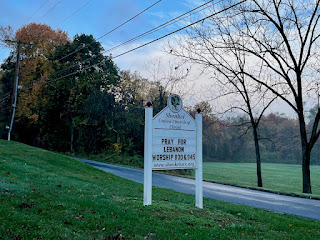
Many ordinary people want to learn, pray and
help Lebanon. (31 Oct. 2021 - Pottstown, Pa.)

            Yet it wasn’t all misery, because we got to meet wonderful, caring people, Armenian and non-Armenian, many of whom were aware of the trials being endured by the Lebanese and the Lebanese-Armenian community. Hearing their questions, seeing their concern and willingness to do something, hearing their words of blessing and being with them in God’s presence was a gift we gratefully received. Yet it was balanced by the exhaustion of upwards of 14,000 mi / 22,000 km of traveling (aside from the 16,000 mi / 25,000 km to actually get to the US and back)! Enviable? Perhaps. I suppose it depends on who is doing the envying.

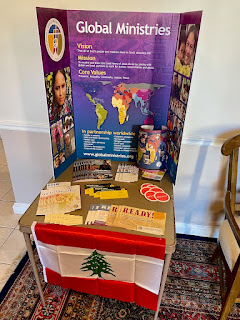
Getting the word out about Lebanon
(6 Nov 2021 - Belmont, Mass.)

            There is a TV ad that has appeared recently on Lebanese television depicting two young Lebanese boys talking about their dreams, which include going to school. It concludes with a voice-over stating, “Rights should not be just dreams.” Yet the dreams of a preponderance of people around us is not to have Lebanon become a livable country, but to leave Lebanon for a livable country. This “exit strategy” is based on yet a different kind of motion sickness: that of being made sick by a society that never experiences stability, that is continually in motion due to the profit-seeking, power struggles or whims of those in authority, whether locally, regionally or worldwide.

            On Beirut’s streets over the years, in my limited Arabic, I would often hear passersby including numbers in their conversations, assumedly regarding the price of this or that. How I wished that the conversations would revolve around ideas, or culture, or wonder at God’s creation! Today virtually all of the street conversations, and possibly also the private ones, are about the exchange rate, the cost of cheese and medicine, and the impossibility of carrying on in these conditions. One man at the exchange house said, “We’re living in an insane asylum!” I wish that my Arabic had not improved to the point where I could understand this much.

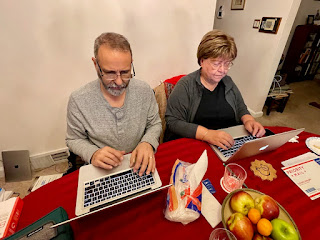
Exciting times on Home Assignment
(6 Dec. 2021 - Broomall, Pa.)

            Economic freefall produces one kind of motion sickness. Seeing dear friends and family members continually zoom away from you (and I’m not referring to screen time) can produce a similar spiritual nausea. When a family, or a community such as the Armenians, conclude that social disintegration is the best route to take, that their children must leave the country, then there is not much that can be said about the hopes for that family’s (or that people’s) future. Even if you are driven by the patriotic emotions that so often cloud Armenians’ judgment about their viability as a people, the consequences of cultural and societal disintegration cannot be dismissed. Many a person will insist on the necessity of laying hold, without delay, of the “promise of a better (economic, educational, health and secure) future elsewhere” – something that is only a promise, not a guarantee. It will apply to some lucky individuals, but what will become of collective identity? What will become of community? What will bring health and strength to the family, that place where individual and collective identity is formed and nurtured? We are in a rush toward “every man for himself”; and the shards of what was a collective hope, a concerted effort to come together to endure hardships and grow in character (such as was seen in the post-Genocide era), will become merely the subject of books and articles that very few read or care to reflect upon. Only a collective awakening to our spiritual and cultural resources can offer us a more hopeful outcome.
It's Christmastime in the city...
(30 Dec. 2021 - Geitawi–Beirut)

            I realize that I enjoy privileges and resources that few around me have. Yet I also have a perspective that many around me lack: that of having experienced the long-term consequences of living in a diaspora situation, in societies that are quite capable of swallowing up and homogenizing the qualities and distinctives that define a people group, including their language, creativity, spirituality, world view, and desire to survive and thrive as a unique entity. The motion sickness that we are all enduring will make it difficult, but all the more crucial, that we together take the long-term into account as well as the short- and medium-term… and listen well to each other.

LebCat 46: You look smashing in red... I mean
on red. (28 Dec. 2021 - Mar Mikhael–Beirut)

            One of the pleasures I enjoyed during “home assignment” was getting back to exercising (which is important, considering how much I enjoyed the pleasures of overeating and gaining weight during that same period). It was a long time since I was able to go to the gym at 6:30 a.m. and get a bit of sweat going. I also got back on the mat at the aikido dojo, but quickly remembered that aspect of warmups that I dread: forward and backward rolls. I dread them because of the dizziness they cause me. But I have learned that the way to work through this sensation is, first of all, to properly position my body to roll; second, to do the rolls more frequently; and third to fix my eye and my mind on a distant, stable point. That long-distance view enables me to be steady when the world seems to be slanted this way or that.

            My prayer for Lebanon, and in particular for the Armenian people, is that we fix our eye on that unchanging Point who does not change (James 1.17), who brings calmness, steadfastness and faith in Christ in the midst of the storm, and who blesses his people in the most difficult of circumstances with the enduring riches of wisdom, truth and love.   [LNB]

Tuesday, August 31, 2021

45.Another World (31 August 2021)

Children's Conference restarted with two one-
day events (KCHAG, Monteverde - 24 July 2021)
It has been two-and-a-half weeks since we left Lebanon for our 5-month “Home Assignment”. The question that dogged us when we told people in Lebanon of our trip (“Are you going to come back?”) is still dogging us here in the U.S., but inverted: “Are you going to go back?” Because things are terrible in Lebanon, and even worse than they were when we flew out, people assume that our (unwise in their estimation) answer must be based only on conditions on the ground. We tell them, “Yes, Lord willing, that is our plan,” since our move there four years ago was also based on the Lord’s guidance above all else. But to those living in this world, we must be unaware of what the situation is on the ground – or in the news.

Enjoying a scavenger hunt at the conference
(KCHAG, Monteverde - 20 July 2021)
            When we think of Lebanon, we do not first of all think of the rampant corruption, the hoarding of resources, those seeking a profit from peoples’ misfortune, the long hours without electricity, the lack of sleep in the hot summer nights, the anxiety over finding food and medicine, the terrible banking system, the destruction of last year’s explosion and much, much more… We think of the people, the friends and loved ones we have, the children and young people, our colleagues, the small businesses we frequent, the churches, schools and institutions where we serve, the Armenian community we are a part of, and so much more. We also look to the coming years, to “what’s next”, the challenges ahead, the opportunity to add our strength and experience to the efforts of others, working with God to sustain life in a place and among a people whose muffled cry is: “We want to live!” The misery that their leaders are spawning all over the land must not determine our steps, but rather the One who placed this on our hearts. It won’t convince everyone questioning our planned return, but that’s the way it is.

A prickly-pear (cactus) seller finds a whole
row of customers, waiting to fill their gas
(25 July 2021 - Beirut)
            As the memory fades of the hardships we faced each day and each moment in Lebanon, it seems like we are currently living in another world. We remember that people continue to suffer even more humiliation there, but it has started to disappear from our consciousness, as we experience the luxuries of life in the U.S. Luxuries such as 24-hour electricity, uninterrupted water supply, filling a tank of gas without waiting in a long line, stable prices and currency, banks that allow you full access to your savings, fully-stocked pharmacies, the ability to plan a work day or a vacation day, heating and cooling of homes and businesses as needed, schools and universities happily planning to receive children and youth for the new school year, continuous internet at fast speeds, and on and on. We are inhabiting a parallel world from the one we left; a world where, strangely enough, things function as they were intended. Much like the world of privilege Lebanon’s leaders inhabit while they perpetuate a world of misery and humiliation for their people.

Socially-relevant graffiti, quoting
prophecy from Isaiah 6
(30 July 2021 - Beirut)
            Although it may seem so to anyone who has to endure daily deprivations, everything is not perfect in this parallel world we inhabit today. As time passes the dark side of life in the U.S. gradually reveals itself to us more starkly. One thing that has begun to creep into my consciousness is the “irrelevance” of being Armenian in this “far” Diaspora (far from the lands we were dispossessed of). With so much to do, buy, see, download, play, watch, consume, fix, replace, who has time to think about existential issues? Questions that keep some of us awake through the night are so irrelevant; questions such as, “Who am I? To whom do I belong? Do we Armenians have a collective future? What are the internal and external threats facing us? Are we our worst enemies, or are the criminal regimes surrounding Armenia? Can we work toward a coordinated Diaspora that neither ignores its own needs nor discounts those of Armenia?” One by one these concerns fade from view as I get wrapped up in the busy-ness of each day, and the many things that insist I pay attention.

            I also consider how “irrelevant” these questions now seem to many enduring great deprivations in Syria, Lebanon, and elsewhere in the “near” Diaspora, where the very visceral struggle just to subsist overtakes any considerations of national identity, of strategic planning for the future, of battling “red” or “white” genocides, of challenging globalization’s threats to us and other small nations… Each of these parallel worlds, one shiny and bright, the other dark and dreary, imposes itself on me, and on us, and makes us push aside any considerations of what truly matters, what keeps us human, what gives us meaning and identity, what can help us endure and flourish as a nation.

From every walk of life, walking to the city
center to remember those lost on August 4,
2020, and demand accountability
(4 Aug 2021 - Geitawi, Beirut)
           Even issues of faith are affected by the powers at play in these worlds. When you have every thing (emphasis on “thing”) available to you, God can become just another add-on to your life, and faith can be a pleasant – and optional – diversion. One that you meld and adjust to fit the values and standards of society. On the other hand, when you have nothing, faith can turn into a mere lifeline that you use to survive each day. Lifting your head up from the misery of each day in order to seek and do God’s will where you are right now can appear as an impossible luxury. How easily the immediate and urgent can supplant the important and foundational, and how often the temporal overwhelms the eternal. How hard it is to live in God’s world no matter what “real world” you occupy.

Portraits of the fallen in the 2020 port blast
(6 Aug 2021 - Saifi, Beirut)
            We had a full summer before we left Lebanon, including an extended stay (again) by our son Sevag, and preparation for our absence. Despite the steady decline in living conditions, we enjoyed being at home together. He had time to serve, time with friends, and time to eat bouza arabi (natural Arabic ice cream, home-made with goat’s milk). When people in his “usual” world ask him, “How was it in Lebanon? Wasn’t it dangerous? Wasn’t it difficult for you?” he simply answers them, “It was very good to be with my parents.” He, too, realizes that it is difficult for people in one world to grasp the reality of another world.

LebCat 45: Dreaming of donuts and other
easy handouts from the AUB crowd
(28 July 2021 - Bliss St., Beirut)
            Having experienced the Port Explosion of 2020 together with Sevag, we also experienced its first anniversary together. Sevag participated in a service of remembrance and prayer at Ashrafieh’s Armenian Evangelical Church, whose church and school buildings were hard hit by the blast. It was also a day for us to express our gratitude to God that we emerged safely from that maelstrom. A Christian artist from the U.S. honored the over-200 dead from the blast by preparing their portraits and pasting them around the perimeter of one of the big, empty buildings being built in downtown Beirut, a few steps away from the Martyrs’ Statue. As we walked past those portraits, gazing into their eyes brought home the pain and the reality of the loss – to their families, their communities, and their country. It’s a temporary exhibit, as those panels will be removed once the construction is completed. Hopefully their memory will not be temporary, and a new generation of those who love the truth will emerge and prevail, to pursue what is right, true and merciful in the world God so loves.    [LNB]