48.Relatively Speaking (28 February 2022)
The world is
quite busy with the current war in Ukraine, with pundits making statements and analyses and
so forth. Aside from all the tragedy, a war can be very helpful to bring focus to people’s lives, and it helps
news outlets to know how to fill their pages. Officialdom is also busy with
making an assortment of punishments, which will then turn into reality. The
story told in the “West” is that they are making the world safe for democracy.
Why do I feel like I’m reading a superhero comic book? The story in the “East”
is probably being told in a similar way, with the protagonists and the
antagonists being swapped. Although details may seem crystal clear to partisans
on one side or the other (especially to those touting the significance of cell
phones to record and disseminate “information” about the war in “real time”), the
only clear and indisputable facts are that armies are fighting and people are
dying and being displaced.Covering up the damage to buildings, while in the
distance Mt. Sannine shines with winter snow.
(13 Feb. 2022 - Marfa'-Beirut)

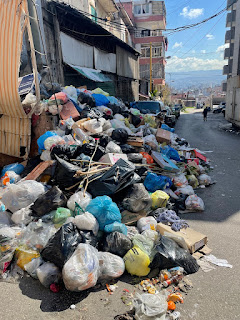
One of the ever-present, never-
resolved crises.
(11 Feb. 2022 - Geitawi-Beirut)
And this arouses a raft of thoughts
and questions and “what-if”s in me. Especially, as an Armenian, I can’t help
but make comparisons and contrasts between what is happening today and the
punishing war on Artsakh by Turkey & Azerbaijan 16 months ago. The war on
Artsakh is not a thing of the past, but is continuing in various forms to this
day. Now that a similar (but only relatively) operation has broken out nearby, these
musings have asserted themselves more forcefully. Musings about the role that
Ukraine played in assisting Azerbaijan’s and Turkey’s armies in their onslaught
against Artsakh. Or the call to foreigners to fight alongside Ukraine, only
slightly similar to Diasporan Armenians wishing to travel to Armenia fight Artsakh’s
aggressors. Or the complicated web of business, military and energy connections
between ostensible adversaries, such as what we see between Russia and Turkey, relative
to their actual mutual dependencies and co-dependencies. And not least of all,
the diffidence exhibited by Russia and the West towards Armenia’s desperate
struggle to not be overwhelmed by overwhelming force, contrasted with the
intense engagement by those same players in the current crisis to prevent
overwhelming force to be used.
When asked what makes the Lebanese keep on going,
refer them to this picture.
(12 Feb. 2022 - Mar Mikhael-Beirut)
It is telling how Europeans express
their shock at such barbarity and brutality in “their” Europe, while accepting
that same barbarity as an unfortunate given in “uncivilized” places like the Caucasus
and the Middle East. It is also telling to see the speed with which Europeans
opened their doors and borders, contrasting sharply with the begrudging and
reluctant acceptance policies for those knocking on the door who are black,
brown or other than “European-looking”. Welcoming the stranger is easy when the
stranger looks, speaks and worships like you, but not so much when the only
thing you have in common is the stranger’s humanity. Imposing an economic and
military barrage on your opponent may seem noble, until you take into account
the financial dependencies that exist between Ukraine (that are almost totally
absent in Armenia’s case) and its defenders and offenders; then the nobility of
the actions begins to appear tarnished. Additionally, the two countries
(Armenia and Ukraine) are probably on relatively equal footing in the “who is
more corrupt” game; but that corruption is overlooked when those leaders lean
in the direction you want and have the goods you want. The next thing you know,
the posse comes riding over the hill to save the day.
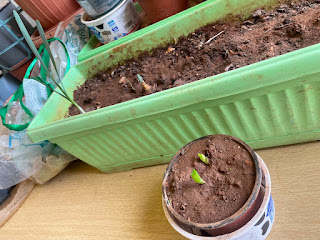
Out of barren soil, spring somehow emerges!
(28 Feb. 2022 - Geitawi, Beirut)
One of the things that saddens me
the most is to hear the same vainglory from Ukraine as what we heard from
Armenia and Artsakh in 2020: “We will win because we are committed. We will win
because we are Ukrainians/Armenians. We will win because we are fighting for
self-determination,” and other such foolish expressions. Armenians were
defeated because they enjoyed living in the past far more than they loved preparing
for the future. This will always be the fatal flaw Armenians must realize they
have if they want to continue existing above ground, and not six feet under. Ukraine’s
fatal flaws and its future trajectory have yet to be seen – as of this writing,
anyway.
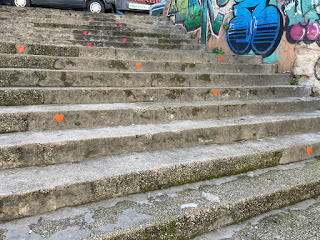
Hearts appear here and there in the neighborhood. Also
kindness, here and there.
(25 Jan. 2022 - Mar Mikhael-Beirut)
For comic relief (although it is
tragicomedy), Turkey’s boss has been quite bellicose about NATO needing to act
more decisively against Russia, its best frenemy. “The West needs to do more
than give advice,” he said, though that advice-and-no-action approach of the West
served him quite well in his war against Armenia, and in the current “normalization”
talks happening between the two countries. He speaks these tough-guy words against
Russia while also keeping his country’s military drone business with Ukraine
humming along. Not to forget Ukraine’s white phosphorus sales to Azerbaijan, used
against Artsakh in 2020. There’s enough hypocrisy to go around, so that every
single country in the world can have a nice, big slice of the pie!
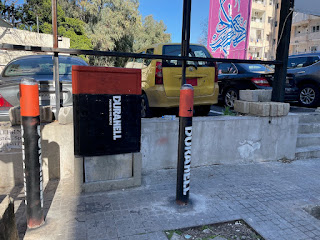
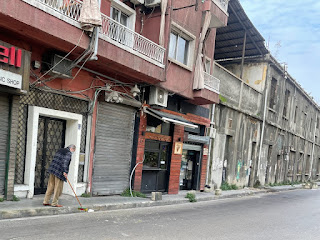
A local Armenian shopkeeper, keeping more than just
his own shop clean. (22 Feb. 2022 - Qobayiat-Beirut)
Relatively speaking, what appears to
be very similar in these two acts of aggression can be both relatively similar
and completely dissimilar, all at the same time. Maybe when books are written about this in 20 or 30
years we’ll be able to figure it out better – that is, if people can still
think or read (or write) in 20 or 30 years…
Spring is trying mightily to make a difference in the cold, rainy days we’ve been living through. Meanwhile, I’m getting a lot less exercise than I did last month. That’s because we’re getting a lot better at assessing our power use and not overloading the supplementary power line, resulting in throwing the circuit breaker down a ways away (cf. Blog 48: “Power-Hungry”). We had a meter installed that shows our consumption, so now we know when we are near the 10A borderline and when we have enough room to turn on a second heater. It’s quite a luxurious feeling not having to run up and down all those steps; so now I’m at a loss as to what to do to stay in shape. But living in a building without an elevator (most of the time) will at the least help my fitness plan a bit.
 |
| LebCat 48: You may kiss my paw if you wish. But just once. (5 Feb. 2022 - Geitawi-Beirut) |
At the joint Vartanants commemoration here in Beirut last week the irony of it occurred to many of us: the same day we were commemorating a war Armenians fought (and lost) in A.D. 451, a new war had broken out. Well, to be fair, the war in Ukraine did not just break out in a single day – it had plenty of time to fester. And the Vartanants battle did not last just one day, nor did it end in defeat, as those with only a partial knowledge of history like to say. It was the opening battle in a 33-year war that ended in Persia granting Armenia the freedom to worship Christ. As we continue to ride the bumpy road to who-knows-where in Lebanon, I think the key idea is to trust God and persevere. There’s relatively little else that we can do than that, and that may actually be the best thing that we can do. [LNB]


