Showing posts with label Vartanants. Show all posts

Monday, February 28, 2022

Relatively Speaking


48.Relatively Speaking (28 February 2022)

Covering up the damage to buildings, while in the
distance Mt. Sannine shines with winter snow.
(13 Feb. 2022 - Marfa'-Beirut)


The world is quite busy with the current war in Ukraine, with pundits making statements and analyses and so forth. Aside from all the tragedy, a war can be very helpful to bring focus to people’s lives, and it helps news outlets to know how to fill their pages. Officialdom is also busy with making an assortment of punishments, which will then turn into reality. The story told in the “West” is that they are making the world safe for democracy. Why do I feel like I’m reading a superhero comic book? The story in the “East” is probably being told in a similar way, with the protagonists and the antagonists being swapped. Although details may seem crystal clear to partisans on one side or the other (especially to those touting the significance of cell phones to record and disseminate “information” about the war in “real time”), the only clear and indisputable facts are that armies are fighting and people are dying and being displaced.

One of the ever-present, never-
resolved crises.
(11 Feb. 2022 - Geitawi-Beirut)


            And this arouses a raft of thoughts and questions and “what-if”s in me. Especially, as an Armenian, I can’t help but make comparisons and contrasts between what is happening today and the punishing war on Artsakh by Turkey & Azerbaijan 16 months ago. The war on Artsakh is not a thing of the past, but is continuing in various forms to this day. Now that a similar (but only relatively) operation has broken out nearby, these musings have asserted themselves more forcefully. Musings about the role that Ukraine played in assisting Azerbaijan’s and Turkey’s armies in their onslaught against Artsakh. Or the call to foreigners to fight alongside Ukraine, only slightly similar to Diasporan Armenians wishing to travel to Armenia fight Artsakh’s aggressors. Or the complicated web of business, military and energy connections between ostensible adversaries, such as what we see between Russia and Turkey, relative to their actual mutual dependencies and co-dependencies. And not least of all, the diffidence exhibited by Russia and the West towards Armenia’s desperate struggle to not be overwhelmed by overwhelming force, contrasted with the intense engagement by those same players in the current crisis to prevent overwhelming force to be used.
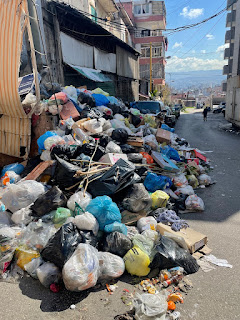
When asked what makes the Lebanese keep on going,
refer them to this picture.
(12 Feb. 2022 - Mar Mikhael-Beirut)


            It is telling how Europeans express their shock at such barbarity and brutality in “their” Europe, while accepting that same barbarity as an unfortunate given in “uncivilized” places like the Caucasus and the Middle East. It is also telling to see the speed with which Europeans opened their doors and borders, contrasting sharply with the begrudging and reluctant acceptance policies for those knocking on the door who are black, brown or other than “European-looking”. Welcoming the stranger is easy when the stranger looks, speaks and worships like you, but not so much when the only thing you have in common is the stranger’s humanity. Imposing an economic and military barrage on your opponent may seem noble, until you take into account the financial dependencies that exist between Ukraine (that are almost totally absent in Armenia’s case) and its defenders and offenders; then the nobility of the actions begins to appear tarnished. Additionally, the two countries (Armenia and Ukraine) are probably on relatively equal footing in the “who is more corrupt” game; but that corruption is overlooked when those leaders lean in the direction you want and have the goods you want. The next thing you know, the posse comes riding over the hill to save the day.
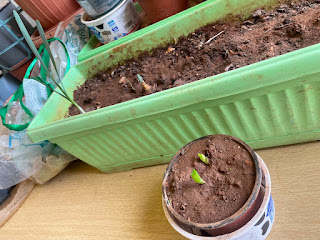
Out of barren soil, spring somehow emerges!
(28 Feb. 2022 - Geitawi, Beirut)


            One of the things that saddens me the most is to hear the same vainglory from Ukraine as what we heard from Armenia and Artsakh in 2020: “We will win because we are committed. We will win because we are Ukrainians/Armenians. We will win because we are fighting for self-determination,” and other such foolish expressions. Armenians were defeated because they enjoyed living in the past far more than they loved preparing for the future. This will always be the fatal flaw Armenians must realize they have if they want to continue existing above ground, and not six feet under. Ukraine’s fatal flaws and its future trajectory have yet to be seen – as of this writing, anyway.
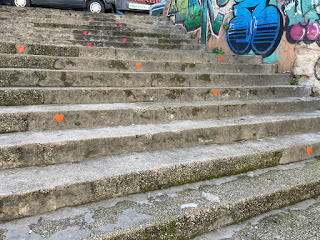
Hearts appear here and there in the neighborhood. Also
kindness, here and there.
(25 Jan. 2022 - Mar Mikhael-Beirut)


            For comic relief (although it is tragicomedy), Turkey’s boss has been quite bellicose about NATO needing to act more decisively against Russia, its best frenemy. “The West needs to do more than give advice,” he said, though that advice-and-no-action approach of the West served him quite well in his war against Armenia, and in the current “normalization” talks happening between the two countries. He speaks these tough-guy words against Russia while also keeping his country’s military drone business with Ukraine humming along. Not to forget Ukraine’s white phosphorus sales to Azerbaijan, used against Artsakh in 2020. There’s enough hypocrisy to go around, so that every single country in the world can have a nice, big slice of the pie!

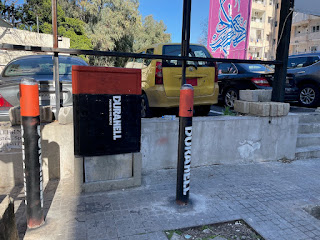
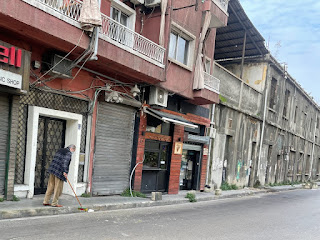
A local Armenian shopkeeper, keeping more than just
his own shop clean. (22 Feb. 2022 - Qobayiat-Beirut)


            Relatively speaking, what appears to be very similar in these two acts of aggression can be both relatively similar and completely dissimilar, all at the same time. Maybe when books are written about this in 20 or 30 years we’ll be able to figure it out better – that is, if people can still think or read (or write) in 20 or 30 years…
            Spring is trying mightily to make a difference in the cold, rainy days we’ve been living through. Meanwhile, I’m getting a lot less exercise than I did last month. That’s because we’re getting a lot better at assessing our power use and not overloading the supplementary power line, resulting in throwing the circuit breaker down a ways away (cf. Blog 48: “Power-Hungry”). We had a meter installed that shows our consumption, so now we know when we are near the 10A borderline and when we have enough room to turn on a second heater. It’s quite a luxurious feeling not having to run up and down all those steps; so now I’m at a loss as to what to do to stay in shape. But living in a building without an elevator (most of the time) will at the least help my fitness plan a bit.

LebCat 48: You may kiss my paw if you wish.
But just once. (5 Feb. 2022 - Geitawi-Beirut)


At the joint Vartanants commemoration here in Beirut last week the irony of it occurred to many of us: the same day we were commemorating a war Armenians fought (and lost) in A.D. 451, a new war had broken out. Well, to be fair, the war in Ukraine did not just break out in a single day – it had plenty of time to fester. And the Vartanants battle did not last just one day, nor did it end in defeat, as those with only a partial knowledge of history like to say. It was the opening battle in a 33-year war that ended in Persia granting Armenia the freedom to worship Christ. As we continue to ride the bumpy road to who-knows-where in Lebanon, I think the key idea is to trust God and persevere. There’s relatively little else that we can do than that, and that may actually be the best thing that we can do.   [LNB]

Thursday, February 28, 2019

Are You from Paradise?


23.Are You from Paradise? (27 February 2019)
Looking deceptively like a paradise. (23 Jan. 2019 –
Ain Mreisse, Beirut)
            No one could accuse us of moving to “paradise” in coming to Lebanon. Just to give a brief whiff of what I mean, the Armenian papers recently published a statement from the nearby Bourj Hammoud municipality explaining (or insisting) that it was not responsible for the terrible garbage smell that has been filling the air in recent weeks. The smell is originating from one of many garbage dumps the government has created up and down the coast (also inland) over the years, where every sort of trash (including millions of plastic bottles as well as chemicals that should not be put in a seaside landfill) is piled high, then flattened out into the Mediterranean, trampling underfoot international treaties and responsible ecological stewardship. And the health of all, men and women, young and old, educated and illiterate, citizens and refugees, believers and agnostics alike.
Let’s say you want to walk on a Beirut sidewalk
instead of the street. Go ahead, give it a try.
(15 Feb. 2019 – Hamra, Beirut)
            Recently Maria and I entered a store to buy something, and the shop owner, detecting that my Armenian accent was unlike the local Armenian style spoken in Bourj Hammoud, asked me (in Armenian) with a bit of a sarcastic tone, “Are you from paradise?” I don’t think he was referring to my Pennsylvania roots (I’ll wait while you look up that place name). It struck us as a strange comment to make to a customer, and it took me a moment as I tried to figure what his intent was. Maybe he was looking for a pretext for charging full price (plus) for what I was buying? So, as lightheartedly as I could muster, I pointed upwards and said, “That paradise? I hope that’s where I’m headed!” He responded by saying, “It’s all the same, there or there, it’s all the same place.”
            OK, now I was confused. So I smiled and let him go on with his… was it a rant? a dissertation? I wasn’t sure of all the ramifications of his lecture to me. But I am sure that many, many people here consider the west – and my country in particular – “paradise”. When you are assaulted by the smells of rotting corruption, and you still don’t have regular water or electricity 30 years after the end of the Civil War, how can you fault people for feeling the way they do?
Maybe try this sidewalk? Careful not to trip over
the steps. (15 Feb. 2019 – Khalil Beddawi, Beirut)
            On the other hand, we’ve been idealizing the west for a long, long time. In the 19th century, when Armenians and others were traveling to Europe and the U.S. for their education, bringing back to their homeland in the Ottoman Empire the ideals and ideas of the west, it was inevitable that discontent would result, followed by flight from the homeland. Could they have seen the endpoint of their westward movement: a dissipation and dissolution of the people called “Armenians”, especially the western-Armenian variety? That discontent and abandonment also had another by-product; it brought about an infatuation with the west, which in today’s Middle East, combined with the disgusting aromas, the ever-increasing cost of basic goods and services, and the actions of an entrenched ruling class, and you have huge numbers of people, Christians and Muslims, looking to the west – to “paradise” – as their avenue of escape. A mentor of mine, commenting on the state of affairs here since the 1975-1990 Civil War, said, “They took a paradise of a country (Lebanon) and turned it into a garbage dump.”
Students at curtain call after their Vartanants program, along
with their stage director, Sister Nariné, who was transferred to
Beirut from Philadelphia… kind of like us! (25 Feb. 2019 –
Bourj Hammoud)
            Tomorrow is the celebration of “Vartanants”, commemorating a battle the Armenians waged in A.D. 451 to resist the Persian Empire’s efforts to convert them from Christianity back to Zoroastrianism. It is considered a decisive, defining moment in our history, when somehow the Armenian people found the courage to choose death with honor, rather than a life subservient to the dominant forces of the day. But where is that courage now? Occasionally it appears, but more often than not Armenians are driven by their fears, not by their ideals or principles.
            An elderly Armenian Catholic nun spoke of this at a Vartanants school program I attended a few days ago. She remarked how she had spent two weeks at an Armenian school in the Los Angeles area, and during recess time, not once did she hear one child speak to another in Armenian. And she challenged the Lebanese-Armenian parents in attendance not to give up in imparting Christian and Armenian values to their children, first at home, and then in Armenian schools. What is happening to us? What befell us to make us this way?
  Don’t give up just yet. Try this sidewalk.
(27 Feb. 2019 – Geitawi, Beirut)
            One thing that definitely shaped us into a fear-filled people was our centuries of existence as a repressed subject people in the Ottoman Empire. Armenians survived by keeping their eyes cast down to the ground, trying their best not to provoke the harshness of the surrounding tribes, who were the real authorities in their historic Armenian lands. Those tribes, still in existence today, and still active in the same ways, considered it their right and privilege to take advantage of the industry of Armenians in agriculture and the trades. A portion of what they stole always went to the government in Constantinople, ensuring that there would be no change in this status quo. Toward the end of the 19th and beginning of the 20th centuries, when Armenians tried to organize to defend themselves and resist governmental and “irregular” terror, before and during the Genocide, they were frequently opposed by other Armenians who feared disturbing the status quo. This is how only a few Ottoman soldiers with guns were able to herd hundreds of Christians to their deaths in the Syrian desert.
            These fears are still alive and well inside of us, so that when a hint of trouble appears in this region, many of us (as well as other Christian groups) are among the first to pack up and leave. A sad contrast to our ancient Christian witness amid trials, as well as our capacity to endure as a distinctive culture group anywhere in the world, including Armenia. I wonder if Vartanants should be a day of national mourning for Armenians, in place of April 24 (i.e., Genocide Remembrance Day). Back then our forebears with their lifeblood took a stand “for Christ and for the homeland”, as the famous saying goes in Yeghishé’s “History of the Armenians”. Today? What remains of who we were?
LebCat 22: Nothing like a good morning stretch. Watch out for
what’s lurking behind the bench, though.
(18 Feb. 2019 – Qobaiyat, Beirut)
            What else, but the struggle, the urgency to continue the struggle, to seek God right where we are, and to not waste our energies seeking “paradise”. This is what every Armenian school is doing, at great cost, amid threatened funding cuts from organizations that should be increasing, not decreasing, their investment in these institutions. This is what every Armenian church is doing, though some would prefer to drop the ethnic orientation and just fit in with the local church scene. This is what every Armenian cultural activity is about, and what every Armenian choir is doing (like the Armiss choir!), what every individual does when opening up a Bible or a book in the Armenian language, or at least when reading about Armenians. “Struggle, struggle, unending struggle” is what a friend exhorted me to do when I wrote to him a few Vartanantses ago. It may not fit well in a world where people want to be entertained. But what sense is there in exchanging the weight of millennia of faith, history, culture and identity for something as ephemeral as whatever is “trending”?   [LNB]