Thursday, October 24, 2019

Devils and Details


29.Devils and Details (24 Oct 2019)
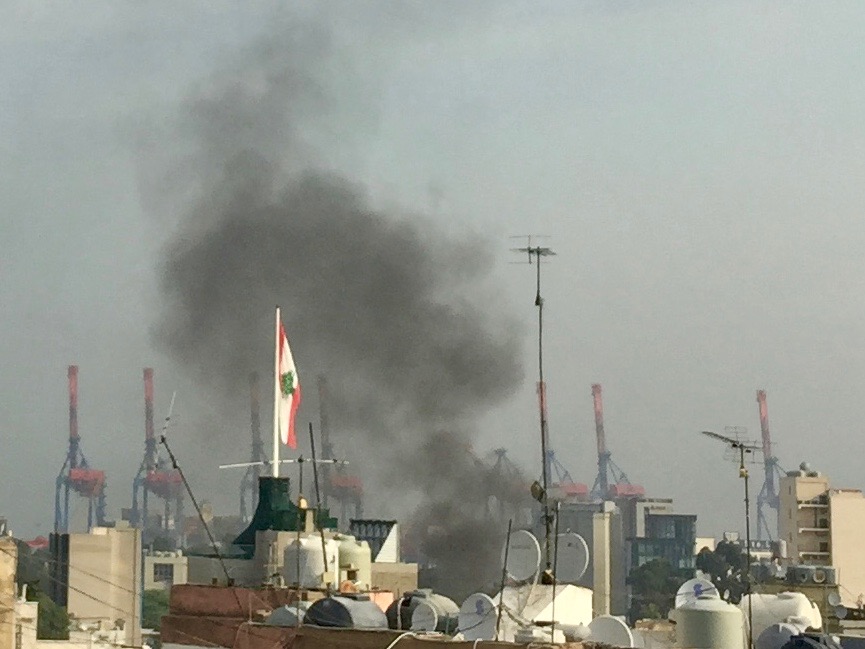
Smoke from tires burning on the Autostrade, filling the air.
(18 Oct. 2019 – Karantina - Beirut)
A week ago there was an announcement, replete with locally generated “great and unmatched wisdom”, in which the government here would begin taxing Internet-based (VoIP) communications (such as Whatsapp, Messenger, FaceTime). As many have already said, this was just the match that lit a blaze, the straw that rendered the camel a paraplegic, yet became an almost-inconsequential detail leading to the explosion of protests all across the country. The outcry and rage even targeted certain well-known leaders whom the populace heretofore has never dared to (publicly) criticize.
Shuttered businesses the entire length of the normally
busy Arax Street. (23 Oct. 2019 – Bourj Hammoud)
            So, the first couple of days we inhaled the acrid smell and particulates of burning tires, in addition to the ongoing stench of garbage dumps and polluted water. Those first few days also saw the emergence of a few disruptors who either were intent on destroying and looting private property, or reasserting the supremacy of their political party and its flags. Both types were quelled by Internal Security and Lebanese Armed Forces. Then emerged the chants of “Thawra! Thawra!” (“Revolution!” “Revolution!”). And the open-air party atmosphere. And the congenial “we’re all in this together” atmosphere.
            Later, other slogans emerged, as the
Push-back against multinational corporations… and an icon
of the protests, a woman kicking an armed guard where it
hurts. (22 Oct. 2019 – Mar Mikhael - Beirut)
demands intensified: “Kellon, ya3ni, kellon!” (“All of them, that is, all of them!”), so that no one group would think its leader exempt from the demands for a complete change in leadership – and a new political system, one not based on religious identity. If there are 3 million Lebanese in Lebanon, then thanks to television crews roaming in and among the various protests sites we are hearing what seems to be 3 million statements of discontent from young and old blocking streets and highways. Their words are crammed with emotion, seething with frustration at the struggle the average citizen has to endure for things like inadequate health care, expensive education, intermittent electricity and water, poor waste management, environmental degradation, unaffordable housing, corruption to the core, and so much more, including a sky-high national debt.
            But what has been absent is someone to take the helm of this movement and focus it into a clearly-defined direction. The prime minister gave a public address the day after the start of the protests, but it appeared to be directed to his political opponents. The president addressed the country today, a week after the start of these events. A decade and a half ago a handful of potential alternative leaders may have existed, except that they disappeared one by one in still-unsolved car bombings. Where are the new visionaries to keep Lebanese from turning against one another, expressions of which are beginning to emerge? There is only so long that an outburst can be sustained, and so what is sometimes (erroneously) compared to Armenia’s “Velvet Revolution” may take some unwanted turns in the days to come. Chanting for overall change is a start, but the devil is in the details.
The last day Lebanon was able to focus on something besides
its protests. (16 Oct. 2019 – Bourj Hammoud)
            And speaking of devils, only a few short weeks have passed since great (and locally great) powers have decided against the Kurds in northern Syria. It is such a familiar narrative; the roles now played by certain peoples and countries were played a century ago by many of the same minorities and world powers. And the story ends the same: strategic and oil interests superseding any humanitarian interest or pang of conscience. Who will be the losers in these military “games” being played out in the region? You can start with the great powers, who again squander their names as they easily abandon their local allies (We all should bring to mind how Armenian brigades and the population were betrayed by Europe). Yet a greater loss is being shouldered by the people of the land, not just Kurds, but Assyrians, Chaldeans, and, yes, Armenians. The Kurds may rebound due to sheer numbers. But what of the Christians, who are the ancient residents of that region? One of the winners no doubt will be the incipient “Islamic State Part 2”, thanks to the support of some and the negligence of others. So many devilish details, too many to keep track of, that invaders will just say “Oops” to you after the fact, as you disappear into the oblivion of genocide, deportation, migration and assimilation.
LebCat 28: A flat cardboard box is better than
no box at all. Hanging out with LebCat 13.
(3 November 2018 – Bourj Hammoud)
            But back to Lebanon. The protests continue, and roads are still blocked; sometimes by protestors, and sometimes by rainwater flooding the highways (like today) due to poor infrastructure… another burden borne by the population. But people need something beyond the protests – and they need a just resolution, without being co-opted by outside forces. They need to be able to work, to eat and send their children to school, but also to dream about the future and marry and care for and protect their homeland. Will this be a moment of historic change for Lebanon and its unity, or will it end in disarray and divisions? My hope and my prayer is that the people will continue to gather under the Lebanese flag, something all sincere religious leaders desire, and something the Bible commands us to do: “Seek the welfare of the city where I have sent you into exile, and pray to the Lord on its behalf, for in its welfare you will find your welfare” (Jer. 29.7).   [LNB]

Sunday, October 6, 2019

It's a Sign!


28.It’s a Sign! (6 Oct 2019)
Children in uniform, and parents carrying school bags. A sure
sign that fall is here. (1 Sept. 2019 – Shushi, Artsakh)
For years our family has had a running (inside) joke. When we see street signs or billboards, especially ones with the name of a city or country on it, we call out, “It’s a sign!” Perhaps not particularly funny… except that I’m a pastor, and one of the features / challenges of pastoral life is the ever-present possibility of relocation. And behind that possibility is the art of determining what constitutes a sign from God, particularly regarding a “call”, and the related relocation from ministry in one city (or country) to another. The joke is that if you are looking for a certain answer, sooner or later a “sign” will appear, confirming what you have already decided on your own. And then you can credit God for the sign. One of those Achilles’ Heels of believers everywhere.
An “old” sign, lying face down on the ground,
defeated by a new pole and by the company
that bagged a contract for replacing every. single.
pole. in the city. (18 Sept. 2019 – Khalil Badawi)
            In recent months in Beirut there has been a sprouting of metal posts and brand-new signs on sidewalks all around the city. Considering the narrowness and impassability of most sidewalks in Beirut, this has been an unwelcome intrusion to us walkers. And considering that the existing, if somewhat beaten-up, collection of traffic signs throughout the city was doing its job just fine, it makes one wonder whether there is something more behind this proliferation of poles than traffic concerns. In such an opaque and … not altogether “clean” … system as exists here, who knows? Rumors about this and a slew of other topics are pretty much all the general populace has to go on, as it tries to make sense of the rough road it has been on for decades.
Will they be able to break Mr. Sevag? An intense scavenger hunt at
the Children’s Conference. (7 Aug. 2019 – KCHAG, Monteverde)
Having the thrill of my life, leading a trained choir in concert, the
“Varanda” ensemble, while Zakar looks on. I wonder what he’s
thinking? (5 Sept. 2019 – Shushi, Artsakh)
            As a sign of how full the summer has been, two and a half months have passed since my last blog post. Why? Meetings and more meetings. Sevag’s month in Lebanon, including some vacation time with him, and a week in KCHAG, with Sevag in the children’s conference, and me in a bungalow, pretending to get studying done. Work in Armenia and time off in Artsakh. So much has come and gone. That trip to Artsakh (or Karabagh) was a memorable one, especially as Maria and I enjoyed the cultural and interpersonal riches of that region. I’ve reflected more about it in another place, but a highlight was definitely my being invited to conduct the “Varanda” childrens/youth choir in “Hayrenikis Hed” in concert.
 
Maria’s niece and family, recently relocated to
Armenia. And a penguin. (29 Aug. 2019 - Yerevan)
          
We were driven from Yerevan to Shushi by a young taxi driver who talked quite a bit about the hopefulness that is permeating Armenia since the so-called “Velvet Revolution” of last year. Yes, lots of things still need to be “fixed” in the country, but he insisted that the current government will get to it in due time. In contrast, a week later, on the taxi ride back to Armenia we had a different driver: an older, university educated man who worked in the Soviet system and the post-Soviet system, and is now witness to the current setup. His view of things was subtly skeptical, since there is movement going on, but not necessarily progress. He asked us a lot about Lebanon, and laughed, “So it seems that there are many, many similarities between the two countries!” He was referring to human potential, but moreso to the shared pitfalls.
Wait, is this town called "garlic"? The French side of the sign
reads like that Arabic word. Oops, my mistake. Good thing I’m
learning to read/understand Arabic! (10 Sept. 2019 – N. Lebanon)
            Armenia – and increasingly Armenians everywhere – speak enthusiastically about one Armenia for all. The Armenian Diaspora (the majority of Armenians in the world) is frequently relegated to a temporary and passing reality. Yet, once upon a time, in recent memory, the slogan was, “A strong Armenia with a strong Diaspora.” No more is this heard. Once upon a time Armenia had a Diaspora Ministry (usually aimed at connecting Diaspora finances to needs in the homeland). Though the channeling of resources, human and otherwise, continues, that Ministry is no more; it was closed up last year and its work subsumed into the Assistant Prime Minister’s portfolio. The Western Armenian language is a “threatened” cultural treasure, but the only serious attempts to strengthen it are coming from Diaspora organizations. (Armenia also closed its Ministry of Culture last year.) These signs betray a lack of depth of understanding of the importance of the Diaspora for Armenia as well as for Armenians everywhere. And a lack of depth in the thinking of the disorganized Diaspora as well as official Armenia.
LebCat 27: I’m looking fine… but don’t those two guys in the back
know how to pose for a selfie? (26 July 2019 – Beirut Cat Café,
Mar Mikhael - Beirut)
            Here in Lebanon, a sign that summer is over and the fall is here is the appearance of children all over the city in their school uniforms and toting their book-bags. We are all carrying another weight, though, as we closed of one of our schools this summer (shrinking income and galloping debt). It is a sign, not that Armenian Evangelical education is no longer needed, but that this vision is being challenged by other factors outside the church Union’s control. In fact, all Armenian schools outside of Armenia face this challenge. As historian Dr. Yervant Kassouny states in his recent book (Reflections on … Diasporan-Armenian Literature, 2019), “Closing an Armenian school in the Diaspora is equivalent to closing an Armenian army base in Armenia” (p. 11, translation mine). The Armenian school, along with the Armenian church and the Armenian family, is the place where this particular nation (in the cultural, not the political, sense) trains for the battle to survive and thrive in a world that works hard at homogenizing everything, not just milk.
            Keeping your eyes open, paying attention to the signs of these times, staying awake and prayerful – these are the means we employ when facing days like these. “A little sleep, a little rest, a little folding of the arms, and your poverty (including your spiritual and cultural poverty) will come upon you like an unexpected traveler, or an armed robber” (Prov. 24.33-34).   [LNB]

Saturday, July 20, 2019

Not Bad for Your Age


27.Not Bad for Your Age (20 July 2019)
Just some old guy doing climbing for the first time
in his life. (25 June 2019 – Guthrie, Oklahoma)
So, how old are you?
            I was asked this question by children and youth at summer conferences in June, when we spent a month in the U.S., traveling around various cities in the southeastern quarter of the country. It was a new world for both Maria and me, and eye-opening in terms of the differences – as well as similarities – between our “Northern” (in the U.S. sense) outlook and that of the region in which we traveled.
            The first time was by a child in Alabama, at a Disciples (CC/DOC, for those interested) camp. We were giving a presentation about Lebanon the country, and where we live, and why we are there. We showed them a map, held up the flag, talked about Lebanon in the Bible, the cedars, and so on. The 4th and 5th graders before us were listening with rapt attention. “Any questions?” I asked. You have to be a fool or very quick on your feet to open the floor to questions from children. Clearly, I was the former, not the latter. First question: “How old are you?” Ahem. This needs a clever rejoinder. “How old do you think I am?” And they started guessing. I thought I should put them out of our misery, so I picked one answer and said, “We’re in our 60s. That’s pretty old, right?” Bless them, they moved on to other questions. These children included us in their program and their hearts, even filling our “warm fuzzies” bag with notes of appreciation and gifts (of candy and chocolate!) during the week.
When it rains on your summer camp… make your own fun!
Just make sure you’re sufficiently young before the belly-flops
in the mud. (18 June 2019 – Wetumpka, Alabama)
            Maria and I were serving as counselors to junior and senior high campers during most of our time in America. Their concerns and questions were similar in some ways to those of the youth here in Lebanon, but they seemed to be facing so much more social disintegration. The family situations they described expressed a deep longing for significant relationships not just with their peers (though that was very apparent in the way they bonded with each other), but also with caring adults. This was one of the fringe benefits of being with them: to experience their warmth even with us, coming from such a distance.
Bringing insights from the Middle East to the parable of the
Good Samaritan during high school camp.
(27 June 2019 – Guthrie, Oklahoma)
            Our role was that of “mission visitors”, so we had varying amounts of time to speak directly to these youth (and adults in North Carolina, Alabama and Oklahoma) about our work and our friends and partners in the Middle East, and to challenge them to consider taking one year or many years for “overseas” ministry. In one of the camps I told the youth, “Please consider spending some time serving others elsewhere in the world. You will learn humility and grace as you go in Jesus’ name. And you will also have the opportunity to view your country (the U.S.) from a vantage point outside your usual world. You might see this country in a different light, and see yourselves as others see you.”
The message is clear: “developers” are not developing for others’
sake, but instead hoping to catch the wave of climbing
property values. (24 May 2019 – Mar Mikhael - Beirut)
            The guys in my cabin in Oklahoma were high school juniors and seniors, and many of them had known each other for years from attending this camp. A lot of them at the camp, boys and girls, were preparing to enter the military. One afternoon during cabin time (how happy I was for those rest times!) one of them asked me, “How old are you?” Not having learned my lesson from the 4th & 5th graders, I said, “Guess.” The guys said numbers which were all over the place, and that made me smile. When I finally helped them figure out the right number, the original questioner said, “Don’t take this the wrong way, but you look really good for 63. I would have thought early 50s. I mean that as a compliment.” And he was totally sincere.
            I’m not sure what to think about compliments like this, or about all those clichés about aging, or about only being as old as you feel. Good health, mobility and flexibility are important to a happy life, but sometimes I feel as if the line is being crossed over to the glorification of youthfulness. Life becomes a matter of feeling good (or young), just like churches often communicate, and not a matter of doing something that matters with your life.
Greening the concrete jungle: flowering plants after they got
their heads plucked off by passersby. (19 July 2019 –
Geitawi - Beirut)
            Again, the contrast these questions were drawing in my head was stark: we live in a place of the world where the signs of old age, the wrinkles, grey hair and bent back are still command respect in many families, even if official programs in this region do not always reflect that. Not surprisingly, it is the religious bodies here that strive to pick up the slack and care for elders – and children. It is why we have institutions like CAHL in Beirut and the Aleppo Armenian Home for the elderly, and why churches here run 5- to 8-week Vacation Bible Schools in the summer. It is why the church has its two KCHAG retreat centers, and why it operates Armenian Evangelical schools, imparting knowledge as well as Christian character with a biblical foundation. This is God’s vision for the church: to be a multi-generational family, a “home”, where respect and care is evident towards all.
Faith, beauty and hope through song at the “Armiss” choir
concert. (2 June 2019 – Beirut)
            I love old things, too. And it’s not just because I’m steadily becoming an old thing. The character that is expressed by things artistic or architectural, things that have stood the test of time, enriches my character and that of the environment. Yet I wonder if these old things can stand the test of money. As I (and others) have often lamented, the ongoing destruction of Beirut’s architectural heritage is most disconcerting. People (who knows who they are, or whether they are even local?) see land as something to profit from, and they aim to create the biggest (and often ugliest) structures they can, in order to gain the most from each square meter. In reaction to this, graffiti artists are creating pieces that express the urgency: “Old Beirut Matters”. Although those with bulldozers rule the day, perhaps sanity, and respect for heritage, will endure these times.
            A couple of days ago a woman entered the mini market I often frequent, brandishing clippers and a broken bloom, complaining to the proprietor, her neighbor, that people walking by her ground floor window boxes snap off blooms as they pass. She was frustrated at all the work she was doing to beautify this world of concrete. After she left, the proprietor turned to me, again in frustration, and said, “Am I supposed to look after her flowers?” Yet today he saw me admiring the plantings and said, “Do you like our garden?” The building across the street, where he lives, had window boxes at every window. I said, “Yes, it’s great! We need to see more green around us!”
LebCat 26: All that a cat could want – fresh garbage and
cardboard boxes! A slice of feline heaven on earth, as
Lebanon's trash crisis looms. (14 July 2019 – Geitawi - Beirut)
            The “Armiss” concert on June 2 went quite well, and had a full house. Afterwards I received many, many words of appreciation for it. The program did not include any new music, but rather traditional works, some new presentations of old music, and some old music that had not been heard for many, many years. I’m currently working on the video footage to create a DVD of the event. I hope that these sorts of events can continue bringing together what is both young and old, fresh and seasoned. Because it matters. It really does.   [LNB]

Saturday, June 1, 2019

Friends and Others


26.Friends and Others (31 May 2019)
Friends gathering after a worship service at Emmanuel Church
to be with Pastor Harut Khachatryan, whom they met last
summer in Armenia. (16 May 2019 - Nor Amanos -
Baouchrieh)
They say that it’s the tough times that show who your true friends are. This doesn’t mean that those who are not really concerned about whether you exist are your enemies. It just means that they aren’t your friends. Sometimes I wish that the term “friend” weren’t so commonly used so as to dilute its meaning. After all, in the Bible the term “friend of God” (applied to Abraham in James 2.23) is intended as a special designation, just as when Jesus called the twelve “my friends” (in John 15.15). Now, a “friend” is what you get when you click on a name. And then there’s the Armenian word, “բարեկամ” (paregam), which means “one who wills good”. Well, even Armenians use the word indiscriminately. Like “Paregam (friend), move your car from in front of my shop.” Said without a smile, but with the implication that you or your car might not remain unscathed.
My friend Angele Kebab slipped and hurt her
arm a few months ago, but now is back to
making delicious sandwiches!
(24 May 2019 - Nor Hadjin - Beirut)
            A few weeks back there was a car parked in front of a nearby apartment building. We have no idea whose it was, but from Saturday afternoon until Sunday morning, for over 14 hours, its theft alarm rang. The whole night. And nobody showed up to claim it and stop it. Fortunately, I lack the tools and the know-how to stop a car alarm. So I merely spent a sleepless night listening to it. My guess is that no one called the police (and their barracks are located right above the place where this car was) to locate the owner and make it stop.  Because, why bother? Not just the police, or the neighborhood, but people in general are easily influenced by the usual things that cause people to abandon responsible behavior. Self-preservation. Gain. Running into walls. Powerful people who make and enforce their own rules. And so, the alarm just keeps ringing all night. Not friendly. But only one night.
            Our regular grocer, a young dad named Attieh (an Egyptian), has officially weighed in: my Arabic is definitely improving. He mentioned it to someone who works at the same school – a high school – where I take lessons. So of course the news got to my Arabic teacher that there’s been progress in my speech, independently verified, so she was delighted, the principal was delighted, Maria was delighted, everyone was delighted. It’s nice having a regular grocer, not just so as to be compelled to speak the language and therefore improve, but also to be treated like a friend, when the cucumbers on display are a bit too limp, or the bananas a bit too long, and he’ll open up the good stash. And brag about your Arabic to others.
A sidewalk vendor. closed for the day, displaying
various Armenian symbols. And the words, "Jesus
loves you". (29 May 2019 - Bourj Hammoud)
            Yesterday I went to buy some traditional “Ramadan bread” – there’s got to be a different name for it, but for years that’s what our family has called it – from the baker at the corner where we lived from 2000-2003, in the Zarif area. Delicious stuff, with sesame and nigella seeds, nice and soft. The neighborhood used to be very heavily Armenian-populated before the Civil War, but now only a few families remain. They remember us – Arab, Armenian, Muslim, Christian, which means you need to go around to all the shops and say hello to all the shopkeepers who used to serve you. As I walked from Haigazian to our old neighborhood I realized that I wasn’t feeling the apprehension I once had due to my (then) limited (i.e., non-existent) Arabic. Back then, I tried to take one of my boys or my wife with me so I wouldn’t get stuck not knowing what to say.
            So I strode from the bakery across the street to Maalim Toufiq and greeted him (3 kisses, the proper way), asked about his family, and he asked how I was, how Maria was, how my children were. Then he introduced me to the other men there, who also remembered us from a decade-and-a-half ago. We talked a bit, he asked again if we were visiting or staying in Lebanon. And then an older gentleman walked in – remember, this is a small “produce stand” by western standards – and he introduced me to him, I wished them each a blessed Ramadan, and was on my way. Like old friends, which we are – both old as well as friends. (But I’m older than Toufiq.)
My little flying friend, waiting on top of the exhaust fan for
someone to come to the rescue. (31 May 2019 - Geitawi, Beirut)
            Today I noticed some kind of dust on the bathroom shelf, and heard a clicking noise from the exhaust fan above the shelf when I switched on the light, like a twig was hitting the fan blades. So I called the building caretaker for us to go up and look at the exit pipe. Nothing unusual there, though just to be sure that no nests could be made there I lowered the cover so that only a few millimeters of gap remained. I went back down to clear out whatever was stuck in the pipe, pulled the fan housing, and what to my wondering eyes should appear, but a juvenile sparrow, sitting on top of the fan assembly? It must have gotten in earlier in the day when there was a greater gap on the roof, and, unable to fly back up the narrow pipe, just sat there. Except that when we turned on the light (and fan), the blades of the fan were hitting its legs and claws, as I later realized when I saw blood spatters while cleaning up the fan.
LebCat 25: Caught in the act of slashing tires,
while the lookout just looks. Hey, they’re cats.
(22 May 2019 – Qobayiat - Beirut)
            Well, a friend (“paregam”) is one who wills and does good, right? So I got a towel, hoping that it would accept my good will and not flap all around the bathroom. I grasped the bird with the towel, tightly enough that it wouldn’t fly, and showed it to Maria (of course). “Show-and-Tell” never gets old! I could feel its heart beating, but since I am not an ornithologist I have no idea if it was normal speed or racing. Also birds do a great poker face, so there was no facial expression I could read. I wondered, was this bird badly injured? Was it able to fly before it fell in? I needed to take it outside, to our patio, and see what condition it was in (junior veterinarian, reporting for duty). When I took it outside and started unwrapping the towel it immediately flew off at high speed. Without even a parting photo op. No selfies of “me and birdie”. And I was relieved to see that.
            In two days I will be conducting a choir concert performed by the “Armiss” choir. The group worked hard, and I’m praying that all goes well. We’re expecting a good-sized crowd, especially after two radio interviews, a bunch of newspaper ads, fliers in store windows, Sunday announcements, and posts on our dear “friend” repository, Facebook. My greatest satisfaction will be presenting this as a gesture of good will, of encouragement and of joy to this strained city and especially to the Armenian community. That’s what friendship is. That’s what friendship does.   [LNB]